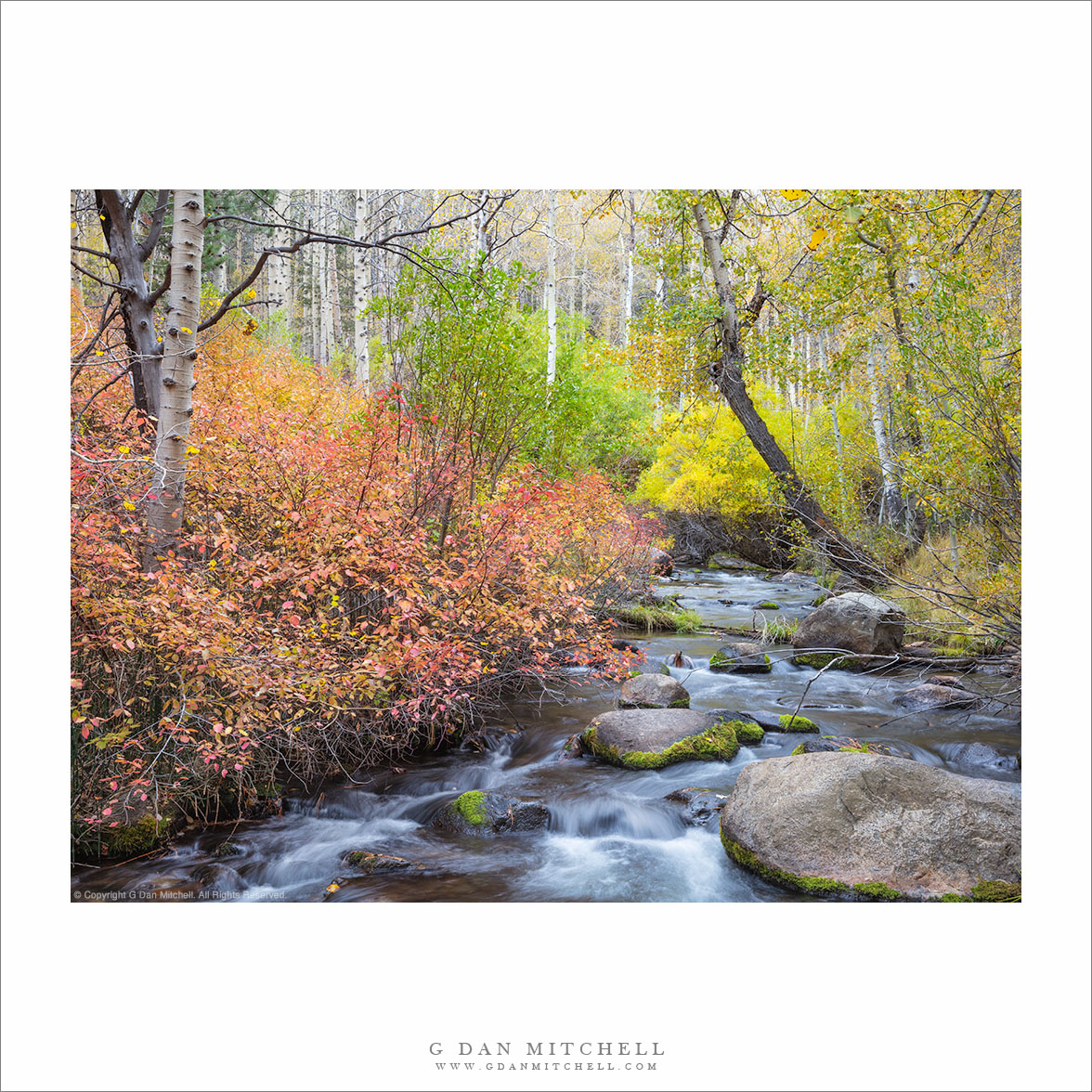
“Eastern Sierra Stream, Autumn” — Autumn colors line the banks of a small Eastern Sierra Nevada stream
This photograph is of one of those little places — you could easily pass right by it and miss it. I have, and I’ve even stopped nearby and not seen a photograph. This time I was heading up a canyon in cloudy conditions and light rain, and perhaps the unusual conditions helped me to see differently. In any case, as I drove past the area I noticed the red plants growing close to the ground, even though there were largely obscured by intervening trees.
I quickly turned around and came back, parked, and then spent some time poking around and looking. I finally ended up down along the bank of the stream, the closest I could get to the red plants, and I found a composition looking upstream toward more colorful plants and the white trunks of an aspen grove.
Leave a comment or question using the form. (If you are reading this on the home page, click the article title to see the full article and the comment form.
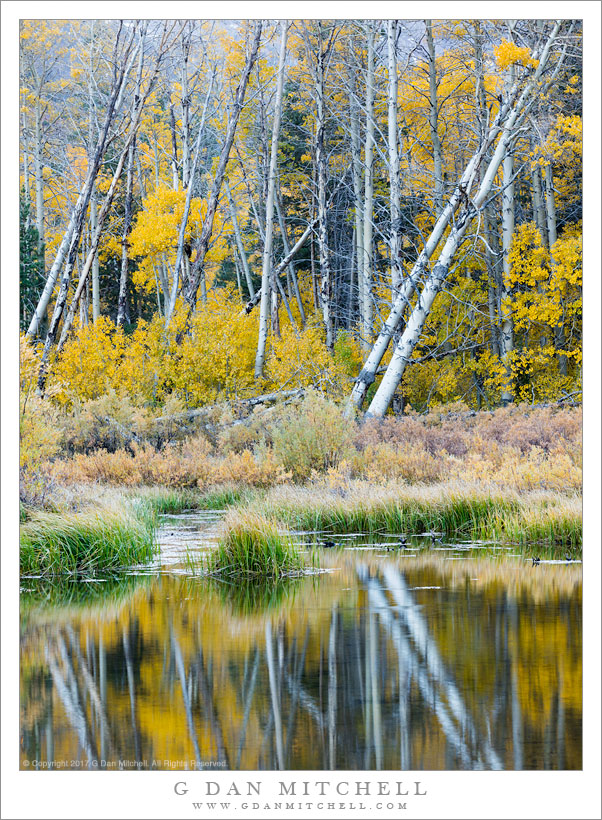
Leaning aspen trees with autumn colors, reflected in an Eastern Sierra Nevada pond
On the first day of this short trip to the Sierra Nevada, with photographs of fall color our objective, we followed a long driving route to the east side so that we could take a look at a wide range of locations. We began by crossing the range quite far to the north at Carson Pass, then headed south over Monitor Pass to US 395, and from there we continued toward our eventual destination in Bishop. Along the way we made quite a few stops and a few side-trips to look at and photograph fall color. By the middle of the day it became clear that we were going to be dealing with wind. (In fact, by the time we arrived in Bishop after dark it was so windy that driving was starting to be an “interesting” experience.) Wind is not generally regarded as being helpful when photographing aspen trees — though there are some ways to deal with it — so eventually we sought out locations where it was moderated a bit.
One way to get out of the worst of the worst winds is to leave the wide-open country east of the range and head up into the narrower canyons. While this typically doesn’t eliminate wind completely, it often does block the worst of it. That’s just what we finally did, turning up into a familiar canyon and driving almost to the end of the road. Here we arrived at a location with quiet ponds surrounded by all kinds of trees, including some with fall foliage. Along the edge of one pond and its boggy surroundings we found large aspen trees leaning away from the water. My assumption is that the soggy ground was no longer solid enough to hold the trees and something, probably even stronger wind than we were dealing with, pushed them toward the nearby grove. Many of the trees were still alive, though you have to wonder whether their current lean angle is the end of the story!
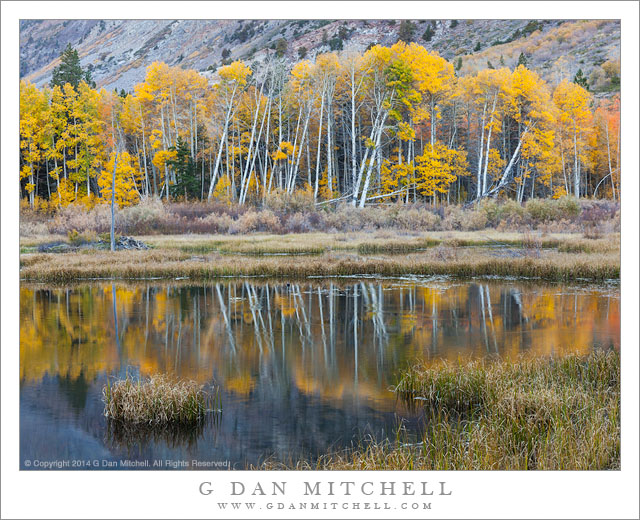
A grove of autumn color aspens reflected in an eastern Sierra Nevada pond
I saved my visit to this place for the final evening of the final day of this year’s aspen hunt. Although I had passed by the mouth of this canyon four days earlier, while heading to another location near the start of my trip, I had only glanced in from the main highway — but I could tell, both from experience and from looking, that there would almost certainly be some good color here later on. Although the color change seemed to start on a rather early schedule this year, later on the pattern seemed to become closer to the norm. Color started high, and by the time I made this photograph a lot of the highest elevation color was going or gone. (Not all of it though — even amidst lots of bare trees up high, I still came across scattered high elevation groves full of color.)
As the color transition continues, it moves to successively lower elevations, and some of the most protected east-side canyons can hold color even longer. In the past this has often been a decent late season location for color, but I’ve also been there when the color came and went early, for reasons I could not decipher. So on this day when I actually entered the canyon for the first time this fall, I wondered if the colors that I could see along the stream where it emptied into larger valley below might be all there was… or if the color would continue up higher. It turned out that the colors did continue, and in outstanding form! The majority of the trees had fully or nearly fully changed color, with a few other trees at either end of the transition — some still all or mostly all green, and a few that had gone to bare trunks and branches. Far up the canyon there are flooded meadows, and I made this photograph at the highest of these ponds.
G Dan Mitchell is a California photographer and visual opportunist whose subjects include the Pacific coast, redwood forests, central California oak/grasslands, the Sierra Nevada, California deserts, urban landscapes, night photography, and more. Blog | About | Flickr | Twitter | Facebook | Google+ | 500px.com | LinkedIn | Email
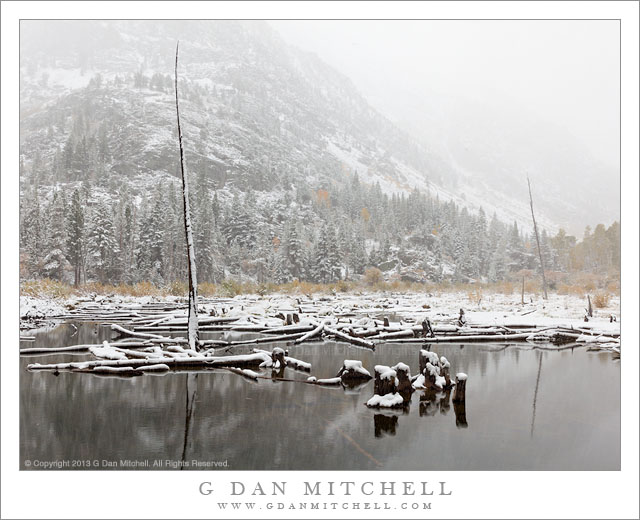
The first snow of autumn falls on an eastern Sierra Nevada beaver pond
We began our October visit to the eastern Sierra aspens with a very long drive from the north, necessitated by an early season snow storm that swept across the range on the day of our drive, closing all of the passes that are not normally plowed – Tioga, Ebbetts, and Sonora. So we drove over Carson and Monitor Passes to reach highway 395. The snow started before we reached the summit of Carson pass and continued intermittently throughout the rest of the day – never enough to interfere with our driving (aside from the closed passes) but enough to make the photography interesting and to create an appearance that seemed more winter- than autumn-like.
As we headed south on highway 395, we stopped quite a bit to make photographs or even take a side road detour or two. Just before reaching Lee Vining we headed up this canyon, which is known as a good spot of aspens – and for a very narrow section of roadway that passes along the side of a so-called beaver pond. I’ve been past this spot many times, but this was the first time in falling snow. The gray skies and the falling snow created a very peaceful effect around the pond, and we paused to photograph it before making a brief visit to the trailhead at the end of the road.
G Dan Mitchell is a California photographer and visual opportunist whose subjects include the Pacific coast, redwood forests, central California oak/grasslands, the Sierra Nevada, California deserts, urban landscapes, night photography, and more. Blog | About | Flickr | Twitter | Facebook | Google+ | 500px.com | LinkedIn | Email
Photographer and visual opportunist. Daily photos since 2005, plus articles, reviews, news, and ideas.
Manage Consent
To provide the best experiences, we use technologies like cookies to store and/or access device information. Consenting to these technologies will allow us to process data such as browsing behavior or unique IDs on this site. Not consenting or withdrawing consent, may adversely affect certain features and functions.
Functional
Always active
The technical storage or access is strictly necessary for the legitimate purpose of enabling the use of a specific service explicitly requested by the subscriber or user, or for the sole purpose of carrying out the transmission of a communication over an electronic communications network.
Preferences
The technical storage or access is necessary for the legitimate purpose of storing preferences that are not requested by the subscriber or user.
Statistics
The technical storage or access that is used exclusively for statistical purposes.The technical storage or access that is used exclusively for anonymous statistical purposes. Without a subpoena, voluntary compliance on the part of your Internet Service Provider, or additional records from a third party, information stored or retrieved for this purpose alone cannot usually be used to identify you.
Marketing
The technical storage or access is required to create user profiles to send advertising, or to track the user on a website or across several websites for similar marketing purposes.