Tag Archives: mount

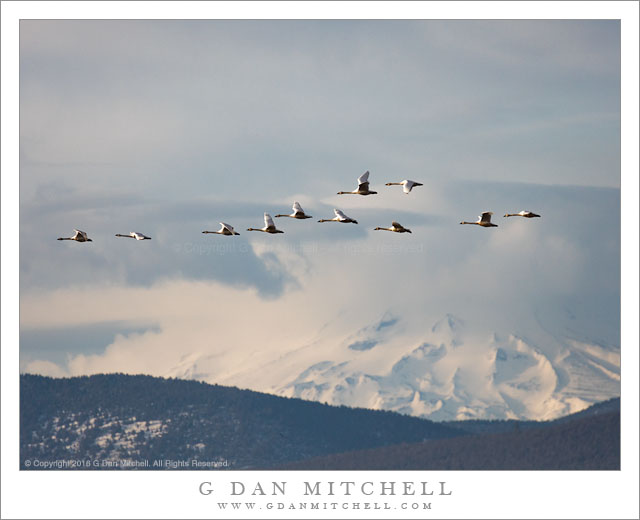
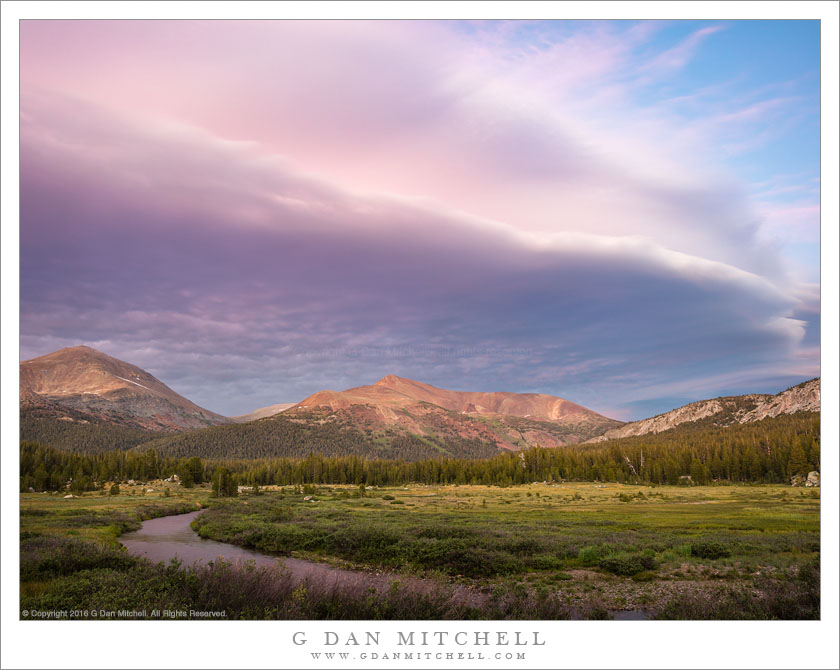
Tundra Swans, Mount Shasta

Tundra Swans, Mount Shasta
Tundra swans fly in front of distant cloud-shrouded Mount Shasta

Tundra Swans, Mount Shasta. Klamath Basin, California. February 12, 2016. © Copyright 2016 G Dan Mitchell – all rights reserved.

Tundra swans fly in front of distant cloud-shrouded Mount Shasta

Mount Shasta is one of those special mountains that stands alone and above all around it. In land that rarely exceeds a few thousand feet in elevation, this peak soars to over 14,000′, only a bit shorter than Mount Whitney, the tallest peak in the Lower 48 States. While Mount Whitney is nestled into a very high section of the Sierra Crest, along with other peaks and ridges of nearly the same height, nothing near Shasta is remotely near as tall. Its bulk soars above the rest of the landscape, especially when it is covered in winter snows — and the clouds that build over its summit can make it seem even larger. As we like to point out, the peak is so big that it makes its own weather.

The peak is clearly visible from this area of the Klamath Basin, and it is the first thing to catch the morning light. While out in this immense valley photographing tundra swans I noticed that some flocks along the far side of the valley were passing in front of the peak, and I started tracking them to see if any would cross the mountain at the right elevation. As I saw a flock far to my northwest, I would begin to track it along the horizon, hoping that it would pass in front of the peak and be high enough to clear the lower and darker mountains, yet not so high as to be far above the peak.


G Dan Mitchell is a California photographer and visual opportunist. His book, “California’s Fall Color: A Photographer’s Guide to Autumn in the Sierra” is available from Heyday Books and Amazon.
Blog | About | Flickr | Twitter | FacebookGoogle+ | 500px.com | LinkedIn | Email


All media © Copyright G Dan Mitchell and others as indicated. Any use requires advance permission from G Dan Mitchell.
Morning Musings: Canon and Mirrorless Cameras

(It has been a while since I’ve written a “morning musings” post, but since I’ve been “musing” about Canon and mirrorless cameras over the past few days and learning a few things about the subject, it seems like time for another such post.)

Unless you’ve been under a rock for the past few years you are aware of the introduction of so-called mirrorless cameras by several manufacturers and of the increasing sophistication of these cameras. Their features typically include:

  • smaller and lighter bodies that may be reminiscent of older rangefinder film cameras.
  • the ability to allow use of smaller lens designs, due to the shorter distance between the lens mount and the sensor.
  • electronic viewfinders (EVFs) that can incorporate additional useful tools and information into the viewfinder display and which have advantages in low light.
  • designs and features that increasingly appeal to serious photographers.

There are still issues with these cameras, and while much progress has been made and will continue, they still lag behind DSLRs is some areas:

  • battery consumption rates tend to be quite high by comparison to DSLRs.
  • AF performance is uneven and in some cases quite slow.
  • EVFs have latency issues.
  • Not everyone is fond of looking at an EVF monitor instead of the “real” image on focusing screen.
  • With some systems (notably Sony) using a wide range of lenses will likely require the use of third-party adapters.

I’ve been using a Fujifilm X-trans mirrorless system for my travel and street photography for nearly three years. (Mine is a discontinued model, but if I were buying today I would get the Fujifilm XT1 or perhaps the Fujifilm XT10.) Virtually all of my street/travel photographs of the past two years were made with my Fujifilm camera and lenses.  For this photography, the small size and excellent quality of the system compensates for the slower AF speeds and the battery consumption issues.

More recently the Sony A7r and A7rII cameras have gotten a lot of attention. When first introduced, the A7r came with the highest MP full frame sensor then available. The cameras can use (with varying degrees of compatibility and functionality) a wide range of non-Sony lenses, and they have a number of the other pluses associated with mirrorless designs. Several landscape photographer friends use the A7r and A7rII bodies for their tripod-based, manual focus photography, and I know several street/travel photographers who like the system a lot.

Sony and Fujifilm are not the only companies moving in this direction. For example, Olympus and others produce some very fine small mirrorless cameras.

All of which leads to the question: “Where is Canon’s mirrorless offering?” (Or, “Is the EOS-M the best Canon can do?”) Continue reading Morning Musings: Canon and Mirrorless Cameras

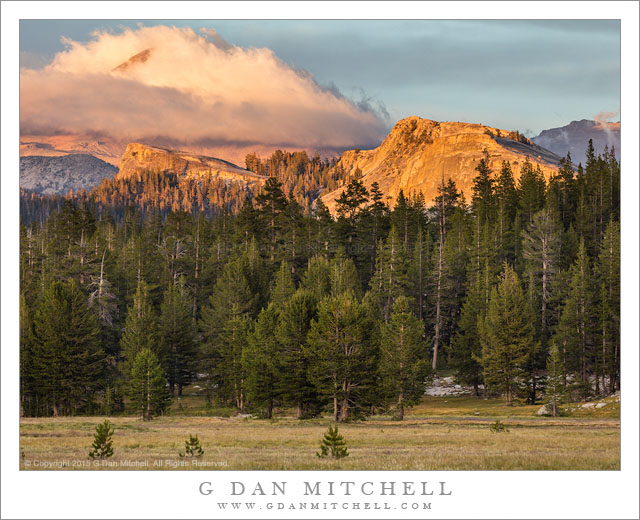
Round Valley, Autumn Snow

Round Valley, Autumn Snow
Sun shines on autumn-dry pastures and cottonwood trees in Round Valley as early autumn snow falls on Mount Tom

Round Valley, Autumn Snow. Eastern Sierra Nevada, California. October 4, 2015. © Copyright 2015 G Dan Mitchell – all rights reserved.

Sun shines on autumn-dry pastures and cottonwood trees in Round Valley as early autumn snow falls on Mount Tom

After a few early October days and nights photographing fall subjects in Bishop Canyon, on my final morning in camp I woke up to temperatures in the middle thirties and snow pellets, with the surround peaking shrouded in clouds that occasionally parted to reveal new snowfall. I got up, headed out to make a few photographs, and worked for a couple of hours before the storm arrived in earnest, with rain and snow up higher. At this point, photography was becoming a less attractive and even possible project, so it was time to bail out and start my long drive home. I stopped in the town of Bishop long enough to get coffee and breakfast, and then I was off on what would be a rather long drive home — multiple trans-Sierra passes having been closed by the storm.

My plan was to move along efficiently and not stop too much, but nature had other ideas. I had hardly gone ten miles before I looked to my left and saw these beautiful cottonwood trees in the middle of golden-brown pastures, with a huge storm brewing over the flanks of Mount Tom and the rest of the Sierra. I pulled over and found a high spot and waited for the right conditions of light and clouds — enough clearing to make out the shape of the mountain with its crown of newly fallen snow plus some light on the pasture and the trees.


G Dan Mitchell is a California photographer and visual opportunist. His book, “California’s Fall Color: A Photographer’s Guide to Autumn in the Sierra” is available from Heyday Books and Amazon.
Blog | About | Flickr | Twitter | FacebookGoogle+ | 500px.com | LinkedIn | Email


All media © Copyright G Dan Mitchell and others as indicated. Any use requires advance permission from G Dan Mitchell.
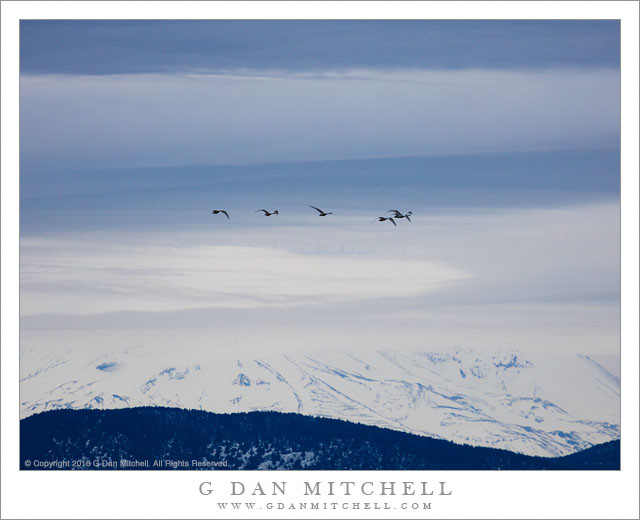
Young Lake, Mount Conness

Young Lake, Mount Conness
Cloud shadows race across the landscape on a summer day near the Sierra crest below Mount Conness

Young Lake, Mount Conness. Yosemite National Park. September 11, 2007. © Copyright 2015 G Dan Mitchell – all rights reserved.

Cloud shadows race across the landscape on a summer day near the Sierra crest below Mount Conness

This is an older photograph, made eight years ago back in 2007 on a late-season solo backpack trip into the Yosemite back-country. A week or so after the Labor Day holiday, the crowds almost disappear from the park’s high country, and everything seems to sort of slow down as the summer comes to and end and the inevitable signs of impending autumn remind us that summer is over and winter is not that far away. I think that this can be the most beautiful time of year in the Sierra, especially on a day with beautiful, warm autumn-like light, golden brown meadows, blue sky, comfortable temperatures, solitude, and perhaps a few passing clouds.

There is a story about how I found myself in this high spot overlooking this lake and the mountains beyond. That morning I had been poking around near by bivy sack camp when I saw someone napping in the lakeside meadow. It turned out to be a backcountry ranger. I made some wise-guy remark (intended entirely in jest, and he took it that way) about the challenges of the ranger’s life, and we got to talking. For him, this late season period was a time to slow down a bit and enjoy his own solitude. As we talked he pointed up towards a rocky saddle above the lake and pointed out what, in retrospect, should have been obvious to me — there was a well-used cross-country route through the saddle. So I decide to depart the lake via this alternative route, and when I reached the top of the climb and looked back I saw this spectacular Sierra panorama.


G Dan Mitchell is a California photographer and visual opportunist. His book, “California’s Fall Color: A Photographer’s Guide to Autumn in the Sierra” is available from Heyday Books and Amazon.
Blog | About | Flickr | Twitter | FacebookGoogle+ | 500px.com | LinkedIn | Email


All media © Copyright G Dan Mitchell and others as indicated. Any use requires advance permission from G Dan Mitchell.