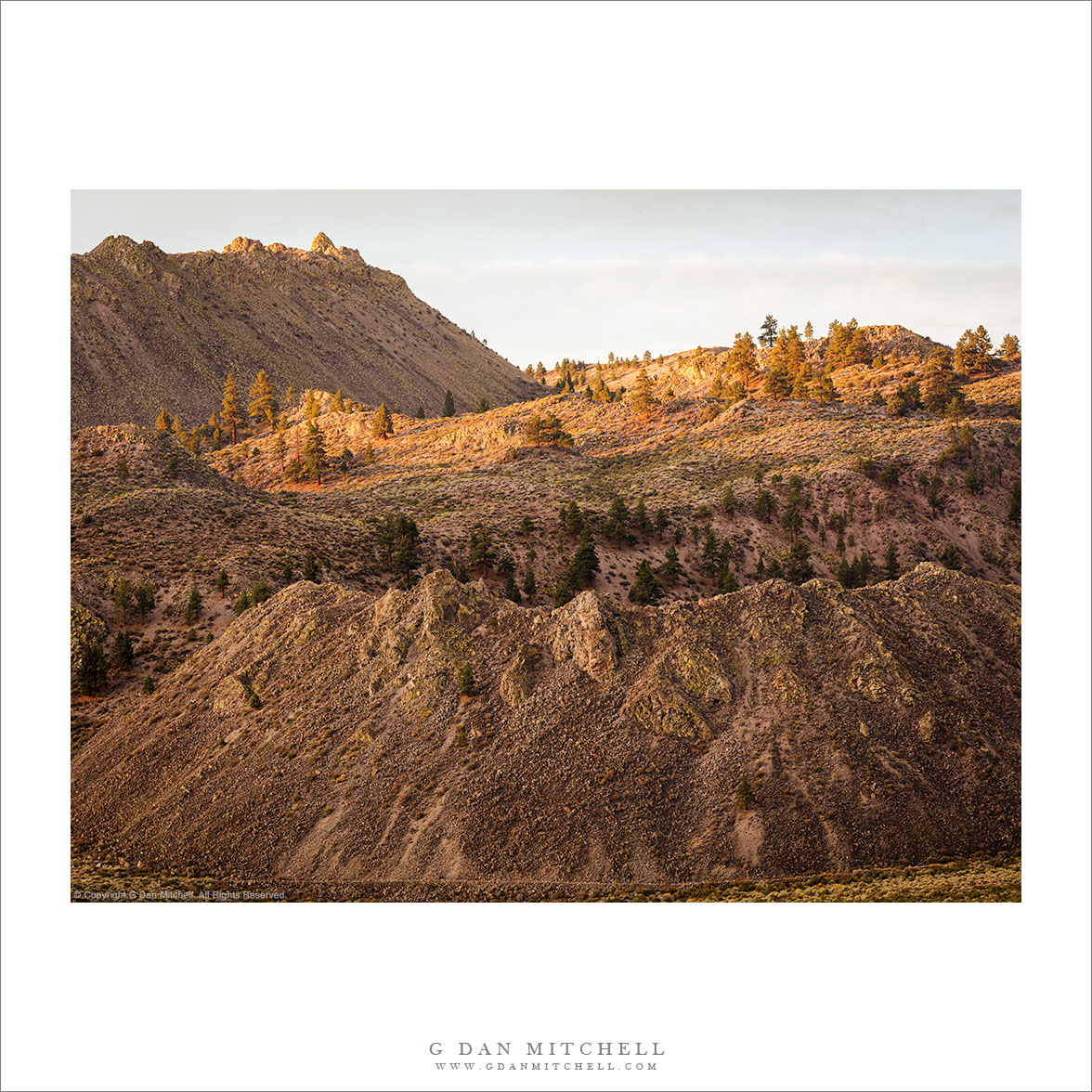
“Early Light, Mono Craters” — First morning sunlight on the slopes of Mono Craters.
Mono Basin is a fine place to contemplate geology and immense spans of time. Mono Lake itself is an ancient body of water, and one that has not always looked like it does today. The lake is probably 3/4 of a million years old, and its ancestor lake was, at times, much deeper and larger than it is today. At times its waters rose high enough to overcome its current landlocked state and drain either north or south. (To really bend your mind, its waters may have drained to ancient Lake Manly in Death Valley.) Today, as large as the lake is, it is greatly diminished in size and depth by comparison.
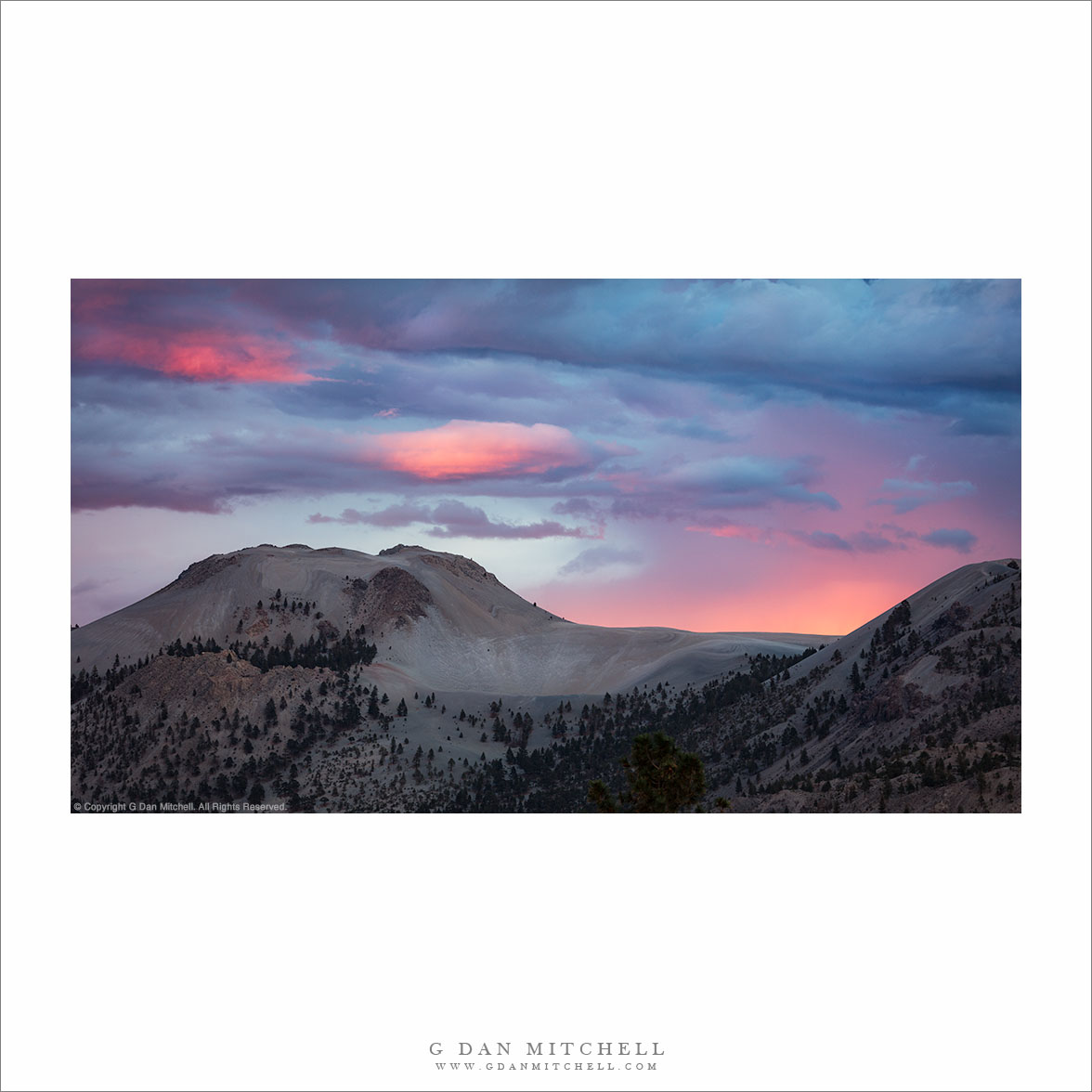
“Sunset Clouds, Mono Craters” — The last sunset light on clouds above Mono Craters.
This ridge is comprised of the Mono Craters, a string of volcanic cones running roughly south from Mono Lake east of the Sierra Nevada. We don’t typically think of the Sierra as a volcanic range, but there are quite a few examples of volcanism to be seen once you get to know the area. If you head over the Sierra to Lee Vining and then turn south you will see a lot of evidence of this. You begin with the islands in Mono Lake, then. see another cinder cone just south of the lake. The Mono Craters rise just south of highway 120 as it heads out into the lonely basin and range country. Continuing south you pass several impressive cones and lava flows on your way to Mammoth Lakes, where Mammoth Peak rises — yes, another volcanic feature. From there, if you hike south you can see the string continue.
I was here at the end of September on a sort of “getting reacquainted with the Sierra” trip after returning from ten weeks of overseas travel. That travel was wonderful, but it was great to be back ”home” in California’s mountains. On this evening I was photographing an absolutely wild sunset over Mono Lake, and as a sort of side-show I saw this lovely light over the craters as the last light illuminated clouds and remnants of falling rain.
G Dan Mitchell is a California photographer and visual opportunist. His book, “California’s Fall Color: A Photographer’s Guide to Autumn in the Sierra” is available from Heyday Books, Amazon, and directly from G Dan Mitchell.
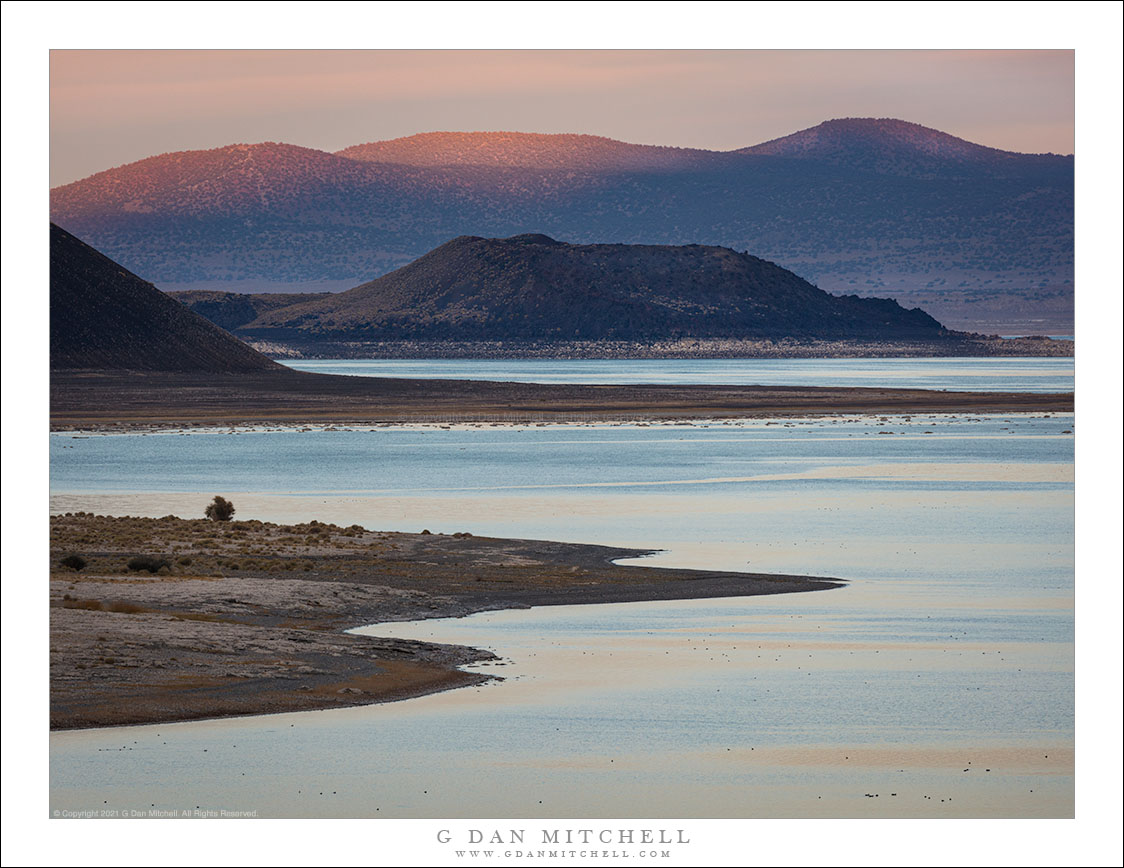
The shoreline of Mono Lake, a cone, mountains, and the last light of an early Autumn evening.
The views from this section of Mono Lake have long intrigued me. I think it may be because I frequently arrive here late in the day from the north, and especially in the autumn it is pretty common for me to come down the grade from Conway Summit at just about sunset. On quite a few occasions I’ve raced the sunset to get there in time for the last light, occasionally with the rising full moon in the scene. By now I have a few particular locations where I like to pull over and set up on these lovely evenings.
This view looks along the shore of the upper “corner” of the lake just off of US 395. The shoreline undulates here now that the waterline has dropped from historic levels. (I’m fairly sure that the foreground peninsula was previously under water.) A second peninsula extends into the lake from the Black Point formation, and beyond that lies Negit Island. In the distance, beyond the far shore of this huge lake, lie desert mountains, catching the final sunlight of the day in this photograph.
G Dan Mitchell is a California photographer and visual opportunist. His book, “California’s Fall Color: A Photographer’s Guide to Autumn in the Sierra” is available from Heyday Books, Amazon, and directly from G Dan Mitchell.
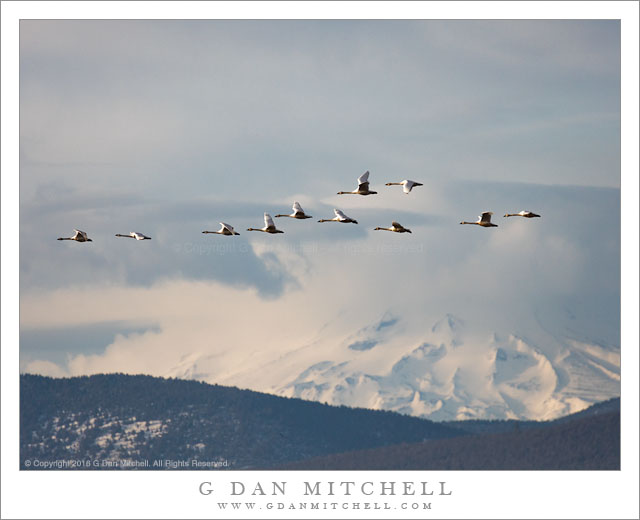
Tundra swans fly in front of distant cloud-shrouded Mount Shasta
Mount Shasta is one of those special mountains that stands alone and above all around it. In land that rarely exceeds a few thousand feet in elevation, this peak soars to over 14,000′, only a bit shorter than Mount Whitney, the tallest peak in the Lower 48 States. While Mount Whitney is nestled into a very high section of the Sierra Crest, along with other peaks and ridges of nearly the same height, nothing near Shasta is remotely near as tall. Its bulk soars above the rest of the landscape, especially when it is covered in winter snows — and the clouds that build over its summit can make it seem even larger. As we like to point out, the peak is so big that it makes its own weather.
The peak is clearly visible from this area of the Klamath Basin, and it is the first thing to catch the morning light. While out in this immense valley photographing tundra swans I noticed that some flocks along the far side of the valley were passing in front of the peak, and I started tracking them to see if any would cross the mountain at the right elevation. As I saw a flock far to my northwest, I would begin to track it along the horizon, hoping that it would pass in front of the peak and be high enough to clear the lower and darker mountains, yet not so high as to be far above the peak.
Photographer and visual opportunist. Daily photos since 2005, plus articles, reviews, news, and ideas.
Manage Consent
To provide the best experiences, we use technologies like cookies to store and/or access device information. Consenting to these technologies will allow us to process data such as browsing behavior or unique IDs on this site. Not consenting or withdrawing consent, may adversely affect certain features and functions.
Functional
Always active
The technical storage or access is strictly necessary for the legitimate purpose of enabling the use of a specific service explicitly requested by the subscriber or user, or for the sole purpose of carrying out the transmission of a communication over an electronic communications network.
Preferences
The technical storage or access is necessary for the legitimate purpose of storing preferences that are not requested by the subscriber or user.
Statistics
The technical storage or access that is used exclusively for statistical purposes.The technical storage or access that is used exclusively for anonymous statistical purposes. Without a subpoena, voluntary compliance on the part of your Internet Service Provider, or additional records from a third party, information stored or retrieved for this purpose alone cannot usually be used to identify you.
Marketing
The technical storage or access is required to create user profiles to send advertising, or to track the user on a website or across several websites for similar marketing purposes.