
Tag Archives: mountains

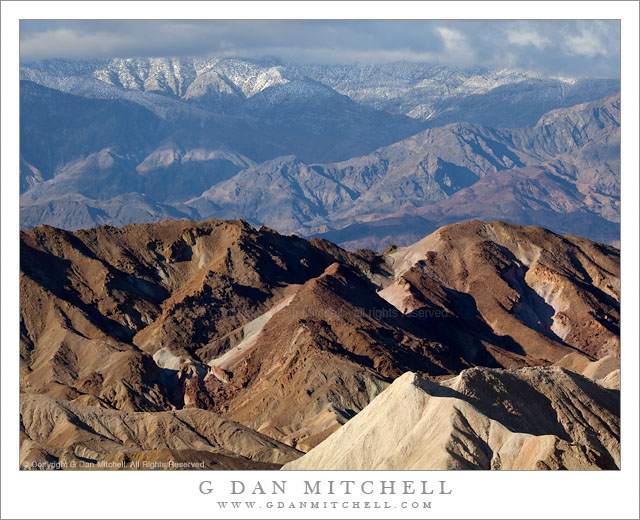
Zabriskie Point Badlands, Morning Snow on the Panamint Range

Zabriskie Point Badlands, Morning Snow on the Panamint Range

Zabriskie Point Badlands, Morning Snow on the Panamint Range. Death Valley National Park, California. February 20, 2010. © Copyright G Dan Mitchell – all rights reserved.

Morning light on fresh snow on the summit of the Panamint Range with Zabriskie Point Badlands in the foreground, Death Valley National Park.

After getting being frustrated by falling snow earlier in the morning when I tried to photograph dawn at Dantes View I headed back down to lower terrain. (Although I was not successful in photographing at Dantes View and, in fact, turned back before the summit in dense clouds and falling snow, it was quite an interesting visit!) I stopped along the way and made some photographs before arriving at Zabriskie Point.

At this point I no longer reflexively photograph at Zabriskie, though I will if something special or unusual is happening with the conditions. Having been frustrated in my original plans, I figured I might as well take a look around since I was there. I left the camera gear in my car and walked up the hill to the famous overlook to see what I could see. The dawn light – if there had even been any on this cloudy morning – was long gone, though a few photographers were still hanging out. As I looked about I noticed two things. First, the clouds were just beginning to thin over the Panamint range. While the summit of Telescope Peak was still socked in – it appeared to be snowing there – light was beginning to break through gaps in the clouds above the east side of the range and interesting shadows were appearing below the snow line. Second, the partially cloudy conditions were softening the light right in the Zabriskie/Gower Gulch area and the light in some of my favorite small gullies to the right of the observation area was looking somewhat interesting. (I have made a project of photographing them with a long lens.)

With no other specific plan, and two potential subjects right here, I followed one of those “laws of photography” that says shoot the thing you see now rather than continuing to wander around hoping that some other miracle crops up. (Sometimes this is great advice. Other times it is dead wrong!) I walked back down the hill to my car, grabbed my gear, and walked back up. I first spent some time photographing the nearby gullies. (I think I have a couple of interesting images of them that will appear here eventually.) But I quickly turned my attention to the interesting weather and light across the Valley, thinking about how I might photograph this wild and rugged scene without making it look like another Zabriskie Point image. I decided to use a relatively long focal length lens – which was already on the camera for shooting the gullies anyway – and try to fill the entire frame with a combination of close and far mountains and snow and clouds in the morning light.

G Dan Mitchell Photography | Flickr | Twitter | Facebook | Email
Text, photographs, and other media are © Copyright G Dan Mitchell (or others when indicated) and are not in the public domain and may not be used on websites, blogs, or in other media without advance permission from G Dan Mitchell.
Branch, Water on Salt Flats

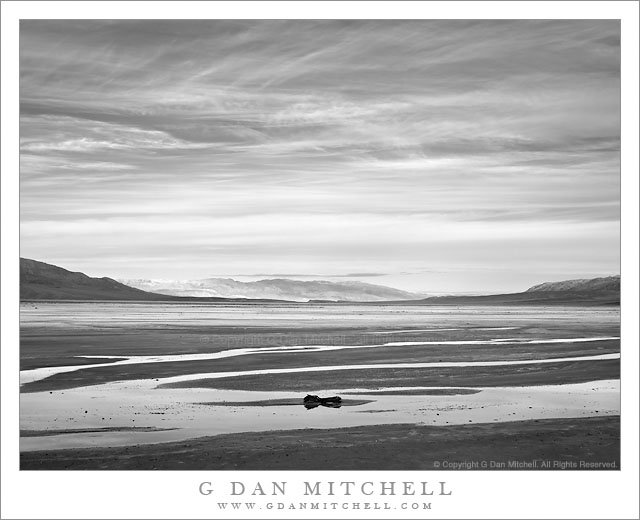
Branch, Water on Salt Flats

Branch, Water on Salt Flats. Death Valley National Park, California. February 21, 2011. © Copyright G Dan Mitchell – all rights reserved.

A forelorn branch sits near pools of reflecting water on salt flats of Death Valley National Park.

After the brief dawn light on the Panamints ended (see the photograph I posted yesterday) and the world went gray over in that direction, I noticed this odd log or branch sitting out on the mud in the salt flats between some of the ponds that streak this section of the flats. While the two minutes of beautiful color on the Panamints had ended, the increasing light was transforming what had been a fairly solid covering of gray into a transparency that revealed interesting layers and patterns of clouds in the morning sky.

I moved a bit closer and made one final sequence of Death Valley photographs before heading back to Stovepipe Wells to take down my camp and start the long drive home. I tried a couple different compositions, including some in which I was closer to the log, but in the end I prefer this one that put some distance between it and me and, I think, suggests the huge spaces that are among of the most compelling characteristics of this landscape.

G Dan Mitchell Photography | Flickr | Twitter | Facebook | Email
Text, photographs, and other media are © Copyright G Dan Mitchell (or others when indicated) and are not in the public domain and may not be used on websites, blogs, or in other media without advance permission from G Dan Mitchell.
Dunes, Cottonwood Mountains, and Dust Storm

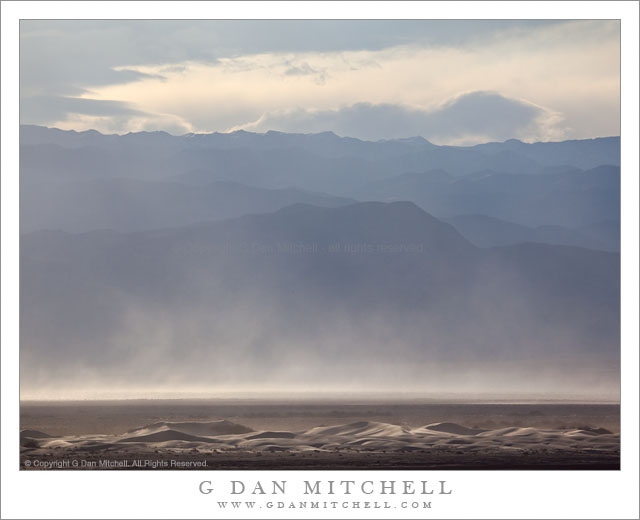
Dunes, Cottonwood Mountains, and Dust Storm

Dunes, Cottonwood Mountains, and Dust Storm. Death Valley National Park, California. February 19, 2011. © Copyright G Dan Mitchell – all rights reserved.

Afternoon winds whip up a dust storm over Death Valley between sand dunes and the high ridges of the Cottonwood Mountains.

Following my typical routine of “get up ridiculously early and shoot until I can’t stand it any longer, hang out during the middle of the day, and then head out for late afternoon and evening shooting,” I had been watching some interesting clouds developing far to the north of Stovepipe Wells during the day and decided that I might head up that way in the evening if they continued to hold promise. After crossing the Valley to the Scotty’s Castle road junction I could see a curtain of virga falling from those clouds to the north, so I decided to head that way.

The wind had been picking up from the south during the afternoon as another weather front approached. As I headed up along the edge of the main valley I could see that this wind was starting to pick up dust and sand from the Mesquite Dunes area near Stovepipe and from areas just north of that. I’m more familiar with the dust being carried south by winds out of the north, so this was a bit of a different site as sand/dust were being picked up from the dunes rather than being deposited there.

The dunes at the bottom of this photograph are not the familiar “main” dunes near Stovepipe, but are instead smaller dunes running north/south up the Valley. While a larger version of the photograph shows some blowing dust on these foreground dunes, the main cloud is coming from further south down the Valley. Beyond the dust and across the Valley are the hills of the Cottonwood range ascending to a ridge that still holds a bit of snow from storms over the previous couple of days, with building clouds above that would bring another dusting on this evening.

G Dan Mitchell Photography | Flickr | Twitter | Facebook | Email
Text, photographs, and other media are © Copyright G Dan Mitchell (or others when indicated) and are not in the public domain and may not be used on websites, blogs, or in other media without advance permission from G Dan Mitchell.

Two Hikers at the Summit of Death Valley Dunes

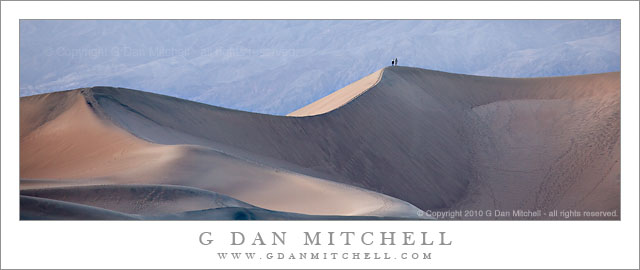
Two Hikers at the Summit of Death Valley Dunes

Two Hikers at the Summit of Death Valley Dunes. Death Valley National Park, California. © Copyright G Dan Mitchell – all rights reserved.

Two hikers take in the evening landscape of Death Valley National Park from the Summit of the dunes.

Many times I might have been disappointed to have two hikers enter “my” scene in such beautiful dusk light, but here I feel like they crystalize the scene. In a larger version of the photograph the two of them seem to stand silently facing the rugged vastness of Death Valley – and I think their presence invites us to think of ourselves in the scene and to imagine our own reaction to it.

My favorite time to photograph these iconic dunes near Stovepipe Wells is in the evening during a brief interval right around sunset and lasting a while after the sun drops behind the peaks to the west. The light softens, especially if there is a bit of haze in the sky, and the dunes that are so bright and harsh at other times of day take on a smoother and softer quality and their subtle colors become visible.

This photograph is not in the public domain and may not be used on websites, blogs, or in other media without advance permission from G Dan Mitchell.

G Dan Mitchell Photography
Flickr | Twitter | Facebook Fan Page | Facebook | Friendfeed | Email