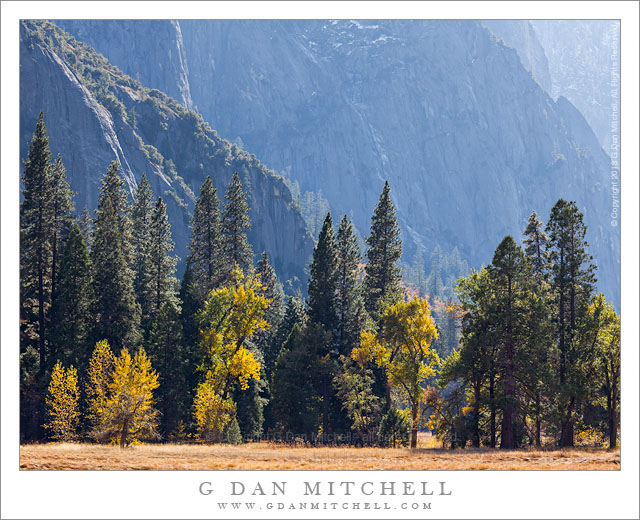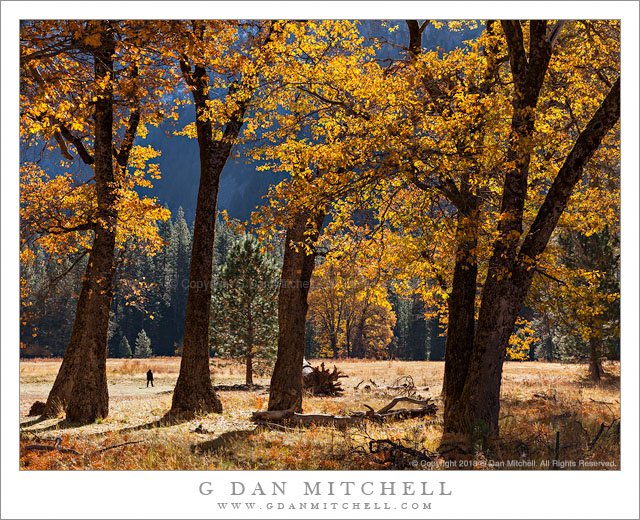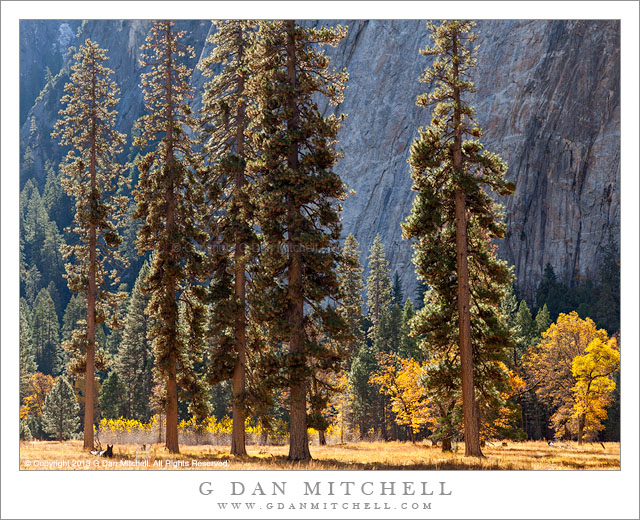
An October storm brings snow to the Parker Canyon area of the eastern Sierra Nevada
This is yet another photograph from our early October “aspen chasing” trip to photograph fall color in the eastern Sierra. We were on the “east side” for five days, in conditions that began with a full day of snow, then turned mostly sunny for a few more days, and returned to more winter-like weather on our final day. On that last day of the visit we tracked far to the east of the Sierra, out into high desert ranges where we saw many interesting things including a number of stands of aspens in surprising and less-visited places.
We looped back from the east and passed by the south shore of Mono Lake, and coming over the rise between there and highway 395 we were not surprised to see a substantial chunk of the Sierra crest laid out before us… but we were a bit surprised to see that it appeared to still be snowing along the crest. We had awakened to light snow in Mammoth Lakes that morning, but assumed that it was just a passing squall. This seemed to be the case, as we did not see much more in the way of precipitation as we headed east. But these were apparently the sort of conditions in which storm clouds form right over the crest, and the result was this very dramatic scene. Low in the frame, the foreground hills pick up a bit of sunlight, and as they ascend toward higher peaks, aspen trees in full autumn color are visible. A forest filled valley, lined by an old lateral glacial moraine, ascends across the frame from right to left, leading to the entrance to steep Parker Canyon. High above, light snow falls and the peaks around Parker Pass slip in and out of the clouds.
G Dan Mitchell is a California photographer and visual opportunist whose subjects include the Pacific coast, redwood forests, central California oak/grasslands, the Sierra Nevada, California deserts, urban landscapes, night photography, and more. Blog | About | Flickr | Twitter | Facebook | Google+ | 500px.com | LinkedIn | Email
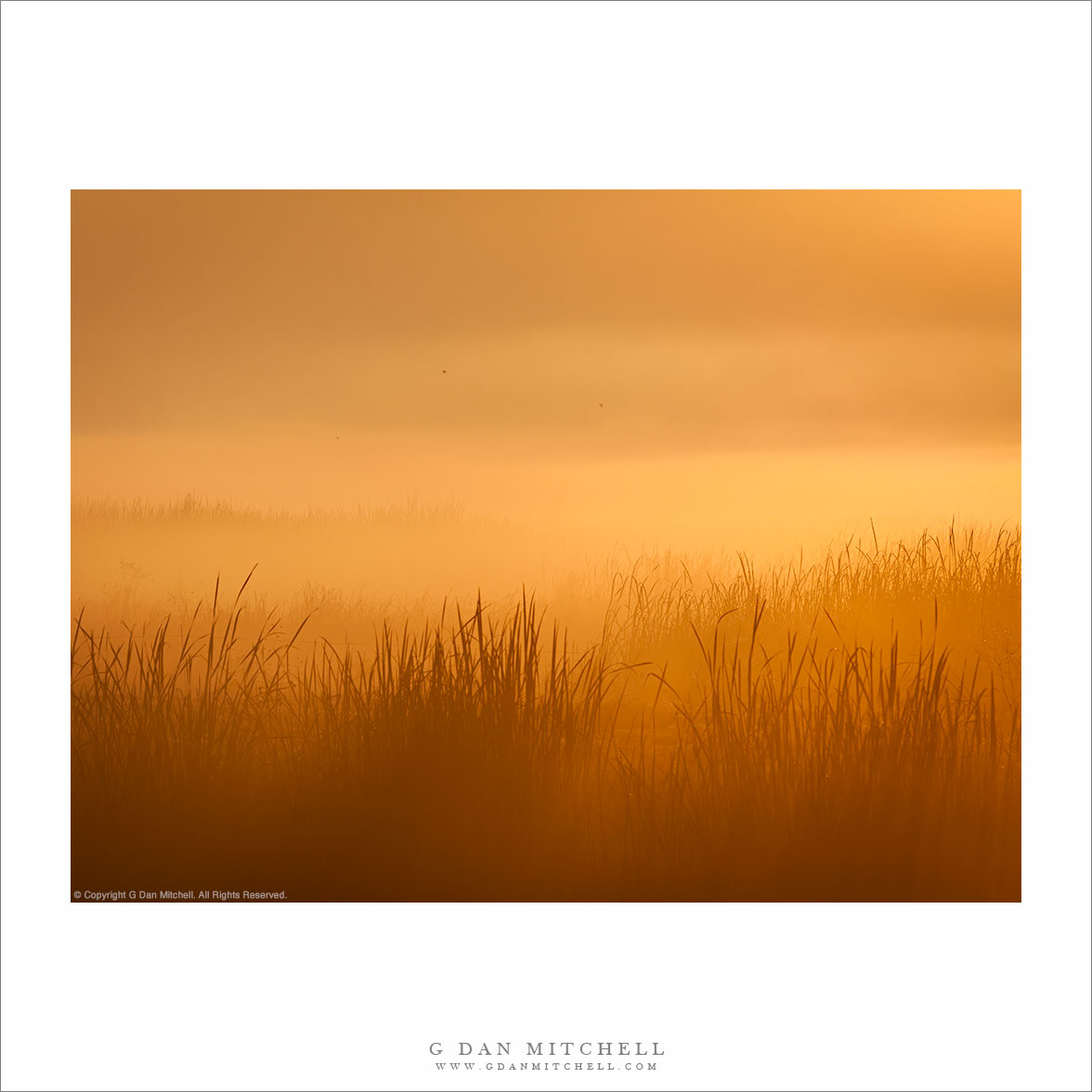
Morning fog drifts through a stand of cottonwood trees with golden autumn leaves, Yosemite Valley
Like essentially everyone who has photographed much in Yosemite Valley, I know this little stand of cottonwood trees very well. It is an obvious attractive photographic subject since its densely grouped trees stand apart from other trees in the middle of a meadow, its “perfect cottonwood-ness” is broken by the presence of a couple of other trees almost hidden within the stand, there are a variety of potential backgrounds for the small grove, at the right times it can be beautifully lit, and the meadow often forms beautiful ground fog early in the morning during certain seasons and conditions. Since the fall color of the trees seemed near its peak, I made a plan to be out there at one of the potentially ideal times on Halloween morning.
On the prior day I had decided on the spot from which I would photograph, with the idea being to make a fairly tightly cropped photograph of the trees with a bit of canyon wall in the background. With this plan in mind, I woke up in the darkness and arrived here well before sunrise and went directly to the spot I had picked out. I was very happy to find ground fog drifting over the meadow and frost on its dried grasses. I started photographing almost right away, before there was any direct light here or anywhere else in the Valley, and I planned to shoot right through sunrise and the point when the first direct light strikes the meadow and this group of trees. Before long, the first bit of sunlight came to the upper edge of the trees, and the light changed quickly as the beam of light from up near Half Dome moved down across the trees and began to cast alternating light and shadow across the meadow. This image from the series of photographs seems like the best combination of fog (which began to dissipate as the sun arrived), sunlight on trees and meadow, and background still in shade.
G Dan Mitchell is a California photographer and visual opportunist whose subjects include the Pacific coast, redwood forests, central California oak/grasslands, the Sierra Nevada, California deserts, urban landscapes, night photography, and more. Blog | About | Flickr | Twitter | Facebook | Google+ | 500px.com | LinkedIn | Email
During the past few years I have become a big fan of photographing migratory birds in California’s Central Valley, and now that summer is over I’m anxious to get back out there and get to work on this year’s bird photographs. Actually, we made our first bird photography trip out there about a week ago, on the first weekend in November. Our main goal was to find sandhill cranes, since we knew they were here already, but we were also interested in seeing what else might have showed up.
In keeping with my new policy of posting multiple photographs in a single message when I have too many photographs waiting in the queue, this post includes five bird photographs. Enjoy!
Late in the morning, long after the morning fly out, we were poking around on some rural backroads when we found a lot of sandhill cranes in dormant fields in thinning morning fog. This group thoughtfully posed for me with a distant pair of trees on the horizon.
Three sandhill cranes stand in a dormant Central Valley, California field
I photographed this group in much the same location as those in the previous photograph. While the cranes seem to collect in large groups near water in the evening and early morning, during the day they are often found more spread out in agricultural areas like this one.
Sandhill cranes land on a Central Valley pond during the evening fly-in
In the evening the cranes do a “fly-in” – where large numbers of them land together in areas around water. When we arrived at this small observation area an hour or so before sunset, there were many birds but no cranes. However, I’ve learned that the sandhill cranes often arrive late, frequently after sunset and sometime when it is becoming rather dark. (One of our most memorable migratory bird encounters occurred at another refuge further south in the valley. We had a great day of photographing birds, beginning very early in the morning and continuing through sunset. As the sun set the bird action began to diminish and it became quite dark. It had been a long, successful day, and we were happy to be finished with this shoot. We were just putting gear away when we began to hear a huge chorus of the easily recognized sound of sandhill cranes coming from out of sight to the southeast. A moment later the sky was filled with the birds – I’ve never seen so many cranes together since then.)
Here the birds began to arrive just a bit earlier. The first groups landed a good distance off, but soon a single large crane settled in on this dry area in front of us and began to produce very large calls, as if to say, “come on down and stop here!” Before long other birds did just that. Here the slow shutter speed allows the winds of the landing birds to blur a bit.
A small group of cackling geese in flight against blue sky over California Central Valley agricultural lands
I have a confession to make, and it is a little embarrassing for a person who is as enthusiastic about photographing birds as I am. Basically, I’m not very good at identifying birds, or at least not good at naming them! (This is an “issue” I’ve always had, and not just with birds. I’m so familiar with certain wild plants that I can tell you exactly what they look like in the wet and dry seasons, when the flowers will appear, and when to find them… but I often cannot name them.) I’m always happy when I can photograph with someone who is better than I at this.
I’m pretty certain these are geese! (Good so far?) I used to think that geese that looked like this were Canadian geese, but when I tried to find photos of these birds online to determine what they were, I kept coming up with “cackling geese.” To make things more confusing – at least for me – I understand that the differences between some Canadian geese and some cackling geese can confuse even the experts. Judging by the size and shape of the bill, the size of the birds, and the pattern and color of feathers, I’m going with this identification until someone shows me differently!
Sandhill cranes settle in to a Central Valley pond during the evening fly-in
This is the same group seen in a photograph earlier in this post, with this photograph being made a bit earlier – clearly the case as there are fewer birds on the ground in this shot, and the color of the sky is less intense. If you look closely about a third of the way in from the left edge of the frame, you may be able to see the larger bird that landed first and was then followed by other later arrivals.
G Dan Mitchell is a California photographer and visual opportunist. His book, “California’s Fall Color: A Photographer’s Guide to Autumn in the Sierra” (Heyday Books) is available directly from him.
Almost a month ago we spent a few hours in the historic ghost town of Bodie, California on the final day of a trip to the eastern Sierra to photograph fall colors. On this day we decided to focus on a few other things, including a looping drive out to the east of the Sierra, followed by a side trip to Bodie, which came up when it looked like the weather conditions out there might be somewhat more interesting than usual.
Rather than save these up for a week’s worth of individual post, I have decided to combine them into a single post. (I have too many photographs queued up for future posts already.) I am presenting them in roughly the order that I shot them as we wandered around in Bodie. For those who may be unfamiliar with Bodie, it was the site of silver and gold mining many decades ago. There are stories of it being a fairly populous place with many “modern” amenities – but also of it being a rather rough place, which isn’t surprising given its remote location and the fact that it was a mining town. The mines gave out and the citizens gradually moved away, leaving the town almost completely abandoned. A few decades ago it was taken over by the California State Park System and it is now a state historical park that focuses on protecting and maintaining the place and making it available to visitors.
Weathered wooden walls and windows, Bodie, California
I passed this building or group of buildings on my way into the town. I have photographed this structure and, in fact, this section of the structure before. Exposed to the harsh summer and winter conditions of this high desert location, it is no surprise that the wood has been severely weathered.
The Standard Mill in the ghost town of Bodie, California
The Standard Mill is a large facility for refining ore, located across the town from the place where most of us begin our walks. To my eyes, it reminds me a lot of certain other mid-century industrial sites where I have photographed. Unfortunately – for me, but perhaps fortunately for other reason – fences surround the site and it is not possible to easily get inside and wander about without a guide. For that reason all of my photographs of the mill are from some distance.
Standard Mill, Bodie
Standard Mill, Bodie – Detail. Bodie, California. October 13, 2013. Copyright 2013 G Dan Mitchell – all rights reserved.
The corrugated metal exterior of the abandoned Standard Mill, Bodie, California
This is a closer photograph of the buildings of the Standard Mill, whose angles, structure, and supporting wires fascinated me.
Old abandoned buildings line the streets of the ghost town of Bodie, California
These are among a number of buildings along the street heading to the entrance to the Standard Mill. The view here looks back across the valley in which the ghost town is located, toward higher hills, a small aspen grove, and cloud-shrouded peaks.
Windows on the front of an abandoned wooden building in the ghost town of Bodie reflect the cloud-filled sky
The squared geometry of the front of this building first caught my, along with the typical weathered condition of the wooden door, window frames, and paneling. The window reflects a distorted and blurred version of the cloud-filled sky, and underneath are hints of what is inside the windows.
The schoolhouse in the ghost town of Bodie, California
This is the view I first had of the schoolhouse, before I realized that it was, in fact, the school. The tall steeple first had me thinking it was perhaps a church. From this side, the building is backed by nothing but the open space of the high desert, highlighting the desolation of the place.
Downtown Bodie ghost town, with barren hills rising beyond
The foreground structure is the same schoolhouse building seen in the previous photograph. Here the perspective looks over the back of the school and across the buildings of the main street leading toward the mill, which is behind my camera position.
G Dan Mitchell is a California photographer and visual opportunist whose subjects include the Pacific coast, redwood forests, central California oak/grasslands, the Sierra Nevada, California deserts, urban landscapes, night photography, and more. Blog | About | Flickr | Twitter | Facebook | Google+ | 500px.com | LinkedIn | Email
Photographer and visual opportunist. Daily photos since 2005, plus articles, reviews, news, and ideas.
Manage Consent
To provide the best experiences, we use technologies like cookies to store and/or access device information. Consenting to these technologies will allow us to process data such as browsing behavior or unique IDs on this site. Not consenting or withdrawing consent, may adversely affect certain features and functions.
Functional
Always active
The technical storage or access is strictly necessary for the legitimate purpose of enabling the use of a specific service explicitly requested by the subscriber or user, or for the sole purpose of carrying out the transmission of a communication over an electronic communications network.
Preferences
The technical storage or access is necessary for the legitimate purpose of storing preferences that are not requested by the subscriber or user.
Statistics
The technical storage or access that is used exclusively for statistical purposes.The technical storage or access that is used exclusively for anonymous statistical purposes. Without a subpoena, voluntary compliance on the part of your Internet Service Provider, or additional records from a third party, information stored or retrieved for this purpose alone cannot usually be used to identify you.
Marketing
The technical storage or access is required to create user profiles to send advertising, or to track the user on a website or across several websites for similar marketing purposes.