
Tag Archives: panamint

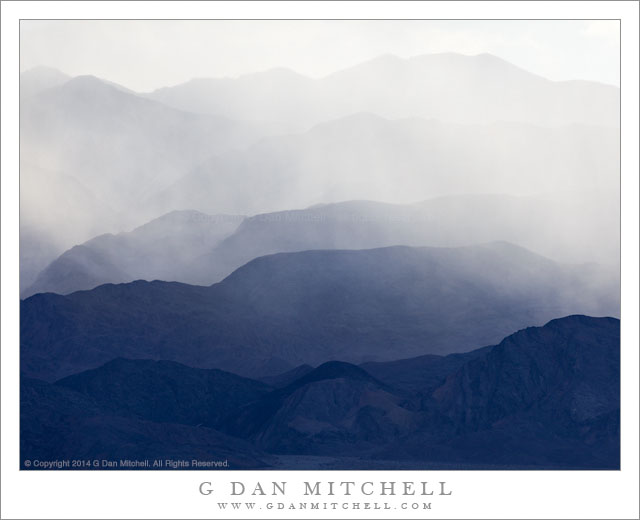
Rain, Cottonwood Mountains

Rain, Cottonwood Mountains

Rain, Cottonwood Mountains. Death Valley National Park, California. April 2, 2014. © Copyright 2014 G Dan Mitchell – all rights reserved.

Afternoon showers from a clearing storm fall on receding ridges of the Cottonwood Mountains, Death Valley National Park

This had been a “weather day,” with several hours of snowfall high up in the Panamint Range, where we had photographed sunrise—such as it was— and wildflowers and, of course, snow. We spent the morning and half the afternoon kicking around up high in these mountains, enjoying the late-season surprise cold weather, finding tons of wildflowers, and visiting various historical remnants of the mining days in Death Valley National Park. My typical shooting day in a situation like this starts well before dawn, includes a midday break, and then moves on to late afternoon and evening shooting until it is dark. But it was well past mid-afternoon when we finally descended from the Panamints.

There was no time for a real break, so we headed right on out to find an evening subject. We had not yet photographed in the Mesquite Dunes, and my initial thought was to photograph there in late afternoon and evening light. In the right conditions there can be wonderful light late in the day, especially during the final few minutes before the sun leaves the dunes. But there were still clouds floating around, especially to the west, and I wasn’t at all sure that we would see the good light out among the dunes. So I decided that it might make more sense to go to a higher spot where the wider panorama would let me pick out various areas of the Valley and surrounding mountains as the light changed. Arriving at “the spot,” I looked west and saw that showers were still falling over the Cottonwood Mountains and glowing with backlight from the late afternoon sun, so I put on the long lens and made some photographs of portions of the range where the falling rain masked the details and turned the mountains into abstract shapes.

G Dan Mitchell is a California photographer and visual opportunist whose subjects include the Pacific coast, redwood forests, central California oak/grasslands, the Sierra Nevada, California deserts, urban landscapes, night photography, and more.
Blog | About | Flickr | Twitter | FacebookGoogle+ | 500px.com | LinkedIn | Email

Text, photographs, and other media are © Copyright G Dan Mitchell (or others when indicated) and are not in the public domain and may not be used on websites, blogs, or in other media without advance permission from G Dan Mitchell.
Clearing Storm, Panamint Range

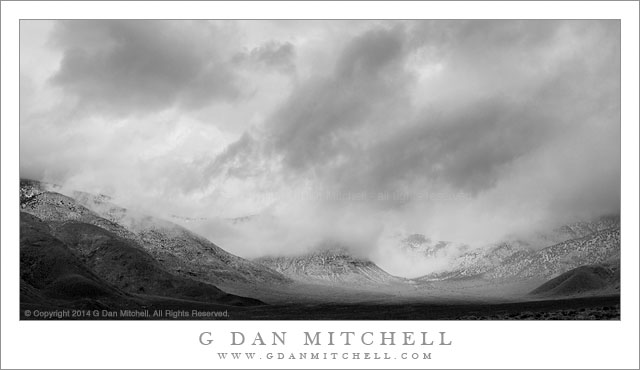
Clearing Storm, Panamint Range

Clearing Storm, Panamint Range. Death Valley National Park, California. April 2, 2014. © Copyright 2014 G Dan Mitchell – all rights reserved.

A clearing snow storm in the Panamint Mountains above Wildrose Canyon, Death Valley National Park

I seem to have a knack for encountering “interesting” weather in Death Valley. The first time I visited the park, on an early April trip back in the late 1990s, I encountered light snow at Scotty’s Castle, an extremely cold wind storm that forced a retreat from the back-country near Teakettle Junction, and a big dust storm at Stovepipe Wells. Since then I’ve experienced a number of dust storms, heavy rain, sub-freezing temperatures, more snow, and plenty of wind. If you are hoping to visit the park for its more typical hot weather, you might want to avoid times when I’m there! Of course, I often visit around the beginning of April, and this seems to be a time of wildly varied conditions in this park—the time of wind storms, and a season when you might see the last Pacific winter storms or the first really warm weather.

On this year’s early April visit things leaned more in the direction of winter-like conditions. As a series of welcome Pacific storms came through there were plenty of clouds, cooler temperatures, strong winds, and some precipitation. The plan on this morning was to start at a very high overlook in the Panamint Range, from which expansive morning vistas are often possible. We were there before sunrise… but it was cloudy and becoming cloudier. There was enough light for some photography, but we also became aware that snow was starting to fall on some of the higher peaks. After an hour or so at this location we retreated to a high, broad, sage-filled valley and continued to watch the clouds close in and the snow spread along other nearby ridges. Not wanting to miss the unusual conditions we headed up into Wildrose Canyon, getting as far as the charcoal kilns before the falling snow convinced me that we shouldn’t go any further. We worked our way back down the canyon where the storm began to temporarily clear from the ridge of the Panamint Mountains.

G Dan Mitchell is a California photographer and visual opportunist whose subjects include the Pacific coast, redwood forests, central California oak/grasslands, the Sierra Nevada, California deserts, urban landscapes, night photography, and more.
Blog | About | Flickr | Twitter | FacebookGoogle+ | 500px.com | LinkedIn | Email

Text, photographs, and other media are © Copyright G Dan Mitchell (or others when indicated) and are not in the public domain and may not be used on websites, blogs, or in other media without advance permission from G Dan Mitchell.
An Informal (and Surprising!) Death Valley Wildflower Report

Gilia Buds
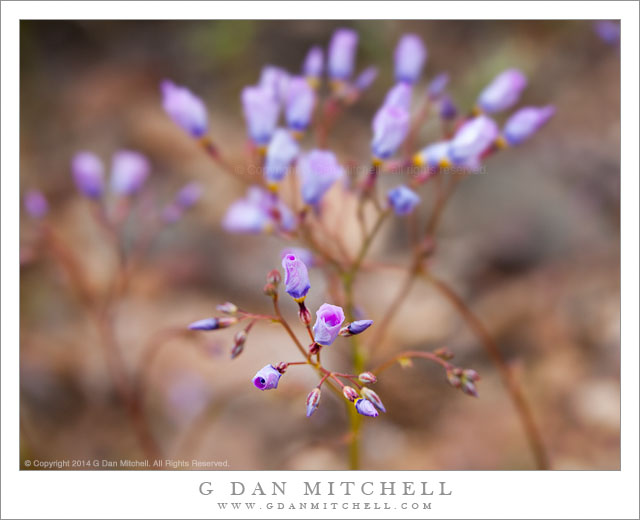
Gilia Buds

Gilia Buds. Death Valley National Park, California. April 2, 2014. © Copyright 2014 G Dan Mitchell – all rights reserved.

Gilia buds opening on a rainy day, Death Valley National Park

This is going to be a sort of hybrid post, covering two subjects and out of phase with my normal daily photograph posts. Think of it as a bonus post—a photograph and an informal report on Death Valley National Park wildflowers. The description of this photograph follows the report on Death Valley wildflower conditions.

Wildflower Conditions

By now it is no longer news that California and other parts of the west are in the throes of a very serious drought. The situation is especially serious in California, which is now experiencing the worst in a series of three below-normal precipitation years. Many parts of the state are experiencing what have been described as historic drought conditions. The situation remains critical—and many of us are worried about the upcoming wildfire season—though recent March and early April rains brought a bit of relief.

All spring I have been hearing that the drought would make this a poor year for desert wildflowers in Death Valley. However, I knew that Death Valley had experienced some rain events in the past few months and that desert plants are quite opportunistic, often quickly blooming in response to moisture. I know Death Valley fairly well, though I’m no expert on wildflowers. However, I had a hunch that we might be surprised by how the wildflower season would play out.

We visited the park for several days right around the beginning of April. Even before we arrived, we saw a decent number of wildflowers as we drove across other desert areas on the way to the park. It seemed like plants were acting in the opportunistic manner I describe above and quickly sprouting up and blooming in response to recent rains. As we entered the park and crossed Towne Pass we (especially my wife, who is passionate about photographing the “small things”) began to notice a lot of wildflowers in many places, including whole beds of colorful flowers in many places along this drive. While we did not see the tremendous blooms on the Valley floor that can occasionally occur, once we got up into higher country we saw flowers everywhere, at least when we slowed down and looked. There was more rain and snow during our visit, and the additional moisture is bound to encourage other plants and flowers to grow.

I just saw a report at the Desert USA website (which names the flowers in ways that I cannot hope to do) confirming what we saw—that there is actually a substantial bloom of desert wildflowers in many places. If you have the opportunity to head out that way soon, do so!

About the Photograph

Believe it or not, it was snowing lightly when I made this photograph! We began our day by driving on gravel roads before sunrise to reach a high location in the Panamint Range from which we planned to photograph at sunrise. The sunrise photography turned out to be a challenge, as it was cloudy at first light and the clouds only increased as the sunrise progressed. Soon we began to notice snow falling on nearby peaks, though it did not fall where we were until after we moved on. Later, in a less exposed location but with temperatures in the low thirties, we encountered our first very light snowfall, and we could see that it was snowing more heavily on the peaks and ridges around us.

We moved on, heading up into Wildrose Canyon. My original plan had been to drive to the end of the road, but by the time we reached the Charcoal Kilns it was snowing hard enough that this no longer seemed like a great idea. In fact, other drivers with two-wheel drive vehicles were having problems ascending the last section of the road to the kilns. We photographed the snowy conditions here and back in Wildrose Canyon, and then as the snow abated a bit we drove on, heading back in the direction of Emigrant Pass. Not far from the pass we found a hillside covered with a spectacular display of flowers. At first it was some cacti that caught our attention, but as we got out and looked around we saw many, many flowers all around. These gilia buds had not yet opened into their more showy display.

G Dan Mitchell is a California photographer and visual opportunist whose subjects include the Pacific coast, redwood forests, central California oak/grasslands, the Sierra Nevada, California deserts, urban landscapes, night photography, and more.
Blog | About | Flickr | Twitter | FacebookGoogle+ | 500px.com | LinkedIn | Email

Text, photographs, and other media are © Copyright G Dan Mitchell (or others when indicated) and are not in the public domain and may not be used on websites, blogs, or in other media without advance permission from G Dan Mitchell.

Sandstorm, Dunes, Desert Mountains

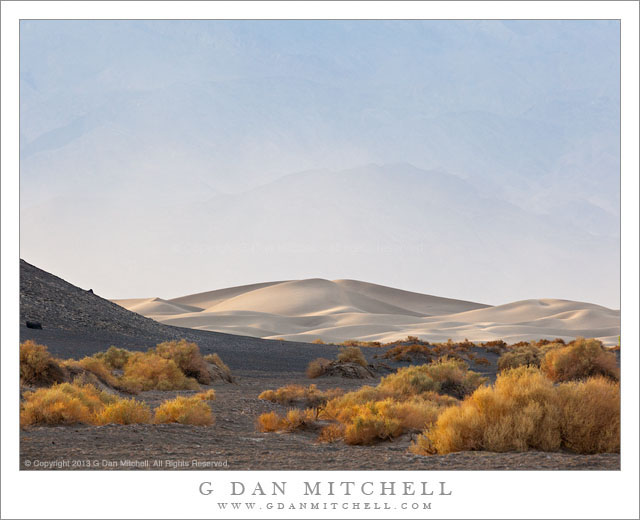
Sandstorm, Dunes, Desert Mountains

Sandstorm, Dunes, Desert Mountains. Death Valley National Park, California. April 4, 2013. © Copyright 2013 G Dan Mitchell – all rights reserved.

Early evening light on sand dunes with clouds of wind-driven dust above and desert mountains beyond, Death Valley National Park

As it got closer to sunset on this sandstorm evening in Death Valley, I stopped at a low, black hill that I like to ascend so that I can shoot in a 360 degree panorama from its summit. The hill itself is interesting, it that it is made up of material that is much different from that of the surrounding desert, a sort of very dark layered rock. The hill itself is almost completely bare of vegetation, but the flats around it support a healthy crop of arrow weed plants, which can glow with a golden color in the right light.

While my original plan was to photograph the further dunes, from here I saw the conjunction of the golden arrow weed plants, the dark curve of the barren black hill, the bright light and shadows on the taller dunes, the clouds of blowing sand beyond the dunes, and in the far distance the lower peaks and ridges of the Cottonwood Mountains. This is an example of an opportunistic photograph, in that I did not plan on this scene beforehand and because the light died within a minute or two of the time I arrived.

G Dan Mitchell is a California photographer and visual opportunist whose subjects include the Pacific coast, redwood forests, central California oak/grasslands, the Sierra Nevada, California deserts, urban landscapes, night photography, and more.
Blog | About | Flickr | Twitter | FacebookGoogle+ | 500px.com | LinkedIn | Email

Text, photographs, and other media are © Copyright G Dan Mitchell (or others when indicated) and are not in the public domain and may not be used on websites, blogs, or in other media without advance permission from G Dan Mitchell.