
Tag Archives: range

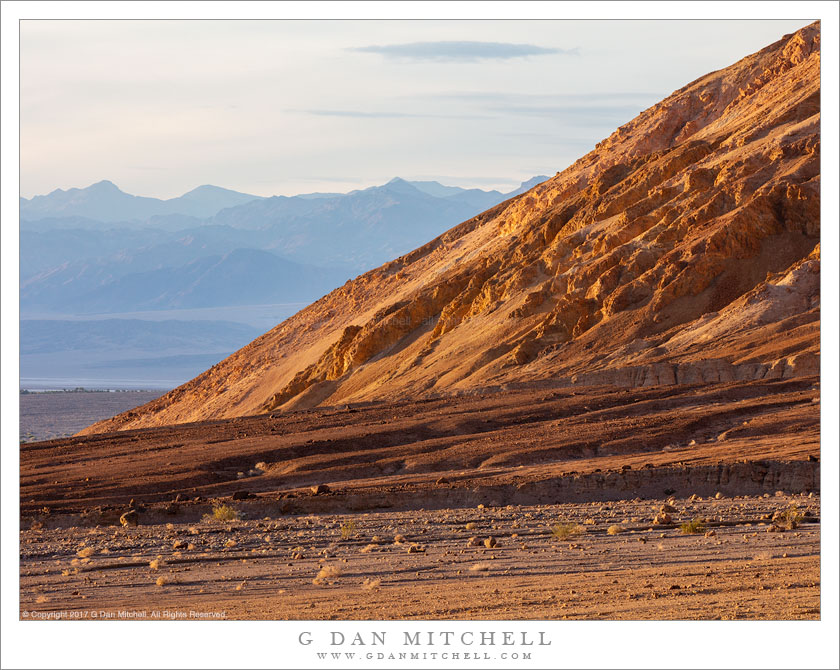
Desert Wash and Mountains, Evening

Desert Wash and Mountains, Evening
Cloudy evening light on Mountains, Death Valley, and a desert wash

Desert Wash and Mountains, Evening. © Copyright 2018 G Dan Mitchell – all rights reserved.

Cloudy evening light on Mountains, Death Valley, and a desert wash

When people ask for advice about how to photograph Death Valley, one thing I tell them is to think a lot about the relationships between the landscape and light throughout the day. Many features align along a generally north-south line, so you can figure out fairly quickly when a location may be in direct sun or produce dramatic shadows. (I also suggest heading into narrow canyons when the sun gets a bit higher in the sky — here the higher sun position may send welcome light into their depths, which can otherwise be a bit murky sometimes.

I made this photograph late in the day after emerging from one of those canyons near the top of a large wash. The wash and the nearby hill face to the west and, as you can see, receive that late afternoon light — at least until the sun dips behind the mountain range on the other side of the valley.


See top of this page for Articles, Sales and Licensing, my Sierra Nevada Fall Color book, Contact Information and more.

G Dan Mitchell is a California photographer and visual opportunist. His book, “California’s Fall Color: A Photographer’s Guide to Autumn in the Sierra” is available from Heyday Books and Amazon.
Blog | About | Flickr | Twitter | Facebook | LinkedIn | Email


All media © Copyright G Dan Mitchell and others as indicated. Any use requires advance permission from G Dan Mitchell.
From Panamints To Death Valley

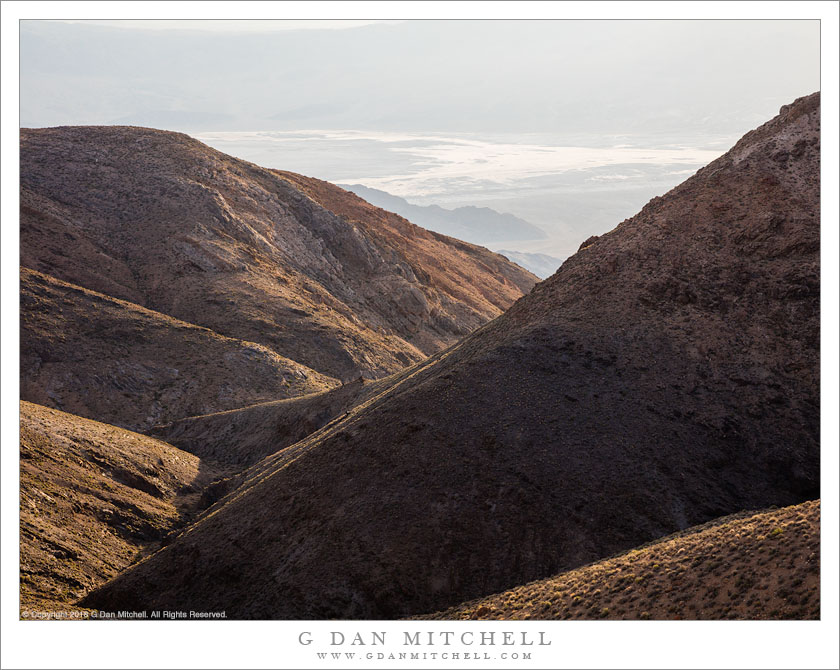
From Panamints To Death Valley
The view down into Death Valley from high along the summit of the Panamint Mountains

From Panamints To Death Valley. © Copyright 2018 G Dan Mitchell – all rights reserved.

The view down into Death Valley from high along the summit of the Panamint Mountains

Death Valley National Park — like virtually all national parks — contains a few features that have become iconic. These are the places everyone goes, and I probably don’t have to name them here. I would not dismiss such places — many of them, as we say, “are icons for a reason.” When I first visited this part two decades ago, I started with a few of those locations and I was thrilled to do so.

But now, after many, many visits to the place, I have pushed out my boundaries more and more. This is a huge and diverse park, with everything from the familiar low desert to high mountain ranges reaching above 11,000′ of elevation. While the better known locations can be a bit crowded, especially during the ideal season (when it isn’t so hot!), it doesn’t take a lot of exploring to find solitude. The location where I made this photograph isn’t the most isolated in the park, but it does afford a different view of the main valley.


See top of this page for Articles, Sales and Licensing, my Sierra Nevada Fall Color book, Contact Information and more.

G Dan Mitchell is a California photographer and visual opportunist. His book, “California’s Fall Color: A Photographer’s Guide to Autumn in the Sierra” is available from Heyday Books and Amazon.
Blog | About | Flickr | Twitter | Facebook | LinkedIn | Email


All media © Copyright G Dan Mitchell and others as indicated. Any use requires advance permission from G Dan Mitchell.
Kit Fox Hills, Amargosa Range

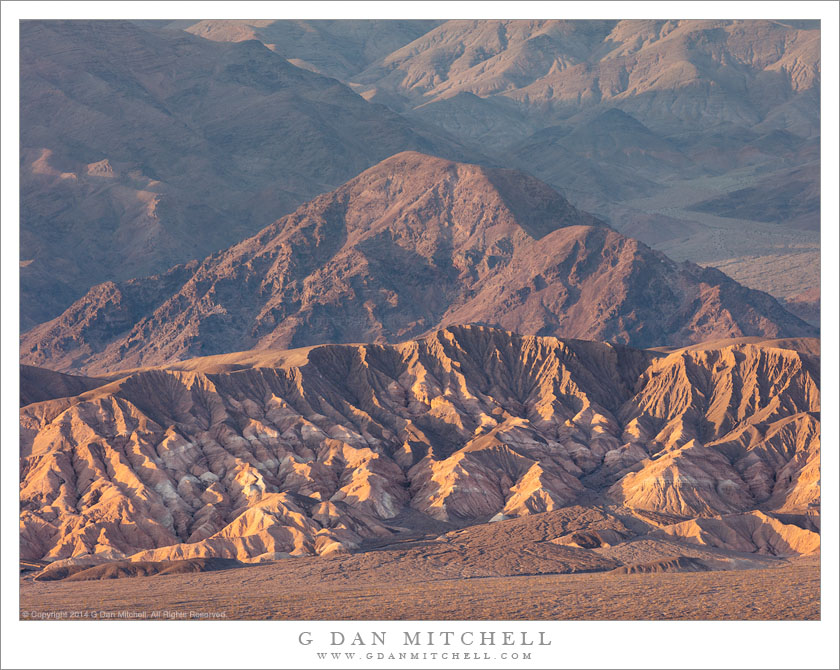
Kit Fox Hills, Amargosa Range
Amargosa Range mountains rise behind the Kit Fox Hills, Death Valley

Kit Fox Hills, Amargosa Range. © Copyright 2018 G Dan Mitchell – all rights reserved.

Amargosa Range mountains rise behind the Kit Fox Hills, Death Valley

These low, deeply eroded, and colorful (in the right light) Death Valley hills lie at the western base of the Amargosa Range near the start of the road heading north toward the Scotty’s Castle area. I recently read that they may be the remnants of an old earthquake fault along the eastern side of Death Valley, marking a division between the rising mountains and the sediment-filled valley. I have walked along the base of these hills, though I still need to find the time to more extensively explore their rugged and eroded landscape.

Late in the day they intercept almost the very last sunlight to reach the valley floor before sunset. With that in mind, I have photographed them many times, often from a good distance away across the valley. That was the case on this evening, when I found a spot elevated above the valley floor and climbed to its summit to watch the late-day light. It was one of those evenings when the light was unpredictable. There were clouds to the west above the Cottonwood mountains, which can turn out to be either a good thing or a bad thing. The clouds may light up at sunset and the minutes just after… or they may simply block the sun and “turn out the lights” on sunset photography. It looked like the latter might turn out to be the case as I watched the sun descend toward a band of thicker clouds. But there was a small gap between the base of the clouds and the top of the mountains, and the sunlight shone through this gap for a few minutes, casting beautiful soft light on these hills.


G Dan Mitchell is a California photographer and visual opportunist. His book, “California’s Fall Color: A Photographer’s Guide to Autumn in the Sierra” is available from Heyday Books and Amazon.
Blog | About | Flickr | Twitter | FacebookGoogle+ | LinkedIn | Email


All media © Copyright G Dan Mitchell and others as indicated. Any use requires advance permission from G Dan Mitchell.
Death Valley, Mountains, Morning

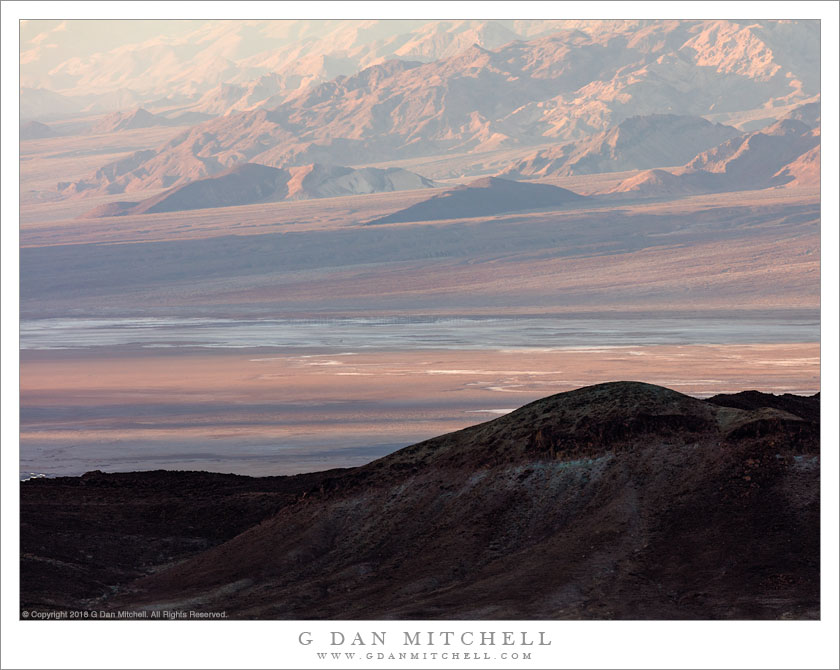
Death Valley, Mountains, Morning
Morning light on Death Valley and the base of the Panamint Mountain Range

Death Valley, Mountains, Morning. © Copyright 2018 G Dan Mitchell – all rights reserved.

Morning light on Death Valley and the base of the Panamint Mountain Range

A few recent photographs here have focused on the intimate landscapes of Death Vally canyons. This one leaves the canyon and moves out into the open, looking from the eastern mountains across valley to the base of the Panamint range on the other side. We had driven up in to these mountains in the morning after first photographing dawn from the valley. Here we could watch the morning light traverse the valley — in the photograph it still had not made it to the low hills below our position.

At about the time of my first visits to Death Valley I had also made my first trips to Alaska. It may seem odd, given their different climates, but it struck me that the two places have a lot in common. Most of all, in both places I experiences huge spaces and immense quiet and stillness in ways that I had not really known before. (I rarely experience this in the Sierra, even above timberline, since the distances are smaller and somewhere in the landscape there will be a tree.) In Death Vally, it is hard to make sense of the scale of the landscape. The combination of huge distances, tremendously large features, and a dearth of objects of known size conspire to confuse us. Look across flats to a barren mountain and its valleys, it might seem that you could just walk there. You could, perhaps, but it might take many days.


G Dan Mitchell is a California photographer and visual opportunist. His book, “California’s Fall Color: A Photographer’s Guide to Autumn in the Sierra” is available from Heyday Books and Amazon.
Blog | About | Flickr | Twitter | FacebookGoogle+ | LinkedIn | Email


All media © Copyright G Dan Mitchell and others as indicated. Any use requires advance permission from G Dan Mitchell.