
Tag Archives: wash

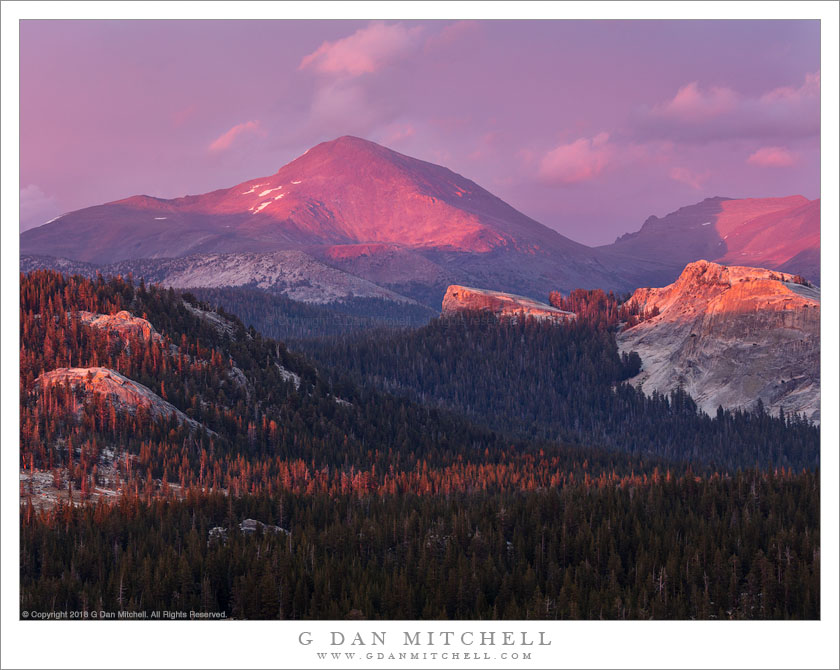
Sunset Storm Light

Sunset Storm Light
Clearing storm clouds at a final wash of sunset color above the Sierra crest near Tuolumne Meadows

Sunset Storm Light. © Copyright 2018 G Dan Mitchell – all rights reserved.

Clearing storm clouds at a final wash of sunset color above the Sierra crest near Tuolumne Meadows

This is another photograph from my mid-July evening of miracle light — or, more accurately, my five minutes of miracle light! As I wrote earlier, I had ascended this high point in the Tuolumne Meadows area on an evening when the light was about as “blah” as it gets. There were weak thunderstorms floating around over the crest, but they were more gray and flat that electrical and exciting. And the cloud shield extended a good distance to the west, which meant that no western light was making its way in to live up the scene. But there I was, on top of a high and spectacular place with a remarkable panoramic view, so I was starting to settle in to simply enjoy the experience and perhaps not make photographs.

But… sometimes boring conditions can actual be precursors to sudden changes and even very special conditions. On overcast mountain evenings (and mornings) there may be a distant break in the clouds near the horizon, and if the setting (rising) sun passes through that space at the right moment a sudden beam of colorful light may illuminate the landscape with golden hour or pinkish light. I felt that the odds weren’t with me on this evening, but I hadn’t written off the possibility entirely either, and I kept my gear at hand just in case. Perhaps five minutes before sunset the first pink light appeared to the north on distant clouds and then began to faintly glow on the closer domes. Within in seconds the scene went from gray and flat light to this marvel of warm reddish tones. I photographed rapidly for perhaps five minutes or less… and then it was gone.


See top of this page for Articles, Sales and Licensing, my Sierra Nevada Fall Color book, Contact Information and more.

G Dan Mitchell is a California photographer and visual opportunist. His book, “California’s Fall Color: A Photographer’s Guide to Autumn in the Sierra” is available from Heyday Books and Amazon.
Blog | About | Flickr | Twitter | Facebook | LinkedIn | Email


All media © Copyright G Dan Mitchell and others as indicated. Any use requires advance permission from G Dan Mitchell.

Kit Fox Hills, Amargosa Range

Kit Fox Hills, Amargosa Range
Amargosa Range mountains rise behind the Kit Fox Hills, Death Valley

Kit Fox Hills, Amargosa Range. © Copyright 2018 G Dan Mitchell – all rights reserved.

Amargosa Range mountains rise behind the Kit Fox Hills, Death Valley

These low, deeply eroded, and colorful (in the right light) Death Valley hills lie at the western base of the Amargosa Range near the start of the road heading north toward the Scotty’s Castle area. I recently read that they may be the remnants of an old earthquake fault along the eastern side of Death Valley, marking a division between the rising mountains and the sediment-filled valley. I have walked along the base of these hills, though I still need to find the time to more extensively explore their rugged and eroded landscape.

Late in the day they intercept almost the very last sunlight to reach the valley floor before sunset. With that in mind, I have photographed them many times, often from a good distance away across the valley. That was the case on this evening, when I found a spot elevated above the valley floor and climbed to its summit to watch the late-day light. It was one of those evenings when the light was unpredictable. There were clouds to the west above the Cottonwood mountains, which can turn out to be either a good thing or a bad thing. The clouds may light up at sunset and the minutes just after… or they may simply block the sun and “turn out the lights” on sunset photography. It looked like the latter might turn out to be the case as I watched the sun descend toward a band of thicker clouds. But there was a small gap between the base of the clouds and the top of the mountains, and the sunlight shone through this gap for a few minutes, casting beautiful soft light on these hills.


G Dan Mitchell is a California photographer and visual opportunist. His book, “California’s Fall Color: A Photographer’s Guide to Autumn in the Sierra” is available from Heyday Books and Amazon.
Blog | About | Flickr | Twitter | FacebookGoogle+ | LinkedIn | Email


All media © Copyright G Dan Mitchell and others as indicated. Any use requires advance permission from G Dan Mitchell.

Winding Desert Canyon

Winding Desert Canyon
A desert canyon winds into the Black Mountains of Death Valley

Winding Desert Canyon. © Copyright 2018 G Dan Mitchell – all rights reserved.

A desert canyon winds into the Black Mountains of Death Valley

These desert canyons come in a variety of forms. In many ways, the slot canyons are the most appealing, with their tall, often vertical walls, serpentine paths, and sometimes very narrow dimensions. But the constitute the minority of the canyon types. Others may be quite wide and shallow, almost having the character of wide washes instead of canyons. These are often found lower in the mountains, and are easy to spot from a distance where the canyons spill out onto (sometimes vast) fans of gravel. Another type feels like a canyon, but has a more open character, with hills rather than walls along the sides, and often with a wide path up the center.

This canyon has the latter character, at least at this point. (Elsewhere in the same drainage it has more of the character of a slot canyon.) While there are low walls along its edges, one wouldn’t be too hard pressed to pass over them, and above these walls the sides of the canyon slope away at relatively low angles that allow sunlight to penetrate to the bottom. Recently it finally occurred to me that one of the things that makes such canyons so enjoyable to walk is that there is no single path to follow. Where the canyon is wide enough, the feeling is midway between following a trail and walking in trail-less country. You do follow the course of the canyon, but you can pick your way through it in any way that seems to make sense.


G Dan Mitchell is a California photographer and visual opportunist. His book, “California’s Fall Color: A Photographer’s Guide to Autumn in the Sierra” is available from Heyday Books and Amazon.
Blog | About | Flickr | Twitter | FacebookGoogle+ | LinkedIn | Email


All media © Copyright G Dan Mitchell and others as indicated. Any use requires advance permission from G Dan Mitchell.

Toward the Valley

Toward the Valley
Reflected light in a twisting desert canyon as it approaches Death Valley

Toward the Valley. © Copyright 2018 G Dan Mitchell – all rights reserved.

Reflected light in a twisting desert canyon as it approaches Death Valley

To walk into a canyon like this one from a huge valley such as Death Valley is to walk from an overwhelming, immense space into a smaller, more intimate place. In the canyons distances are often measured in feet rather than miles, and long distance views are most often cut off entirely. This is especially true when entering such canyons where the route often begins in a wide wash above the Valley, then constrict through the mouth of the canyon, and soon begins to wind back and forth in a serpentine manner between hills or cliffs.

The trip back out often seems to have a different feeling. It usually takes less time, partly due to the downhill slope and even more because one is now retracing familiar terrain rather than discovering it for the first time. In many cases, the closer one gets to the outlet of the canyon the more that signs of the valley below appear. The canyon walls become shorter, and views over the nearer walls being to reveal blue sky and distant mountains instead of more canyon walls. Before long the light changes and the route leaves the canyon confines and is again back in the huge, open space.


G Dan Mitchell is a California photographer and visual opportunist. His book, “California’s Fall Color: A Photographer’s Guide to Autumn in the Sierra” is available from Heyday Books and Amazon.
Blog | About | Flickr | Twitter | FacebookGoogle+ | LinkedIn | Email


All media © Copyright G Dan Mitchell and others as indicated. Any use requires advance permission from G Dan Mitchell.