
Tag Archives: wildlife

Two White-Faced Ibises

Two White-Faced Ibises
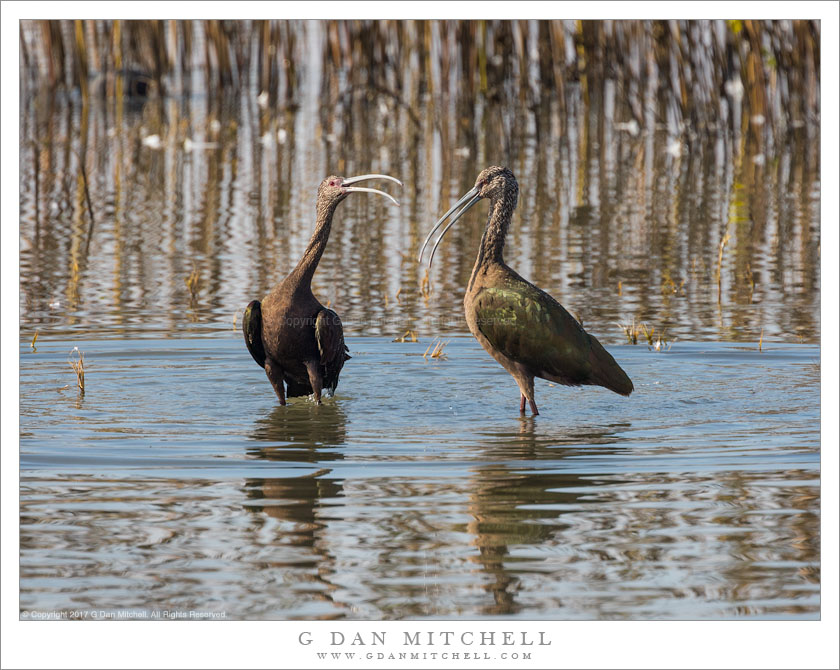
Two white-faced ibises interacting in a San Joaquin Valley wetland pond

Two White-Faced Ibises. © Copyright 2017 G Dan Mitchell – all rights reserved.

Two white-faced ibises interacting in a San Joaquin Valley wetland pond

The white-faced ibises have intrigued me since before I knew what they were — in fact, I suppose I could say that I photographed them before I realized that they existed. Some years back, on my very first more or less accidental exposure to bird photography, I found myself “out there” on an early morning, with no more clue about what was going on than “someone told me I should go here and see the birds.”(That someone was a colleague where I taught.) I barely knew a goose from a swan, at least when they were flying quickly overhead, but I was amazed by the number and variety of birds that morning. I photographed like a madman, not really knowing at all what I was photographing. Later on, back home and looking at files, I recall finding a series of photographs of a line of birds overhead that had oddly long and curving beaks. I wondered what they were. It turns out they were ibises.

Ibises are not always the most common specimens. In addition to their unusual beaks, they have another particular visual characteristic. In many situations you would regard them as dark and fairly drab-looking birds. Photographing them in flight is often difficult, partly because they frequently just end up looking black against any lighter background. But catch them in the right light and the texture, patterns, and colors of their feathers begin to appear. On this morning I happened upon a group of ibises, perhaps a couple dozen, in shallow water. I stopped and watched quietly and was able to photograph a variety of behaviors, including this interaction between two of the birds.


G Dan Mitchell is a California photographer and visual opportunist. His book, “California’s Fall Color: A Photographer’s Guide to Autumn in the Sierra” is available from Heyday Books and Amazon.
Blog | About | Flickr | Twitter | FacebookGoogle+ | LinkedIn | Email


All media © Copyright G Dan Mitchell and others as indicated. Any use requires advance permission from G Dan Mitchell.
Two Black-Necked Stilts

Two Black-Necked Stilts
A pair of wading black-necked stilts and their reflections

Two Black-Necked Stilts. © Copyright 2017 G Dan Mitchell – all rights reserved.

A pair of wading black-necked stilts and their reflections

For decades I did not think of myself as a “bird person,” much less a “birder.” I’m still no birder — I’m not great at identifying the critters and I don’t necessarily seek out new sightings as much as photographic opportunities. However, my fascination with them has increased as I have spent more time photographing them. The first time I intentionally went out to photograph birds, I had basically no idea what I was seeing — it was just, “Wow! Lots of birds!” And that was exciting. This led to a focus on photographing migratory birds, and ,ore recently I’ve become more aware of some of the smaller birds, too.

One of the first to these “smaller birds” was the black-necked stilt. At first I only noticed them tangentially while looking for other things. On a few occasions when those “other things” were nowhere to be found, I turned my camera toward the stilts. They are attractive, though sometimes gangly, birds, with their stark contrast of black and white feathers. They often permit a relatively close approach, and they frequently work their way slowly around a small area, making it easier to photograph them. But getting somewhat unusual photographs of them requires patience and some luck. They do fly, but when they do it is often sudden and very quick… and not at all easy to keep them in the viewfinder. And while one feeding stilt is interesting, that is a pretty common sight. It is more challenging to try to photographs groups of them in ways that are visually linked and interesting. This pair obliged for a moment to two, coming close together and moving in parallel before separating and going their separate ways.


G Dan Mitchell is a California photographer and visual opportunist. His book, “California’s Fall Color: A Photographer’s Guide to Autumn in the Sierra” is available from Heyday Books and Amazon.
Blog | About | Flickr | Twitter | FacebookGoogle+ | LinkedIn | Email


All media © Copyright G Dan Mitchell and others as indicated. Any use requires advance permission from G Dan Mitchell.
Two Geese Landing

Two Geese Landing
Two geese descend to land in a wetland pond

Two Geese Landing. © Copyright 2017 G Dan Mitchell – all rights reserved.

Two geese descend to land in a wetland pond

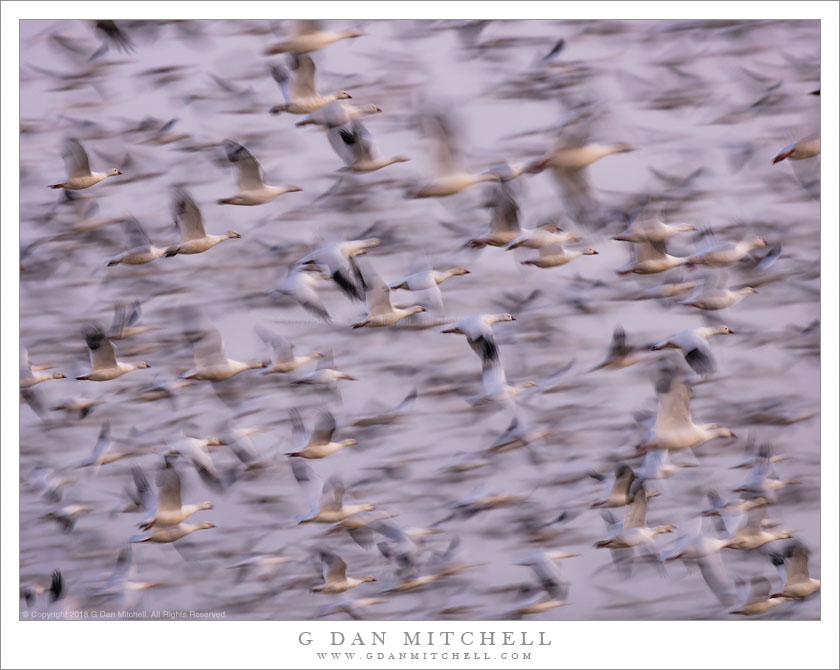
Since we’re well into my “bird season,” focused on migratory and other birds, I’ll stick with that theme a bit longer. I photographed this pair of geese (I’m pretty sure they are Ross’s geese) back at the beginning of December. Near the end of the day I moved to where the light would come in from the right, highlighting light and shadow and the textures of the birds features. Not too long before sunset, geese began to arrive and land in the pond, and I was able to photograph their descent.

I often marvel at the contortions of these birds during the final instants of their flights. In the air they are often graceful, but the landings vacillate between that grace and nearly-out-of-control clumsiness as they transform from creatures of the to earthbound animals. They glide in, instinctively facing into the breeze, and can sometimes then seem to almost drop right out of the sky. Wings go upwards, feet extend down, and necks stretch forward, and quickly they are on the ground.


G Dan Mitchell is a California photographer and visual opportunist. His book, “California’s Fall Color: A Photographer’s Guide to Autumn in the Sierra” is available from Heyday Books and Amazon.
Blog | About | Flickr | Twitter | FacebookGoogle+ | LinkedIn | Email


All media © Copyright G Dan Mitchell and others as indicated. Any use requires advance permission from G Dan Mitchell.
Egret, Blue Hour Fog

Egret, Blue Hour Fog
An egret hunting in blue hour fog

Egret, Blue Hour Fog. © Copyright 2018 G Dan Mitchell – all rights reserved.

An egret hunting in blue hour fog

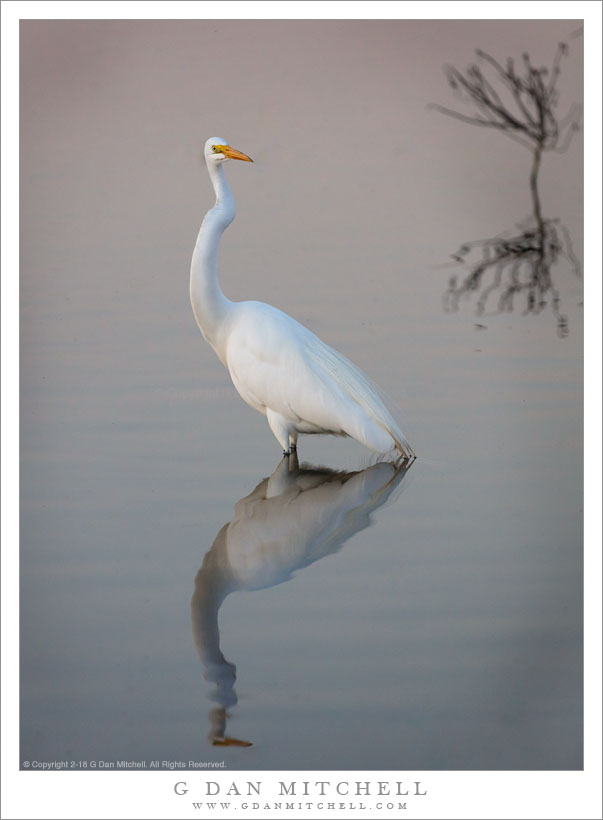
For those who don’t know the term, “blue hour” is that twilight period when the light tends to become soft and blue, most likely because the primary illumination is from the blue sky itself, with no assistance from direct sunlight. You might not notice the depth of the blue color of the light if you don’t think about it carefully or look at a photograph. Our eyes adjust to the color and see things as being “normal,” but the camera records (more or less) “what is.” Most often when people refer to blue hour they are referencing that period of early twilight — just after the red sunset tones have faded, but before it becomes extremely dark. Of course, there are two “blue hours” every day – one before sunrise and one after sunset.

I usually start my bird photography before it becomes light, and I frequently have to wait a bit before starting to photograph. On this morning it was exceptionally murky — not only was it still dark, but the tule fog was very thick. Eventually I looked for subjects that I could photograph in this challenging light. You are never far away from an egret in places like this, and it wasn’t long before I came upon one that was hunting in the nearby vegetation. In many cases I might try to compensate for the blue tones and the darkness, but here I instead decided to “go with the blue” and produce a photograph that feels more like such mornings actually feel.


G Dan Mitchell is a California photographer and visual opportunist. His book, “California’s Fall Color: A Photographer’s Guide to Autumn in the Sierra” is available from Heyday Books and Amazon.
Blog | About | Flickr | Twitter | FacebookGoogle+ | LinkedIn | Email


All media © Copyright G Dan Mitchell and others as indicated. Any use requires advance permission from G Dan Mitchell.