
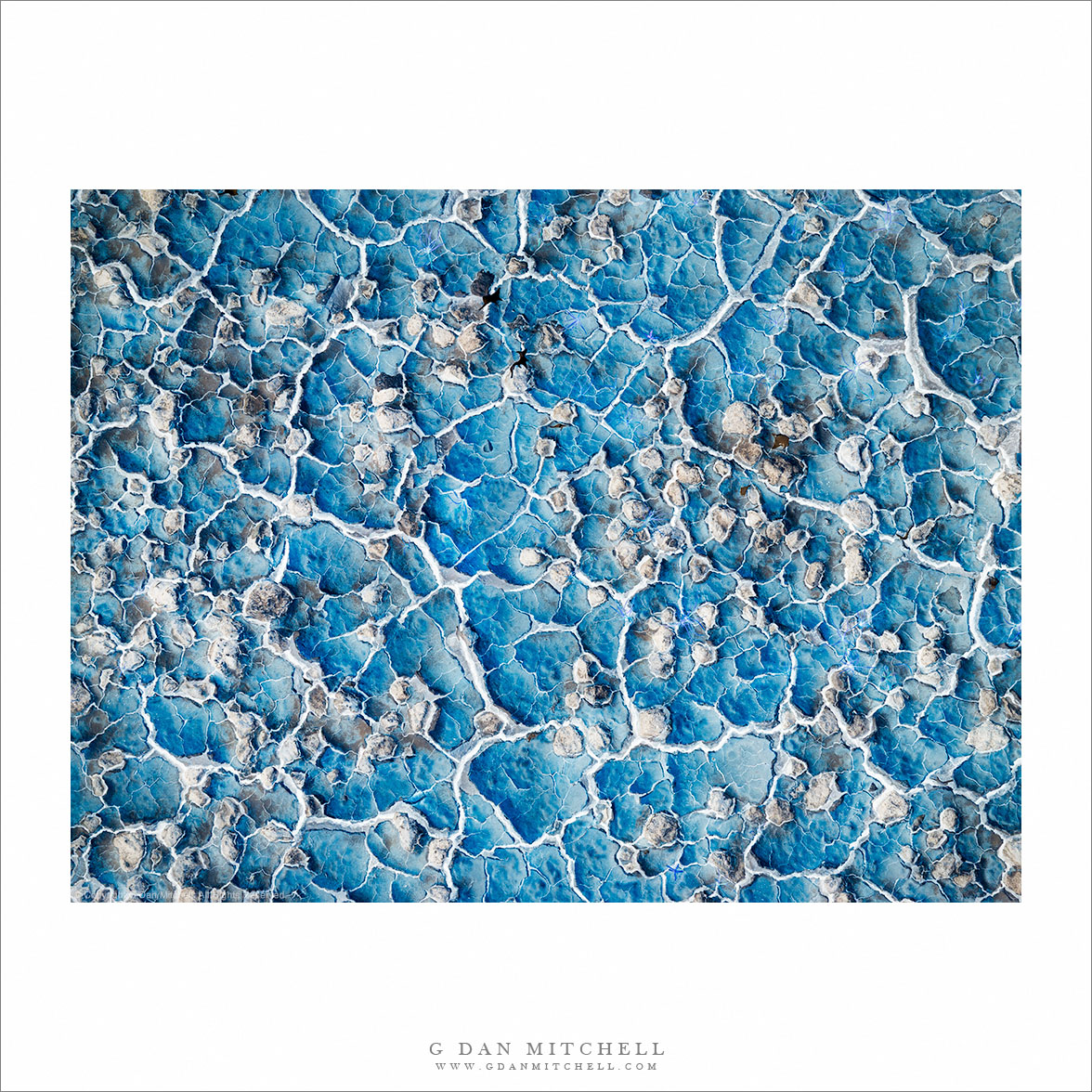
I have photographed in Death Valley National Park for almost three decades. I have heard whispered rumors of this remarkable “Blue Playa” for years, but no one would share anything definite about it. All I knew was that somewhere in a remote and seldom-visited area of this vast park there was purportedly a small playa featuring astonishingly colorful soil which, in the right lighting conditions, is so blue that it rivals the color of a clear sky. This has been on my mind for years.
Since those who know weren’t talking, it was clear that I’d have to do some sleuthing. All I knew was that the place is remote, surrounded by difficult mountains, and not terribly large. Out of respect for the feature — and concern about potential damage should the location become widely known — I’m going to omit specific details. But here’s as much of the story as I can share publicly.
Death Valley is a big park, and a lot of it is remote and isolated. But the majority of the park could be ruled out as a possible location. Playas are flat areas that flood and are with silt that then dries out. There are plenty of playas in the park, but they comprise a small percentage of its total area. In this case, I knew that it had to be both small and isolated, since otherwise it would be widely known and visited.
The satellite image version of Google Maps is a valuable tool when searching for obscure features in remote places. After untold hours poring over this resource, I found a pretty good prospect — a very small playa in a very remote place in the mountains… where I thought I saw a blue tint in the photographs.
Getting there would be extremely difficult. Looking more closely at maps, it seemed that I might get there via a remote 4WD route, then hike cross-country up an unnamed side canyon into a mountain basin, from which I could cross a rocky ridge and descend to the likely spot. (I’m being vague about the details since I am concerned that too many visitors could wreck the place.)
I was in the park twice this past winter. My first attempt to get to the location was unsuccessful — a big winter storm swept in, flooding washes, including one that I would need to hike, and making back-roads impassable. I returned a couple of months later, and this time the weather cooperated. The initial drive was long and extremely rough — and took me away from more popular back-country routes and onto an old and disused single-track. I parked where it ended, loaded my pack and started walking.
The wash leading into the side canyon was easy enough at first, but eventually it grew narrower and the walls grew higher, and before long the going became quite challenging. I found a breach in the canyon wall and clambered up to a plateau. From there I saw a route to the top of the rocky ridge. An hour later, from the ridge I saw a small open area where the playa should be, and after another hour and a half of descending I came to its edge.
Indeed, there was the playa, and a hundred yards away, at its narrow end, I saw the blue tint in the soil. I headed over excitedly and what I found was literally unbelievable — the most amazingly intense coloration I’ve seen anywhere in the park. Between the chunks of blue material, the cracks revealed a layer of stark white material beneath. I set up my camera and made a few photographs, being careful to leave out any hint of the surroundings in the photos, since I want to keep the location anonymous.
And, no, I won’t share any more information about the location, so don’t ask. If you think you want to look for such a thing, you are on your own. And if you ever find it, please don’t reveal the location!
COMMENT OR QUESTION? Scroll down to the comment form.
G Dan Mitchell is a California photographer and visual opportunist. His book, “California’s Fall Color: A Photographer’s Guide to Autumn in the Sierra” (Heyday Books) is available directly from him. Blog | Bluesky | Mastodon | Substack Notes | Flickr | Email
All media © Copyright G Dan Mitchell and others.