
All posts by G Dan Mitchell

G Dan Mitchell, photographer and visual opportunist focusing on the Pacific coast, the Sierra Nevada, redwood forests, California oak/grasslands, California deserts, urban landscapes, night photography and more. Posting daily photographs since 2005, along with articles, reviews, news, and ideas.

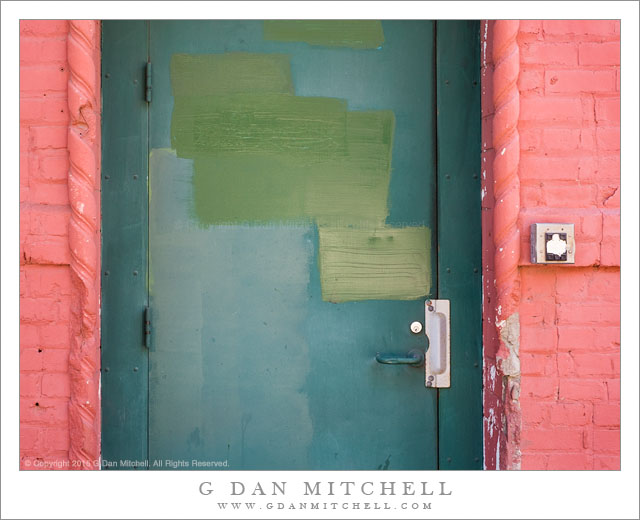
Green Door, Brick Wall

Green Door, Brick Wall
Repainted and patched green door in the brick wall of an old San Francisco building

Green Door, Brick Wall. San Francisco, California. August 14, 2015. © Copyright 2015 G Dan Mitchell – all rights reserved.

Repainted and patched green door in the brick wall of an old San Francisco building

On this mid-August morning I got up early, took the bus to the train and the train to San Francisco, then walked right up into the downtown core of the City. The walk began with among train commuters heading up toward Market Street, past construction zones, freeway interchanges, and lots of traffic. Once at Market Street I turned toward the Bay and walked slowly, stopping frequently to watch and photograph. At the end of Market I turned south and began my walk back to the train station along the Embarcadero.

Eventually I decided to leave the Embarcadero and follow smaller streets to cross back to the Caltrain station. Like so many parts of San Francisco today, this is an area in transition. There are still some gritty old buildings, but things are rapidly evolving in a much more upscale and expensive direction — and for now the gritty and the modern live side by side. But not for long. Given the price of real estate in this area, funky old buildings like the one with this doorway do not have much of a future. I imagine that almost all of them will be knocked down for more condos and townhouses, and those that remain will be cleaned up and gentrified in ways that retain only the stylish chic quality. Two things (at least) caught my attention about this doorway, at least sufficiently to make me stop for a minute and make a few exposures. First is the stark contrast between the pinkish color of the painted bricks and greens of the doorway. Second is the sum effect of paint over graffiti and then painting it over again, which often produces interesting cubist patterns on San Francisco architecture in places like this.


G Dan Mitchell is a California photographer and visual opportunist. His book, “California’s Fall Color: A Photographer’s Guide to Autumn in the Sierra” is available from Heyday Books and Amazon.
Blog | About | Flickr | Twitter | Facebook | Google+ | 500px.com | LinkedIn | Email


All media © Copyright G Dan Mitchell and others as indicated. Any use requires advance permission from G Dan Mitchell.
Sharpening Basics: A Primer

(Minor updates to this article were made in February 2019.)

Sharpening is a very important step for optimizing digital photograph files. If you let your camera save images in the common .jpg format (a compressed image format that is often used on the web) the camera is applying sharpening to the image produced by the camera sensor. If you use the raw format (a high quality format that retains the original sensor data of the exposure) you will find that the photograph looks soft until you apply sharpening during the post production phase.

Sharpening optimizes the visibility of details that are already in your photograph. It is a matter of more clearly revealing what is in the photograph than  a matter of creating detail where there was none. Most sharpening works by increasing the contrast between light and dark areas in the image — what we call sharpening as actually more about adjusting the relative brightness of adjacent portions of the photograph.

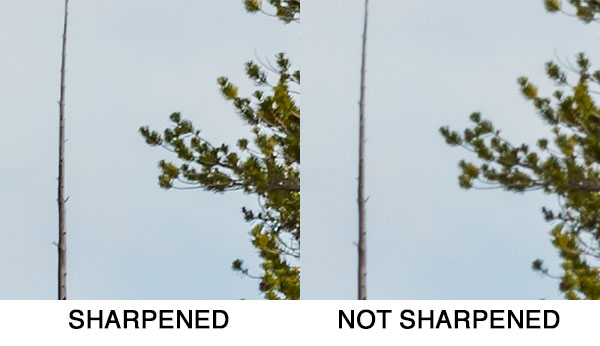
Typical sharpening

The image above is an example of a small section of a photograph.[1] It is a “100% magnification crop” of a tiny area from a much larger photograph made with a high megapixel DSLR camera. A “100% magnification crop” is an image displayed so that each pixel — or individual picture element — of the original photograph is displayed using a single pixel on the screen. (Things are a bit more complicated than that when using modern high-resolution monitors, though I’ll let that description stand for now.) 100% magnification crops let us look very closely at what is going on in photographas “at the pixel level.” In this case, the full original image from which these small examples were extracted would be equivalent to prints at a width of roughly 10-12 feet.

The right side of the example shows this tiny section of the photograph before sharpening. The left side shows the results of fairly typical sharpening. Continue reading Sharpening Basics: A Primer →

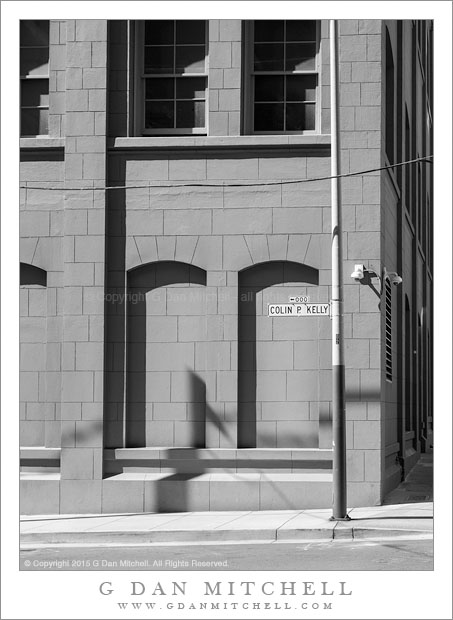
Colin P. Kelley

Colin P. Kelley
Stark light on an old building on Colin P. Kelly Street, San Francisco

Colin P. Kelley. San Francisco, California. August 14, 2015. © Copyright 2015 G Dan Mitchell – all rights reserved.

Stark light on an old building on Colin P. Kelly Street, San Francisco

Most often when I go out to make photographs I do not have extremely specific ideas about my subject or even about how I will photograph the subjects I encounter. Usually, and especially with street photography, it is more a matter of tuning in to my surroundings and essentially hunting, conspiring to be in places where I think I might find interesting things, paying attention, and being ready to take advantage of whatever opportunities arise. On the other hand, I often do have some general ideas about the sorts of things that might interest me, and on my way to this morning on San Francisco streets I had specifically thought about a sort of image that might be black and white and which might use rather stark light a bit later in the morning — so when I saw this building on a corner near the train station I didn’t hesitate to photograph it.

What about the name of this photograph? It was simply a practical matter. I usually do not like to name photographs in ways that tell the viewer how to think of the photograph — most often I feel that if the photograph has anything to say to the viewer, the viewer should be allowed to figure that out from the visual content. (Yes, there are some exceptions.) So in this case the choice to use the words on the street sign near the right side of the frame was simply a practical decision… especially since I forgot to look for any other name on the building! However, I did wonder who Colin P. Kelley is/was. Most likely the street is named after a man known for being “one of the first American heroes of the war [who sacrificed] his own life to save his crew” in World War II. (There are lots of interesting little San Francisco streets with unusual and surprising naming histories like this.)


G Dan Mitchell is a California photographer and visual opportunist. His book, “California’s Fall Color: A Photographer’s Guide to Autumn in the Sierra” is available from Heyday Books and Amazon.
Blog | About | Flickr | Twitter | Facebook | Google+ | 500px.com | LinkedIn | Email


All media © Copyright G Dan Mitchell and others as indicated. Any use requires advance permission from G Dan Mitchell.
Forest Edge, Mountain Slopes, Evening

Forest Edge, Mountain Slopes, Evening
Forest edge in evening light with forest sloping upwards toward Sierra crest peaks

Forest Edge, Mountain Slopes, Evening. Yosemite National Park, California. July 13, 2015. © Copyright 2015 G Dan Mitchell – all rights reserved.

Forest edge in evening light with forest sloping upwards toward Sierra crest peaks

This is most certainly not an iconic view, but I’m sure that many fellow Yosemite high country aficionados have been to this spot and gazed at this and the surrounding view. (Part of one Yosemite high country icon does appear in this photograph, but it is the bottom part.)

Earlier on this visit to the park I had walked out into this landscape to photograph in the meadow, on low hills, among trees, and alongside a river. As I passed by here again on this early evening I stopped and was entranced by the warm evening light on the trees at the edge of the meadow and by the further forest-covered slopes rising into the alpine zone and eventually above tree line to the elevations where there is little but rock and tundra plants. While the landscape often seems rather static during the day, at moments like this near the beginning and ending of the day the landscape changes dynamically as light shifts and highlights and then shadows subjects.  I had only a brief moment to make this photograph (and a couple of others) before the light lifted from the trees and left them in shadow.


G Dan Mitchell is a California photographer and visual opportunist. His book, “California’s Fall Color: A Photographer’s Guide to Autumn in the Sierra” is available from Heyday Books and Amazon.
Blog | About | Flickr | Twitter | Facebook | Google+ | 500px.com | LinkedIn | Email


All media © Copyright G Dan Mitchell and others as indicated. Any use requires advance permission from G Dan Mitchell.