OK, “torture test” might be overstating things just a bit, but I’ve been meaning to check out a few things related to the capabilities of the autofocus system of my new Canon EOS 5DS R. A few years ago birds, especially winter migratory birds, became one of my photographic passions. While this camera is not really optimized for this sort of photography, I plan to use it for this purpose, as I did my 5DII.
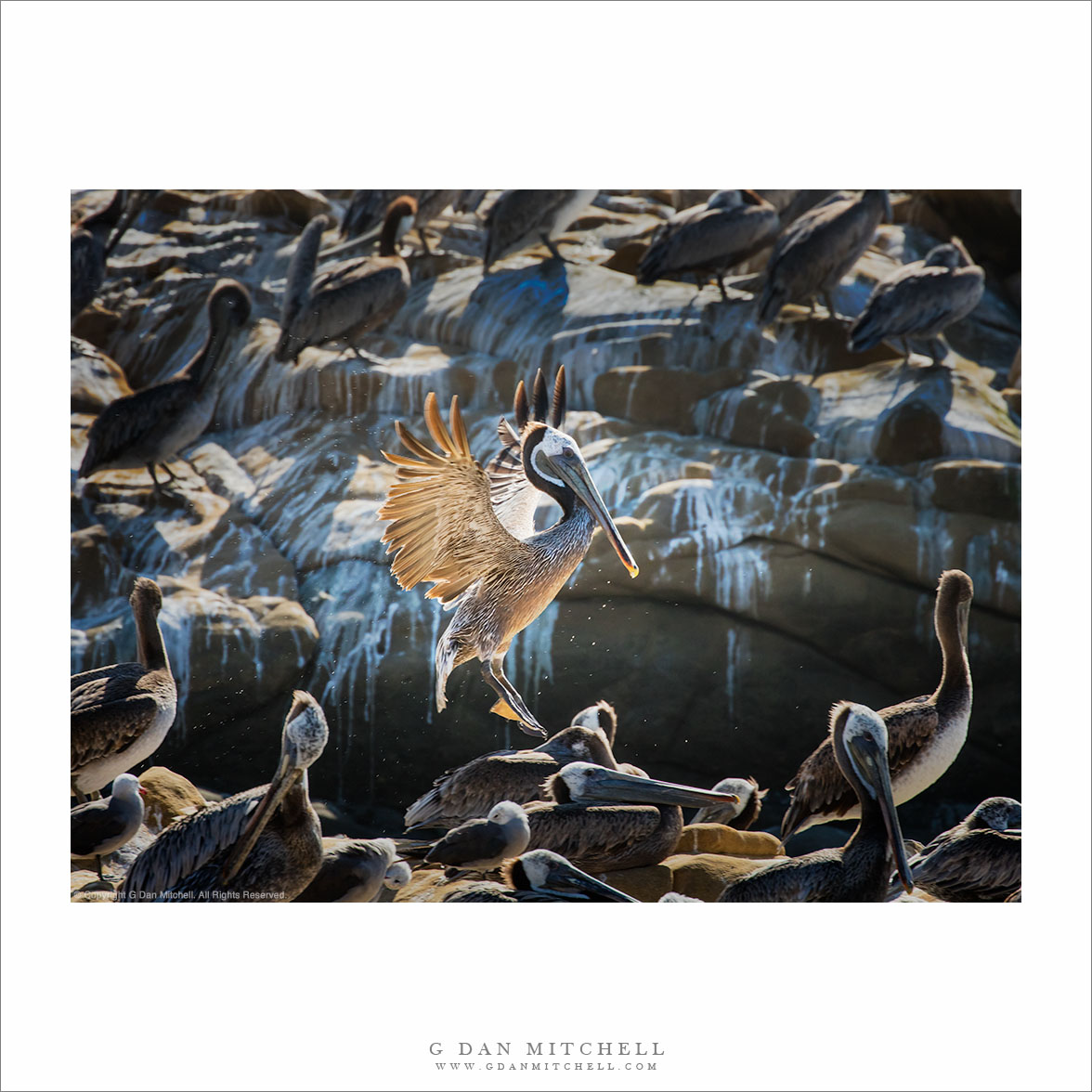
“The Landing” — A brown pelican joins the flock on a rock along the Pacific coast of California
Most often when I photograph birds I use the Canon EF 100-400mm f/4.5-5.6L IS II lens. It usually provides enough reach for my purposes, it focuses accurately and quite quickly, it is sharp, and its flexibility fits my style of photography. (I often pause while photographing the birds and use the lens to photograph landscapes.) It was my understanding that the 5Ds R added the capability to autofocus (AF) at smaller apertures down to f/8. This means that I should be able to add my Canon Extender EF 1.4x III tele-extender to get 560mm at f/8 from this lens.
A few days ago I was doing landscape/seascape photography along the Central California coast between lower Big Sur and San Francisco. On the final afternoon as we drove north we passed a small island where scores of brown pelicans had landed.
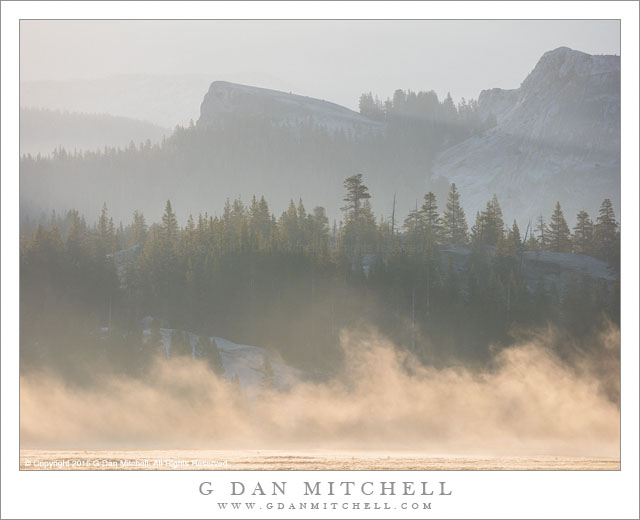
Morning fog rises from Tuolumne Meadows toward surrounding forest and ridges
I was up quite early on this morning, and with a plan to drive a bit to photograph a particular subject as it was struck by the first dawn light. In the dark I got dressed, crawled out of my tent, got in my vehicle, and quietly left the campground. Within a few hundred yards of the campground exit my plans changed. A low fog lay across almost the entirety of Tuolumne Meadows, shallow in places and deeper in others, partially obscuring trees and domes. In the pre-dawn light the quiet scene was one of very low contrast and not altogether interesting color, but I suspected that once the sun begin to come over the Sierra crest that it might strike the fog and create some interesting effects. So, out the window with the original plan, and now to see what I could make of my new plan.
I headed to the far end of the meadow where I figured that several potentially interesting things would happen. First, the fog was likely to be back-lit once the sun hit it. Second, I could shoot back across large sections of the fog-blanketed meadow and do so from a slight elevation. Third, I knew that I could position myself so that interesting ridges and trees might appear in the frame. In fact, it all worked out! As the sun rose high enough to illuminate the drifting fog, it began to rise and form more distinct patterns against the background of ascending ridges. I’m often somewhat surprised to find myself completely alone at this utterly beautiful times of day, when the sun is just coming up or when its last light is leaving the meadows. Tuolumne is an impressive place at any time, but it is often special in all sorts of ways during these beginning and ending of the day times. Yet most people, folks who I assume come here at least partially to seek out mountain beauty, miss out as they sleep in, linger over morning coffee, or head back to campfires before the day is over.
It is no secret that I’m pretty serious about my landscape photography. I spend a lot of time going to interesting places, searching out subjects, and making photographs. In fact, this activity is undoubtedly the single biggest influence on the nature of my outdoor experiences.
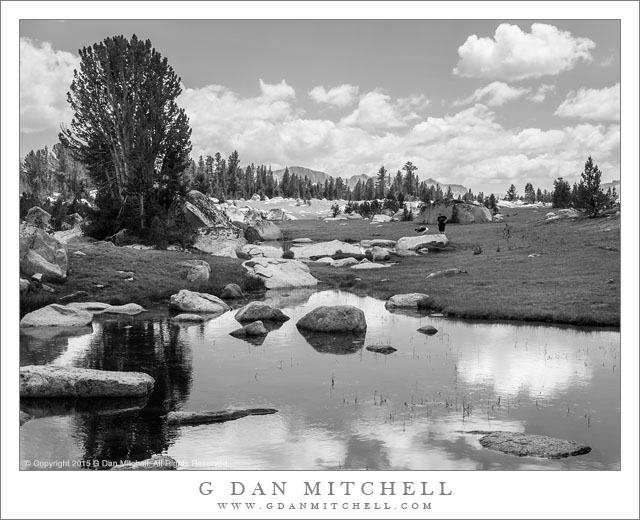
Midday summer sky reflected in a subalpine tarn, Yosemite National Park
I embrace this effect and regard it as highly positive. I’m convinced that photography deepens my appreciation and understanding of these places and subjects. Like every photographer I know who shares my passion for these subjects, entering the natural world to make photographs focuses my perceptions in powerful ways. I slow down. I stop. I look. I ponder. I wonder. I indulge my curiosity and I see things that I would otherwise miss. I’m intensely aware of light, color, atmosphere, form, and subject.
“Island and Trees, Tuolumne River” — Trees grow on a small ,rocky island in the Tuolumne River, Yosemite National Park
This first evening on a recent trip to the Yosemite high country turned out to be special. I arrived in the park in the middle of the day and snagged a camp site at Tuolumne Meadows. I set up my simple camp, lounged around a bit, and then it was time to head out and look for photographs. I headed back along Tioga Pass Road, making note of several possibilities as I passed the meadow, then turned around to go back to one of them. Along the way I decided to pull over to take in the view and by lucky coincidence I pulled in right behind my friends Michael and Claudia. We ended up hiking across the meadow to a likely photography location. Within moments a couple caught up with us — another group of friends, Charlotte and Gary!
Our group continued hiking along the river, eventually reaching a beautiful area where the slope increased, the channel narrowed, and the river picked up speed. Here it glides across granite slabs, bounces around and across boulders, and occasionally pools for a moment in hollows in the valley. We stopped at a granite bowl where the river makes a bend, and I photographed this small island and its trees against a background of late-afternoon sky with dissipating clouds.
G Dan Mitchell is a California photographer and visual opportunist. His book, “California’s Fall Color: A Photographer’s Guide to Autumn in the Sierra” (Heyday Books) is available directly from him.