
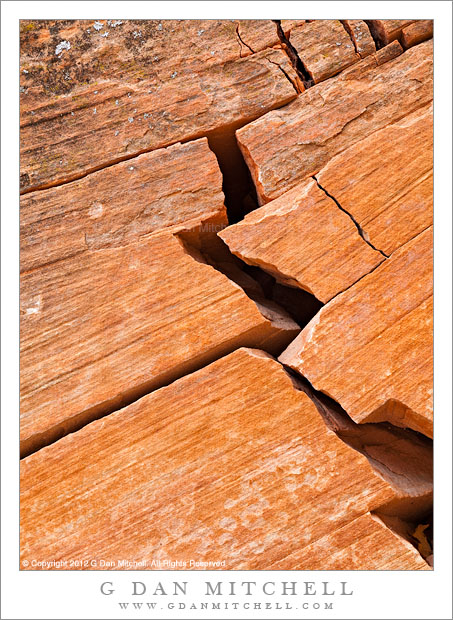
Cracked Sandstone

Cracked Sandstone - Large cracks in layers of sandstone, Zion National Park
Large cracks in layers of sandstone, Zion National Park

Cracked Sandstone. Zion National Park, Utah. October 22, 2012. © Copyright 2012 G Dan Mitchell – all rights reserved.

Large cracks in layers of sandstone, Zion National Park

On our way to Utah points further east in late October, we passed through Zion National Park and ended up spending the better part of a day photographing along the Mount Carmel Highway route through the park. There are any number of places here to park the car, get out, and walk down into the narrow washes and valleys or climb up to various prominences. On this day the prospect was even more interesting since autumn color had come to the high country – much more than in the more famous Zion Canyon – and the oak and red maple trees were showing brilliant and vivid colors.

At several points we decided to investigate small canyons that passed near the roadway, and several of them included short stretches that were very narrow. There is a lot of tortured looking geology in some of these places, the result of eroding and sculpting power of the sand and water and other processes. Here a large “chunk” of sandstone was leaning away from the creek and was cracking, both along the natural strata in the rock and perpendicular the layers. In these places it is often interesting to see how seemingly solid rock can take on the qualities of a plastic material that has been bent and carved.

G Dan Mitchell is a California photographer whose subjects include the Pacific coast, redwood forests, central California oak/grasslands, the Sierra Nevada, California deserts, urban landscapes, night photography, and more.
Blog | About | Flickr | Twitter | FacebookGoogle+ | 500px.com | LinkedIn | Email

Text, photographs, and other media are © Copyright G Dan Mitchell (or others when indicated) and are not in the public domain and may not be used on websites, blogs, or in other media without advance permission from G Dan Mitchell.

Fractured Sandstone Detail

Fractured Sandstone Detail - Details of fractured sandstone rock, Zion National Park
Details of fractured sandstone rock, Zion National Park

Fractured Sandstone Detail. Zion National Park, Utah. October 12, 2012. © Copyright 2012 G Dan Mitchell – all rights reserved.

Details of fractured sandstone rock, Zion National Park

On this day we had driven across a good chunk of Arizona and southern Utah while traveling from Moab towards Springdale and Zion – and it had rained, heavily at times and lightly most of the day. Back in Arizona many of the creeks and rivers had come back to life, and north of where we were it may have been snowing. By the time we reached Zion and headed across the Mount Carmel Highway on our way to Springdale, everything was quite wet.

Rain radically changes the appearance of this portion of the park. (In truth, it changes the appearance of many things, but that is a topic for another post!) There were puddles and rivulets everywhere, and those dry waterfalls that characterize this country were no longer dry. The clouds soften the light and fill in the shadows, and the moisture intensifies the colors, especially the red and pink colors of the sandstone. Shortly after entering the park we pulled over and spent some “quality time” exploring this change near a small valley that held pools and a little temporary creek, and I found this area of fractured sandstone.

G Dan Mitchell is a California photographer whose subjects include the Pacific coast, redwood forests, central California oak/grasslands, the Sierra Nevada, California deserts, urban landscapes, night photography, and more.
Blog | About | Flickr | Twitter | FacebookGoogle+ | 500px.com | LinkedIn | Email

Text, photographs, and other media are © Copyright G Dan Mitchell (or others when indicated) and are not in the public domain and may not be used on websites, blogs, or in other media without advance permission from G Dan Mitchell.

“Have you ever shot a Leica or Contax lens on your Canon Body?”

(From time to time I re-post stuff that I wrote elsewhere, including things from various photography forums. This is one of those posts. While I do believe it using good and appropriate photographic equipment, I do not believe in “magical gear,” whether lenses or cameras or whatever. Gear is important, but only insofar as it actually affects your ability to produce the photographs that you are working on. This particular – and lengthy! – comment was a response to a common response to those of us who don’t believe in magical gear, namely to suggest that because we don’t use it we must not understand. Enjoy!)

G Dan – just one question Have you ever shot a Leica or Contax lens on your Canon Body?”

That dismissive come-back doesn’t work, despite the fact that such a reply is often offered as if it should stop discussion in its tracks.

So, no, I have not. There are many things I have not done, however, that I don’t do because facts don’t support the wisdom of doing them, or because facts do support the wisdom of doing something else. Let me give you a photographic example. I have chosen certain specific lenses for my photography. In the process of making those decisions I investigated and considered many other lens options, almost all without actually trying them, and came to logical and intelligent decisions that led me to choose something else.

The argument that people can only have opinions about things they have actually “used” is, on its face, simply nonsense. It also is an absurdly impractical concept. I’d be willing to bet that those who offer up this gem of an argument do not follow it in the rest of your lives. For example, you might be able to offer an opinion about various political systems or countries and whether you would prefer to live in them or not, but you would be a very unusual person if you had actually lived in all of them about which you have an opinion. I’ll bet that when you purchase a car, you do not try all of the options that you dismiss before deciding that you are uninterested in them. You might admit to knowing things about places you have never visited or about which you have not made direct observations yourself. (It is cold in Antarctica. There is no oxygen on the moon. When it is night where you are, it is day on the opposite side of the planet.) Continue reading “Have you ever shot a Leica or Contax lens on your Canon Body?”

Autumn Foliage and Sandstone

Autumn Foliage and Sandstone, Utah
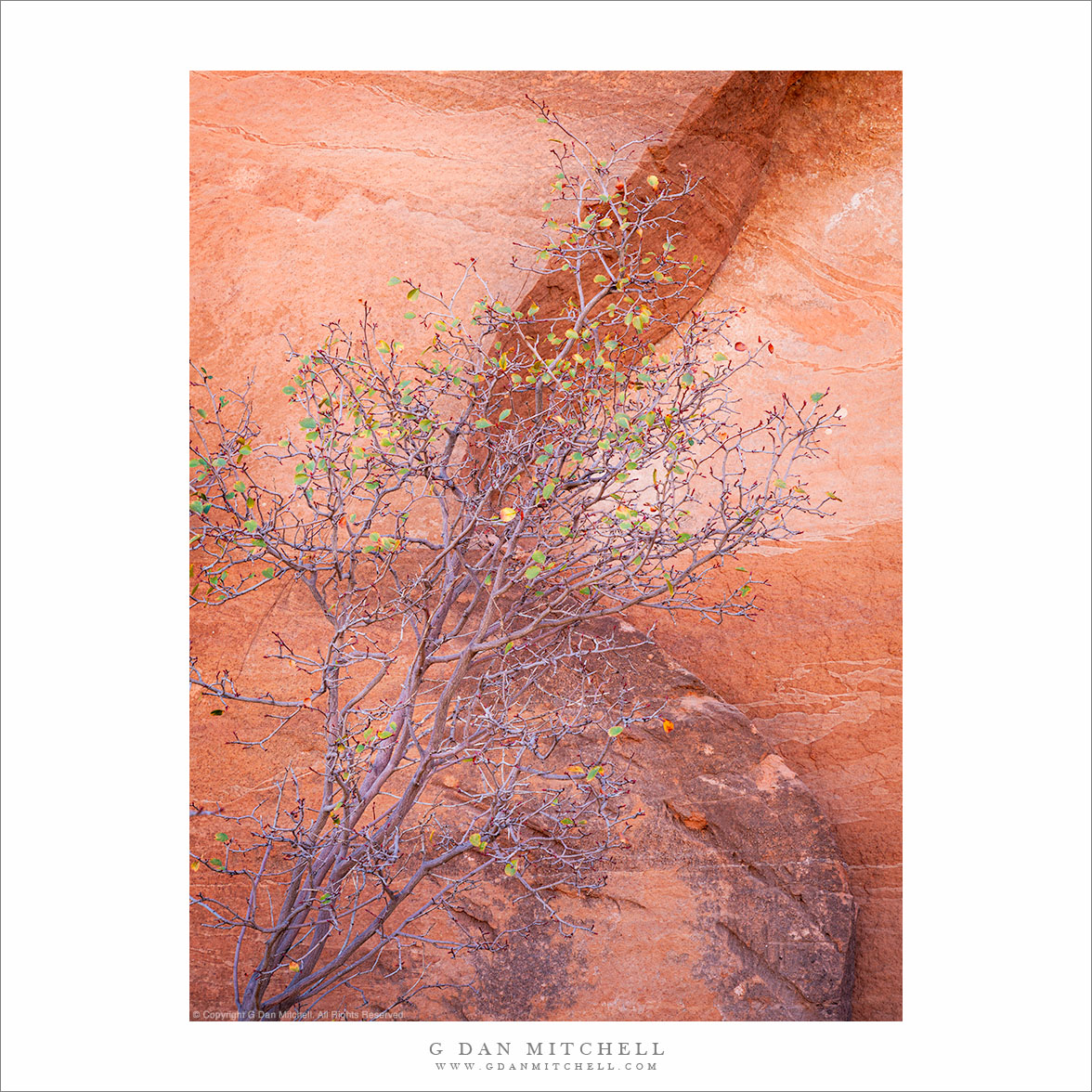
“Autumn Foliage and Sandstone” — A bush with a few remaining autumn leaves in front of an s-shaped crack in a sandstone wall

At the suggestion of another photographer, near the end of our trip we decided to investigate the canyon in which I photographed this tree. The canyon begins in an inauspicious manner, in a shallow wash at the bottom of a slight canyon – the sort of place you could easily drive through and not particularly notice it. There is no sign to mark the route. Following the wash downstream across the flats, another wash joins from the right and soon the sandy bottom becomes rocky as the route meets the top of a sandstone layer. This layer gradually tilts higher and begins to form low walls, and almost before you know it you are inside the beginning of the canyon. A very narrow slot with a large drop-off interrupts the passage and the route detours around it before dropping back into the bottom of the canyon.

Before long, and almost before you know it, the sandstone walls of the canyon become hundreds of feet tall and even begin to overhang the canyon in places, and it is now clear that you have entered the alternate and isolated universe of a deep canyon. At first the canyon is rather barren, but after some distance there are more trees as the route turns and twists downward. As always, surprises appear continually. In this case of this photograph, a simple little bush happened to appear in front of an s-curve marking the edge of a joint in the sandstone where rock had fallen away, and the light reflected among the canyon walls colored the sandstone red.


G Dan Mitchell is a California photographer and visual opportunist. His book, “California’s Fall Color: A Photographer’s Guide to Autumn in the Sierra” (Heyday Books) is available directly from him.

G Dan Mitchell: Blog | Bluesky | Mastodon | Substack Notes | Flickr | Email


All media © Copyright G Dan Mitchell and others as indicated. Any use requires advance permission from G Dan Mitchell.

Photographer and visual opportunist. Daily photos since 2005, plus articles, reviews, news, and ideas.