
Tag Archives: amargosa

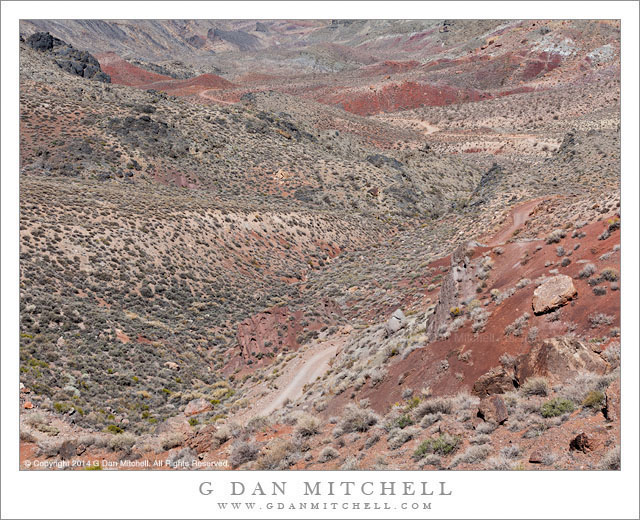
Upper Titus Canyon

Upper Titus Canyon
Upper Titus Canyon

Upper Titus Canyon. Death Valley National Park, California. April 1, 2014. © Copyright 2014 G Dan Mitchell – all rights reserved.

Titus Canyon road descends into the upper canyon from Red Pass, Death Valley National Park

At first glance this landscape lacks a central focus and the colors are relatively unsaturated. The contrasts within the terrain are subdued, without the striking divisions between light and shadow that we might see in places like the alpine zones of the Sierra. In the past I have often not bothered to photograph such places, since they appear to lack the dramatic qualities that we often search out in a place like Death Valley. And there is no questioning the appeal of those subjects that possess starker lines, brighter colors, greater contrast, and perhaps towering geological forms. Yet, it occurred to me a year or two ago that the places like this are part of the true experience of the desert and of Death Valley, and that their character is a big part of what forms my sense of this terrain. To ignore them seems both a bit unfair and a bit dishonest. So I decided to try to see if I could find ways to photograph them, a project I’m still working on but also one on which I’m confident that I’m making some progress—and, in the process, learning to see the place more fully.

This photograph was made at Red Pass, the high point of the Titus Canyon road between the Amargosa Valley and Death Valley. (The source of the the name of this pass is probably obvious from one look at the color of the rocks.) The narrow, twisty, one-way gravel road is perhaps best known for traveling through very narrow slot canyon terrain near its lower end, but the whole thing is part of the experience. After a steep climb out of the upper reaches of Titanothere Canyon, the road tops the narrow ridge of the pass before descending steeply into the upper reaches of Titus Canyon. The view from the pass down into upper Titus Canyon is remarkable. The canyon drops away and the road is visible twisting and turning its way down the initial descent and then crossing flatter areas beyond. Barely visible in the upper left area of the image is the location of the historic ghost town of Leadville, a town built on the false promises of mineral wealth that great and then died in the space of about a year—in a place that could hardly be more remote or less hospitable.

G Dan Mitchell is a California photographer and visual opportunist whose subjects include the Pacific coast, redwood forests, central California oak/grasslands, the Sierra Nevada, California deserts, urban landscapes, night photography, and more.
Blog | About | Flickr | Twitter | FacebookGoogle+ | 500px.com | LinkedIn | Email

Text, photographs, and other media are © Copyright G Dan Mitchell (or others when indicated) and are not in the public domain and may not be used on websites, blogs, or in other media without advance permission from G Dan Mitchell.
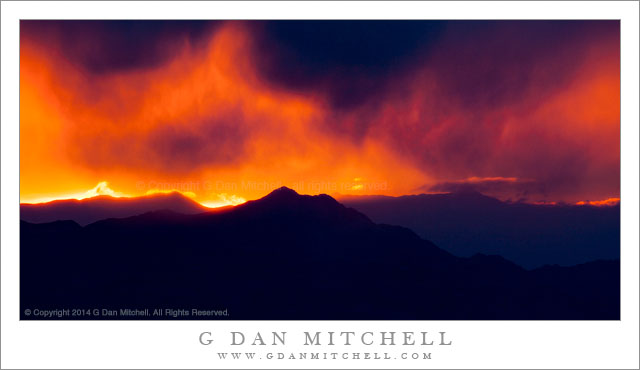
Desert Mountains, Stormy Sunrise

Desert Mountains, Stormy Sunrise

Desert Mountains, Stormy Sunrise. Death Valley National Park, California. April 2, 2014. © Copyright 2014 G Dan Mitchell – all rights reserved.

Sun rises through the clouds of a developing storm over the Amargosa Range, Death Valley National Park

We arrived very early at this high overlook in Death Valley National Park’s Panamint Range, hoping to photograph a desert mountain sunrise. When conditions are good at this location, there is an almost 360 degree panorama of rugged and desolate mountain terrain, punctuated by deep valleys, especially the chasm of Death Valley itself which lies immediately below. Because the spot is so high, even further views abound—far out into Nevada to the east, and back to the crest of the Southern Sierra to the west.

But little of that happened on this morning. We arrived before dawn and I could tell that a cloud deck was coming over the Panamint crest behind us and extending out to the east over Death Valley. There was a gap in the clouds to the east, but it was a narrow one, and more clouds were beginning to build over the ridges in that direction. On a perfect morning here, beams of sunrise light play over the tops of the peaks and shine into valleys near and far. But on this morning things were rapidly tending toward gray. However, for a few moments there was a bit of brilliant color just over those eastward ridges, where the clouds had not yet closed down on their summits, and by using a very long lens I was able to isolate this scene just as the sun came up, backlighting the virga falling from the clouds above the silhouetted forms of the ridges.

G Dan Mitchell is a California photographer and visual opportunist whose subjects include the Pacific coast, redwood forests, central California oak/grasslands, the Sierra Nevada, California deserts, urban landscapes, night photography, and more.
Blog | About | Flickr | Twitter | FacebookGoogle+ | 500px.com | LinkedIn | Email

Text, photographs, and other media are © Copyright G Dan Mitchell (or others when indicated) and are not in the public domain and may not be used on websites, blogs, or in other media without advance permission from G Dan Mitchell.
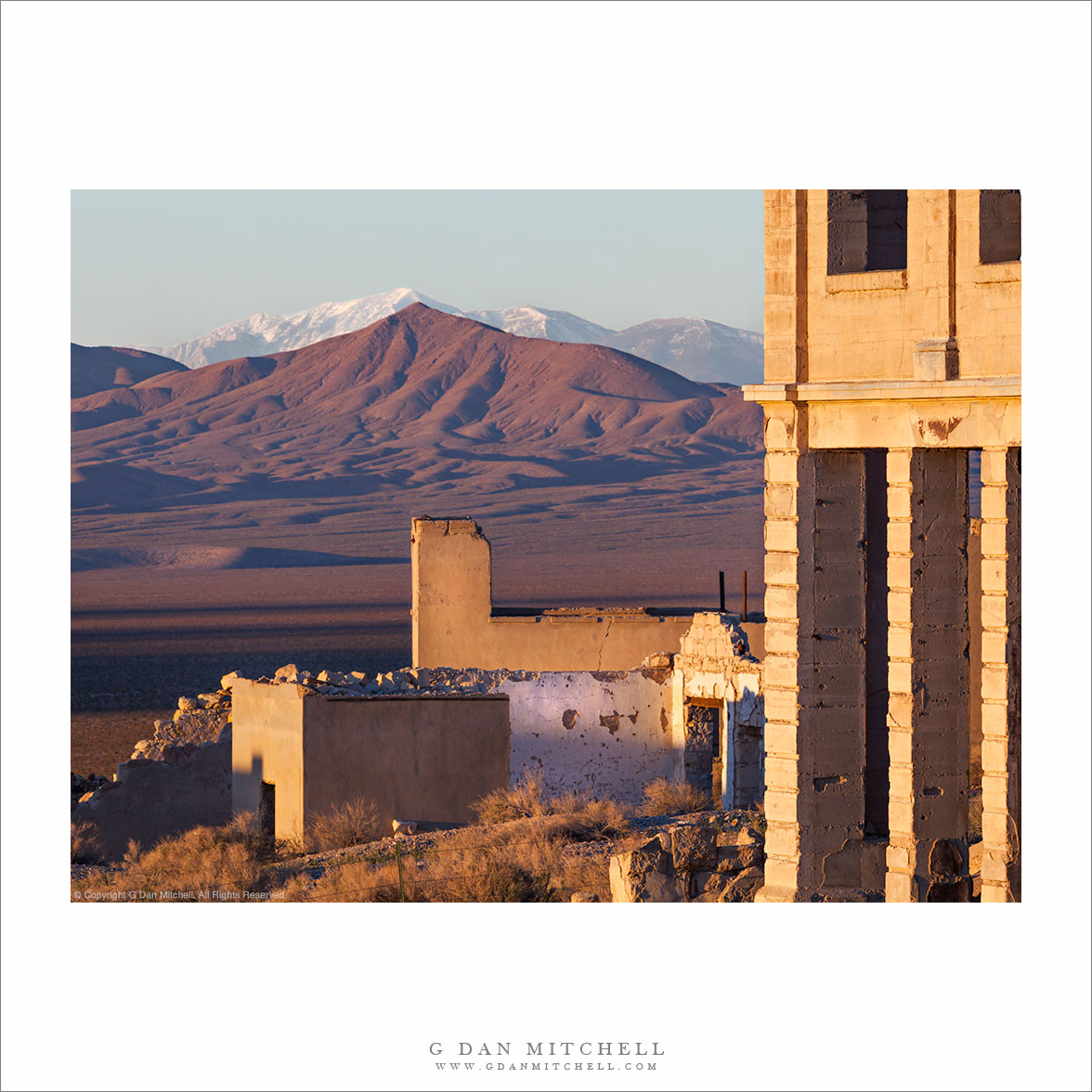
Rhyolite, Amargosa Valley, Telescope Peak

Rhyolite, Amargosa Valley, Telescope Peak
“Rhyolite, Amargosa Valley, Telescope Peak” — Telescope Peak, the Amargosa Mountains, and the Amargosa Valley seen beyond the ghost town of Rhyolite Nevada

I first visited the fabled ghost town of Rhyolite, Nevada perhaps a decade ago. I lies outside of Death Valley National Park, not too far from Beatty, Nevada. The place has existed in a state of mostly natural decay in the decades since it was abandoned. The story is that it was once a very successful and busy mining town, but as happens to virtually all such places, the mines played out and the town died. Not a lot is left at this point, though there are a few very interesting structures. Their size gives evidence of what the town must have been: a railroad station, a crumbling bank building, the remains of a large schoolhouse, and more.

When I first visited Rhyolite the place was pretty much what it was, and you could go just about anywhere you wanted to go. Within a few years fencing began to appear around some of the more dangerous structures—tall ruins of stone walls that are eventually going to fall. As time passed more and more fences were erected, and today many of the old buildings are off-limits. In a way this disappoints me, but given the increasing number of visitors and the increasingly fragile state of the town and its structures, I’m will to accept these limitations as a way to slow the eventual decay of the place. I’ve photographed at various times of day and in a range of conditions, but I still like dawn the best here. When the conditions are right, the sun comes up over a low ridge to the east and its light strikes the old bank building and other structures in the town just after it reaches the Amargosa Range and the summit of distant Telescope Peak, the highest point in Death Valley National Park.


Leave a comment or question using the form. (Click the title to see the full article and to comment if you are viewing it on the home page.)

G Dan Mitchell is a California photographer and visual opportunist. His book, “California’s Fall Color: A Photographer’s Guide to Autumn in the Sierra” (Heyday Books) is available directly from him. Blog | Bluesky | Mastodon | Substack Notes | Flickr | Email

All media © Copyright G Dan Mitchell and others.

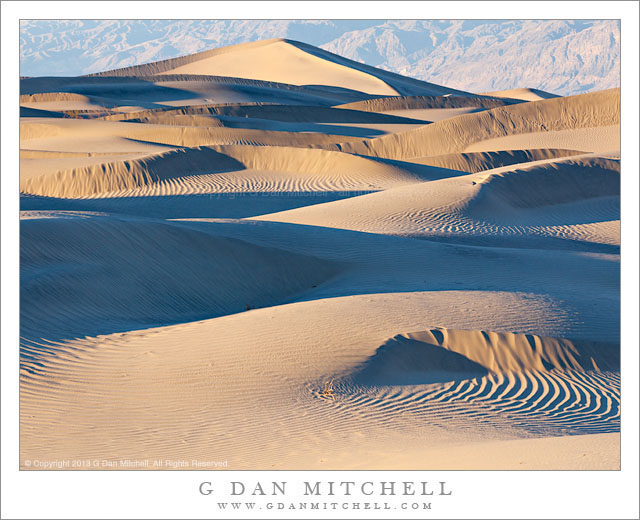
Dunes, Evening

Dunes, Evening
Dunes, Evening

Dunes, Evening. Death Valley National Park, California. December 11, 2013. © Copyright 2014 G Dan Mitchell – all rights reserved.

Receding layers of sand dunes in evening light, Death Valley National Park

After a very long day spent driving a lengthy backcountry gravel road through mountainous terrain, I headed back to my camp at Furnace Creek to take care of camp business and grab something to eat. As I usually do in Death Valley, I scheduled my day around a morning subject and an evening subject. Since the morning work had lasted so long, I was thinking of something closer for the evening and, besides, by the time I was ready to shoot it was probably too late to travel very far in the remaining light before the early sunset of this December day. So I decided to travel up the valley a bit to well-known dunes, where I can almost always find something interesting to photograph if I just go looking.

I stopped some distance from the “usual location,” loaded up some basic equipment, and wandered out into a likely looking section of the terrain that would probably not seem all that special to those seeing the area for the first time. (That’s easy to understand, when the impressive and large sand dunes tower above everything else not far from here!) But I know there is a wealth of interesting things to be found even in what appears to be the plainest of the dunes – conjunctions of light and shadow, textures of sand, tracks of small creatures, plants poking through the sand, and more. When I arrived the low sunlight was just about to leave this area, so I worked quickly, trying to take advantage of fleeting moments of shadow and light. As I came to the top of a low dune I saw this complex terrain of dunes and shadows stretching in front of me.

G Dan Mitchell is a California photographer and visual opportunist whose subjects include the Pacific coast, redwood forests, central California oak/grasslands, the Sierra Nevada, California deserts, urban landscapes, night photography, and more.
Blog | About | Flickr | Twitter | FacebookGoogle+ | 500px.com | LinkedIn | Email

Text, photographs, and other media are © Copyright G Dan Mitchell (or others when indicated) and are not in the public domain and may not be used on websites, blogs, or in other media without advance permission from G Dan Mitchell.