Tag Archives: arid

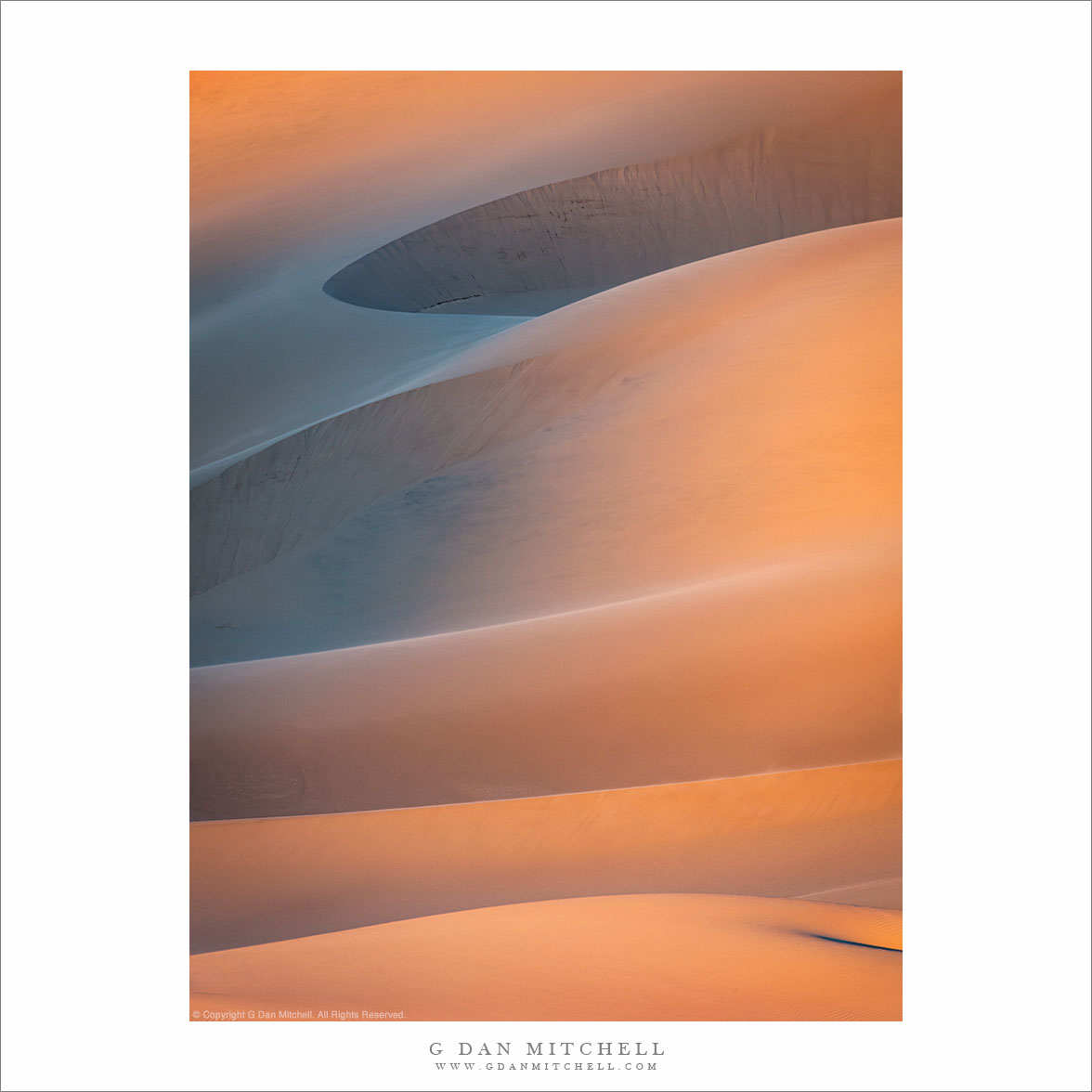
Last Light, Sand Dunes

Last Light, Sand Dunes
Desert winds blow sand across the lip of sand dunes in sunset light.

Last Light, Sand Dunes. © Copyright 2022 G Dan Mitchell – all rights reserved.

Desert winds blow sand across the lip of sand dunes in sunset light.

Some things are only at their best for a brief moment. Think of a fresh espresso, a soufflé, or perhaps the half hour of beautiful spring snow between ice and slush. The light in the moment when shadows from distant hills arrive at the edge of sunset light (or its inversion at sunrise) is another such thing. This light does things to the landscape that aren’t seen at any other time of day, but the event may last barely a few minutes.

Near the end of my shoot at this location I turned and saw the colorful, low-angle light coloring the sand and bringing relief to its features. I quickly went to work photographing it, working quickly and instinctively, as I knew that the moment would be brief. In fact, along the left side of this photograph is the the shadow marking the edge of light. A moment after I made this photograph, the light was gone.


G Dan Mitchell is a California photographer and visual opportunist. His book, “California’s Fall Color: A Photographer’s Guide to Autumn in the Sierra” is available from Heyday Books, Amazon, and directly from G Dan Mitchell.

Blog | About | Flickr | FacebookEmail

Links to Articles, Sales and Licensing, my Sierra Nevada Fall Color book, Contact Information.

Scroll down to leave a comment or question. (Click this post’s title first if you are viewing on the home page.)


All media © Copyright G Dan Mitchell and others as indicated. Any use requires advance permission from G Dan Mitchell.
Angle of Repose

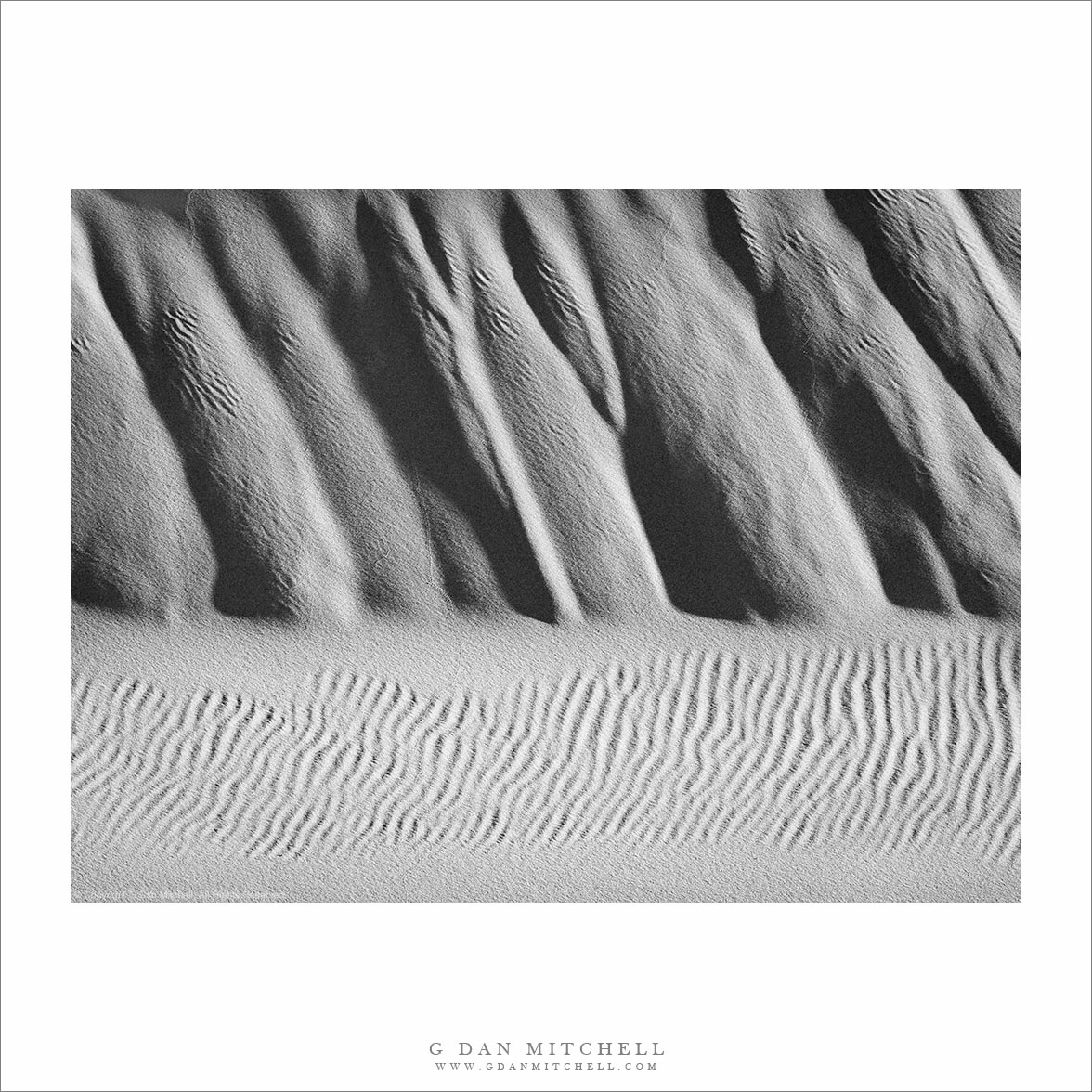
Angle of Repose
Sand dune patterns, Death Valley National Park.

This “intimate landscape” is a sand dune vignette made in a specific place but which could be found almost anywhere. A close look may reveal some details that desert and sand aficionados may find interesting. The large patterns are typically found on one side of dunes where sand blown over the top of the dune collects below. The smaller “ripples” are a common feature of dunes, too, and these are completely undisturbed since the dunes are somewhat remote. Looking even closer may reveal some tinier patterns and tracks across the face of the sand.

The term “angle of repose” refers to the steepest angle at which a material, such as this sand, might collect without collapsing or sliding downhill. It is also the title of a wonderful Wallace Stegner novel, and that is where I first encountered the term. Fans of the history of the American West, especially the part that came after initial explorations, and especially those who have roots in the west may enjoy the novel as much as I did, with its connections to places and types of people that I know from my own experience.


Leave a comment or question using the form. (If you are reading this on the home page, click the article title to see the full article and the comment form.

G Dan Mitchell is a California photographer and visual opportunist. His book, “California’s Fall Color: A Photographer’s Guide to Autumn in the Sierra” (Heyday Books) is available directly from him. Blog | Bluesky | Mastodon | Substack Notes | Flickr | Email

All media © Copyright G Dan Mitchell and others.

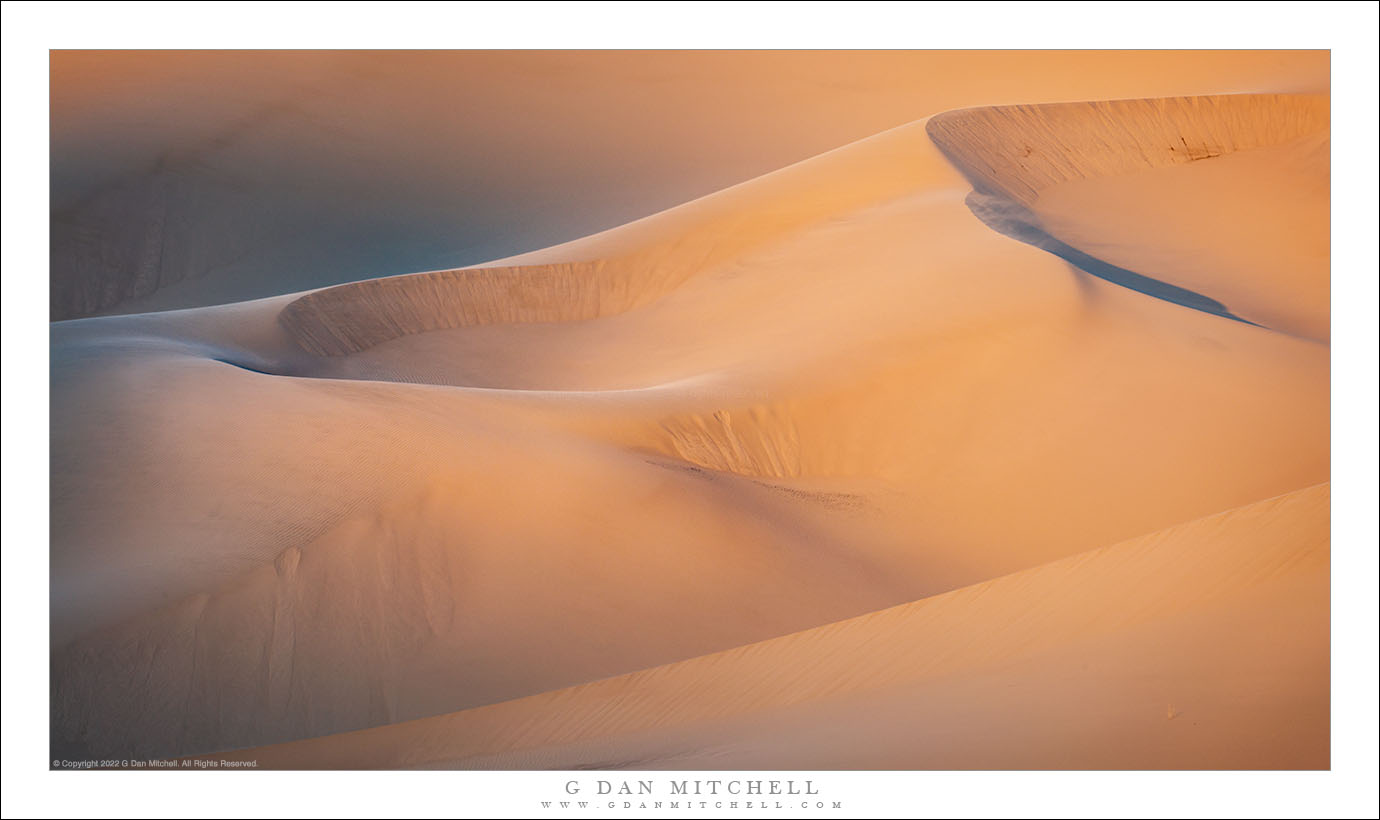
Layers, Sunset Dunes

Layers, Sunset Dunes
“Layers, Sunset Dunes” — layers of desert sand dune formations in the last sunset light of the day.

When photographing dunes that are new to me, I have little to go on when I first venture into them. I typically start walking toward them when the light is still somewhat flat and harsh, or before dawn when it is dark. It is difficult to imagine the details of how the light will evolve. I make some guesses based on the direction of the sun, how I think distant ridges may affect the arrival of shadows, and what I can see of the dunes’ features in the less-than-ideal light. In the end, I’m almost always surprised by how these first visits play out.

I approached these dunes in the late afternoon in preparation for sunset and evening light. I picked out a destination along the base of a particular dune where I saw some potentially interesting plants. Because the ridges to the west are quite low here, I guessed that I’d have a bit longer period of colorful light and longer shadows later on. Initially I walked past the location of this photograph because the textures of the successive ridges had little contrast in the daytime light. Later, as I finished photographing other nearby features that fell into shadow, I happened to look back in this direction, where the very last bit of colorful light was now delineating these shapes as evening shadows approached.


Leave a comment or question using the form. (If you are reading this on the home page, click the article title to see the full article and the comment form.

G Dan Mitchell is a California photographer and visual opportunist. His book, “California’s Fall Color: A Photographer’s Guide to Autumn in the Sierra” (Heyday Books) is available directly from him. Blog | Bluesky | Mastodon | Substack Notes | Flickr | Email

All media © Copyright G Dan Mitchell and others.

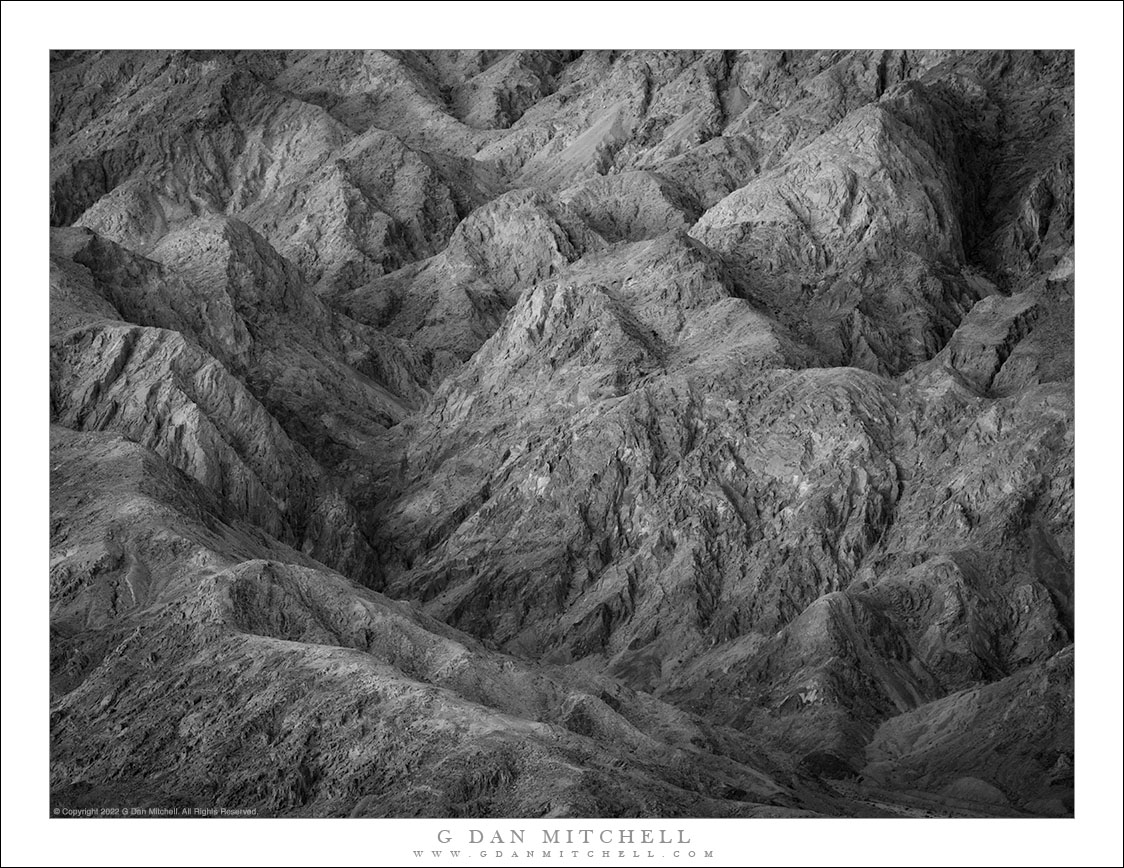
Desert Mountains, Before Sunrise

Desert Mountains, Before Sunrise
A canyon twists down through rugged desert mountains in pre-sunrise light.

Desert Mountains, Before Sunrise. © Copyright 2022 G Dan Mitchell – all rights reserved.

A canyon twists down through rugged desert mountains in pre-sunrise light.

One thing that has always appealed to me about the desert landscape — which for me often means the Death Valley landscape — is that the geology is laid bare almost everywhere. So many landscapes are to a great extent about what covers them — the forests, grasslands, lakes, meadows, rivers, and more. But here most of the vegetation is so sparse (or it matches the colors of rocks and soil so well) that we see straight to the underlying earth — the canyons, the colors of rock and soil, strata twisted and uplifted, runoff channels, landslides, fans, and more.

This canyon descends toward Death Valley from high in the Panamint Mountains, following a twisting path down from the heights as it links up tributary valleys and eventually forms a broad wash that spills out at the top of a gigantic gravel fan. I made this photograph before sunrise, when the soft, early light suffused the canyons and revealed subtle details that can be lost in harsher light later in the day.


G Dan Mitchell is a California photographer and visual opportunist. His book, “California’s Fall Color: A Photographer’s Guide to Autumn in the Sierra” is available from Heyday Books, Amazon, and directly from G Dan Mitchell.

Blog | About | Flickr | FacebookEmail

Links to Articles, Sales and Licensing, my Sierra Nevada Fall Color book, Contact Information.

Scroll down to leave a comment or question. (Click this post’s title first if you are viewing on the home page.)


All media © Copyright G Dan Mitchell and others as indicated. Any use requires advance permission from G Dan Mitchell.