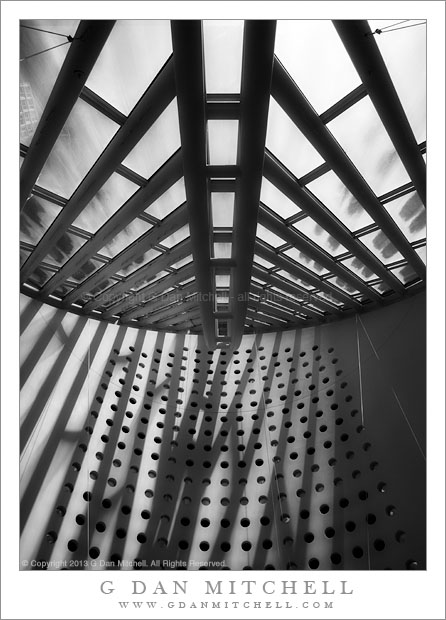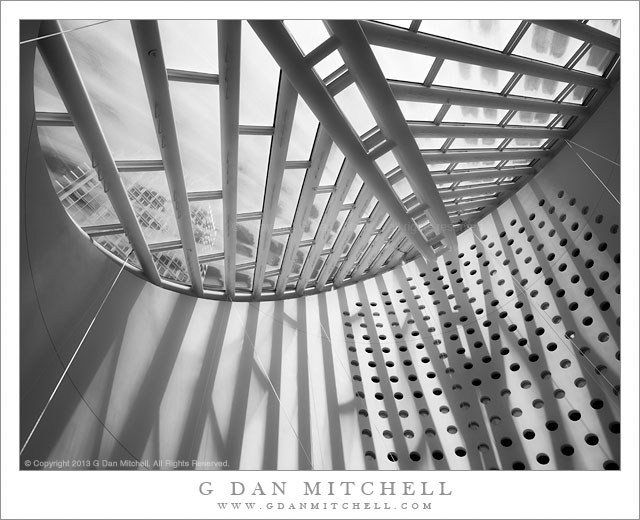
Midday light inside beneath the skylight in the atrium of the San Francisco Museum of Modern Art
For the time being I’m not going to write all that I could write about this photograph – that would be far too much to post here. Nonetheless, this might be a slightly longer “photo post” than usual.
The subject is the skylight in the turret at the top of the atrium at the San Francisco Museum of Modern Art. Just below the skylight there is a catwalk that crosses from one side of the cylindrical upper area of the atrium to the other, and this is a place of magical light in almost any conditions. I visited this past Friday since the museum closes after today (June 2, 2013) for two years for renovation and expansion, and I wanted to have one last chance to wander around in the museum and I wanted to see the wonderful Garry Winogrand exhibit.
During the “wandering” part of my visit I went to this catwalk and thought about how I could photograph it. It is almost embarrassing to photograph in this spot, since it is one of the most obvious iconic places to grab an iPhone shot, and many other visitors were doing just that. I first made a few symmetrical photographs looking up at the skylight in a more direct way and then thought that I’d try a few “off kilter” shots, perhaps with the Winogrand images – which often tilt and twist in surprising ways – still in my mind. Having also just spent time in the museum’s wonderful exhibit of classic black and white work by other photographers, I was in a bit of a black and white state of mind, and I was pretty certain that this would end up as a monochrome image.
(For those who wonder about such things, this photograph was made with the small Fujifilm X-E1 camera and the wonderful Fujifilm XF 14mm f/2.8 lens.)
G Dan Mitchell is a California photographer and visual opportunist whose subjects include the Pacific coast, redwood forests, central California oak/grasslands, the Sierra Nevada, California deserts, urban landscapes, night photography, and more. Blog | About | Flickr | Twitter | Facebook | Google+ | 500px.com | LinkedIn | Email
I just read the stunning and deeply disturbing story of the theft (not “merely” the all-to-common defacing) of a number of petroglyphs from a California location. (See “Petroglyph Thefts Near Bishop Stun Federal Authorities, Paiutes”) Apparently a group of depraved individuals hauled rock-cutting equipment to the site and sawed out the rocks holding several examples of native rock art, defacing and destroying other examples in the process. Anyone who has visited the better known examples of rock art is aware that a certain pathetic sub-group of the human race finds itself unable to resist the temptation to add their own “art” or deface that which is already there, but this incident represents a new low.
Defaced Petroglyph Site
Photographers, those who operate photography workshops, and those of us who write about photography need to take this as an opportunity to think very carefully about how much information we should share about fragile places and things and about where and how we do our sharing. A few years ago I wrote about an occasion on which some friends and fellow photographers called me out on this (“Disclosing Photo Locations: How Much Information is Too Much?”), causing me to re-think how and what I write about my photographs and the places where I make them.
Here is the problem, more or less. “Back in the day,” we might well share what we knew about certain places and subjects without much care at all. While we certainly would not blabber about fragile places in front of people who we thought might disrespect or even damage them, we had no qualms about sharing information with trusted friends. And, in fact, the dangers of that kind of sharing in the pre-web world were not really all that great. The word-of-mouth sharing reached very small number of people, and it was unlikely (though not quite impossible) that the information would eventually get to “the bad guys.” We could even argue that we were serving a greater good by sharing this knowledge with others who should know, and whose voices might contribute to the protection of these places and subjects.
However the web has changed everything. Anything that you or I post today becomes cataloged, is searchable, is readily shared and re-shared, becomes linked to other pieces of information about the same subjects… and can be seen by millions of people you don’t know, among them many whom you would not trust and some that you would never share this stuff with. That’s the new reality. Among the people who may see our work and read our descriptions online are thoughtless barbarians who stand on top of fragile arches, who climb on tufa towers, who inscribe their own “art” into ancient sites, who drive all over the landscape, who remove “sailing rocks” from their playa homes, who leave trash in the landscape, who create trails across wilderness landscapes, who harm wildlife, who party in sacred and quiet places, and more.
As photographers who share our work and write about it and even take other people to these places, we have a responsibility to our subjects to do everything we can to protect them, even if this means restricting what we say, what we share, and where we share it.
Using photographs of rock art as an example, I think that responsible photographers should adopt the following policies:
When posting a photograph, if location information is not important to understanding the photograph, don’t share such information at all.
When some location context is actually important – and sometimes it is – anonymize it as much as possible. Perhaps the name of the 200-mile-square geographical region is sufficient. Perhaps the word “canyon” can be used without naming the canyon.
When making photographs of such things, avoid the inclusion of surrounding or background elements that will help the cretins figure out the location. I know this is hard, given the photographic potential that you’ll need to forego – but a your discretion serves a greater good, and you can figure out an effective alternative way to shoot these subjects. (For my part, I enjoy the challenge of trying to work out an effective composition that doesn’t give things away.)
If you realize that you have been too open about information, edit your text, remove unnecessary or risky references, or withdraw certain photographs. (There used to be an extensive guide to photographing in Death Valley on this web site – it was removed for such reasons.)
When writing about photographs of such subjects, always include some reference to their fragility, their significance, the power of experiencing them, and the responsibility of protecting them.
Recognize that everything you share, no matter the online forum in which you share it, will eventually reach a much wider audience – and think about how much you want the lowest-common-denominator types in that audience to know.
Exercise caution even when you share directly with those you know. Share only with those who you trust to share your love for and concern about these places, and only with those who will refrain from sharing more widely. Perhaps sharing with “online friends” is a bit to liberal – maybe you want to restrict this to people you really know and work with. Even with direct, personal sharing… be conservative.
As tremendously tempting as it is – for financial as well as self-aggrandizement reasons – don’t take your workshops to these places. I’m afraid it isn’t enough to think you have told your students how fragile these places are. Once they leave they will share their photos, they will talk about your workshop, they will give directions, they will brag about the cool thing you showed them… and they’ll do it in that linked, searchable, uncontrollable world of the web.
Speak about these issues more openly – with other photographers, online, in your workshops, and so forth.
Our work to photograph these subjects and the photographs that result from this work should be evidence of our recognition of the importance of these places and of protecting them – and not something that will contribute to endangering them.
Update: A few months later the petroglyphs were recovered. Final outcome in the case is not known as of this writing.
Petroglyphs on a rock face overlooking desert terrain.
Encountering these very old and very mysterious traces of people who lived in this desert terrain many, many years ago is always a special experience. Perhaps you have read the following story here before, but I think of it every time I encounter these things. Well over a decade ago I was camped in a place in Death Valley National Park that lies somewhere between popular and the anonymous wild spaces far out in the back areas of the park. I was with a group of other people. In the morning I wandered away from the place where we were camped. I crossed a wash and walked up onto the base of a great alluvial fan, found a suitable “sitting rock,” and just sat there for a while taking in the immense space and silence. I happened to look down at the rocky ground and I an oddly shaped rock caught my attention. I’m no expert on these things, but it seemed completely clear to me that this rock had been shaped by human hands. (I later came to understand that it was probably a “knife,” perhaps one designed for scraping.)
At the moment I saw and then picked up and held this rock, the place was transformed from a semi-wilderness of rock and scattered plants into a very different sort of thing – a place that had been the home of people, many years before I sat there on my rock. My thoughts turned from the landscape around me to try to imagine the person who had created and held this rock – who was this person? what was it like to live in such a place in such a time? what had happened to them? I returned the rock to the desert floor and walked back to my camp.
The petroglyphs in the photograph are located in another place in the park, and I have visited and photographed them more than once. These are perhaps the most precious and among the most fragile things in this desert, which is why I never write about the specifics of their locations. (I also have photographs of petroglyphs that have been defiled by thoughtless morons.) If you know where these are, let’s keep it to ourselves, OK?
The first time I photographed these examples of rock art, I simply shot them straight on so that the shapes were as clear and large as possible. Since then I had been thinking of trying to photograph them in a way that might reveal them in the context of the larger surroundings – perhaps as the person or people who made them might have seen the place.
G Dan Mitchell is a California photographer whose subjects include the Pacific coast, redwood forests, central California oak/grasslands, the Sierra Nevada, California deserts, urban landscapes, night photography, and more. Blog | About | Flickr | Twitter | Facebook | Google+ | 500px.com | LinkedIn | Email
Edge of an upper landing with a railing, stairs, and windows at the Museum of Modern Art, New York City.
I think I have visited, at least briefly, the Museum of Modern Art every time I have been in New York City. (As a “west coaster” that isn’t all that often, but still…) My secret is that photographing inside and around the museum is, for me, almost as interesting as viewing the exhibits. There is a ton of interesting subject material to work with: the people, the interior (and to a lesser extent, exterior) architecture of the place, details that can be found by looking around a bit, the surrounding neighborhoods, and juxtapositions of any and all of these things.
We visited a wonderful show of photography when we were there this year, and at the end of a hallway outside the entrance to this show I saw this translucent wall of windows with a glow enhanced by, if I recall correctly, some cloudiness outside. Shooting quickly with the 50mm prime that was on my camera, I first grabbed some shots mostly of these windows. Then I tried a few that focused more on the stairway seen here at lower right. Finally, I narrowed it down to just this bit of curving railing and floor, throwing the rest of the scene out of focus by shooting at the largest aperture.
(Basic EXIF data may be available by “mousing over” large images in posts when this page is viewed on the web. Leave a comment if you want to know more.)
Photographer and visual opportunist. Daily photos since 2005, plus articles, reviews, news, and ideas.