Tag Archives: beak

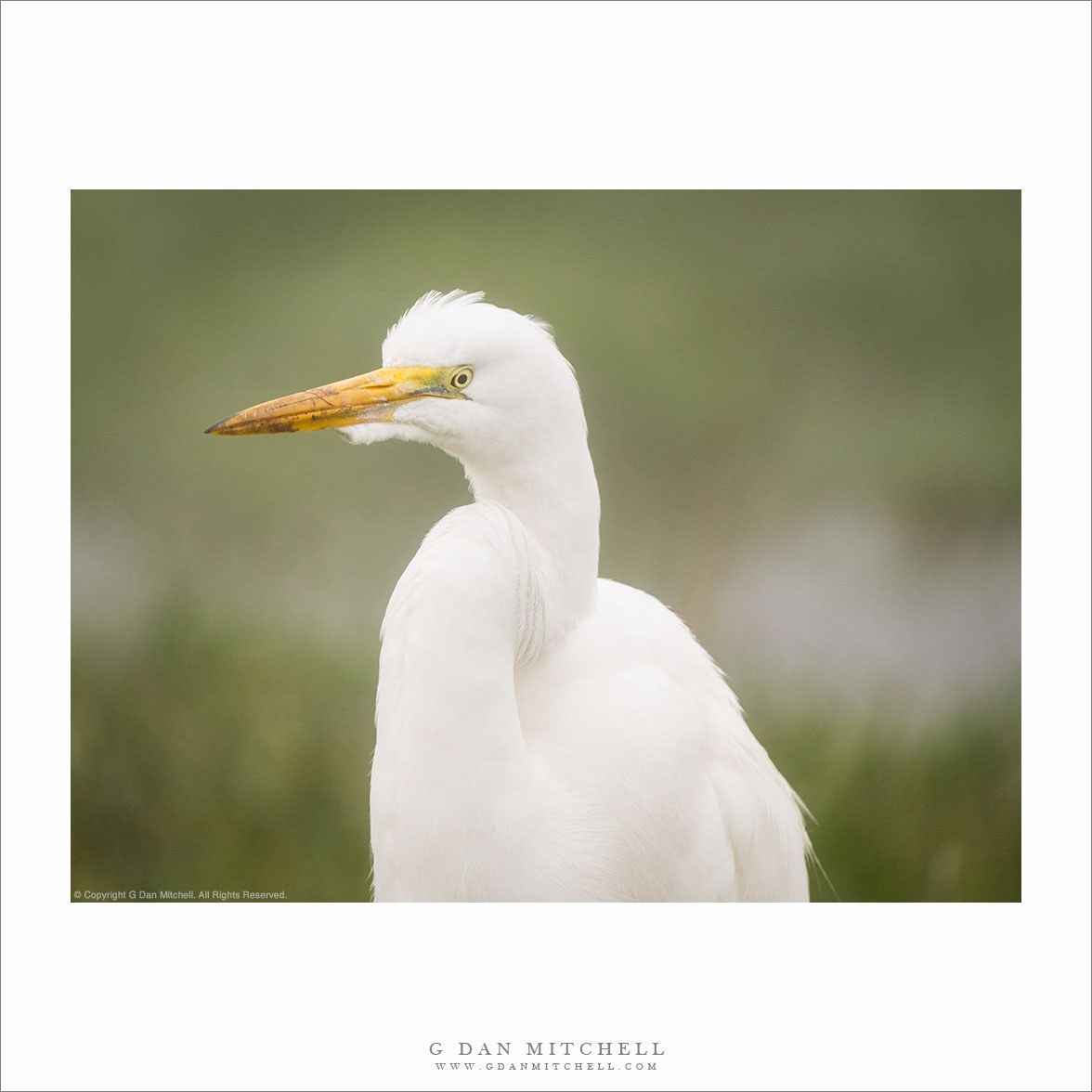
Great Egret Portrait (horizontal)

Great Egret Portrait (horizontal)
“Great Egret Portrait (horizontal)” — A “head shot” of a great egret.

I have been meaning to share this critter’s head shot for a while. It is a great egret, a bird whose presence in nature is announced by its large size, its long neck, and its striking white plumage. Quite a few of them were around when I visited one of my bird photography haunts in California’s Central Valley.

This one was less bothered by my presence than some. I wasn’t as close as it may appear — I was using a long telephoto lens. But still, egrets have boundaries, and if you cross them they will quickly fly away. But this one stuck around, and even paused in the soft, cloudy light.


Leave a comment or question using the form. (Click the title to see the full article and to comment if you are viewing it on the home page.)

G Dan Mitchell is a California photographer and visual opportunist. His book, “California’s Fall Color: A Photographer’s Guide to Autumn in the Sierra” (Heyday Books) is available directly from him. Blog | Bluesky | Mastodon | Substack Notes | Flickr | Email

All media © Copyright G Dan Mitchell and others.
Great Egret Portrait

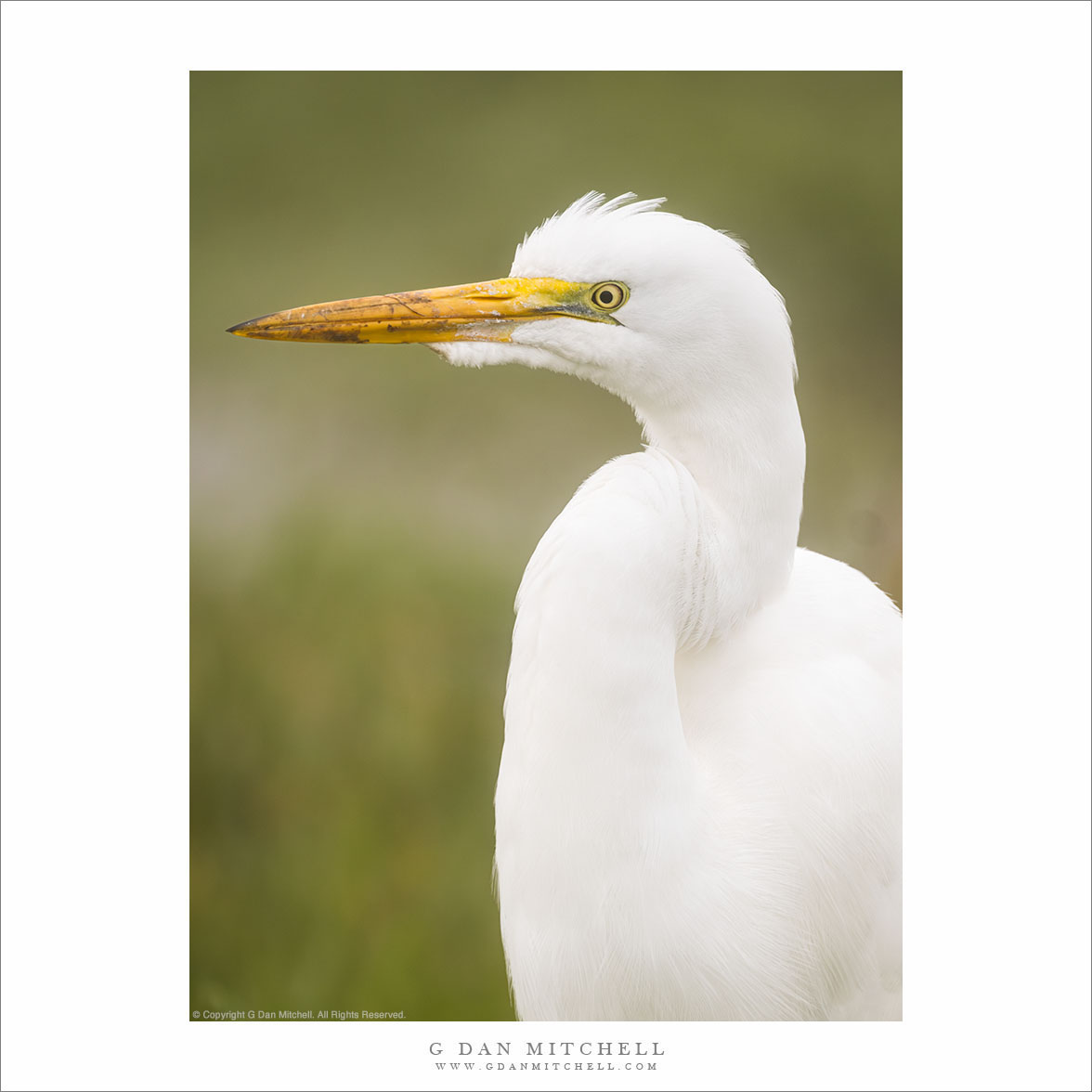
Great Egret Portrait
“Great Egret Portrait” — A “head shot” of a great egret.

Great egrets are a common sight here in California, from the coastline to inland wetlands and creeks. Their distinctive white plumage makes them stand out in almost any landscape. It doesn’t hurt that they are quite large, too — the largest of several different egret species. I photographed this one at a wetland area in California’s Central Valley on a foggy day that softened the light.

In some ways it is easy to photograph them, but in others it can be tricky. It is a bit easier to fill the frame with an egret since the birds are large. They also tolerate human presence… up to a point. So, it isn’t too hard to photograph them on the ground. Catching them in flight is a different matter. Most often they will be flying away from me, and when they take off they often do so suddenly and without much warning.


Leave a comment or question using the form. (Click the title to see the full article and to comment if you are viewing it on the home page.)

G Dan Mitchell is a California photographer and visual opportunist. His book, “California’s Fall Color: A Photographer’s Guide to Autumn in the Sierra” (Heyday Books) is available directly from him. Blog | Bluesky | Mastodon | Substack Notes | Flickr | Email

All media © Copyright G Dan Mitchell and others.
Great Blue Heron, Fog

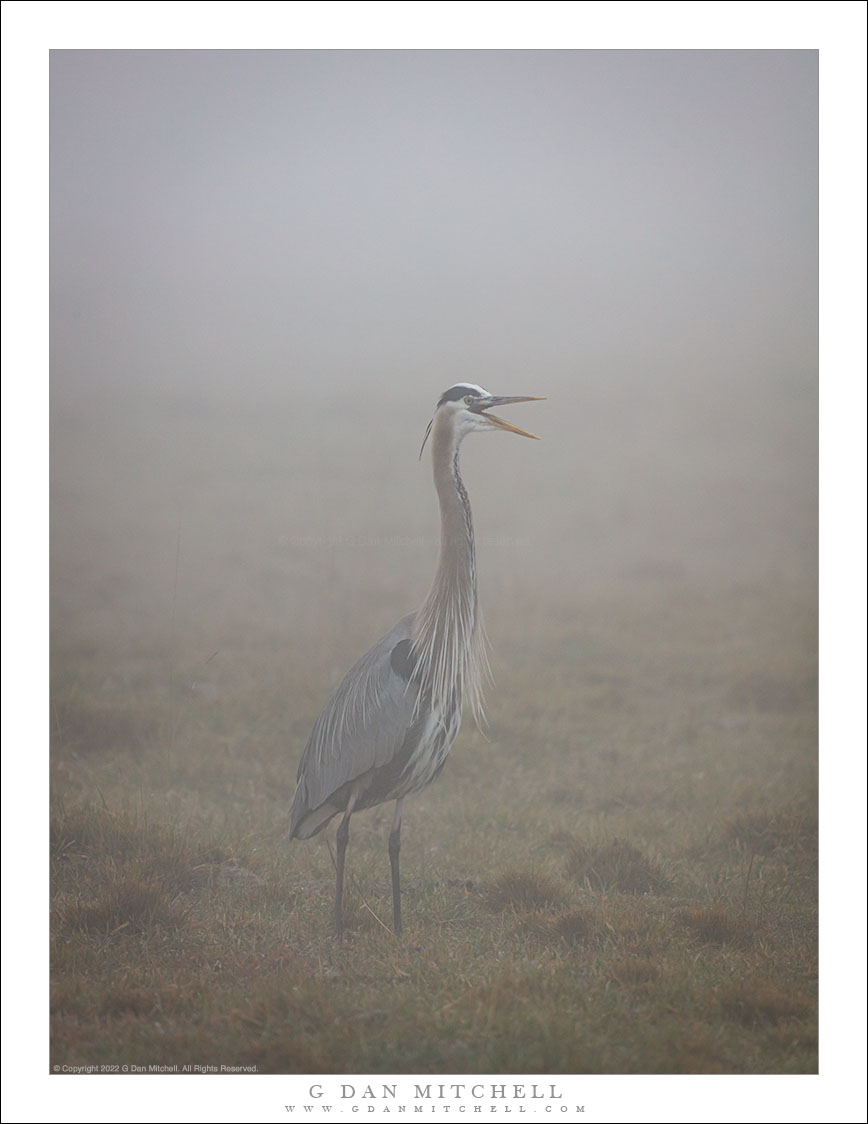
Great Blue Heron, Fog
A great blue heron, photographed on a winter morning of heavy fog along the Paciic Flyway.

Great Blue Heron, Fog. © Copyright 2022 G Dan Mitchell – all rights reserved.

A great blue heron, photographed on a winter morning of heavy fog along the Paciic Flyway.

Fog can make for lovely, evocative atmosphere when photographing birds. In fact, I often try to time my winter bird photography for foggy days. On the best of these days, the sunrise hours begin with slightly translucent fog, colored by dawn light. Then a transition begins as the sun rises and begins to make the shallow tule fog layer glow. The fog continues to thin and the light becomes more directional. Every one of these stages in the evolution of the light has its attractions, and such mornings are often quite busy.

Then there are the foggy days like this one. There is such a thing as too much fog, especially when it comes to bird photography. On this morning conditions were verging on the “I can hear them but I can’t see them” state — and at first I was unable to see most of the birds that I could hear off in the fog. I finally came across this magnificent great blue heron near the edge of a pasture, and I almost missed seeing it in the murk.


G Dan Mitchell is a California photographer and visual opportunist. His book, “California’s Fall Color: A Photographer’s Guide to Autumn in the Sierra” is available from Heyday Books, Amazon, and directly from G Dan Mitchell.

Blog | About | Flickr | FacebookEmail

Links to Articles, Sales and Licensing, my Sierra Nevada Fall Color book, Contact Information.

Scroll down to leave a comment or question. (Click this post’s title first if you are viewing on the home page.)


All media © Copyright G Dan Mitchell and others as indicated. Any use requires advance permission from G Dan Mitchell.

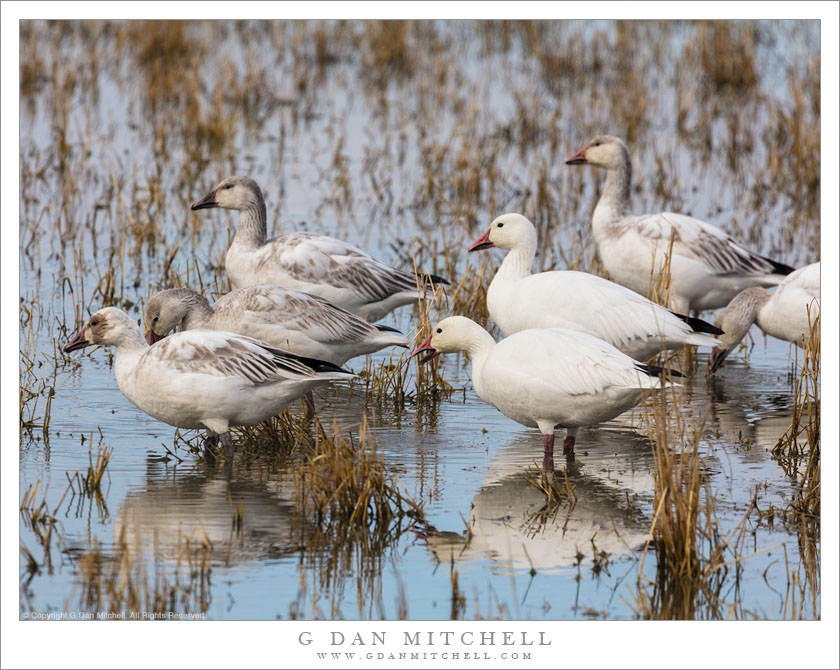
Snow Goose Variations

Snow Goose Variations
A group of snow geese exhibiting variations in coloration

Snow Goose Variations. © Copyright 2018 G Dan Mitchell – all rights reserved.

A group of snow geese exhibiting variations in coloration

Upon a first experience with these birds they seem to be nearly identical in every way — the initial impression is of white birds (with a pattern of black wing markings when in flight) and a certain uniformity of their calls. Surprisingly, perhaps, I was first alerted to the differences by a friend who has learned to detect the type of flock by subtleties in their cries. I hadn’t noticed, but once he pointed it out I started to pay a lot more attention… and I can hear this, too.

I soon realized that there is more than one type of “white goose,” and I began to consult various guides to understand how to identify them. Some of the cues are pretty obvious once you learn about them, but the guides also reveal that things are not as regular as you might think. For example, the supposedly white types of geese are most certainly not always white! The birds in this photograph are all the same type… but there is actually quite a range in coloration.


See top of this page for Articles, Sales and Licensing, my Sierra Nevada Fall Color book, Contact Information and more.

G Dan Mitchell is a California photographer and visual opportunist. His book, “California’s Fall Color: A Photographer’s Guide to Autumn in the Sierra” is available from Heyday Books and Amazon.
Blog | About | Flickr | Twitter | Facebook | LinkedIn | Email


All media © Copyright G Dan Mitchell and others as indicated. Any use requires advance permission from G Dan Mitchell.