
Tag Archives: birds

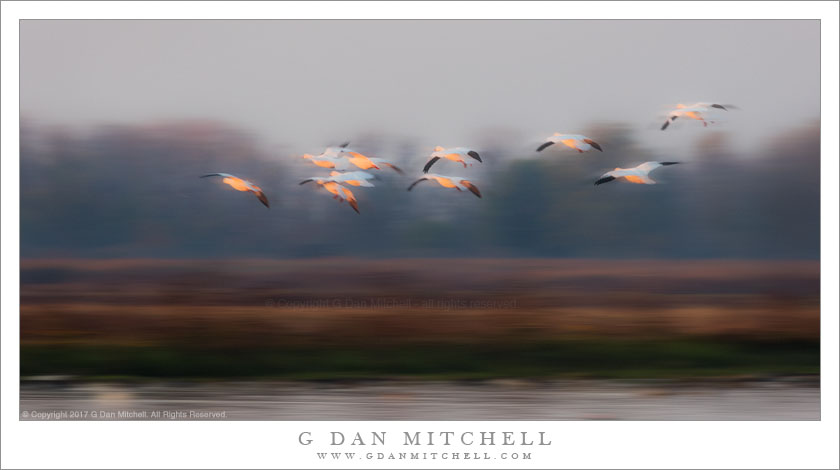
Into Evening Light

Into Evening Light
A small group of geese takes flight in evening light

Into Evening Light. © Copyright 2017 G Dan Mitchell – all rights reserved.

A small group of geese takes flight in evening light

There are many ways to photograph birds: sharp images of birds filling the frame that reveal the details of color and shape and feathers, landscape photographs that show them in the worlds they inhabit, shots that capture them social groups ranging form groups of a few individuals up to flocks of many thousands, captures of them engaging in particular behaviors, and much more. (I’m occasionally amused by discussions of “the way” to photograph birds of or “the right” equipment to do this.)

This flock of geese suddenly took to the air as the very last golden hour light shone across this hazy landscape, and the birds were partially illuminated by the colors of the warm sunset light, but against the less vibrant colors of the local surroundings. A sharp-edged photograph was a possibility, but here I think the abstracting blur of camera motion and fast-flying birds may better suggest the feeling of the scene.


G Dan Mitchell is a California photographer and visual opportunist. His book, “California’s Fall Color: A Photographer’s Guide to Autumn in the Sierra” is available from Heyday Books and Amazon.
Blog | About | Flickr | Twitter | FacebookGoogle+ | LinkedIn | Email


All media © Copyright G Dan Mitchell and others as indicated. Any use requires advance permission from G Dan Mitchell.

Wetlands Evening

Wetlands Evening
Trees, plants, and a few birds under a bank of clouds above San Joaquin Valley wetlands

Wetlands Evening. © Copyright 2018 G Dan Mitchell – all rights reserved.

Trees, plants, and a few birds under a bank of clouds above wetlands

The process of bird-photography, at least as I know it, is perhaps not quite what people who don’t photograph this subject might imagine. The actual practice and experience varies from photographer to photographer and, no doubt, from place to place. However, I’d be willing to bet that many people would be surprised at how much not-photographing goes on! There are amazing moments when we come upon a special scene, when a huge flock of geese lifts off, when we get close to a raptor, when the light and sky do something astonishing. Then there are all the other moments, and they form the majority of the experience. The birds are somewhere else. They are just a bit too far away. The light goes flat. It rains. And so on.

The fact of the matter is that in order to photograph those periodic extraordinary moments, you have to spend a lot of time just being there. If really special stuff happens, say 1% of the time, you’ll increase your odds of experiencing it if your base is 100 hours rather and one. Of course, that also means that you’ll increase the number of slow hours when not much happens. Be ready. Bring a book. Take a nap. Wander a bit. And sometimes take a look at other subjects, like the still and quiet grasses growing in a shallow pond beneath winter skies, even though there aren’t a whole lot of birds there.


G Dan Mitchell is a California photographer and visual opportunist. His book, “California’s Fall Color: A Photographer’s Guide to Autumn in the Sierra” is available from Heyday Books and Amazon.
Blog | About | Flickr | Twitter | FacebookGoogle+ | LinkedIn | Email


All media © Copyright G Dan Mitchell and others as indicated. Any use requires advance permission from G Dan Mitchell.

Snow Geese, Pond

Snow Geese, Pond
A flock of snow geese stands in a shallow wetland pond.

Snow Geese, Pond. © Copyright 2018 G Dan Mitchell – all rights reserved.

A flock of snow geese stands in a shallow wetland pond.

This is a somewhat different photograph of geese than I might usually make. More often I photograph them in flight or in huge flocks, either landed or flying, and quite often the photographs feature Ross’s geese. This group is none of those things. When I came to this spot — and, yes, I was looking for big flocks — I found small groups of geese (and other birds) that were mostly quietly tending to their business in these shallow ponds. There wasn’t a lot of flying, a lot of noise, or much else.

However, their relative passivity did give me a chance to make some photographs that can (especially when viewed larger than these web images permit) reveal some of the individuality of the birds in the group. Their heads are up, which often indicates that they are aware of something that focuses their attention, possibly a potential danger of some sort. (It could have been me, but I was using a long lens and was pretty far away.) Because of their erect bearing, we get to see the juxtaposition of all those heads and beaks, pointing in various directions. It is also possible (again, in a larger version of the photo) the tell-tale “grin” pattern on the sides of the beaks that characterizes snow geese. (It is easy to mistake them for Ross’s geese and vice versa, and the indicators can be a bit subtle.) In addition, contrary to our expectation that such bird will all look pretty much the same, among the members of this group you can spot some significant variations in appearance. For example, note the two birds with darker feathers or the several with distinctly yellow features on their heads.


G Dan Mitchell is a California photographer and visual opportunist. His book, “California’s Fall Color: A Photographer’s Guide to Autumn in the Sierra” is available from Heyday Books and Amazon.
Blog | About | Flickr | Twitter | FacebookGoogle+ | LinkedIn | Email


All media © Copyright G Dan Mitchell and others as indicated. Any use requires advance permission from G Dan Mitchell.
Geese and Sky

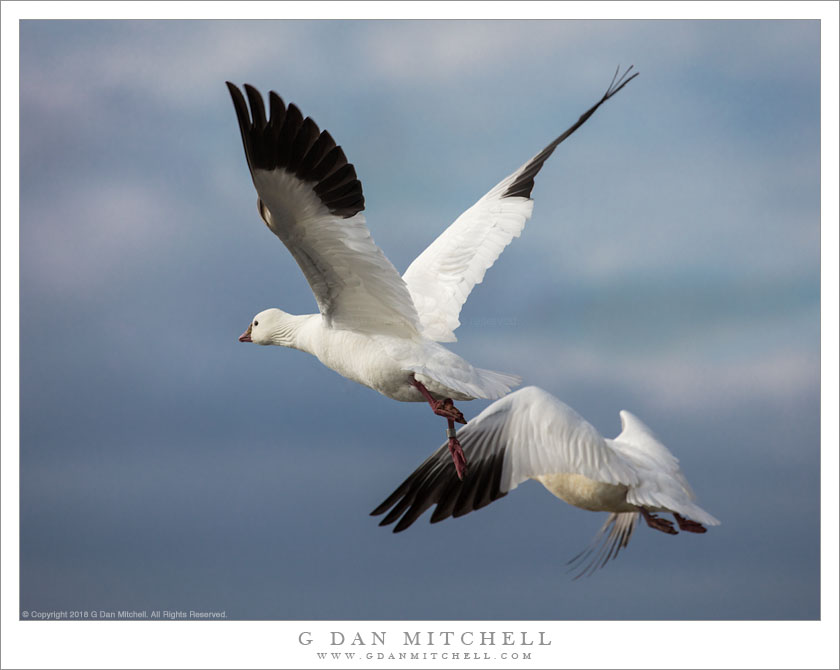
Geese and Sky
Two geese take flight into winter sky

Geese and Sky. © Copyright 2018 G Dan Mitchell – all rights reserved.

Two geese take flight into winter sky

There is something primal about being among these migratory birds, at least if you stop to ponder. They come to my part of the world every winter, settling in to wetland areas in California. But the opposite end of their remarkable migration is along the arctic shorelines of northern Canada, an annual migration that is astonishing to imagine. (Wikipedia tells me that the majority of the world’s Ross’s geese nest in the arctic tundra of the Queen Maud Gulf Migratory Bird Sanctuary.) To spend time with them is to become open to a world that is not the human world, one in which we are temporary visitors and in which they are the permanent residents.

Getting close to such birds requires a lot of patience and persistence. The first problem is managing to be in the places they frequent when they are actually there, and these could be almost anywhere. I’ve gone to such places only to find no geese or, perhaps more frustrating, spot a cloud of thousands of geese in the air a mile or more in the distance and at a location I can’t go to. Once you do find them, you can only get so close and then you must wait for them to come to you — either as the flock moves across the land or as they fly. Sometimes, with luck and a bit of prediction, you find yourself quite close, at which point you move slowly and quietly and hope to sustain the experience. On this afternoon a flock settled onto a levee across which my route travelled. I moved slowly into a close position and then waited, occasionally moving just a bit closer if it seemed that the flock wasn’t alerted by my presence. I made many photographs of them on the ground, and then — as always happens — they began to depart, suddenly lifting into the air in groups.


G Dan Mitchell is a California photographer and visual opportunist. His book, “California’s Fall Color: A Photographer’s Guide to Autumn in the Sierra” is available from Heyday Books and Amazon.
Blog | About | Flickr | Twitter | FacebookGoogle+ | LinkedIn | Email


All media © Copyright G Dan Mitchell and others as indicated. Any use requires advance permission from G Dan Mitchell.