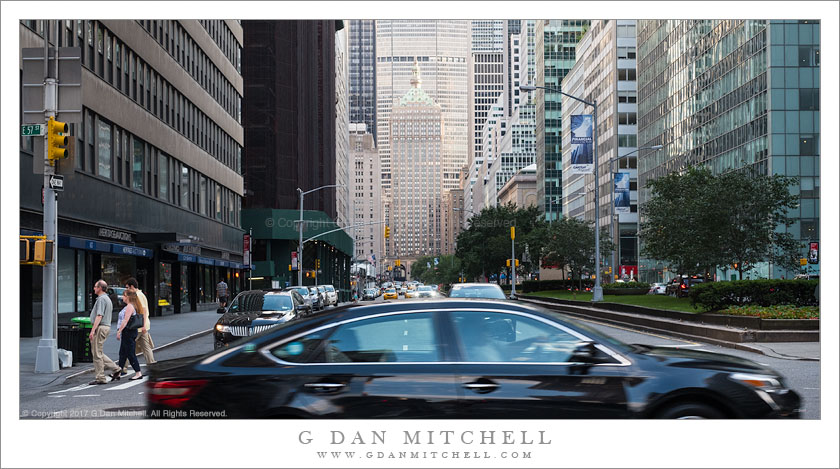
There is perhaps not a whole lot to write about this photograph, but here goes. My initial thought was of a photograph that included only buildings and street, with the perspective lines heading away to converge at the lighter towers in the distant center of the frame. I hoped that the pedestrians might be in the center or near two it as they passed by in the cross walk.
But photographing such a scene in any city, and perhaps especially in Manhattan, is a tricky thing. Obvious, I had to be in the street myself, which meant that I was crossing on the green light and pausing just long enough to make a photograph or two. This meant that I did not have much time to wait for the perfect conjunction of moving elements and… there was this car.
We returned last night from a week in Manhattan, mostly visiting family but also wandering… and eating… and photographing. I know for a fact that I’m not the only so-called nature or landscape photographer who also loves photographing the urban landscape, and when there is hardly a more varied or compelling location than New York City — from Central Park to the skyscraper canyons to the variety of neighborhoods. I’m often happy to just go out walking with my camera, with only the vaguest notions of what I’ll photograph, and to be open to surprise.
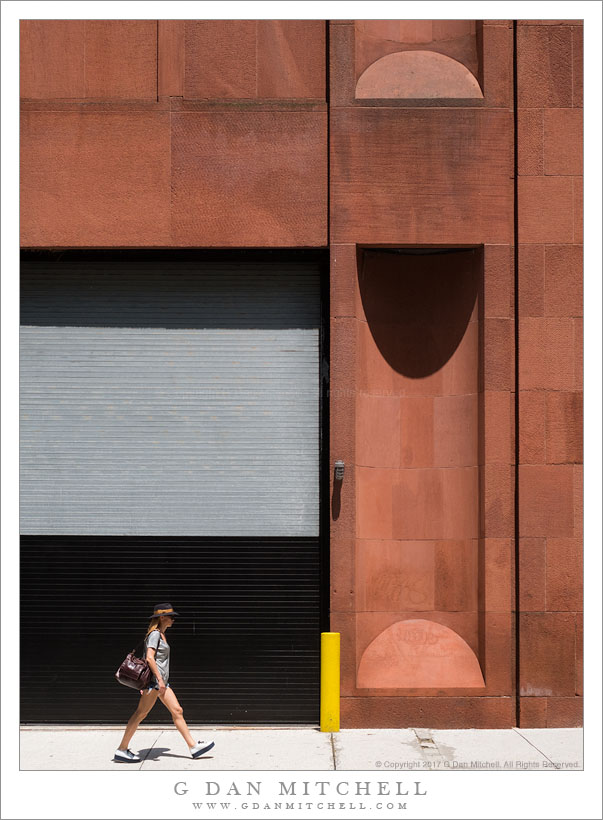
We were walking uptown from our hotel, which was on Grand, almost in the middle of the Little Italy area, and we decided to pass through the Washington Square area. We were almost there when we approach portions of the NYU campus and I saw this cubist scene, with colors, shapes, and textures that immediately reminded me of the sandstone canyons of the Southwest. (Yes, my mind works that way, even in the Big City.) I made a few quick initial exposures and then paused to see who would walk into the frame on this sunny morning.
Just after dawn, the precursors of a day of Death Valley dust storms
I’ve been through a number of desert dust storms in and around Death Valley National Park — ranging from minor “dust blowing through the campsite” events to “damaging to my vehicle” events. (The latter was some years back as I left the park and headed out to highway 395 and, as I later found out, drove through record-breaking wind and driving dust and sand, to the permanent distress of my windshield.) It is fair to say that my feelings about such conditions are mixed. Frankly, they are very unpleasant — the dust gets into everything, from clothes to eyes to camera gear, and it is almost impossible to do much of anything if you are inside a really bad storm. In fact, near the end of the day on which I made this photograph we simply had to hunker down indoors for several hours and wait for it to stop. But there can be a kind of terrible beauty in these events as well, and if you are cautious you can photograph them.
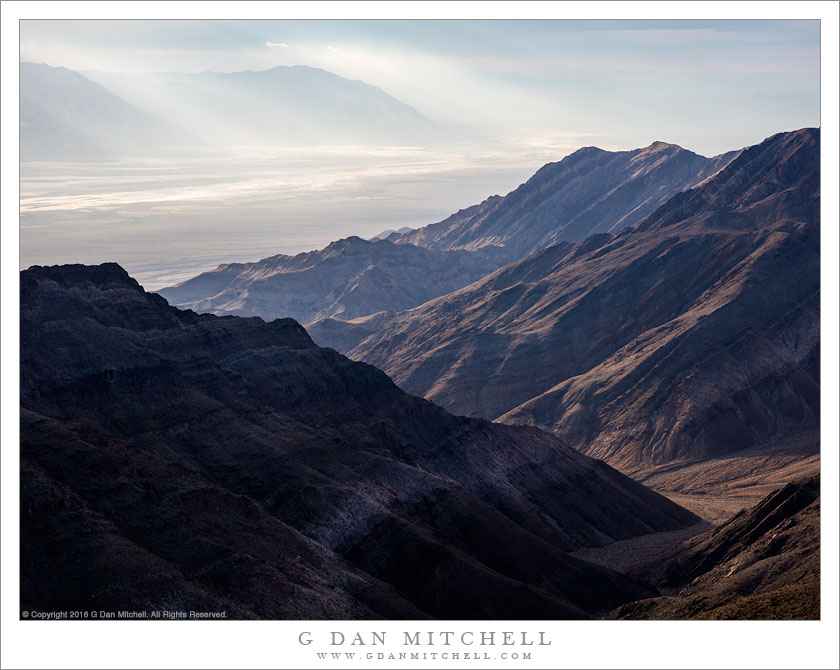
I recall a day many years ago when I started to make sense of the antecedent conditions that lead to such storms. It was the final day of a Death Valley visit and I was down along the southeast part of the main valley, when I noticed a kind of fuzzy glow in the atmosphere. I made a few photographs and headed north to leave the park, and within an hour or so I was engulfed in a huge cloud of dust. On the day I made this photograph we went to a high overlook along the top of a mountain range to photograph dawn light. This time I recognized that strange, milky atmosphere, seen along and above the Black Mountains in the distance in the photograph. The morning was, indeed, quite beautiful. But it was only hours later that we began to see dust above us — even though we were thousands of feet up in the mountains — as a giant storm developed, and by the time we returned to the bottom of Death Valley in the mid-afternoon one of the biggest dust storms I have seen enveloped the area.
The evening view down Trail Canyon, across Death Valley, and to the Black Mountains
The first day of any trip to Death Valley is often a long one for me. Typically it begins with a very early departure from the San Francisco Bay Area for the long drive down the Central Valley, east over Tehachapi Pass and then back to the north to reach the park. This year’s journey to the park was even longer since I took a first-day detour and briefly joined friends on the Carrizo Plain for an evening and a morning of wildflower photography. But the time I was on the road the second day it was mid-morning, and I arrived in Death Valley in the mid-afternoon to find winds and dust kicking up in the Valley. Not looking forward to camping in those conditions, I reconsidered and headed up to Wild Rose Canyon, where the mountains can provide some shelter.
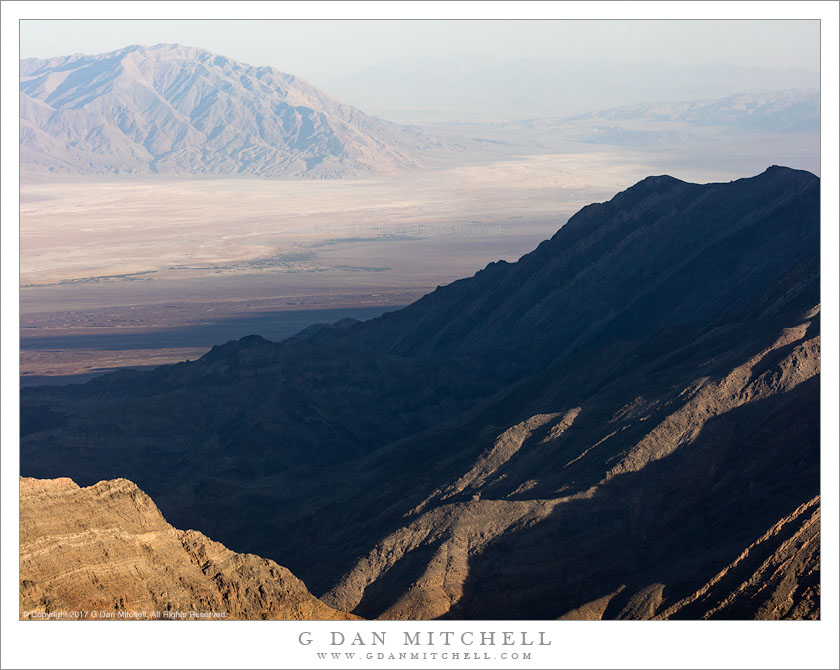
I got there and found plenty of campsites. I grabbed one and just sat around for a while, recuperating from too much time behind the wheel. However, I knew that I wanted to do some photography on this first evening, so I worked up the energy to rise from my camp chair and head out to a favorite spot along the ridge of the Panamint Range. Often my Death Valley visits combine return visits to places I know well and want to continue to explore photographically with visits to places I haven’t been before. This spot is a very familiar one by now, and it seemed like and almost sure bet for this first evening. It was hazy — remember the wind and dust I just mentioned? — but as the color of the light warmed near the end of the day the landscape’s features became a bit more visible. This photograph looks across Trail Canyon in the foreground, with the late-day shadows already concealing the features of the ridge, toward the main portion of Death Valley, with its large salt flats. Beyond lie the Black Mountains and the southern boundary of the park, with further mountains just barely visible through the distant haze.
Photographer and visual opportunist. Daily photos since 2005, plus articles, reviews, news, and ideas.
Manage Consent
To provide the best experiences, we use technologies like cookies to store and/or access device information. Consenting to these technologies will allow us to process data such as browsing behavior or unique IDs on this site. Not consenting or withdrawing consent, may adversely affect certain features and functions.
Functional
Always active
The technical storage or access is strictly necessary for the legitimate purpose of enabling the use of a specific service explicitly requested by the subscriber or user, or for the sole purpose of carrying out the transmission of a communication over an electronic communications network.
Preferences
The technical storage or access is necessary for the legitimate purpose of storing preferences that are not requested by the subscriber or user.
Statistics
The technical storage or access that is used exclusively for statistical purposes.The technical storage or access that is used exclusively for anonymous statistical purposes. Without a subpoena, voluntary compliance on the part of your Internet Service Provider, or additional records from a third party, information stored or retrieved for this purpose alone cannot usually be used to identify you.
Marketing
The technical storage or access is required to create user profiles to send advertising, or to track the user on a website or across several websites for similar marketing purposes.

 G Dan Mitchell is a California photographer and visual opportunist. His book, “California’s Fall Color: A Photographer’s Guide to Autumn in the Sierra” is available from Heyday Books and Amazon.