
Tag Archives: clouds

Dunes and Sky

Dunes and Sky
Morning light and clouds, sand dunes, Death Valley National Park

Dunes and Sky. Death Valley National Park, California. March 30, 2016. © Copyright 2017 G Dan Mitchell – all rights reserved.

Morning light and clouds, sand dunes, Death Valley National Park

For photographers (and probably for others, too) sand dunes are a source of endless fascination. There is always something interesting, from the smallest scale (footprints of insects?) to the largest, all-compassing landscape. None of this is ever the same twice except in the most general ways. While the general configuration remains from year to year, the specific details change quickly, sometimes as you watch. And because the sand itself is a fairly neutral subject, the effects of light — its angles and qualities and colors — play out in unending ways on the dunes.

As is typical, we had wandered out amongst the dunes before sunrise, beginning to photograph in predawn light and then moving to larger landscape subjects as the first pink sunlight struck distant desert mountains. Before long the sun was up and the light began to lose the early hour color. This can make the scene extremely stark and harsh, but on this morning high clouds muted its intensity and we continued to photograph. I had a vague idea of a photograph combining dune textures and sky in a mostly abstract form, and this area of the dunes provided a subject that fit that concept.


G Dan Mitchell is a California photographer and visual opportunist. His book, “California’s Fall Color: A Photographer’s Guide to Autumn in the Sierra” is available from Heyday Books and Amazon.
Blog | About | Flickr | Twitter | FacebookGoogle+ | LinkedIn | Email


All media © Copyright G Dan Mitchell and others as indicated. Any use requires advance permission from G Dan Mitchell.
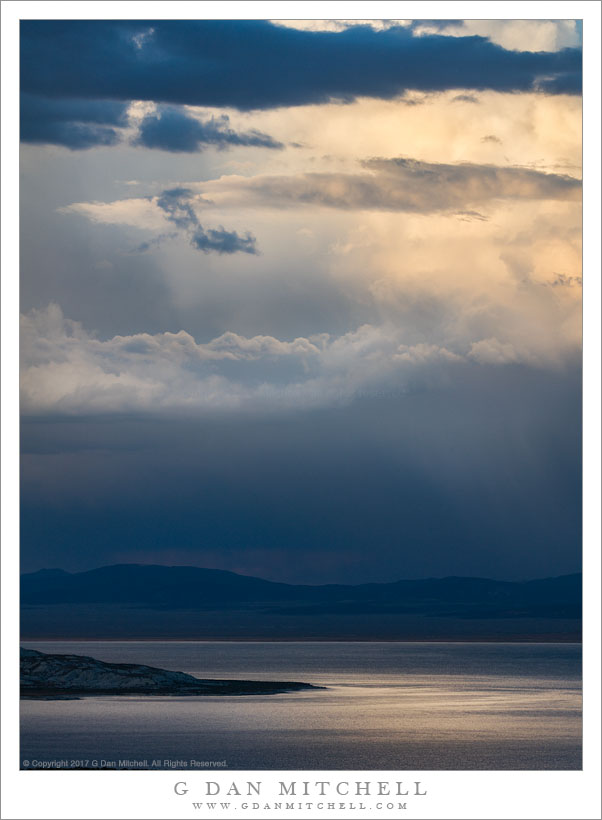
Panamint Valley and Mountains

Panamint Valley and Mountains
Looking into Panamint Valley and toward the Panamint Mountain Range

Panamint Valley and Mountains. Death Valley National Park, California. April 7, 2017. © Copyright 2017 G Dan Mitchell – all rights reserved.

Looking into Panamint Valley and toward the Panamint Mountain Range

When most people think of Death Valley they probably think of incredibly hot desert conditions. Those conditions are real, and are among the reasons that I do not visit the place during the warmer times of the year. But the conditions are quite a bit more varied than that reputation would suggest. I have been snowed on in Death Valley — on one memorable occasion photographic desert wildflowers in a snow storm! — and I have encountered temperatures ranging from over 100 degrees to below freezing. The variations are related to seasons (there are some very cold places here in the winter!) and to elevation, which ranges from below sea level to over 11,000′.

This photograph captures a range of those conditions in one image. It was a pleasantly warm, though cloudy, day as I left the park. The winds were howling down below in Panamint Valley, where a dust storm was beginning to kick up. Winter snow was still thick on the highest peaks of the Panamint range, and an incoming storm was developing and promising more precipitation.


G Dan Mitchell is a California photographer and visual opportunist. His book, “California’s Fall Color: A Photographer’s Guide to Autumn in the Sierra” is available from Heyday Books and Amazon.
Blog | About | Flickr | Twitter | FacebookGoogle+ | LinkedIn | Email


All media © Copyright G Dan Mitchell and others as indicated. Any use requires advance permission from G Dan Mitchell.
Lenticular Clouds, Death Valley

Lenticular Clouds, Death Valley
Dawn lenticular clouds from above the Black Mountains and Death Valley

Lenticular Clouds, Death Valley. Death Valley National Park, California. April 7, 2017. © Copyright 2017 G Dan Mitchell – all rights reserved.

Dawn lenticular clouds from above the Black Mountains and Death Valley

After a cold and windy final night camping in the Panamint Mountains of Death Valley National Park this spring, I woke up early and headed to an overlook along the summit ridge for the range before dawn. The most typical experience here is to watch the sun rise into clear skies above the desert landscape, but this time a weather system was approaching. It was cold, extremely windy, and the sky was filled with dark clouds. The only sunrise color I saw was along a distant band of light at the horizon, produced by clearer skies far to the southeast.

I had seen the giant lenticular cloud forming the previous afternoon. These clouds are almost a part of the landscape at times, arising in predictable locations and formed by interactions between the atmosphere and features such as mountain ridges. Unlike other clouds, the lenticular can remain almost stationary for long periods of time — but this is the first time I’ve awakened to see clouds from the previous day still there. The choice to use a monochrome interpretation allowed me greater interpretative latitude in the final image, and this let me draw attention to certain shapes mirrored by the clouds and the geology in the scene.


G Dan Mitchell is a California photographer and visual opportunist. His book, “California’s Fall Color: A Photographer’s Guide to Autumn in the Sierra” is available from Heyday Books and Amazon.
Blog | About | Flickr | Twitter | FacebookGoogle+ | LinkedIn | Email


All media © Copyright G Dan Mitchell and others as indicated. Any use requires advance permission from G Dan Mitchell.

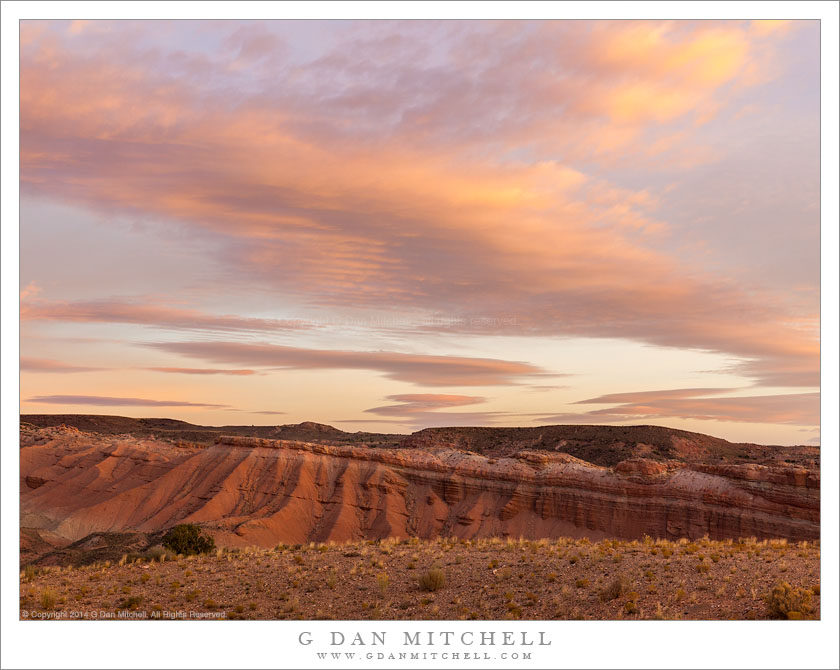
Sunrise Wave Cloud

Sunrise Wave Cloud
A wave cloud develops above Death Valley mountains at sunrise

Sunrise Wave Cloud. Death Valley National Park, California. April 6, 2017. © Copyright 2017 G Dan Mitchell – all rights reserved.

A wave cloud develops above Death Valley mountains at sunrise

When it comes to desert skies, it can be hard to find just-right conditions. Often the skies at Death Valley are simply clear, with few or no clouds aside from contrails from passing jets. And when there are clouds during the dawn and dusk hours when color potential is at its greatest, more distant clouds can block the light that would create the bright colors. This is especially true in the evening in Death Valley, where it is not uncommon for there to be thicker clouds in the moister regions to the west at sunset.

The latter situation was in play on this morning. In fact, I had originally planned to photograph south of this location. I had driven there and started to set up in the near darkness, only to realize that a fairly thick cloud deck was not going to clear and that it was going to block the morning light. I had a backup plan, and when I arrived at this spot a good distance to the north there was a break in the clouds. This color comes quickly and doesn’t last long — you more or less have to be ready for it before it is visible, though you may get a hint of developing color from clouds far off and near the horizon. Here a wave cloud is forming over Tucki Mountain, with a few more lenticular clouds out over the Cottonwood Range and beyond.


G Dan Mitchell is a California photographer and visual opportunist. His book, “California’s Fall Color: A Photographer’s Guide to Autumn in the Sierra” is available from Heyday Books and Amazon.
Blog | About | Flickr | Twitter | FacebookGoogle+ | LinkedIn | Email


All media © Copyright G Dan Mitchell and others as indicated. Any use requires advance permission from G Dan Mitchell.