
Tag Archives: erosion

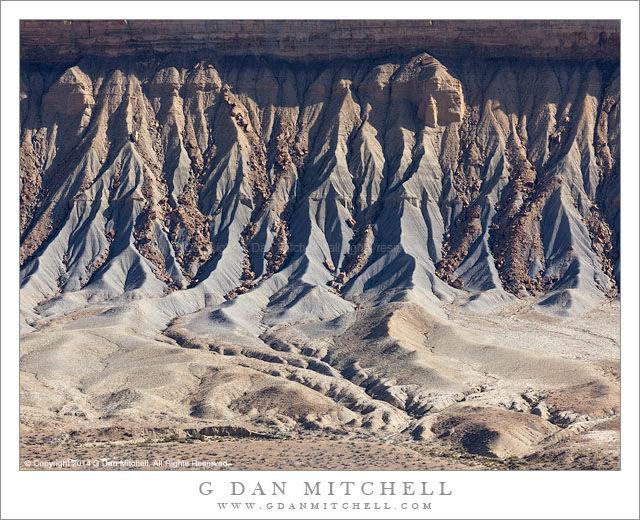
Erosion Gullies, Waterpocket Fold

Erosion Gullies, Waterpocket Fold

Erosion Gullies, Waterpocket Fold. Capitol Reef National Park, Utah. October 22, 2014. © Copyright 2014 G Dan Mitchell – all rights reserved.

Eroded gullies at the base of cliffs along the east side of the Waterpocket Fold Valley, Utah

The Waterpocket Fold is a huge geological feature of Utah that essentially defines Capitol Reef National Park, creating the deep valley along its east flank, the uplift that created the high ridge that runs the length of the park, and the many exposed edges of rock strata found all over the park. Its westward-trending uplift is also a reason why you may be challenged to get a traditional golden hour spectacular western sky photograph from along the west side of the park — the land continues to trend upward to the west there.

It is easy to overlook the feature if you are within the intimate landscape of many of the popular portions of the park, where you may be more attracted to washes and canyons and trees and nearby cliffs. But if you head down the east side of the park — on a long gravel road — the immensity of this feature becomes very obvious. This photograph was made from a high point in this part of the park, at a location that sits on the edge of this big valley and offers views to the north, east, and south. Here the view is straight across the valley toward the base of the tall ridge on the opposite side, below which there are steep gullies in the material that has eroded from the faces above, a bit of which is visible at the top of the frame.

And, yes, it is a double post day.


G Dan Mitchell is a California photographer and visual opportunist whose subjects include the Pacific coast, redwood forests, central California oak/grasslands, the Sierra Nevada, California deserts, urban landscapes, night photography, and more.
Blog | About | Flickr | Twitter | FacebookGoogle+ | 500px.com | LinkedIn | Email

Text, photographs, and other media are © Copyright G Dan Mitchell (or others when indicated) and are not in the public domain and may not be used on websites, blogs, or in other media without advance permission from G Dan Mitchell.
Erosion Patterns

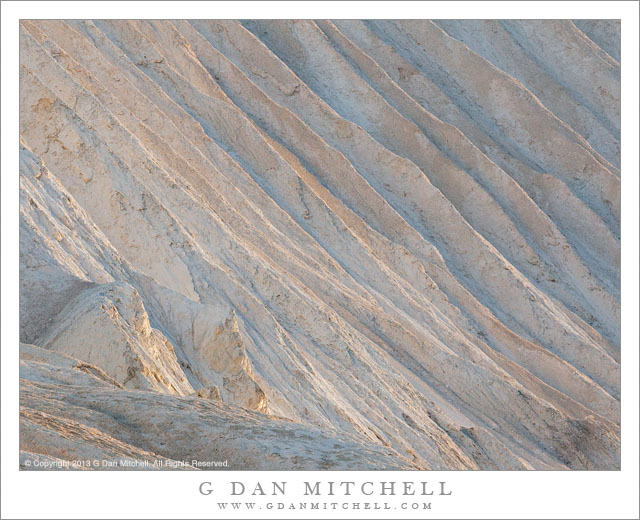
Erosion Patterns
Erosion Patterns

Erosion Patterns. Death Valley National Park, California. December 10, 2013. © Copyright 2014 G Dan Mitchell – all rights reserved.

Deeply furrowed erosion patterns in early morning light, Death Valley National Park

I spent some time photographing Death Valley National Park in mid-December, during a very cold time of the year. It is not unusual for the place to be surprisingly cold in the middle of winter, but this was a period of exceptional cold and it got down to 25 degrees in the Valley and much colder in some of the places I visited in the surrounding desert mountains. I had arrived the evening before I made this photograph, and a sequence of events on the drive it suggest an inauspicious beginning to this visit. I usually come in through Ridgecrest and then up through Trona. I usually drive almost straight through to Ridgecrest and then take a long, late lunch break there – getting my last espresso until I come back out of the park, filling up the gas tank, and so forth. I killed pretty close to an hour taking care of these odds and ends, and then started out of town toward Trona.

Less than a mile up the road I ran into a flashing warning sign announcing that this entrance to the park was closed! This necessitated a bit of backtracking and then travel north up US 395 to then head east toward the park on highway 190. I had originally planned to arrive by mid-afternoon, set up camp, and then photograph in the evening… but by the time I finished all of this driving it was dark when I arrived and I simply pulled into the campground and slept in my car. Early the next morning, feeling just a bit disconnected, I drove over towards 20 Mule Team Canyon where I knew I should be able to find some nice morning light. In fact I did, and I soon found this beautiful miniature landscape of nearly parallel gullies in a hillside along the canyon. As the first light hit the edges off the ridges between the gullies I found a composition that mostly filled the frame with them. I finished shooting here and moved on. At my next location, I finally must have engaged my brain, and I checked the camera to find that it had been left on ISO 3200 from my previous work photographing musicians backstage at a concert in natural light. Groan! So this photograph is one that I managed to salvage from that little escapade… and I’m grateful for the relatively good performance of modern cameras… even when the operator is not paying attention!

G Dan Mitchell is a California photographer and visual opportunist whose subjects include the Pacific coast, redwood forests, central California oak/grasslands, the Sierra Nevada, California deserts, urban landscapes, night photography, and more.
Blog | About | Flickr | Twitter | FacebookGoogle+ | 500px.com | LinkedIn | Email

Text, photographs, and other media are © Copyright G Dan Mitchell (or others when indicated) and are not in the public domain and may not be used on websites, blogs, or in other media without advance permission from G Dan Mitchell.
Slot Canyon Walls

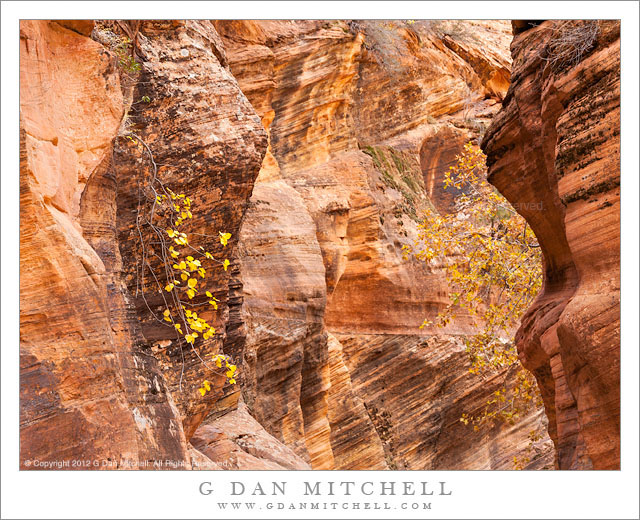
Slot Canyon Walls - The sculpted walls of a narrow and curving slot canyon, Zion National Park
The sculpted walls of a narrow and curving slot canyon, Zion National Park

Slot Canyon Walls. Zion National Park, Utah. October 22, 2012. © Copyright 2012 G Dan Mitchell – all rights reserved.

The sculpted walls of a narrow and curving slot canyon, Zion National Park

On the first non-travel day of my most recent Utah visit, since we were passing through Zion National Park on our way to points beyond, we decided to spend the better part of the day shooting there. For a few reasons, including that it was a bit early for fall color there, we chose to not go to Zion Canyon, but to instead spend the time along the Mount Carmel Highway that cuts through the park from west to east. Our object was to photograph the wide range of interesting subjects found there: sandstone of all shapes, textures, and colors; trees, both evergreen and those with fall foliage, and more.

We ended up spending most of the day along this route. An observer might have wondered a bit about us. We would drive slowly along the road in one direction, frequently slowing down and pulling over, looking around a bit, then either getting back on the road or piling out and heading off in various directions – either up into rocks or down into a wash or canyon. Eventually we worked our way to one end of the road’s passage through the park… and we turned around and headed back. We did this loop several times. Why? First, things that you might miss while driving one direction become easier to see when you head the other way. Second, and perhaps most important, light is not a static thing. It changes in may ways – intensity, color, angle, direction, what it strikes and what it misses – as the day goes on, so while the <i>landscape</i> might have been, arguably, “the same,” the <i>lightscape</i> was in constant flux. I made this photograph in a short section of slot canyon, contriving to find a point of view from which almost nothing but the twisting and overlapping forms of the rocks would be visible, along with just a bit of foliage.

G Dan Mitchell is a California photographer whose subjects include the Pacific coast, redwood forests, central California oak/grasslands, the Sierra Nevada, California deserts, urban landscapes, night photography, and more.
Blog | About | Flickr | Twitter | FacebookGoogle+ | 500px.com | LinkedIn | Email

Text, photographs, and other media are © Copyright G Dan Mitchell (or others when indicated) and are not in the public domain and may not be used on websites, blogs, or in other media without advance permission from G Dan Mitchell.

Aretes, Hoodoos, and Trees

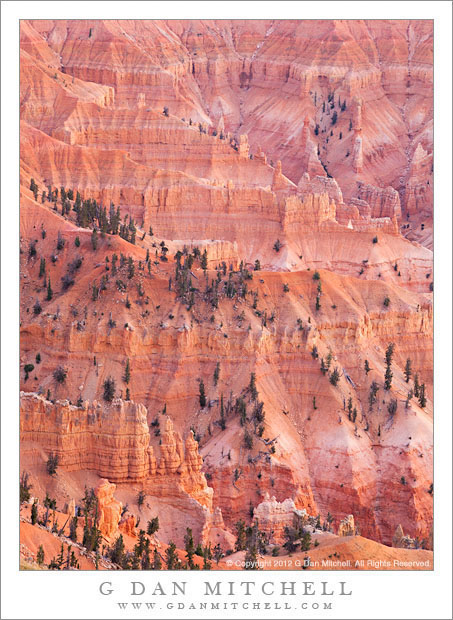
Aretes, Hoodoos, and Trees - Sunset light on sparse trees, hoodoos, and descending aretes at Cedar Breaks National Monument, Utah
Sunset light on sparse trees, hoodoos, and descending aretes at Cedar Breaks National Monument, Utah

Aretes, Hoodoos, and Trees. Cedar Breaks National Monument, Utah. October 4, 2012. © Copyright 2012 G Dan Mitchell – all rights reserved.

Sunset light on sparse trees, hoodoos, and descending aretes at Cedar Breaks National Monument, Utah

Cedar Breaks National Monument is almost (but not quite!) a sort of “one trick pony” of a park, though it is quite a spectacular pony! The main draw is the steep and very colorful Bryce-like canyon that drops precipitously from a high ridge along which the park road runs. Below this ridge, beautiful pink layers are exposed, and they have been heavily weathered and eroded into ridges, canyons, steep cliffs, and hoodoo, dotted here and there with a few sparse trees. The canyon faces roughly west, to the late afternoon and evening light on these red rock formations can be quite stunning. (Meanwhile, above the drop-off, the land is entirely different, consisting of gently rolling highland forest mixed with meadows.)

On our first day in the area we got settled in to lodging at nearby Brian Head ski area – where rooms were available at really low rates since this was probably about as “off-season” as you can be! We had some time in the evening so we headed up the road out of Brian Head and were quickly inside the monument. There are quite a few viewpoints along this road, so we picked one. This photograph was in light softened by low clouds on the horizon that still allowed a bit of fading light to illuminate the canyon features from the right.

G Dan Mitchell is a California photographer whose subjects include the Pacific coast, redwood forests, central California oak/grasslands, the Sierra Nevada, California deserts, urban landscapes, night photography, and more.
Blog | About | Flickr | Twitter | FacebookGoogle+ | 500px.com | LinkedIn | Email

Text, photographs, and other media are © Copyright G Dan Mitchell (or others when indicated) and are not in the public domain and may not be used on websites, blogs, or in other media without advance permission from G Dan Mitchell.