
Tag Archives: fall

Looking for Eastern Sierra Aspen Color?

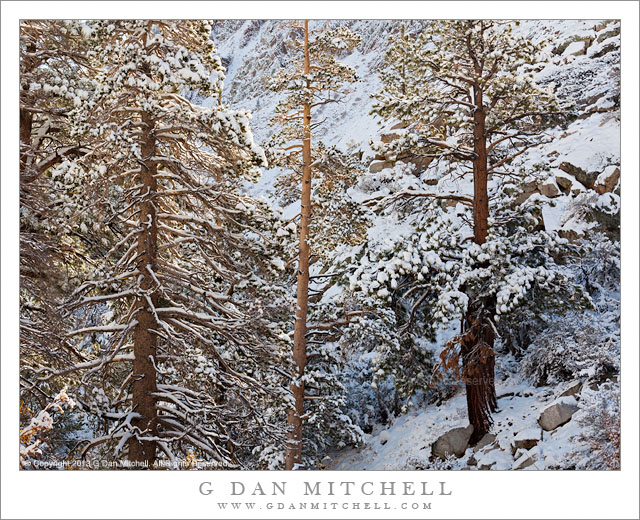
Since this is the season of aspen color along the east slope of the Sierra Nevada mountains, it seems like a good time to share a link to my article on where and how to find and photograph these beautiful trees: Sierra Nevada Fall Color Season – Coming Sooner Than You Think

Fallen Aspen Branch, Snow - A small aspen tree branch blown down by an early fall storm rests on snow, North Lake, California.
Fallen Aspen Branch, Snow – A small aspen tree branch blown down by an early fall storm rests on snow, North Lake, California.

“Fallen Aspen Branch, Snow” Sierra Nevada Range, California. © Copyright G Dan Mitchell – all rights reserved.

I originally wrote this article four years ago, in response to a lot of questions about this seasonal change, and I have updated it regularly since then. The short story is that the aspens begin to change near the end of September in a typical year, and if you know where to look you can find aspen color for the next three weeks or perhaps just a bit longer. The change starts in the highest groves of trees and then works its way down to lower elevations as the transformation progresses, with later potential down along the base of the range and in some of the east side canyons.

I have not (yet) been up to photograph the trees this season – though I plan to rectify that situation very soon! – but everything I’m hearing right now suggests that the change came earlier than usual this year. In a more typical year I would expect to see the best color perhaps starting right about now and continuing for another week or longer – but this year there are a lot of reports of high elevation trees already dropping leaves and of lower elevation areas already in peak form. If you are going this year, I would make it sooner rather than later!

G Dan Mitchell is a California photographer and visual opportunist whose subjects include the Pacific coast, redwood forests, central California oak/grasslands, the Sierra Nevada, California deserts, urban landscapes, night photography, and more.
Blog | About | Flickr | Twitter | FacebookGoogle+ | 500px.com | LinkedIn | Email

Text, photographs, and other media are © Copyright G Dan Mitchell (or others when indicated) and are not in the public domain and may not be used on websites, blogs, or in other media without advance permission from G Dan Mitchell.

About the Yosemite “Rim” fire… and more

UPDATE and a NOTE:

Update: Shortly after I posted this, my reports on highway 120 through the park via the Tuolumne Meadows area  were rendered incorrect/outdated by way of an updated announcement from the park service as follows:

“Beginning at 12:00pm on Wednesday, August 28th, Tuolumne Meadows and the High Sierra will only be accessible via Highway 120 East through Lee Vining.  The Tioga Rd/Hwy 120 East will be temporarily closed between White Wolf Lodge and the Big Oak Flat Rd./Hwy 120 West at Crane Flat; the closure is estimated to be 3 to 4 days.  Tuolumne Meadows Lodge, the High Sierra Camps, and Tuolumne Meadows and Porcupine Flat campgrounds all remain open.”

Basically, this means that you will not be able to use highway 120 as a route across the Sierra until further notice. I’m not surprised – in fact, I’ve been somewhat surprised that the road remained open this long. Apparently the following URL is also a good source of updates from the park: http://www.yosemitepark.com/yosemite-fire-update.aspx

Note: All of which brings me back to my original statement that I don’t have inside information on this fire, and that anyone traveling to the area needs to check official sources for conditions updates. I will likely not update this page as things change, so the information posted here should be regarded as potentially being out of date!

My original post follows…

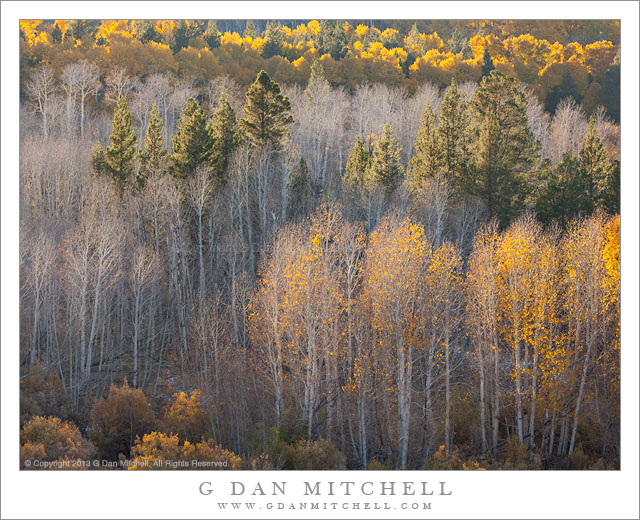
A few people have asked me for information about the “Rim” fire which started not far from Groveland near highway 120, and which is currently burning along the northwest boundary of Yosemite National Park, generally moving east and north toward the highway 108 area. While I know much of this area fairly well from many years (decades, actually) of visits, I do not have any inside information about the fire itself, nor am I an expert on wildfires. One good source of (limited but objective) information is the Stanislaus National Forest Rim Fire Incident web page. A map on this page is a quite amazing source of information, especially when combined with some familiarity with the area and a reading of various written reports. (The version on the main page seems to be based on Google Maps, and allows you to scroll around and zoom in.) Lots of folks who live and work in the area are sharing updates on the usual social media sites. The Mariposa Gazette is another local news source.

The fire started on August 17 more or less midway between Groveland and the  northwest park entrance and not far off of the highway 120 corridor near the Rim of the World area overlooking the canyon of the Tuolumne River. (Highway 120 is a common route for entry to the park from the west and northwest, and it connects via Tuolumne Meadows and Tioga Pass to the east side of the Sierra at the town of Lee Vining.) The spread of the fire at first was somewhat quick, which is no surprise given the extremely dry conditions in the Sierra following a second very dry winter and almost no real precipitation since late 2012. Then, between about August 20 and 23, the fire exploded, expanding  very quickly to cover a huge area generally to the east and north of the starting point, with the fire generally racing northeast but also spreading to the north and south. Continue reading About the Yosemite “Rim” fire… and more

Pipes, Window, Stucco Wall, and Shadows

Pipes, Window, Stucco Wall, and Shadows

Pipes, Window, Stucco Wall, and Shadows. San Jose, California. March 16, 2013. © Copyright 2013 G Dan Mitchell – all rights reserved.

Late winter shadows fall across a suburban scene composed of a stucco wall, pipes, and a window

This is the second of two “walking around” photographs made in my neighborhood while wandering around with a camera and a couple of lenses. These walks are exercises in seeing, in several ways: When I carry the camera I pay a lot more attention to things around me that I would otherwise simply not see at all, and the process of looking and seeing photographs in places that are so mundane that I might regularly walk past them helps “tune up” my seeing skills.

As I often do, on this walk I was paying a lot of attention to shadows falling across the walls of buildings. As I write in my last photo post, once I started noticing the shadows, which are everywhere in this area, I began to see the buildings differently. For example, here is a building that I might otherwise have simply thought of as a tan building. But now it is a building with branches “painted” over almost its entire surface. And in this one, the branch shadows converge on the mundane little collection of faucets and wires and what-not at the lower left, then spread and open up to surround the white window frame above and to the right.

G Dan Mitchell is a California photographer and visual opportunist whose subjects include the Pacific coast, redwood forests, central California oak/grasslands, the Sierra Nevada, California deserts, urban landscapes, night photography, and more.
Blog | About | Flickr | Twitter | FacebookGoogle+ | 500px.com | LinkedIn | Email

Text, photographs, and other media are © Copyright G Dan Mitchell (or others when indicated) and are not in the public domain and may not be used on websites, blogs, or in other media without advance permission from G Dan Mitchell.
Maple Leaves and Sandstone

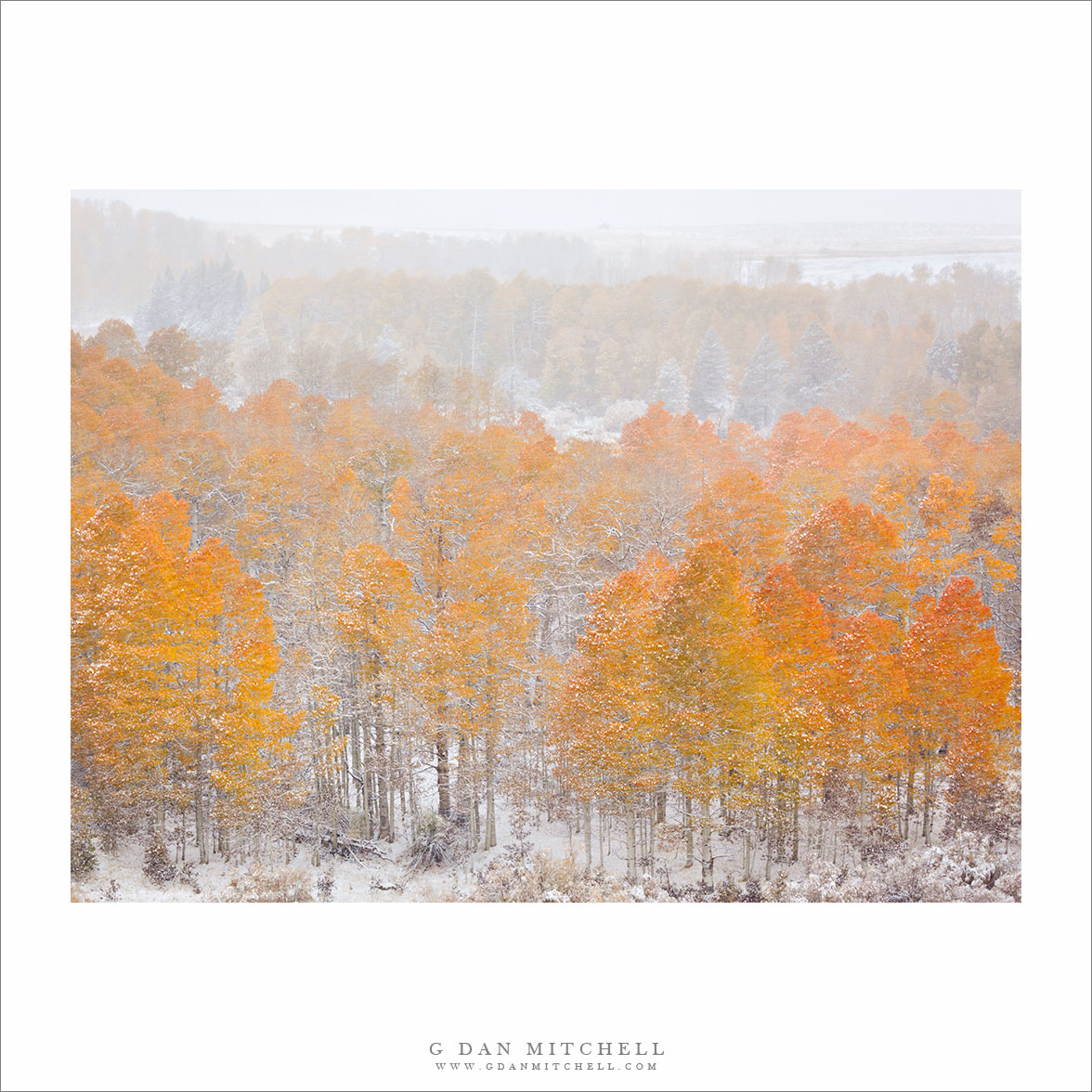
Maple Leaves and Sandstone - Fallen autumn maple leaves lie on pink sandstone slabs in the high country of Zion National Park
Fallen autumn maple leaves lie on pink sandstone slabs in the high country of Zion National Park

Maple Leaves and Sandstone. Zion National Park, Utah. October 22, 2012. © Copyright 2012 G Dan Mitchell – all rights reserved.

Fallen autumn maple leaves lie on pink sandstone slabs in the high country of Zion National Park

Wind is not usually the photographer’s friend, at least when the photographer is shooting natural subjects that include foliage. Later on this trip we were stymied by strong winds when shooting in the Escalante River Canyon, as the trees and leaves were being whipped around in the gale. But the same winds that create these problems – and I was experiencing some of them with tree photographs on this day, too – also bring down the autumn leaves and in the right conditions can create a thick carpet of the wild fall colors.

This photograph, like quite a few I have shared recently, was made in the bottom of a wash where leaves tend to collect, but by means of water flow and, as here, due to the wind. These maple leaves ranged in color from yellow-gold through orange to almost red, and here they littered the rocks in the bottom of the channel. Like spring flowers, these colors are a fleeting thing, and the leaves on the ground quickly blow away or turn brittle and brown.

G Dan Mitchell is a California photographer whose subjects include the Pacific coast, redwood forests, central California oak/grasslands, the Sierra Nevada, California deserts, urban landscapes, night photography, and more.
Blog | About | Flickr | Twitter | FacebookGoogle+ | 500px.com | LinkedIn | Email

Text, photographs, and other media are © Copyright G Dan Mitchell (or others when indicated) and are not in the public domain and may not be used on websites, blogs, or in other media without advance permission from G Dan Mitchell.