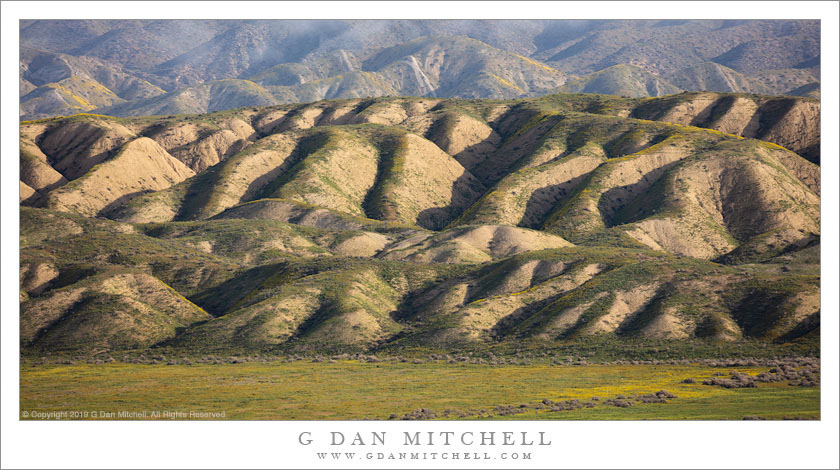
Morning light on spring-green hills of the Temblor Range.
Many landscapes appeal to me, but if you want to see geology laid bare I think the best places are those where few things grow, or at least where the plant life is so small and sparse as to permit a direct view of the land itself — places above timber line or arid places. This location, the Carrizo Plain, is not the driest place in California, but it is hot enough in the warm season to turn the place brown, and there are virtually no trees here.
The geology and geography here are worthy of attention. The most obvious feature is the Temblor Range of mountains lying to the northeast. These mountains mark the mighty San Andreas earthquake fault — its line sit at their base and the effects of its motion may be see in many places. A second feature, at least for me, is the immensity of the landscape. It is one of those places where distances are deceiving, and what looks like a quick jaunt across the valley could add up to nearly ten miles. On the morning I made this photograph the valley had been full of post-rain fog when the first light arrived. As it cleared it left a certain combination of both clarity and softness in the light.
G Dan Mitchell is a California photographer and visual opportunist. His book, “California’s Fall Color: A Photographer’s Guide to Autumn in the Sierra” is available from Heyday Books and Amazon.
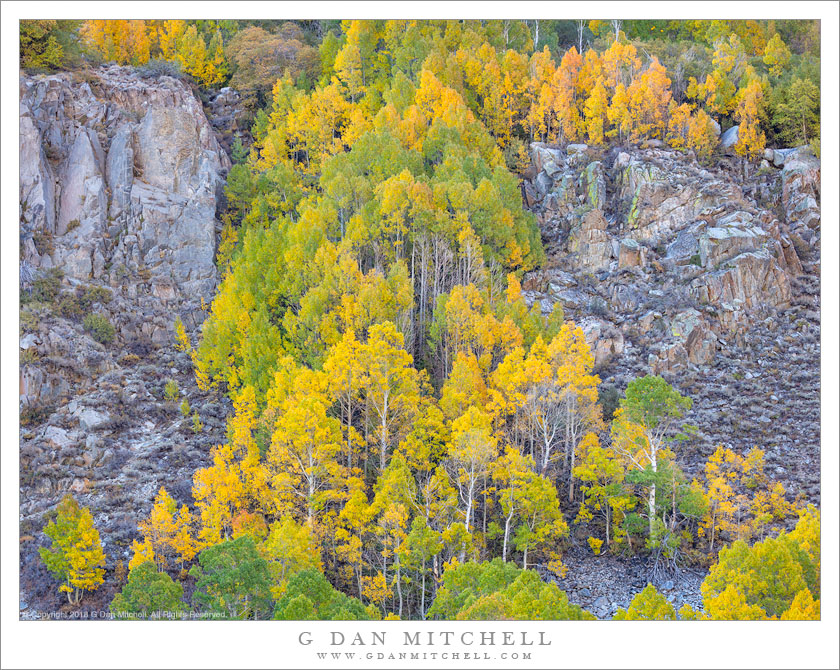
Colorful autumn aspen trees ascend a gully in the Eastern Sierra Nevada
In the past I have looked at this grove but not photographed it. Unfortunately, it stands in close proximity to an Eastern Sierra Nevada “feature” that has long troubled me — a fake waterfall apparently created by a nearby homeowner who seems to have redirected a stream over the top of an outcropping in order to make his/her backyard more picturesque. Unfortunately, once you see how this was done you cannot unsee it, and the “waterfall” becomes an annoying and even insulting feature.
But there are these trees. And they are quite nice, following a narrow gully in the break between two outcroppings of solid Sierra rock. I like the way that the ascending band of trees narrows as it rises, almost suggesting a queue of travelers passing through a narrow pass. There are also some beautiful and colorful trees stretched across the bench at the top of the outcroppings. Finally, these trees are in the state of color transition that I’m almost ready to say I enjoy the most — that stage where a few trees are intensely yellow/gold and others are still just barely beginning to change.
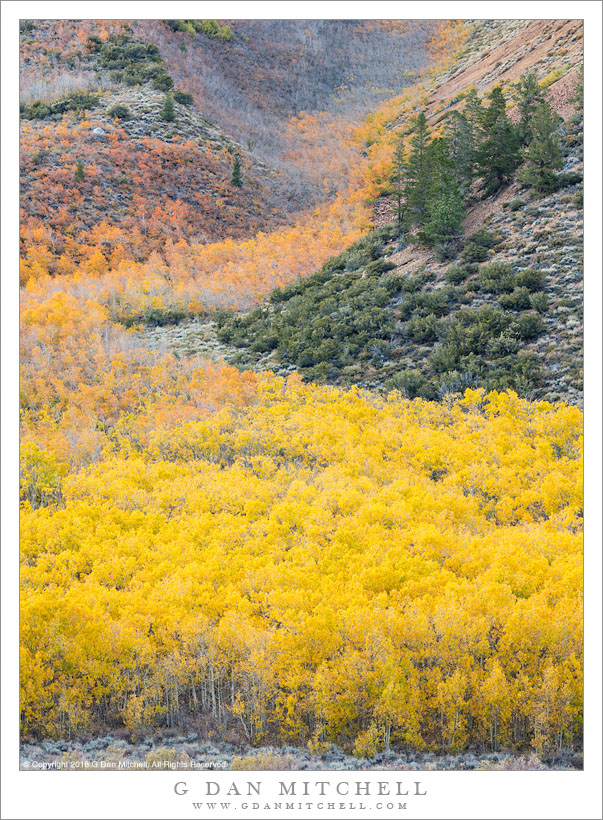
An aspen grove in various stages of autumn color transition descends from a Sierra Nevada ridge
Some of you may recognize this aspen grove as being somewhat iconic — though you probably also know that it is often photographed in a somewhat different way. It is also usually photographed at a different time of day from when I was there — on a cloudy afternoon as a weather front was starting to fill in over the Sierra crest, moving conditions toward the potential for some light rain or even a few snow showers a bit later on.
Once again, I photographed in this soft light rather than in full sun. The direct sun can overwhelm the colors of an aspen grove like this one, while the soft light opens and illuminates the shadow areas and can even make the colors seem more intense, especially when some of that soft light is a bit directional and fills in the color from behind. This grove is rarely all in prime color condition all at once, since it covers a range of exposures and elevations. Here it is quite colorful both at the bottom and the top, though there are clearly areas where the leaves have already dropped.
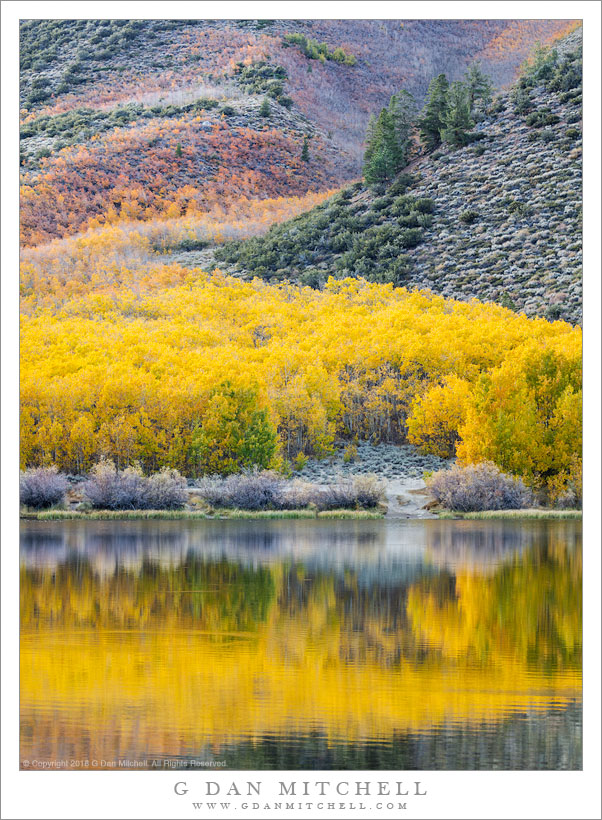
A grove of autumn aspen trees descends to the shoreline of a reflecting lake
I’ll use today’s post for several purposes — the usual photograph shared with comments, plus some thoughts and observations about the Sierra Nevada autumn color season. The photograph comes from a well-known location in the Eastern Sierra. I was fortunate to visit on a day when the usual crowds weren’t there, and I had the place almost to myself! It probably helped that I arrived at an unusual time of day, taking advantage of some broken clouds that produced some special light on the river of aspen trees flowing down the hillside to the edge of this subalpine lake. Parts of the grove were past the proverbial prime, but in some ways I like seeing a few bare trees in the scene.
On this past week’s short trip to photograph Eastern Sierra Nevada fall color I thought a bit about what I’ve learned over the years regarding the timing of the annual transition. One thing that I finally have accepted is that it is more or less impossible (with some minor exceptions) to accurately predict the evolution of the color in a particular year. A second thing I’ve realized is that, despite year-to-year variations within the season, the overall color transition tends to take place on more or less the same schedule each year. In other words, leaving aside truly exceptional times such as year five of the recent five-year drought, things tend to start and end on about the same schedule each year — despite the annual initial “observations” about how the season is going to be an unusual one — beginning high and working down the mountains to lower elevations, with other local variations in the evolution. (I confess… I’ve made those predictions, too.)
While the start/end times of the fall color transition tend to be fairly consistent (for example, week two of October is almost always a good bet), there are sometimes variations within that time frame. Some are obvious. For example, a big, windy storm when there are lots of yellow leaves will blow down many of those leaves, and there will be a gap of a few more days before other leaves change color and take their place. Others are more mysterious. I noted a few of those mysteries this year. For example, in one location where I often find trees losing their leaves somewhat earlier than elsewhere, this year there were still some green trees! Yet, in other nearby locations trees that are often coming into form just a bit later… were in full color already!
What to do? My advice is still pretty much the same. Target a time around the end of the first week of October for your visit, expecting that the week starting then is likely to produce good color. Once on the scene, be alert for variations and be ready to change plans. If one area is still green, try going higher. If the trees you visit seem to be losing (or have already lost!) their leaves when you get there, try a lower elevation, a location with larger trees, or a deep east side canyon. And realize that it is almost unheard of for all the trees in an area to be at peak color simultaneously — you are far more likely to find some bare and some green trees mixed in with your trees in prime condition.
What about this year? Based on what I saw last week, this weekend (October 12, 13, 14) should be great in many places. In addition, given the number of purely green trees I saw in various locations, it should be quite possible to still find excellent color in another week.
Photographer and visual opportunist. Daily photos since 2005, plus articles, reviews, news, and ideas.
Manage Consent
To provide the best experiences, we use technologies like cookies to store and/or access device information. Consenting to these technologies will allow us to process data such as browsing behavior or unique IDs on this site. Not consenting or withdrawing consent, may adversely affect certain features and functions.
Functional
Always active
The technical storage or access is strictly necessary for the legitimate purpose of enabling the use of a specific service explicitly requested by the subscriber or user, or for the sole purpose of carrying out the transmission of a communication over an electronic communications network.
Preferences
The technical storage or access is necessary for the legitimate purpose of storing preferences that are not requested by the subscriber or user.
Statistics
The technical storage or access that is used exclusively for statistical purposes.The technical storage or access that is used exclusively for anonymous statistical purposes. Without a subpoena, voluntary compliance on the part of your Internet Service Provider, or additional records from a third party, information stored or retrieved for this purpose alone cannot usually be used to identify you.
Marketing
The technical storage or access is required to create user profiles to send advertising, or to track the user on a website or across several websites for similar marketing purposes.