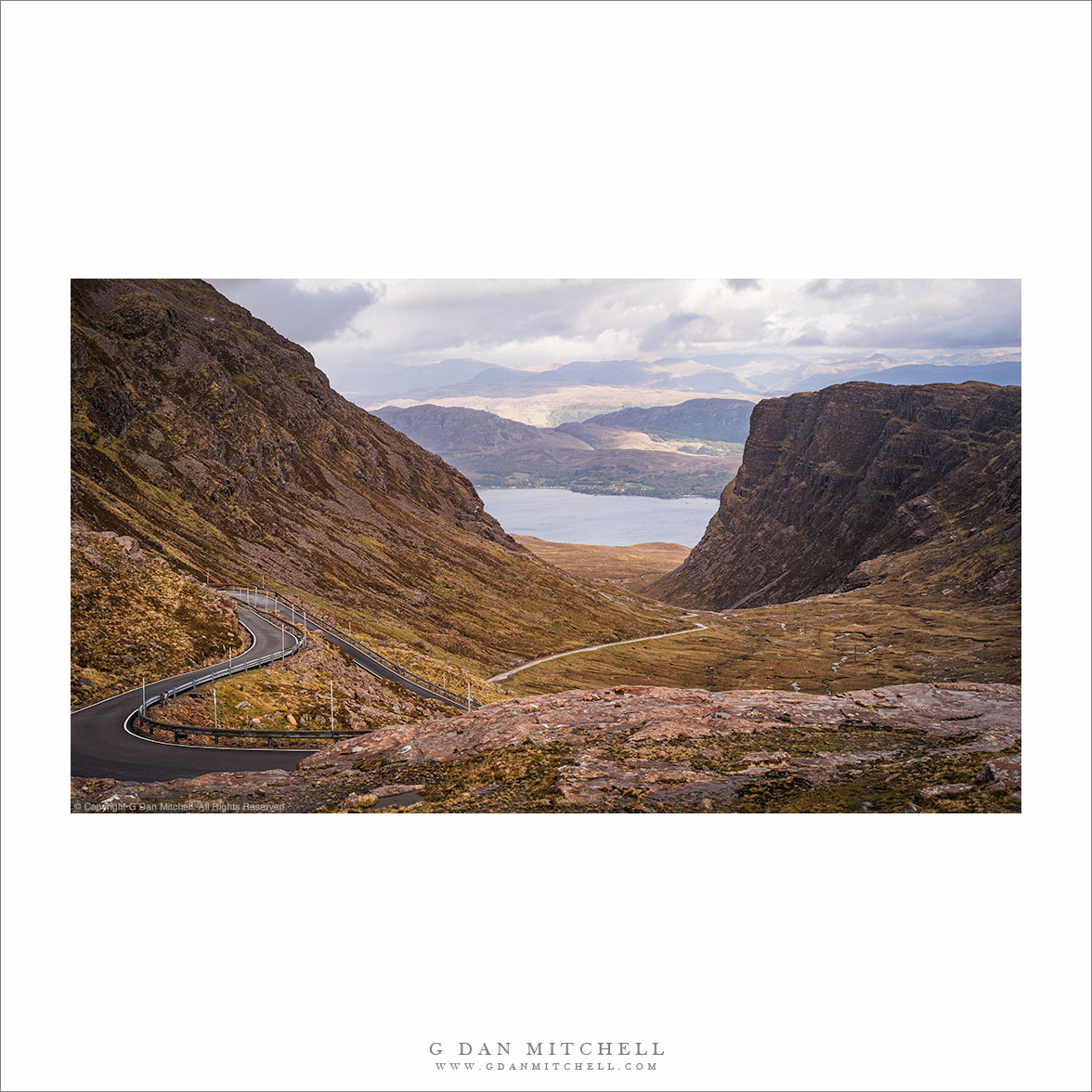
“Below Applecross Pass” — The road from Applecross Pass winds through a deep canyon toward Kishorn and Ardarroch.
We were surprised by this spectacular canyon soon after we began our return drive towards Ullapool from Applecross, on the western Scottish coast. The road climbed steadily from Applecross, passed through barren alpine country, and offered great views to the west toward Skye and other islands. The road leveled off near the high point as it arrived at the pass.
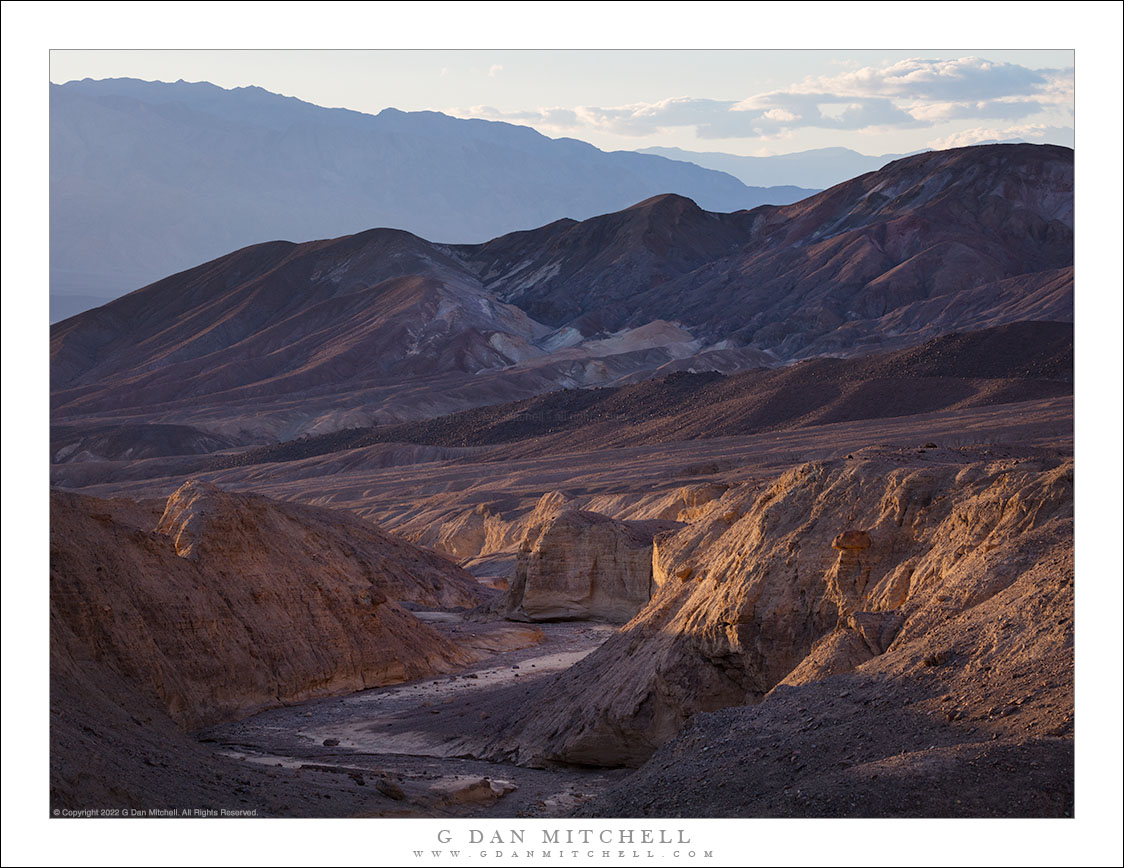
The last of the day’s light illuminates a wash descending though desert mountains, Death Valley National Park.
This feels like a “quiet photograph” to me — a desert scene that appears to be almost entirely static. In fact, one of the most powerful desert experiences I have had in the desert comes from moments in lonely, quiet places where it seems that nothing is moving and that it has been that way for a very long while. It is as close to the feeling of time stopping as we’re likely to experience.
The truth is that I made this photograph in a location that is not exactly quiet and still. Very close to my position there were dozens of people lined up to photograph one of the icons of Death Valley. (This particular icon is interesting but not photographically compelling to me, but as I mentioned in another recent post… my perspective can change!) The photograph illustrates another useful idea in photography, that when you are faced with an obvious subject it is still good to look around at all of the other things that might be worthy of your attention.
G Dan Mitchell is a California photographer and visual opportunist. His book, “California’s Fall Color: A Photographer’s Guide to Autumn in the Sierra” is available from Heyday Books, Amazon, and directly from G Dan Mitchell.
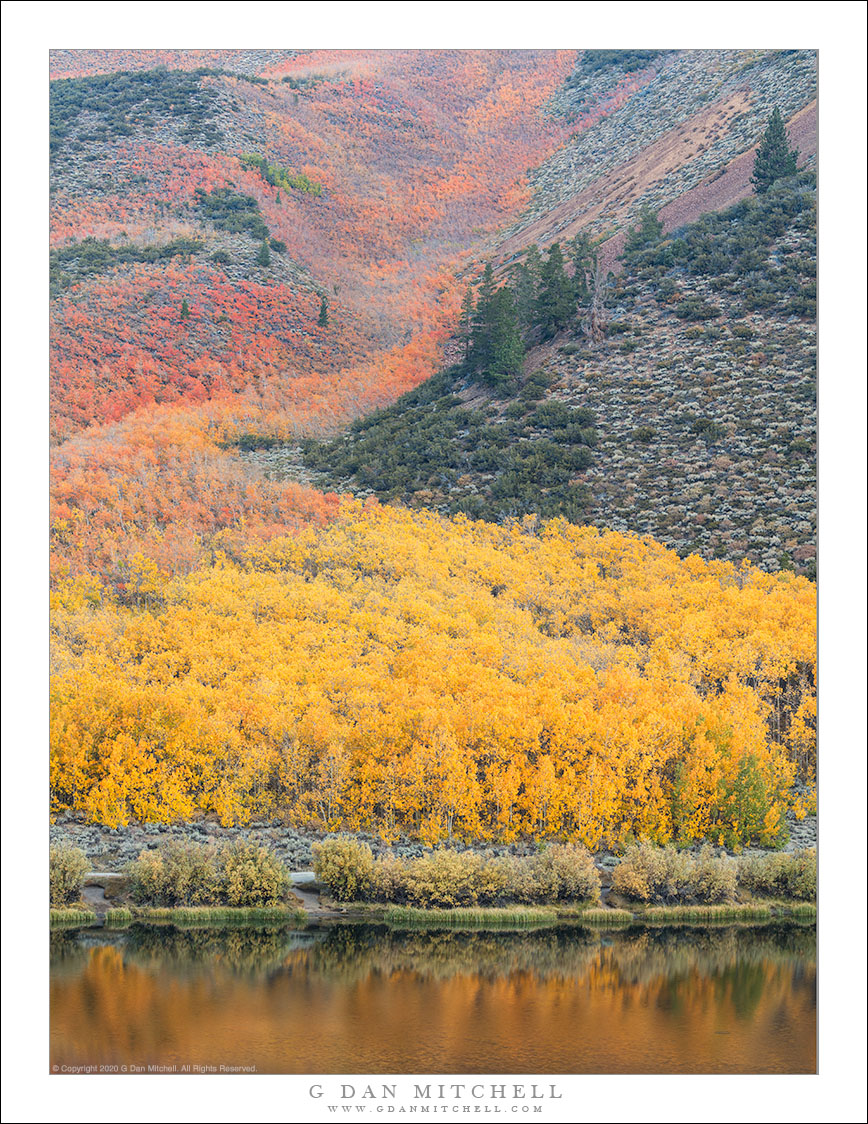
Autumn aspens descend from a ridge to the shore of an Eastern Sierra Nevada subalpine lake.
This spot is probably familiar to you, especially if you use the version of the Mac OS that used a different photograph of the feature as its branding. This aspen forest or grove — which someone once aptly referred to as the “Cheetos Forest” — is an example of something you can find in many Sierra locations, namely aspen groves that follow a watercourse as it descends from the heights. The result can be the appearance that the grove itself seems to flow over the landscape.
This grove also provides a notable example of other transitions that may take place within a single aspen grove. The color variation from top to bottom here is striking, with red autumn leaves up high, a distinct orange band in the middle, and then yellow/gold trees as the trees fan out just above the lake. The size of the trees also evolves within the grove from very small “scrub aspens” higher up to larger (though still not gigantic) trees lower down.
G Dan Mitchell is a California photographer and visual opportunist. His book, “California’s Fall Color: A Photographer’s Guide to Autumn in the Sierra” is available from Heyday Books and Amazon.
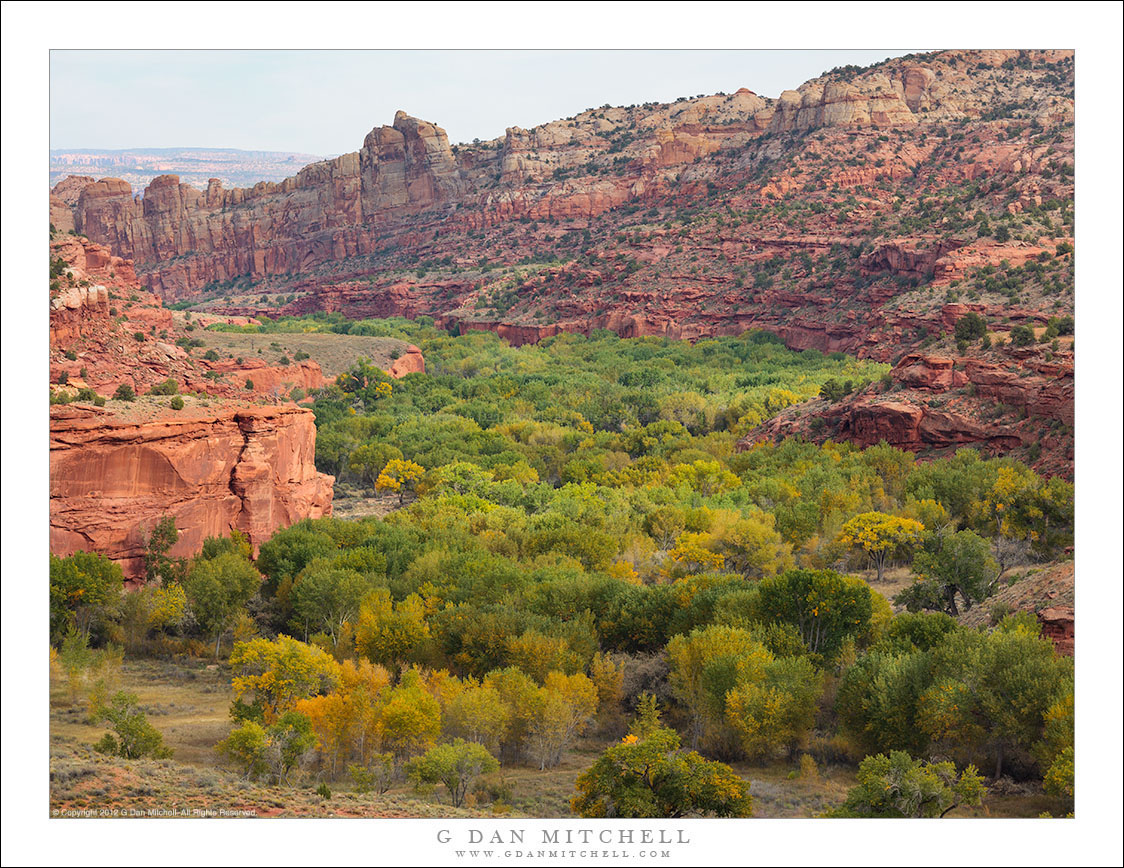
If this photograph looks familiar, that may be because it is the landscape orientation presentation of a scene I shared a few weeks ago. The Escalante River and the remarkable national monument (which we hope is soon restored to its original boundaries) through which it flows are beautiful. This beauty takes many forms — the quiet of a river bend deep in the canyon, the dry and almost. barren uplands from which the canyon is invisible, and a few grand and open scenes like this one.
Much of the canyon is difficult to access, and walking to and through it is ideal. But on this day we were driving between Escalante and Boulder, and when we crossed the river here clouds were breaking up the sun and alternating bands of light and shadow were moving across the early autumn landscape.
G Dan Mitchell is a California photographer and visual opportunist. His book, “California’s Fall Color: A Photographer’s Guide to Autumn in the Sierra” is available from Heyday Books and Amazon.
Photographer and visual opportunist. Daily photos since 2005, plus articles, reviews, news, and ideas.
Manage Consent
To provide the best experiences, we use technologies like cookies to store and/or access device information. Consenting to these technologies will allow us to process data such as browsing behavior or unique IDs on this site. Not consenting or withdrawing consent, may adversely affect certain features and functions.
Functional
Always active
The technical storage or access is strictly necessary for the legitimate purpose of enabling the use of a specific service explicitly requested by the subscriber or user, or for the sole purpose of carrying out the transmission of a communication over an electronic communications network.
Preferences
The technical storage or access is necessary for the legitimate purpose of storing preferences that are not requested by the subscriber or user.
Statistics
The technical storage or access that is used exclusively for statistical purposes.The technical storage or access that is used exclusively for anonymous statistical purposes. Without a subpoena, voluntary compliance on the part of your Internet Service Provider, or additional records from a third party, information stored or retrieved for this purpose alone cannot usually be used to identify you.
Marketing
The technical storage or access is required to create user profiles to send advertising, or to track the user on a website or across several websites for similar marketing purposes.