
Tag Archives: national

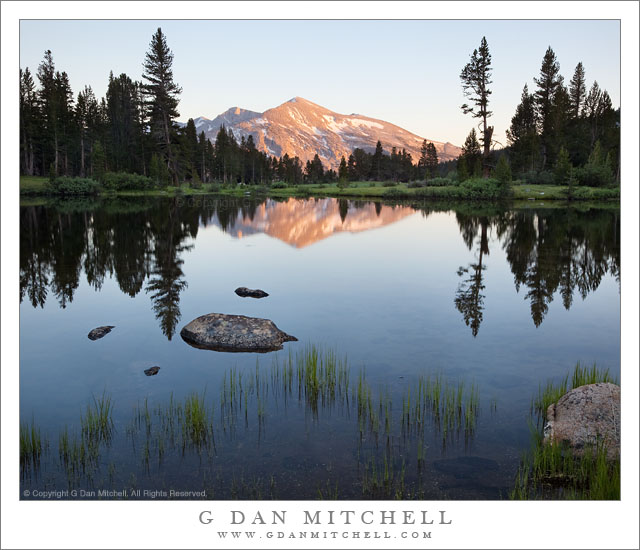
Mammoth Peak Reflected in Tioga Tarn

Mammoth Peak Reflected in Tioga Tarn

Mammoth Peak Reflected in Tioga Tarn. Yosemite National Park, California. July 22, 2010. © Copyright G Dan Mitchell – all rights reserved.

Mammoth Peak in sunset light, reflected in the still surface of Tioga Tarn, Tioga Pass, Yosemite National Park.

This view of Mammoth Peak on Kuna Crest in the Yosemite High Country from the Tioga Tarns at the top of Tioga Pass is a classic Sierra Nevada scene. The foreground tarns are lush green in the early summer after the snow melts out and fall into shadow early in the evening as the sun drops behind the ridge between this area and Gaylor Lakes. Mammoth Peak, however, has an almost unobstructed line of sight to the west, so this peak continues to hold the sunset light until the last possible minute. (Don’t let the peaceful appearance of the scene fool you – I was being devoured by clouds of mosquitos as I made these exposures.)

In order to deal with the extremely large dynamic range between the Mammoth Peak snow fields in direct sun and the very dark shadows of the nearby forest I resorted to exposure blending and a few other post-processing techniques. With exposure blending, I make two exposures, one optimized for the brightest areas of the scene and the second a slightly longer exposure to capture a bit more of the shadow detail. In post I began with the darker frame, since that presented Mammoth Peak the way I remembered it. Then I placed to other exposure beneath it and used a mask layer to reveal some of the lighter areas from the lower layer.


G Dan Mitchell is a California photographer and visual opportunist. His book, “California’s Fall Color: A Photographer’s Guide to Autumn in the Sierra” (Heyday Books) is available directly from him.

G Dan Mitchell: Blog | Bluesky | Mastodon | Substack Notes | Flickr | Email


All media © Copyright G Dan Mitchell and others as indicated. Any use requires advance permission from G Dan Mitchell.

Lodgepole Pine, Evening Shadows

Lodgepole Pine, Evening Shadows

Lodgepole Pine, Evening Shadows. Yosemite National Park, California. July 22, 2010. © Copyright G Dan Mitchell – all rights reserved.

The evening shadow cast by a nearby high ridge approaches a lone lodgepole pine and an old snag near Tioga Pass, Yosemite National Park.

One of my favorite kinds of light is that found at the edges of shadows from higher peaks as they move across lower terrain. (A secret: Among other “tricks,” I like to find and follow these margins when I shoot in Yosemite Valley, too.) Because this light most often happens during the relatively early and late hours of the day, the color quality of the light tends to be warm and the angle low. As the patterns of light and shadow move across the landscape, individual elements may get picked out the light and can often be isolated against darker backgrounds, as in this photograph.

The Sierra is full of trees pretty much like this one, and such meadows with the isolated small and large trees and scattered boulders are not hard to find. This particular tree is in one of the extensive meadow areas in the general area of Tioga Pass. The photograph was made in the very late afternoon as the tall ridge to the west was blocking the sun.

Despite the still and tranquil nature of the scene, this is an example of a sort of shot that reveals the wrongness of the idea that all landscape is done slowly and methodically and with all the time in the world to work. Sometimes that is the case, but when you work the margins of shadows (or many similar dynamic subjects) there may only be brief seconds when the light is where you want it. An observer might find it humorous to watch the photographer run to get into position and then work very quickly.

G Dan Mitchell Photography | Flickr | Twitter (follow me) | Facebook (“Like” my page) | LinkedIn | Email
Text, photographs, and other media are © Copyright G Dan Mitchell (or others when indicated) and are not in the public domain and may not be used on websites, blogs, or in other media without advance permission from G Dan Mitchell.

Shoreline Grasses and Subalpine Pond

Shoreline Grasses and Subalpine Pond
“Shoreline Grasses and Subalpine Pond” — Passing clouds reflected in the surface of a subalpine pond with summer meadow grass, Tioga Pass, Yosemite National Park.

I made this photograph on a special afternoon late last July. Although I had been across Tioga Pass earlier in the season when it was still very snowy, this was my first real visit to the summer high country of the season. It was a beautiful, sunny afternoon with just a few fluffy clouds floating about when I came to the meadows near Tioga Pass. The color of the meadow grasses was at just that perfect point that we think of when we imagine summer subalpine meadows – the intense green just before the wildflowers bloom and the inevitable change toward fall begins. (Yes, after some summers in the high country this cycle becomes clearer and clearer.)

Continue reading Shoreline Grasses and Subalpine Pond

Boulders and Spring Torrent, Cascade Creek

Boulders and Spring Torrent, Cascade Creek
“Boulders and Spring Torrent, Cascade Creek” — Runoff from spring snow melt rushes over boulders of Cascade Creek, Yosemite National Park.

I recently posted the black and white version of this photograph of Cascade Creek in full spring flow.

The color version of this photograph posed a series of post-processing questions and problems that others who have worked with a scene like this one can probably imagine. The creek descends through a narrow, rocky gorge at this point and I photographed it early in the morning before any direct sunlight was able to reach the water. Benefits of shooting at this time included the softer light, which tends to both throw some light into the shadows and to soften the brightest highlights. This also permits a longer exposure which allows the water to blur a bit and express the wild motion of the creek. However, since the primary source of light was the open sky, the camera “sees” a very blue scene. (Our visual system compensates for this, so it doesn’t look as blue as it really is when you are on the scene.)

There are several ways to deal with the color balance issues that this situation creates. You could just “go with the blue,” and I’ve seen photographs done that way. I’ve even seen some in which the photograph amped up the saturation and ended up with something very blue. In general, that’s not my thing! I’m most often looking for something that seems “believable” – it may not be objectively accurate, but I intend it to be “subjectively accurate.” With this in mind, my first instinct was simply to warm the color balance in order to move away from the blue cast and toward a warmer one.

My immediate impression was that this was an improvement, and I worked with this interpretation for several days – but something about it didn’t sit quite right with me. (This is perhaps one reason that I also worked with the black and white rendition in the meantime.) Eventually I did some comparisons between the “warmed up” version and the original… and neither seemed like what I was after. The overly blue original looked garish but the overly warm version seemed artificial. I tried some other approaches and finally discovered that because the blue was so intense that I could simply desaturate it – more than you might think – and keep the “colder” coloration without letting it overwhelm the image.

G Dan Mitchell Photography | Flickr | Twitter (follow me) | Facebook (“Like” my page) | LinkedIn | Email
Text, photographs, and other media are © Copyright G Dan Mitchell (or others when indicated) and are not in the public domain and may not be used on websites, blogs, or in other media without advance permission from G Dan Mitchell.

Canon EOS 5D Mark II (at B&H)
Canon EF 70-200mm f/4 L USM at 126mm (at B&H)
ISO 100, f/16, 1/8 second