
Tag Archives: photography

Tourist Shop, Night

Tourist Shop, Night
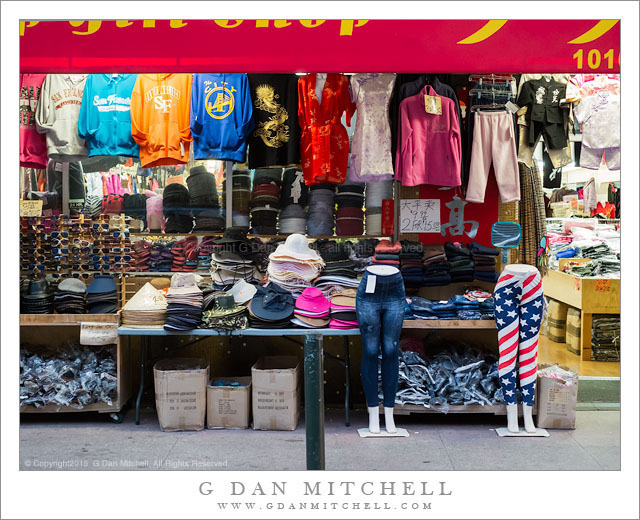
Front of a Chinatown tourist shop at night, San Francisco

Tourist Shop, Night. San Francisco, California. July 25, 2015. © Copyright 2015 G Dan Mitchell – all rights reserved.

Front of a Chinatown tourist shop at night, San Francisco

Like any big city popular with tourists, San Francisco has its share — and then some! — of these little shops whose sole purpose seems to be to sell cheap proof that “I was there!” to folks visiting the city. This one happens to be in the densely packed Chinatown district of the City, right on Grant, but you can find the same thing alone the areas of the waterfront that are on the tourist circuit and in a number of other places.

The items included in the stock of such shops, while often sharing the same level of kitsch and cheap manufacture, are often a sort of study in the ways that cities portray themselves and in the ways they are viewed. Exhibit #1: How about those American flag tights! Wow! It was getting late when we passed through here, and many shops had already closed or were in the process of closing.


G Dan Mitchell is a California photographer and visual opportunist. His book, “California’s Fall Color: A Photographer’s Guide to Autumn in the Sierra” is available from Heyday Books and Amazon.
Blog | About | Flickr | Twitter | FacebookGoogle+ | 500px.com | LinkedIn | Email


All media © Copyright G Dan Mitchell and others as indicated. Any use requires advance permission from G Dan Mitchell.
Three Men, Urban Garden

Three Men, Urban Garden
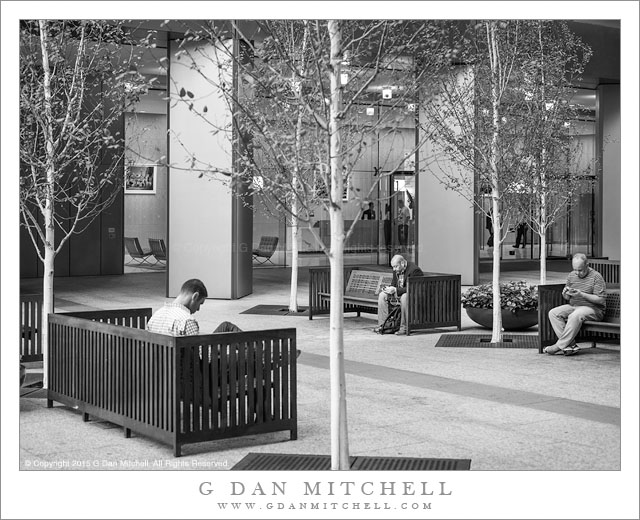
Three men sitting on benches in a downtown San Francisco courtyard

Three Men, Urban Garden. San Francisco, California. August 14 ,2015. © Copyright 2015 G Dan Mitchell – all rights reserved.

Three men sitting on benches in a downtown San Francisco courtyard

This seemed like a rare quiet scene in this part of San Francisco, along busy Market Street, which is crowded with tourists, locals, buses and taxis at this time of year. While walking through this area with my camera I had taken a break to grab a coffee when I saw this scene right outside the window.

There are many things that strike me about the relationship between urban environments like this one and the natural world that is also a subject of my photography. Places like Market Street are so antithetical to almost the entirety of the rest of the world — they noise and bustle and crowds are truly an anomaly on this planet. In some places it is quite possible to see almost no evidence of that non-human world, except perhaps by looking straight up at the sky. Yet in places like this an image of that world, synthetic though it may be, is constructed — and it brings some quiet and stillness.


G Dan Mitchell is a California photographer and visual opportunist. His book, “California’s Fall Color: A Photographer’s Guide to Autumn in the Sierra” is available from Heyday Books and Amazon.
Blog | About | Flickr | Twitter | FacebookGoogle+ | 500px.com | LinkedIn | Email


All media © Copyright G Dan Mitchell and others as indicated. Any use requires advance permission from G Dan Mitchell.
Urban Reflections

Urban Reflections
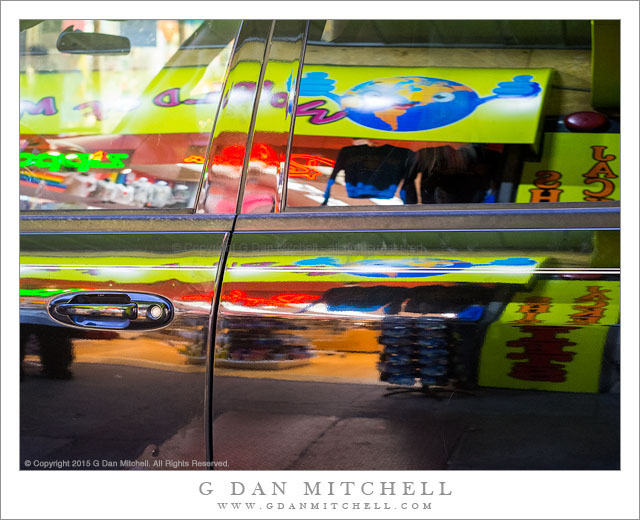
Reflected image of lights in San Francisco’s Chinatown

Urban Reflections. San Francisco, California. July 25, 2015. © Copyright 2015 G Dan Mitchell – all rights reserved.

Reflected image of lights in San Francisco’s Chinatown

This photograph comes from a late-July evening spent doing night street photography in San Francisco, this time working the area between North Beach and Union Square… which of course means largely the Chinatown district. We began photography at dusk a few streets up from the touristy main drag, walking along Stockton street as the last shops closed up for the day. From here we wandered down narrow streets to the main drag, Grant, arriving there as darkness came on.

Even though it was a Friday night during the height of tourist season, there were not all that many people here, at least by the sometimes extraordinarily crowded standards of this area. Some shops were still open — catering to the out-of-town visitors — but many had closed or were closing. Nonetheless, the street held a wild variety of bright lights. At several points I forced myself to take a break from the “normal” street photography stuff and try to look at things in different ways. Here I had decided to look at light reflected in other objects, in this case a parked car.


G Dan Mitchell is a California photographer and visual opportunist. His book, “California’s Fall Color: A Photographer’s Guide to Autumn in the Sierra” is available from Heyday Books and Amazon.
Blog | About | Flickr | Twitter | FacebookGoogle+ | 500px.com | LinkedIn | Email


All media © Copyright G Dan Mitchell and others as indicated. Any use requires advance permission from G Dan Mitchell.
Sharpening Basics: A Primer

(Minor updates to this article were made in February 2019.)

Sharpening is a very important step for optimizing digital photograph files. If you let your camera save images in the common .jpg format (a compressed image format that is often used on the web) the camera is applying sharpening to the image produced by the camera sensor. If you use the raw format (a high quality format that retains the original sensor data of the exposure) you will find that the photograph looks soft until you apply sharpening during the post production phase.

Sharpening optimizes the visibility of details that are already in your photograph. It is a matter of more clearly revealing what is in the photograph than  a matter of creating detail where there was none. Most sharpening works by increasing the contrast between light and dark areas in the image — what we call sharpening as actually more about adjusting the relative brightness of adjacent portions of the photograph.

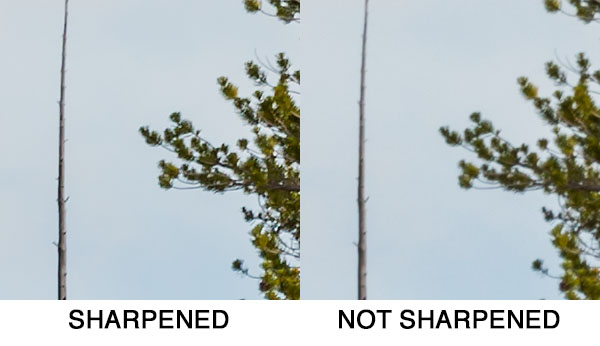
Typical sharpening

The image above is an example of a small section of a photograph.[1] It is a “100% magnification crop” of a tiny area from a much larger photograph made with a high megapixel DSLR camera. A “100% magnification crop” is an image displayed so that each pixel — or individual picture element — of the original photograph is displayed using a single pixel on the screen. (Things are a bit more complicated than that when using modern high-resolution monitors, though I’ll let that description stand for now.) 100% magnification crops let us look very closely at what is going on in photographas “at the pixel level.” In this case, the full original image from which these small examples were extracted would be equivalent to prints at a width of roughly 10-12 feet.

The right side of the example shows this tiny section of the photograph before sharpening. The left side shows the results of fairly typical sharpening. Continue reading Sharpening Basics: A Primer