“Desert Plants and Dried Mud” — Small desert plants sprout on dry and cracked mud.
When spring (or late winter, actually) arrives in Death Valley National Park after a wet season, a striking show of wildflower can appear. It seems incongruous in this arid landscape, and it can be spectacular. Uncountable colorful wildflowers cover normally-dry gravel slopes. A closer look reveals even more plants underfoot, where tiny sprouts suddenly appear in many areas in the park.
This photograph focuses on that subject, and a close look reveals more and more little things in the frame — various sorts of new plants, bits of old vegetation, and more. And all of this appears against one of the subjects most irresistible to photographers, dry cracked desert mud.
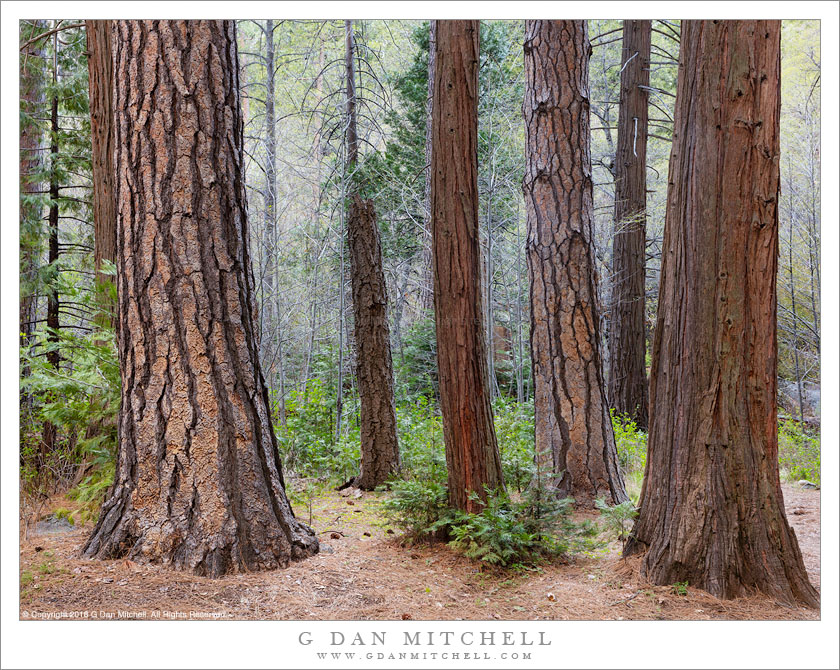
Spring plants sprout among the conifers in Yosemite Valley
This photograph is the result of some aimless wandering and of finally visiting a spot that I have wondered about for years. Most of my landscape photography is done early and late in the day, and when the days get longer this can leave me with a lot of free midday time. What I do during those hours varies. If I am camping I may take that time for camp chores, otherwise known as eating, reading, and napping. When I’m in the gigantic landscape of Death Valley I may use this as travel time. On this recent set of visits to Yosemite Valley I used it as hiking time — either with my full complement of photography equipment or perhaps with a smaller camera and a couple of lenses. (Sometimes it is a relief to leave the “big gear” behind for a while!)
Although the light wasn’t favorable at this time of day, I decided to head up the Valley on foot towards a place where the shadows of towering cliffs would block the harsh daytime light a bit earlier in the day. I got there and saw a sigh I had seen before for something called “the fen.” I know that word from literary sources, but I had never (after all these decades!) bothered to investigate it in the Valley. I was in no hurry, so I wandered off in that direction. One of the features of the area is rather dense and, in some ways, lush vegetation. I looked, I finished, I wandered off to look at something else. But in the back of my mind I was thinking about these trees, and a bit later when the cliff shadows had lengthened enough to reach this spot I returned and made this photograph. While big, iconic features evoke Yosemite for us — and with good reason — for me these quiet little out-of-the-way spots in the forest are just as important in defining the place.
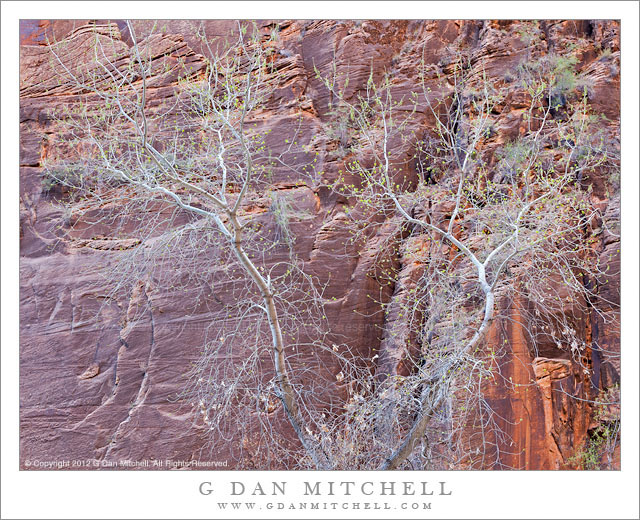
A cottonwood tree with early spring leaves stands in front of a sandstone cliff, Zion National Park, Utah.
This was my first visit to Zion National Park – believe it or not – and I had been thinking about photographing cottonwood trees against red sandstone cliffs well before we arrived. We got there in the afternoon, checked in to our lodgings, and soon went up into the main canyon on the shuttle and then hiked up toward the Narrows from there.
It was a special and unusual experience for me to be photographing in an entirely new place, and to have very little idea of the geography of the Zion at all – I had almost intentionally avoided researching ahead of time, preferring to take it for what it was when I arrived. I was so naive that when we passed over a bridge and I looked downstream I thought, “Oh, that is the Watchman.” (For those who don’t know, the photograph of the Watchman Tower above the Virgin River, photographed from the bridge that crosses the river just inside the park is, roughly speaking, the Zion equivalent of photographing Half Dome from Sentinel Bridge in Yosemite.) We kept going, staring up at the beautiful sandstone towers and walls as the shuttle travelled up the canyon to the very end at the Temple of Sinawava, where we got off and started to walk. The walls in this very area are beautiful, and my progress up the trail was very slow as I stopped to gawk and photograph all of these wonderful new subjects, including this almost bare tree with its first spring growth. against the backdrop of the sandstone cliffs.
G Dan Mitchell is a California photographer whose subjects include the Pacific coast, redwood forests, central California oak/grasslands, the Sierra Nevada, California deserts, urban landscapes, night photography, and more. Blog | About | Flickr | Twitter | Facebook | Google+ | 500px.com | LinkedIn | Email
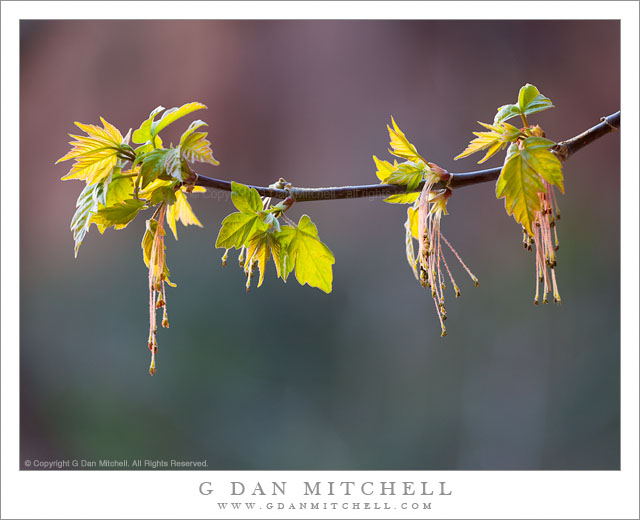
New spring leaves and seeds appear on the branch of a box elder tree, Zion National Park, Utah.
Among the places I photographed on my recent Utah trip was Zion National Park – I place about which I have heard and seen much, but which I had not previously visited. A friend described the Virgin River Canyon in this park as “Yosemite Valley in red,” and this seems like an apt description. I responded differently to each of the parks we visited. Canyonlands was huge and austere. Arches was literally “fantastic,” and elicited the most intense response. But Zion seems like a place that is more subtle, with a lot to see and get to know.
Among the features that seem to me to typify this area are the cottonwood, box elder, red maple, and other trees. During our visit they were just barely beginning to get their new spring leaves – in some places we saw bare trees, in a few we saw trees that had almost a full set of leaves, but for the most part we saw trees that had just a hint of the bright green color of new leaves. One morning we took the short walk to weeping rock in Zion Canyon. While I didn’t quite see photographs in this feature itself, I did spot this box elder branch suspended just about the trail, backlit by morning light and with the faint colors of sandstone cliffs and canyon bottom plants beyond.
G Dan Mitchell is a California photographer whose subjects include the Pacific coast, redwood forests, central California oak/grasslands, the Sierra Nevada, California deserts, urban landscapes, night photography, and more. Blog | About | Flickr | Twitter | Facebook | Google+ | 500px.com | LinkedIn | Email
Photographer and visual opportunist. Daily photos since 2005, plus articles, reviews, news, and ideas.
Manage Consent
To provide the best experiences, we use technologies like cookies to store and/or access device information. Consenting to these technologies will allow us to process data such as browsing behavior or unique IDs on this site. Not consenting or withdrawing consent, may adversely affect certain features and functions.
Functional
Always active
The technical storage or access is strictly necessary for the legitimate purpose of enabling the use of a specific service explicitly requested by the subscriber or user, or for the sole purpose of carrying out the transmission of a communication over an electronic communications network.
Preferences
The technical storage or access is necessary for the legitimate purpose of storing preferences that are not requested by the subscriber or user.
Statistics
The technical storage or access that is used exclusively for statistical purposes.The technical storage or access that is used exclusively for anonymous statistical purposes. Without a subpoena, voluntary compliance on the part of your Internet Service Provider, or additional records from a third party, information stored or retrieved for this purpose alone cannot usually be used to identify you.
Marketing
The technical storage or access is required to create user profiles to send advertising, or to track the user on a website or across several websites for similar marketing purposes.