
Tag Archives: structure

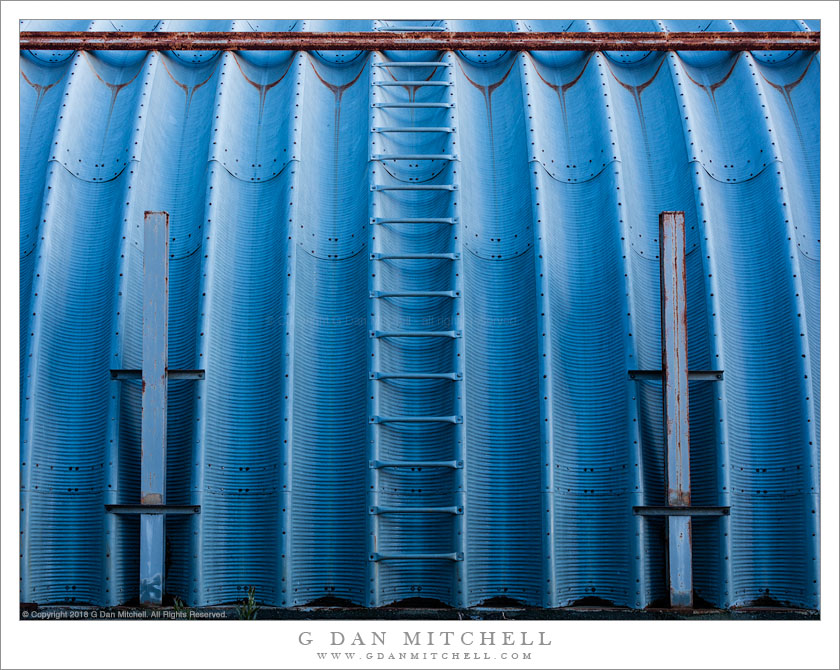
Blue Metal Structure

Blue Metal Structure
Detail of a blue metal building at the Mare Island Naval Ship Yard.

Blue Metal Structure. © Copyright 2018 G Dan Mitchell – all rights reserved.

Detail of a blue metal building at the Mare Island Naval Ship Yard.

I was at the historic Mare Island Naval Ship Yard to spend the evening doing night photography with my friends from the original Nocturnes group, and I had arrived well before sunset. After meeting up in the Mare Island Museum for pizza and conversation we realized that the end of the day was coming. I went outside about a half hour before sunset, and I thought of some old industrial buildings that I had passed on the way in. Instead of staying where I was and starting my typical routine of wandering on foot with my gear I decided to take short drive back to those buildings and see if I could make a few quick photographs in the end-of-day light.

I soon arrived and made a few photographs in golden hour light, but the sun quickly dropped below the horizon and I was left with that post-sunset glow. This light can be quite warm if clouds reflect some of the remaining red, yellow, and orange tones of sunset, but if the sky is clear what remains is the intense blue of early twilight. The latter light is what evolved, and I soon moved back to this unusual structure whose blue paint’s color was even more intensified by this twilight illumination.


G Dan Mitchell is a California photographer and visual opportunist. His book, “California’s Fall Color: A Photographer’s Guide to Autumn in the Sierra” is available from Heyday Books and Amazon.
Blog | About | Flickr | Twitter | FacebookGoogle+ | LinkedIn | Email


All media © Copyright G Dan Mitchell and others as indicated. Any use requires advance permission from G Dan Mitchell.
Abandoned Mill

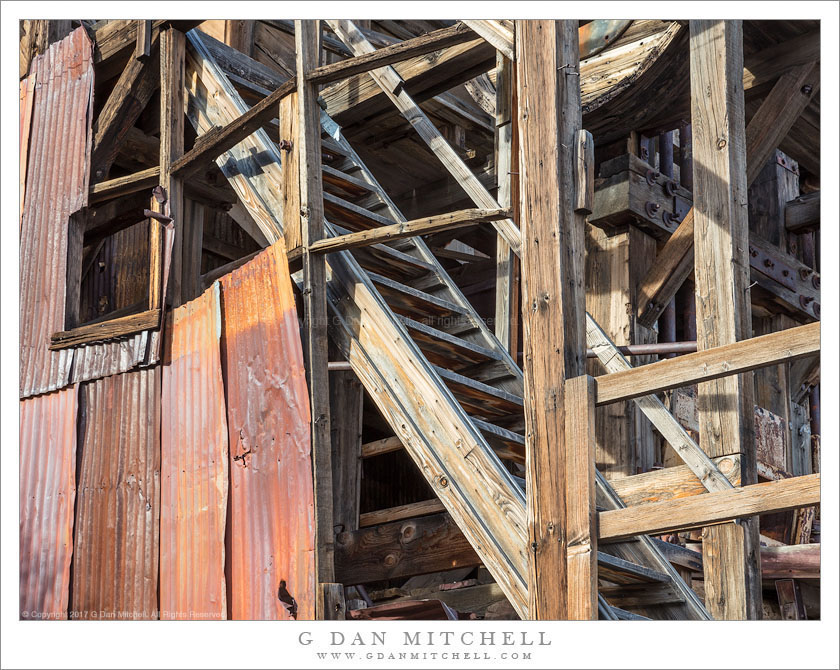
Abandoned Mill
The ruins of an abandoned mill in the desert backcountry

Abandoned Mill. Desert Mountains, California. April 4, 2017. © Copyright 2017 G Dan Mitchell – all rights reserved.

The ruins of an abandoned mill in the California desert backcountry

During the nearly twenty years since I first “discovered” California deserts, my experience with them has changed. To be honest, as a person largely focused on the coast and the Sierra, when I was younger I didn’t really know much about these wild places, and I wasn’t really attracted to them. It wasn’t until the late 1990s that I actually made a serious visit and began to “get it” about the things that make these areas so marvelous. At first, like almost anyone else, I focused on some of the most obvious and iconic places. But eventually as I returned to these places, especially to Death Valley National Park, I began to push out my boundaries bit by bit. As I did so I discovered many more interesting things about these places, both the natural wilderness and the human history. One of the first experiences that connected me to the human history was an accident. One evening I wandered away from a camp and just sat down on a boulder in an elevated location on an alluvial fan. I happened to look down to see an unusual rock. I picked it up and quickly realized that it was a cutting implement left their by the earliest people to make their lives here — and my notions of the depth and variety of human experience in the desert was profoundly altered.

That human influence has many facets. Certainly the experience of the people we now refer to as “native Americans” is central. (I like Canada’s term: “first people.”) Later settlers showed up for a range of reasons — pioneers passing through, prospectors chasing the dream of the big strike, folks looking for a job, people not well suited to living in the civilized world, and other. They all left traces. The prospectors and miners left lots of them all over the desert landscape, and you can’t travel around these places without running into it. The photograph is a detail from one amazing structure high on a desert ridge, abandoned only recently in the context of the larger scale of history, but still putting us in touch with an era that is mostly gone now from these places.


G Dan Mitchell is a California photographer and visual opportunist. His book, “California’s Fall Color: A Photographer’s Guide to Autumn in the Sierra” is available from Heyday Books and Amazon.
Blog | About | Flickr | Twitter | FacebookGoogle+ | LinkedIn | Email


All media © Copyright G Dan Mitchell and others as indicated. Any use requires advance permission from G Dan Mitchell.
Inside The Oculus

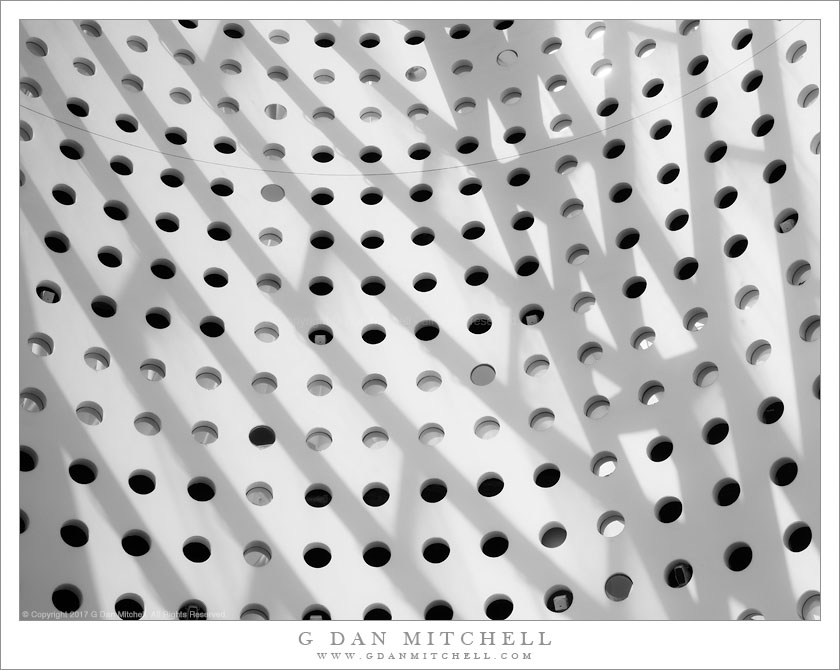
Inside The Oculus
Play of midday light and shadows on the walls of the Oculus, SFMOMA

Inside The Oculus. San Francisco Museum of Modern Art. July 13, 2017. © Copyright 2017 G Dan Mitchell – all rights reserved.

Play of midday light and shadows on the walls of the Oculus, SFMOMA

This week we made a visit to the San Francisco Museum of Modern Art (SFMOMA) to see and hear the Soundtracks exhibit, which presents objects and installations of sonic art of various sorts. To be honest, I wasn’t that hopeful about this exhibit — I’ve often found that many visual artist’s ideas about sound art can be naive and banal in too many cases. However, the exhibit was (is, and you should go) excellent, with a wide variety of work that is interesting in a range of ways.

In any case, virtually every visit to this museum is also an excuse to make at least a few photographs, often of the architecture of the place. The central “Oculus” structure (which housed one of the sonic art pieces, too) is interesting to me as much for the play of light and shadows on its curved walls as it is for its own architectural form. I have photographed it many times, but being so close to the summer solstice the shadows took on different qualities than I had seen before. Here shadows from the structure of the upper window fall across a curved wall that is perforated by a pattern of large holes.


G Dan Mitchell is a California photographer and visual opportunist. His book, “California’s Fall Color: A Photographer’s Guide to Autumn in the Sierra” is available from Heyday Books and Amazon.
Blog | About | Flickr | Twitter | FacebookGoogle+ | LinkedIn | Email


All media © Copyright G Dan Mitchell and others as indicated. Any use requires advance permission from G Dan Mitchell.
Abandoned Stamp Mill

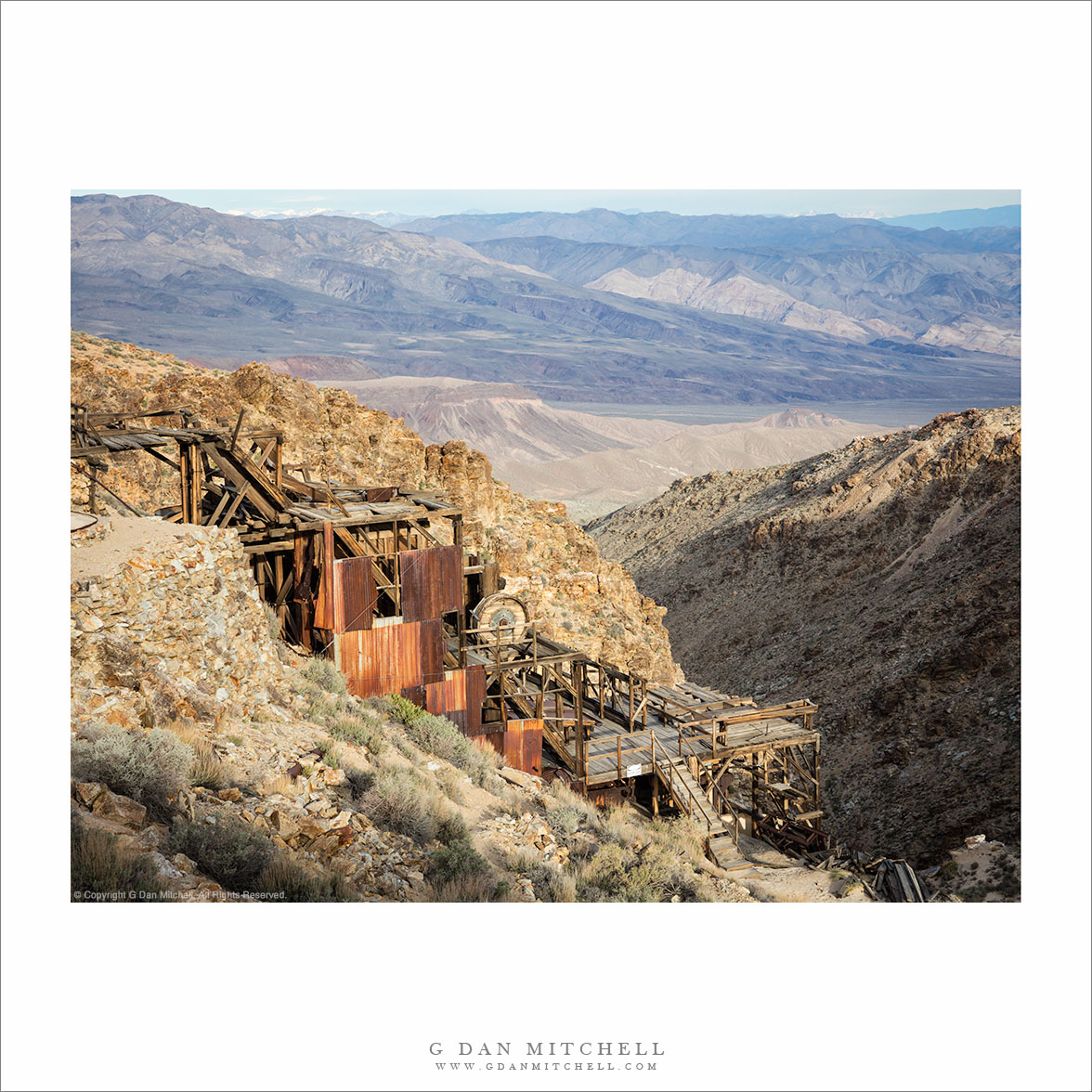
Abandoned Stamp Mill
“Abandoned Stamp Mill” — An abandoned water-powered stamp mill high in the Panamint Range, Death Valley National Park

It seems that every national park or monument has both a natural and a human hisstory, or perhaps a story about the relationship between the two. While the power of natural forces (heat, water, geology, and more) is abundantly obvious in the huge, austere landscape of Death Valley National Park, the human history of the place is rarely far from view. It begins with the evidence of people who lived here long before European-origin settlers came, evidence that can be seen in rock art scattered throughout the park, in the recognition that many settlements (current and now-abandoned) have a very much longer history than we may think, and in the native people who still occupy and identify with this landscape.

Perhaps more obvious is the more recent history of those who came to look for mining success. (There are places in the park where extraction still takes place.) Some examples are obvious to the casual visitor, but the more time you spend in the back-country of the park the more you understand that this particular history is everywhere — though not usually as obvious as this example. This stamp mill, built to crush gold ore, is amazing in multiple ways. Perched at the end of high ridge in very remote location, it was powered in the most unlikely manner… by water piped in from a spring over twenty miles away. The location is stupendous, and it is easy to think that practical issues may not have been the only considerations in choosing the site. From here one can look down thousands of feet to broad alluvial slopes leading towards Death Valley, but one can also look further into the distance and see the snow-covered peaks of the Sierra Nevada.


Leave a comment or question using the form. (Click the title to see the full article and to comment if you are viewing it on the home page.)

G Dan Mitchell is a California photographer and visual opportunist. His book, “California’s Fall Color: A Photographer’s Guide to Autumn in the Sierra” (Heyday Books) is available directly from him. Blog | Bluesky | Mastodon | Substack Notes | Flickr | Email

All media © Copyright G Dan Mitchell and others.