
Tag Archives: wall

Brooklyn Rorschach Test

Brooklyn Rorschach Test. Brooklyn, New York. August 8, 2014. © Copyright 2014 G Dan Mitchell – all rights reserved.

Layers and paint and removed paper create patterns on a concrete wall in Brooklyn

There isn’t really a lot to say about this photograph, but there might be a few things to ask. This was more or less a quick “grab shot,” taken while walking not far from the waterfront at the Brooklyn Bridge Park, where it isn’t uncommon to find places where various signs and billboards have been posted and then removed.

So, what you are looking at here is the result of various layers of paint and the after-effects of material that was glued to the walls and then removed. I think it is interesting to ask what you see in these patterns when you look at them. The more I look the more I see, but I won’t try to convince you that what I see is the “right” thing to notice, and I think that lots of other interpretations are possible — or that you might even choose to simply see it as a place where stuff was removed from a black and green wall!

G Dan Mitchell is a California photographer and visual opportunist whose subjects include the Pacific coast, redwood forests, central California oak/grasslands, the Sierra Nevada, California deserts, urban landscapes, night photography, and more.
Blog | About | Flickr | Twitter | FacebookGoogle+ | 500px.com | LinkedIn | Email

Text, photographs, and other media are © Copyright G Dan Mitchell (or others when indicated) and are not in the public domain and may not be used on websites, blogs, or in other media without advance permission from G Dan Mitchell.
Plants, Canyon Wall

Plants, Canyon Wall
Plants, Canyon Wall

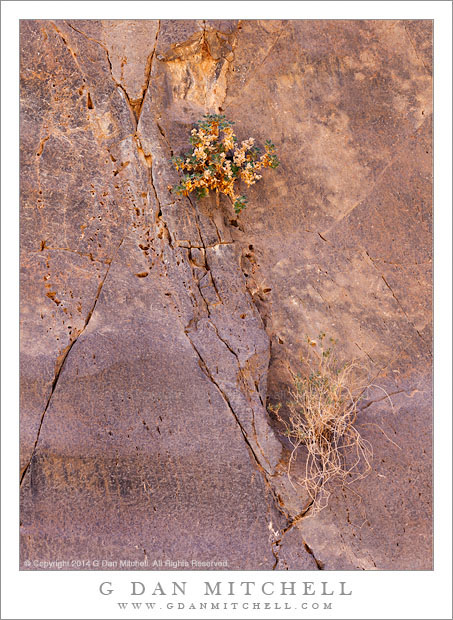
Plants, Canyon Wall. Death Valley National Park, California. April 1, 2014. © Copyright 2014 G Dan Mitchell – all rights reserved.

Plants grow from thin cracks in the rock wall of a desert canyon, Death Valley National Park

I found this little scene in a well-known Death Valley Canyon, where the walls become vertical, hundreds of feet high, and quite close together. Canyons like this are some strange combination of beautiful — with soft light, colorful rock, shade — and harsh — with the clear evidence of flooding that periodically sweeps through and rearranges everything, against a backdrop of more typical aridity, and a terrain almost entirely consisting of rock.

In these places I am always intrigued by where and how plant life manages to survive. This is nowhere more true than in such canyons in Death Valley National Park, where the usual challenges are made worse by extreme heat and dryness. Here two kinds of plants have managed to find a foothold, but in must be a very tenuous one. The grow from thin cracks in solid rock, a good distance above whatever water comes during the periodic flooding of the wash, in an environment in which the light is most often muted yet in which extreme temperatures are common for much of the year.

G Dan Mitchell is a California photographer and visual opportunist whose subjects include the Pacific coast, redwood forests, central California oak/grasslands, the Sierra Nevada, California deserts, urban landscapes, night photography, and more.
Blog | About | Flickr | Twitter | FacebookGoogle+ | 500px.com | LinkedIn | Email

Text, photographs, and other media are © Copyright G Dan Mitchell (or others when indicated) and are not in the public domain and may not be used on websites, blogs, or in other media without advance permission from G Dan Mitchell.
Double Bass, Backstage

Double Bass, Backstage

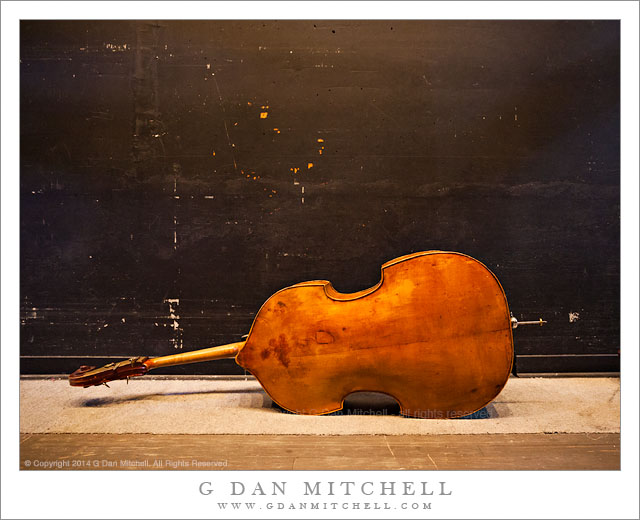
Double Bass, Backstage. San Jose, California. May 14, 2014. © Copyright 2014 G Dan Mitchell – all rights reserved.

A double bass rests back stage during a break in a rehearsal of Symphony Silicon Valley

This is a photograph from my ongoing project related to classical music performing groups and the musicians who belong to them. It falls into a category I have mentioned before, namely photographs of people and things that happen to turn up in the small areas of interesting backstage light that I have discovered. As I have worked several venues over the past two years I have gotten to know many things about them intimately, and one of those things is the location of the many little unexpected pools of interesting light. Sometimes I “stalk” those spots, just waiting for someone or something to happen there, and I always check them as I walk around the theater with my camera.

This is, obviously, a visually simple image—just a double bass lying on its side during a break in a rehearsal. (I was attracted by the contrast between the warm colors and interesting textures of the instrument and the “industrial” surroundings with their signs of heavy use and even minor damage.) From my point of view, however, it could lead to thoughts of a whole range of other things. I’m fascinated by what an instrument is and what it isn’t. Instruments, musical and otherwise, are often remarkable things in that they allow us to do things that we can’t otherwise do with our minds and bodies alone. The instruments of classical (and many other types of) music are fundamentally pretty simple things and often the result of some really “primitive” technologies, yet they are remarkably adapted to the purposes for which they are intended, generally as a result of a long and complex evolutionary process. But in the end, I would argue that even the most beautiful and sophisticated instrument is no more than a tool, and the really interesting things are how the tool is used by a person or persons to produce something far more meaningful and interesting than the instrument itself.

G Dan Mitchell is a California photographer and visual opportunist whose subjects include the Pacific coast, redwood forests, central California oak/grasslands, the Sierra Nevada, California deserts, urban landscapes, night photography, and more.
Blog | About | Flickr | Twitter | FacebookGoogle+ | 500px.com | LinkedIn | Email

Text, photographs, and other media are © Copyright G Dan Mitchell (or others when indicated) and are not in the public domain and may not be used on websites, blogs, or in other media without advance permission from G Dan Mitchell.

Curves, Desert Canyon

Curves, Desert Canyon

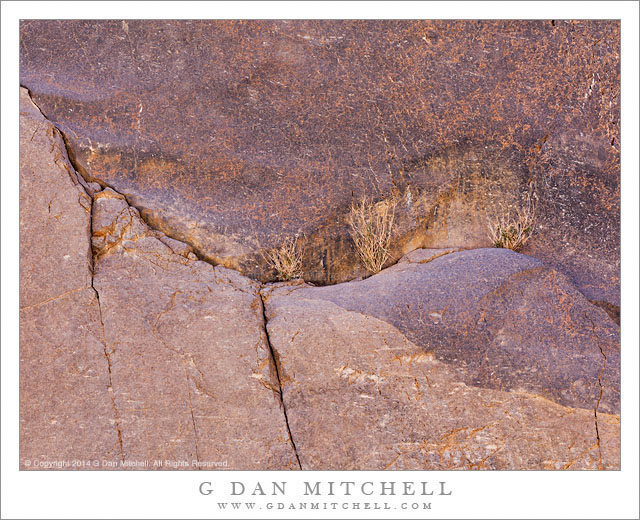
Curves, Desert Canyon. Death Valley National Park. April 1, 2014. © Copyright 2014 G Dan Mitchell – all rights reserved.

Small dry plants grow in a curving crack in a two-toned desert canyon, Death Valley National Park

Passing through this deep and narrow canyon, I always watch the rock walls for little odds and ends of shape and form and color and occasional surprising bits of vegetation. If you had asked me about this section of canyon after my first passage some years ago, I might well have mentioned how narrow and deep it is and perhaps how dusty. I might have commented on the way the bottom remains in shade even in the midday heat. But repeated visits have shown me that there is much more to see, and the fact that I still see new things on every visit tells me that there is far more yet to be discovered.

On one hand this is a pretty plain photograph of some rocks with cracks running through them. On the other hand, I think there are some stories behind the scent that are interesting to contemplate. At least I think so! If you look closely you will see some very dry plants that have grown in this curving crack. It is hard to imagine a more inhospitable place for a plant to grow—perhaps a dozen feet up the nearly solid rock wall of an arid and hot desert canyon. Yet somehow these plants found a way, as did and do many other plants throughout this desert landscape. Behind the small, delicate, and even intimate element of these plants is the backdrop of a small section of a massive rock wall that towers out of sight above the frame of the photograph. Here is a boundary between two sorts of rock—I’m not enough to a geologist to make technical observations, but I do note that the upper layer is darker and more solid while the lower is lighter and has more cracks in its surface. From the upper left a crack follows the junction of the two rock layers, but for some reason the crack leaves the junction and curves back upwards into the darker rock, and it is in this surprising bit of geological dissonance that the small plants took root.

G Dan Mitchell is a California photographer and visual opportunist whose subjects include the Pacific coast, redwood forests, central California oak/grasslands, the Sierra Nevada, California deserts, urban landscapes, night photography, and more.
Blog | About | Flickr | Twitter | FacebookGoogle+ | 500px.com | LinkedIn | Email

Text, photographs, and other media are © Copyright G Dan Mitchell (or others when indicated) and are not in the public domain and may not be used on websites, blogs, or in other media without advance permission from G Dan Mitchell.