Evening light on a stream bed dropping though Temblor Range hills toward the Carrizo Plain
On this early April day I drove south from the San Francisco Bay Area on highway 101, leaving that route and heading east near Paso Robles to travel through the impossibly green spring landscape of Central California hills. I wasn’t alone. This being a beautiful spring Sunday, many others were out here to look for spectacular wildflower displays. And here, as in many other similar California locations, we found what we were looking for.
I continued to the east, eventually arriving at this high plain, often a desolate place but for a few weeks in wet years a place full of growth and color. I met up with friends who were already camped there, and we soon headed out to look for places with special color. We followed a small gravel road up into the foothills of the Temblor Range — we parked where it ended, loaded up packs, and continued on up into the hills of foot, heading toward some extensive fields of colorful wildflowers. As we topped the first rise I paused an looked back down at the base of the hills where the gully of a small stream winds its way toward the plain.
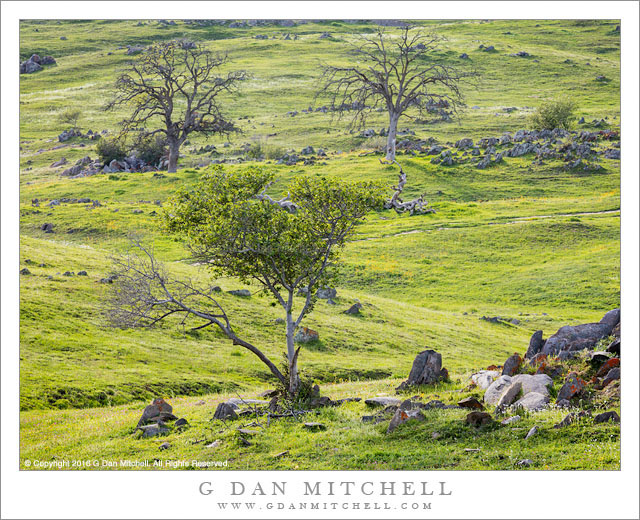
Winter grasses and wildflowers come to life among trees and boulders in the Sierra Nevada foothills
Returning from a few days in Yosemite Valley early this year — we were there for the opening of the annual Yosemite Renaissance exhibit — we looped somewhat lazily through Sierra foothill terrain on our way home. Since the plan was to arrive at a Central Valley bird refuge before sunset, we had most of the day to poke around and make photographs.
Late winter in California is the greenest time of year. When people visit the state during summer and remark on the golden brown hills, I always want to say, “You should have been here a few months ago!” This is the impossibly green season, when enough rain has fallen to get the grasses to take root and cover these hills, followed quickly by the appearance of wildflowers.
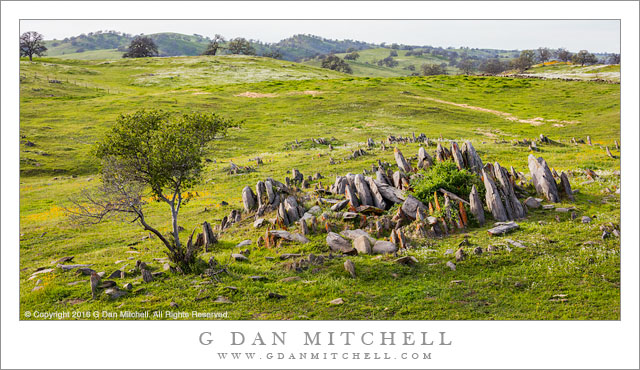
Flowers and new grass at the beginning of the “green season” in the Sierra Nevada foothills
Today I went for a hike — not in the Sierra Nevada foothills but in a place where some of the same seasonal cycles are found. The hike took me up to a ridge, where I followed a trail along its crest. It was hot and dry, and the hills were covered by brittle, brown grasses. That’s how summer works in much of California. People who come here from the east or the north are often taken aback by what looks like a dead and dry landscape, and they may not be able to see the beauty in it.
But it isn’t that way all year. In fact, during winter, when many of those green-in-summer places are freezing or buried under snow, much of California erupts into what I call the “impossibly green season.” Believe it or not, this photograph was made in February in the Sierra Nevada foothills. Snow was still falling in the higher mountains, and it would continue to do so for several more months. But here in the low hills along the western edge of the range, winter rains had resurrected the grasslands and caused the wildflowers to bloom
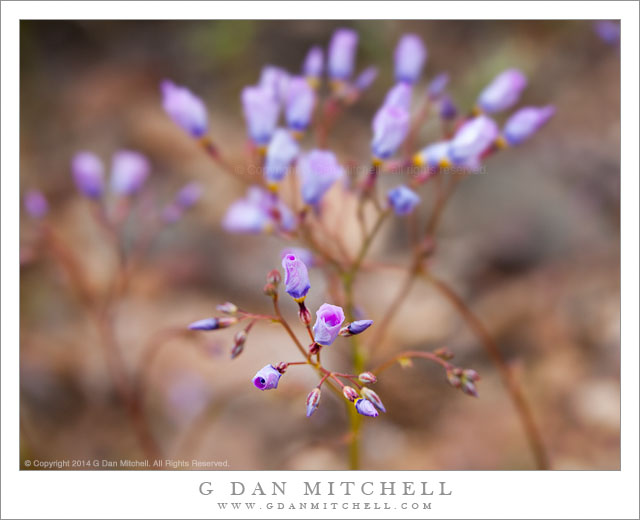
Gilia buds opening on a rainy day, Death Valley National Park
This is going to be a sort of hybrid post, covering two subjects and out of phase with my normal daily photograph posts. Think of it as a bonus post—a photograph and an informal report on Death Valley National Park wildflowers. The description of this photograph follows the report on Death Valley wildflower conditions.
Wildflower Conditions
By now it is no longer news that California and other parts of the west are in the throes of a very serious drought. The situation is especially serious in California, which is now experiencing the worst in a series of three below-normal precipitation years. Many parts of the state are experiencing what have been described as historic drought conditions. The situation remains critical—and many of us are worried about the upcoming wildfire season—though recent March and early April rains brought a bit of relief.
All spring I have been hearing that the drought would make this a poor year for desert wildflowers in Death Valley. However, I knew that Death Valley had experienced some rain events in the past few months and that desert plants are quite opportunistic, often quickly blooming in response to moisture. I know Death Valley fairly well, though I’m no expert on wildflowers. However, I had a hunch that we might be surprised by how the wildflower season would play out.
We visited the park for several days right around the beginning of April. Even before we arrived, we saw a decent number of wildflowers as we drove across other desert areas on the way to the park. It seemed like plants were acting in the opportunistic manner I describe above and quickly sprouting up and blooming in response to recent rains. As we entered the park and crossed Towne Pass we (especially my wife, who is passionate about photographing the “small things”) began to notice a lot of wildflowers in many places, including whole beds of colorful flowers in many places along this drive. While we did not see the tremendous blooms on the Valley floor that can occasionally occur, once we got up into higher country we saw flowers everywhere, at least when we slowed down and looked. There was more rain and snow during our visit, and the additional moisture is bound to encourage other plants and flowers to grow.
I just saw a report at the Desert USA website (which names the flowers in ways that I cannot hope to do) confirming what we saw—that there is actually a substantial bloom of desert wildflowers in many places. If you have the opportunity to head out that way soon, do so!
About the Photograph
Believe it or not, it was snowing lightly when I made this photograph! We began our day by driving on gravel roads before sunrise to reach a high location in the Panamint Range from which we planned to photograph at sunrise. The sunrise photography turned out to be a challenge, as it was cloudy at first light and the clouds only increased as the sunrise progressed. Soon we began to notice snow falling on nearby peaks, though it did not fall where we were until after we moved on. Later, in a less exposed location but with temperatures in the low thirties, we encountered our first very light snowfall, and we could see that it was snowing more heavily on the peaks and ridges around us.
We moved on, heading up into Wildrose Canyon. My original plan had been to drive to the end of the road, but by the time we reached the Charcoal Kilns it was snowing hard enough that this no longer seemed like a great idea. In fact, other drivers with two-wheel drive vehicles were having problems ascending the last section of the road to the kilns. We photographed the snowy conditions here and back in Wildrose Canyon, and then as the snow abated a bit we drove on, heading back in the direction of Emigrant Pass. Not far from the pass we found a hillside covered with a spectacular display of flowers. At first it was some cacti that caught our attention, but as we got out and looked around we saw many, many flowers all around. These gilia buds had not yet opened into their more showy display.
G Dan Mitchell is a California photographer and visual opportunist whose subjects include the Pacific coast, redwood forests, central California oak/grasslands, the Sierra Nevada, California deserts, urban landscapes, night photography, and more. Blog | About | Flickr | Twitter | Facebook | Google+ | 500px.com | LinkedIn | Email
Photographer and visual opportunist. Daily photos since 2005, plus articles, reviews, news, and ideas.
Manage Consent
To provide the best experiences, we use technologies like cookies to store and/or access device information. Consenting to these technologies will allow us to process data such as browsing behavior or unique IDs on this site. Not consenting or withdrawing consent, may adversely affect certain features and functions.
Functional
Always active
The technical storage or access is strictly necessary for the legitimate purpose of enabling the use of a specific service explicitly requested by the subscriber or user, or for the sole purpose of carrying out the transmission of a communication over an electronic communications network.
Preferences
The technical storage or access is necessary for the legitimate purpose of storing preferences that are not requested by the subscriber or user.
Statistics
The technical storage or access that is used exclusively for statistical purposes.The technical storage or access that is used exclusively for anonymous statistical purposes. Without a subpoena, voluntary compliance on the part of your Internet Service Provider, or additional records from a third party, information stored or retrieved for this purpose alone cannot usually be used to identify you.
Marketing
The technical storage or access is required to create user profiles to send advertising, or to track the user on a website or across several websites for similar marketing purposes.


 G Dan Mitchell is a California photographer and visual opportunist. His book, “California’s Fall Color: A Photographer’s Guide to Autumn in the Sierra” is available from Heyday Books and Amazon.