
Tag Archives: yellow

Peak New England Color

Peak New England Color
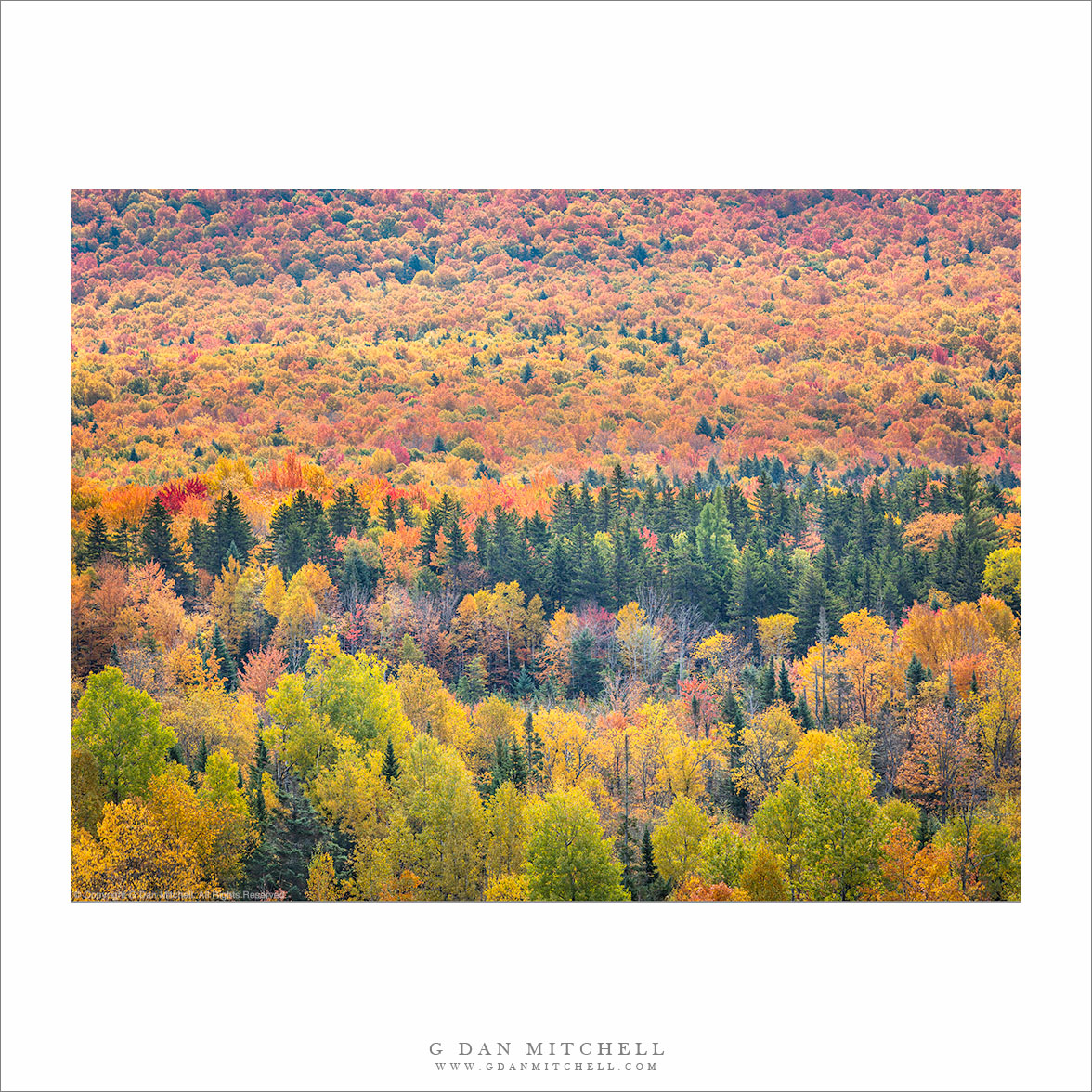
“Peak New England Color” — A White Moutains forest of almost-exclusively hardwood trees at the peak of fall color.

This photograph, if nothing else, illustrates some aspects of how New England fall color is different from what I usually photograph in California, particularly in the Sierra Nevada. Out here the colors tend to be relatively uniform, usually yellow to brown, broken by occasional examples of other colors. For example, the great majority of our aspens turn yellow/gold, which is why the occasional red and orange exceptions attract so much attention. And the Sierra trees are far less likely to appear in huge, mountain-covering stands — they more typically line the bottom of a valley, run upslope along a gully or other feature, and are surrounded by green conifers.

So what differences can we see here? First, the hardwoods vastly outnumber the sparse conifer trees. (I like the contrast the latter provide, however.) The hardwood forest stretches for great distances — that area of the photograph is quite large but it is only a small portion of the fall-colored trees I could see here. The tree color is also much more diverse, here including every shade from green through orange and red.


Leave a comment or question using the form. (If you are reading this on the home page, click the article title to see the full article and the comment form.

G Dan Mitchell is a California photographer and visual opportunist. His book, “California’s Fall Color: A Photographer’s Guide to Autumn in the Sierra” (Heyday Books) is available directly from him. Blog | Bluesky | Mastodon | Substack Notes | Flickr | Email

All media © Copyright G Dan Mitchell and others.
White Mountains Creek, Autumn

White Mountains Creek, Autumn
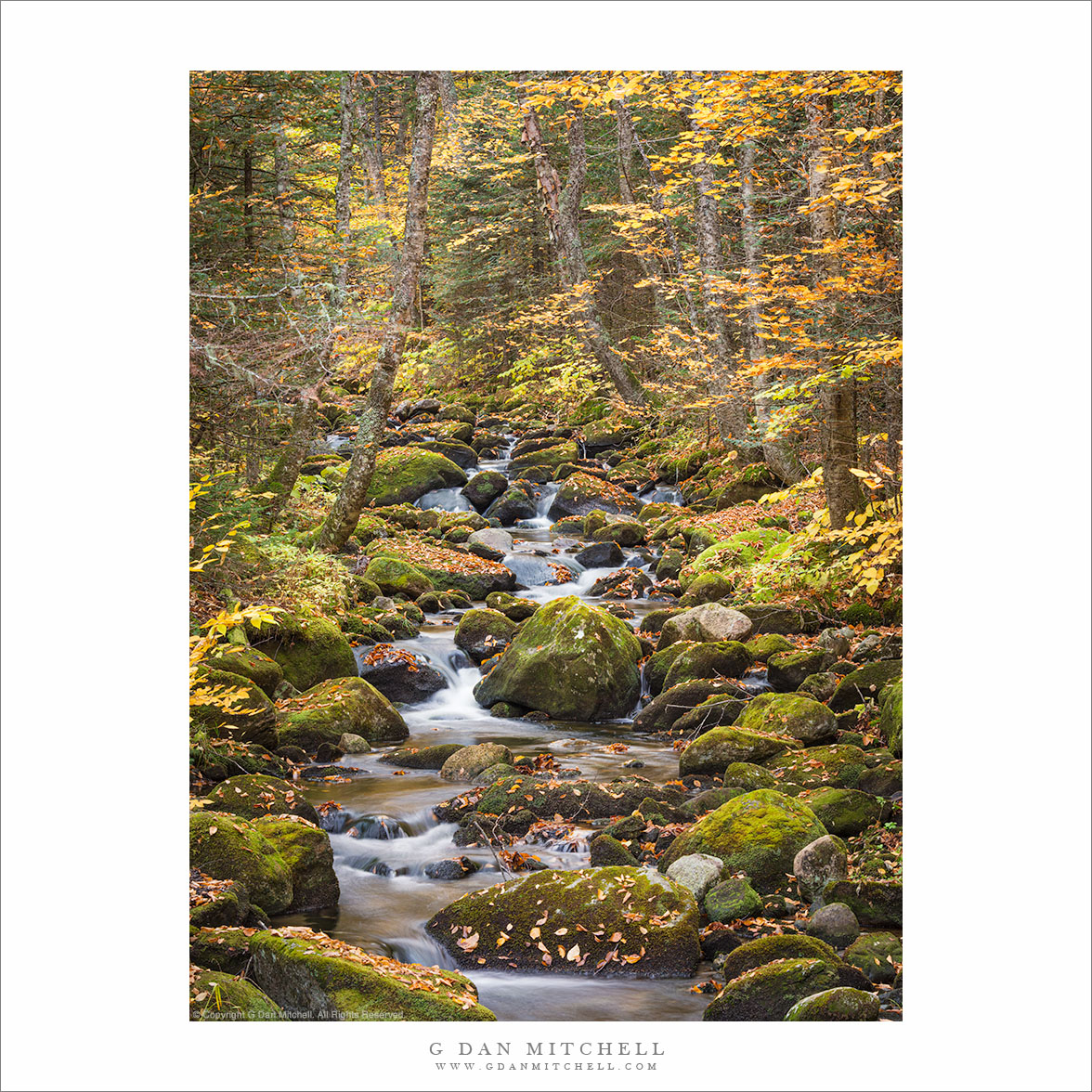
“White Mountains Creek, Autumn” — Autumn trees along a boulder-strewn White Mountains creek littered with fallen leaves.

This photograph exists because we eventually thought to move beyond the lovely but iconic area we first photographed to explore a bit. We headed away from where we were staying, driving north and east, heading toward some locations that seemed interesting for little more than their names on a map. As we drove along one two-lane highway, for no reason that I can now recall I turned off onto a smaller road that took us through some lovely flatlands. A mile or two up that road a gravel road branched off — it had an intriguing name so I took it. It entered thick forest and began to rise, often following small creeks. We stopped where the roadway crossed one of them, got the cameras out, and began photographing this lovely and lonely area.

I was encouraged not only because this turned out to be a nice locations but also because it marked a transition from taking in the icons (often a great way to begin) to exploring, poking around, and discovering subtle little treasures that one usually won’t find on the main roads. Taking this detour also confirmed some advice I had been given by photographers with more experience in this region: explore those little side roads!


Leave a comment or question using the form. (If you are reading this on the home page, click the article title to see the full article and the comment form.

G Dan Mitchell is a California photographer and visual opportunist. His book, “California’s Fall Color: A Photographer’s Guide to Autumn in the Sierra” (Heyday Books) is available directly from him. Blog | Bluesky | Mastodon | Substack Notes | Flickr | Email

All media © Copyright G Dan Mitchell and others.
Autumn Leaves, White Mountains

Autumn Leaves, White Mountains
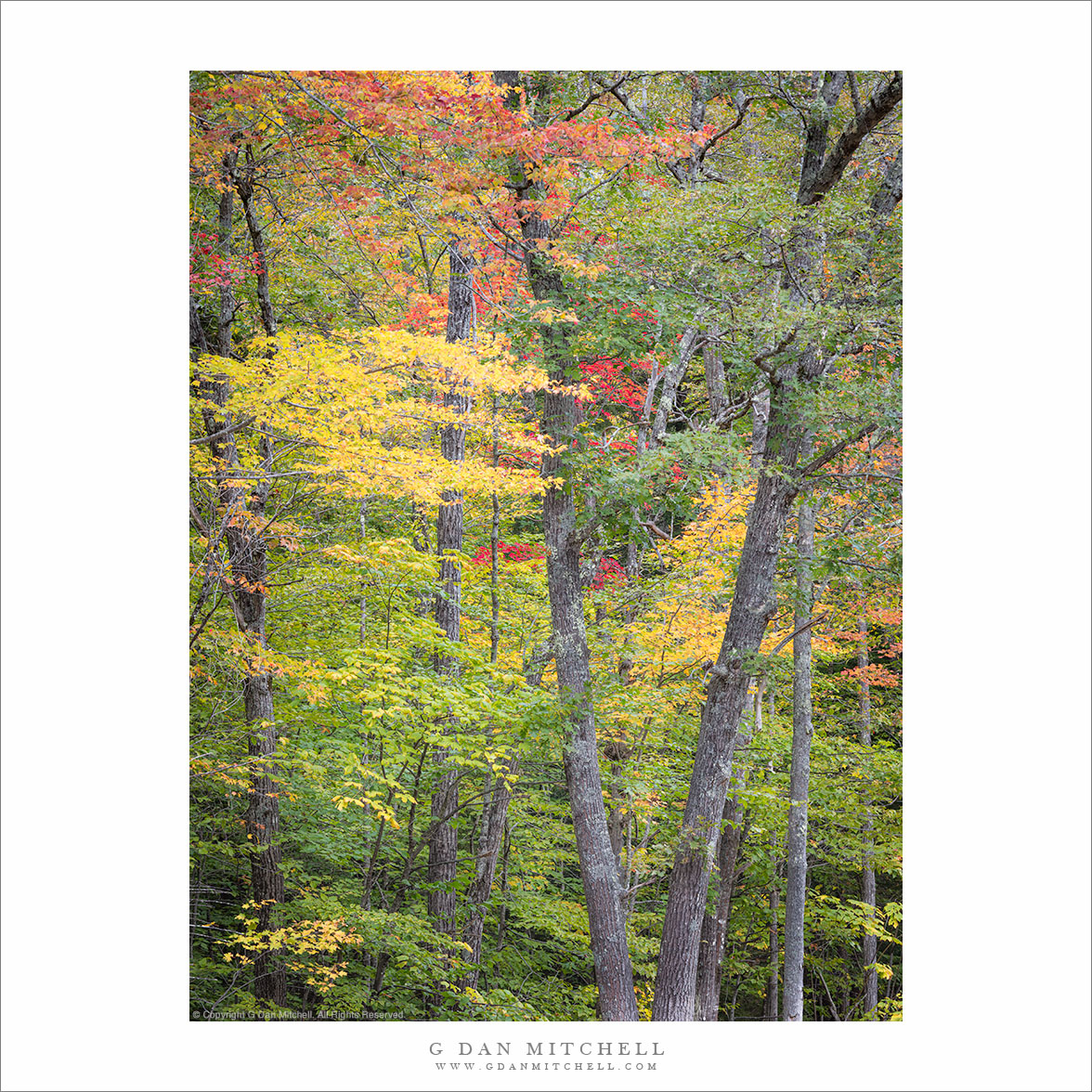
“Autumn Leaves, White Mountains” — Autumn leaves and soaring tree trunks in a White Mountains forest.

This photograph illustrates a few important take-aways from fall photography, things that can be extrapolated to other kinds of photography, too. Again, the location was not iconic, even though it is along/near iconic places. We had stopped after seeing a sign for a pond, but I ended up finding the nearby forest even more interesting. Note that not all of the trees have changed color. As overwhelming as a fully fall-colored forest can be, the colors often stand out when there is some “non-color” in the frame, too. Note, too, that I made this photograph in soft light, which intensifies the colors while opening up the shadows. Finally, I think that some non-color structural elements can help with the composition of photographs of the subject — here that comes from the verticals of the tree trunks.

One thing we learned on this trip — our first to New England in the fall — is how quickly the leaves reach and then pass their peak color. The build-up seems a bit slower, but there was literally one day when it was obvious that the peak had arrived. And only one day later the leaves began to fall more quickly, bare trees became more apparent, and the color was in decline. The show wasn’t over, but the process was clear. Fortunately, because the color doesn’t arrive everywhere at the same moment, flexible photographers and leaf-peepers can move on to different locations that haven’t peaked yet.


G Dan Mitchell is a California photograph


Leave a comment or question using the form. (If you are reading this on the home page, click the article title to see the full article and the comment form.

G Dan Mitchell is a California photographer and visual opportunist. His book, “California’s Fall Color: A Photographer’s Guide to Autumn in the Sierra” (Heyday Books) is available directly from him. Blog | Bluesky | Mastodon | Substack Notes | Flickr | Email

All media © Copyright G Dan Mitchell and others.
thers as indicated. Any use requires advance permission from G Dan Mitchell.

Autumn Trees, New Hampshire

Autumn Trees, New Hampshire
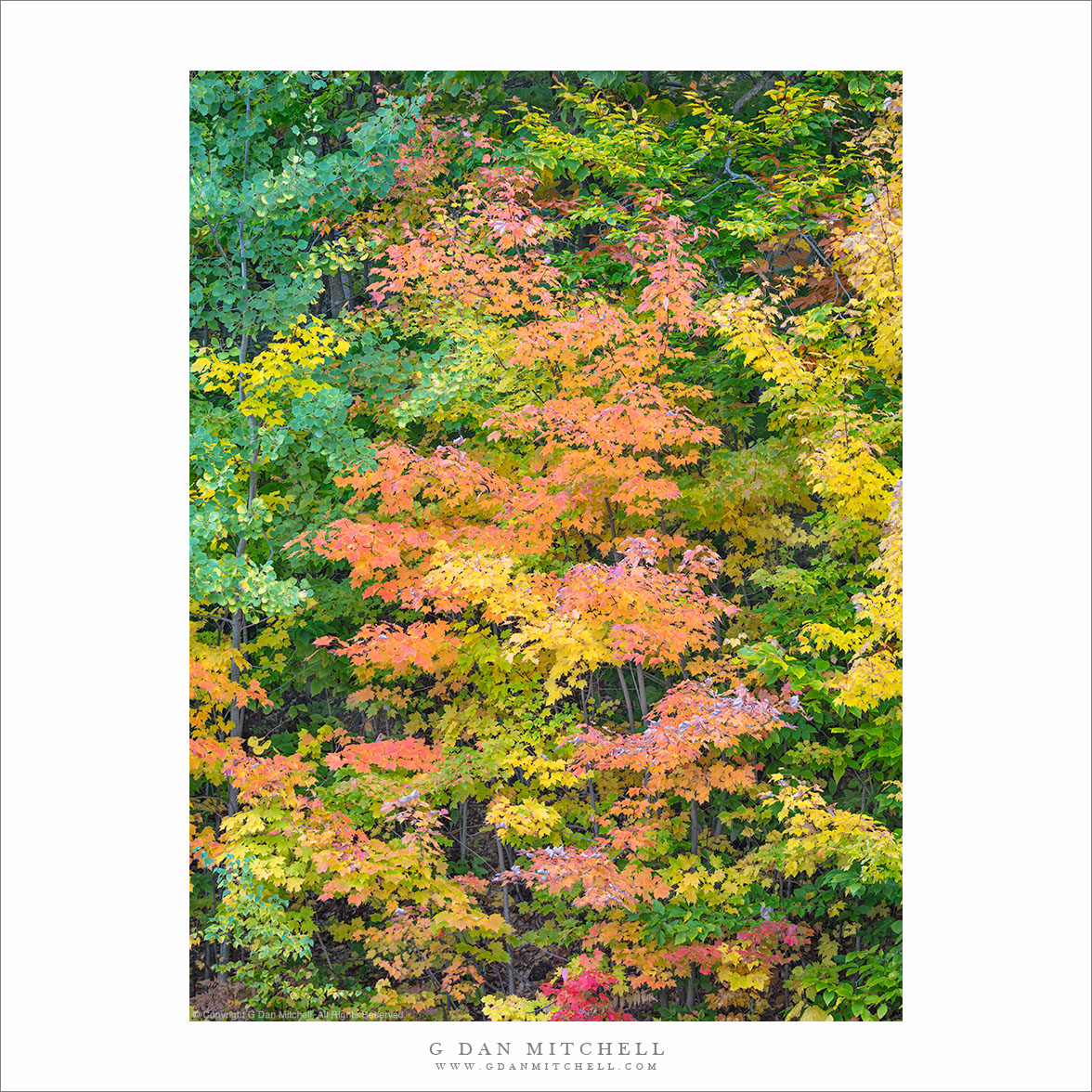
“Autumn Trees, New Hampshire” — A dense wall of trees with autumn leaves, New Hampshire.

This vignette of one small bit of White Mountains autumn color is somewhat indicative of the intensity and variety of the color there. My baseline for considering autumn color is California, which means the aspens (and a few other things) of the Eastern Sierra, the maples and oaks and dogwoods of the west slope of the range, and the mixture of native and non-native trees another areas of the state. It is rare to fine large, continuous hardwood forests with a mix of trees in California — almost unheard of, in fact. Yet that seems to be the norm in New Hampshire and other parts of New England we visited. It seems like the period of time with best color may be shorter here, but during the window the variety and intensity is remarkable.

The circumstances of the photography often seemed different in New England, too. (In fairness, this was my first visit, and I can see how my process might adapt to this different landscape over time.) Once I found color in New Hampshire — and, believe me, it was not hard! — in some cases photographing it was almost too easy. Here, for example, I had stopped at a popular roadside pull-out to photograph an open landscape view to the north. When that view turned out to be problematic I turned around and basically looked for colors and patterns to photograph in a large “tree wall” across the roadway!


Leave a comment or question using the form. (If you are reading this on the home page, click the article title to see the full article and the comment form.

G Dan Mitchell is a California photographer and visual opportunist. His book, “California’s Fall Color: A Photographer’s Guide to Autumn in the Sierra” (Heyday Books) is available directly from him. Blog | Bluesky | Mastodon | Substack Notes | Flickr | Email

All media © Copyright G Dan Mitchell and others.