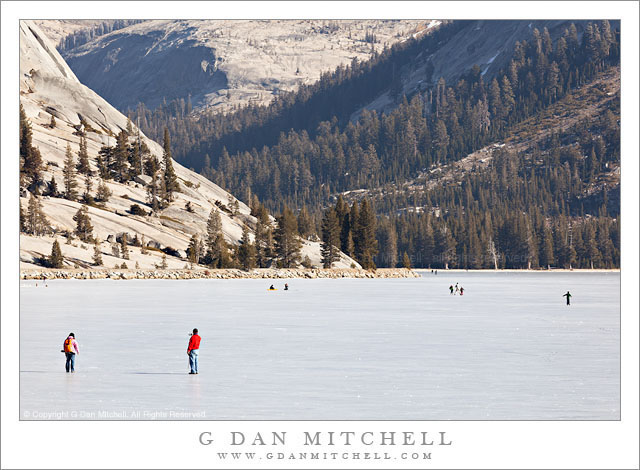
Skaters and walkers on frozen Tenaya Lake, accessible via the still-open Tioga Pass Road on January 16, 2012.
I have been meaning to post this photograph since I made it last month, on January 16, 2012. The serious California drought (or so it seems) of 2012 created very unusual conditions in the Sierra this winter. The Tioga Pass Road (highway 120) through Yosemite National Park usually closes by some time in November, and has been known to close as early as October. The early season this year made it appear that we might have a normal or even heavier than normal winter – early storms near the beginning of October brought a lot of snow to the range and temporarily closed the road more than once. But by December it became clear that this was not going to be a normal year at all, and by the end of the month there was almost no snow anywhere in the range.
A week before this visit I had crossed and re-crossed the pass on a trip to Death Valley. While I appreciated the convenience and shorter drive, I found the odd conditions unnerving. Aside from a few patches here and there, I saw no snow at all, though the seasonal cold had frozen the high country lakes. A week later it looked like a storm or two might finally arrive, so we decided to make the trip up to the Tuolumne area to see the high country in a state that we probably (hopefully!) won’t see again. During the week before this visit, local news stations around California had made this story well known, and they almost all mentioned that people were visiting Tenaya Lake. And, indeed, there were tons of people at the lake when we arrived. There were about as many cars as you might see on an August afternoon. People were clustered along the frozen edge of the lake, were walking along its borders, even setting up tables for picnics on the ice. A few people thought to bring ice skates and they were skating great distances. (Fortunately for us, most people went no farther than Tenaya, and the crowds decreased rapidly after that point.)
G Dan Mitchell is a California photographer whose subjects include the Pacific coast, redwood forests, central California oak/grasslands, the Sierra Nevada, California deserts, urban landscapes, night photography, and more. Blog | About | Flickr | Twitter | Facebook | Google+ | 500px.com | LinkedIn | Email
UPDATE: As of 2020 I am no longer posting annual updates concerning this subject — and I am editing older posts on the subject in light of the need to be more responsible about not encouraging the onslaught. I also no longer recommend going to the Valley to see it. Unfortunately, too much exposure (yes, I played a part in it, unfortunately) has led to absurd crowds, traffic jams, littering, destruction of areas in the Valley where too many people go to see it… and the park has increasingly — and appropriately — cracked down. Parking options have been eliminated, at least one viewing location has been closed. Good news! The rest of Yosemite Valley is still there and often exceptionally beautiful at this time of year.
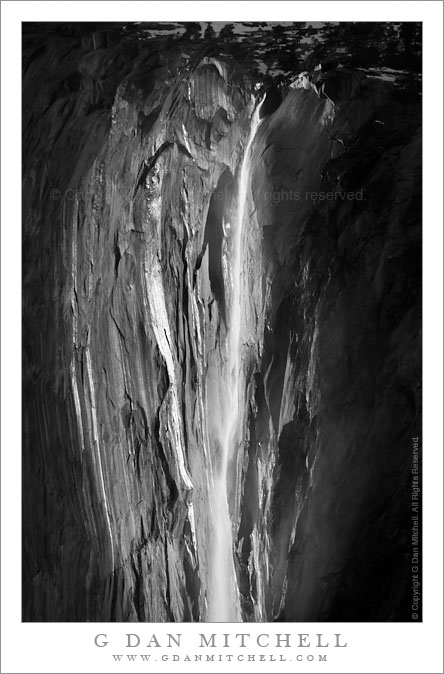
The silver strand of Horsetail Fall and water reflecting on surrounding cliffs in late afternoon light, Yosemite Valley.
This being February, it seems that Horsetail Fall has again (and more every year) become a hot topic. Horsetail Fall, sometimes referred to as the “Natural Firefall” has been popularized to an absurd and, frankly, dangerous level on social media and in the press. To be honest, I now recommend that you not go.
The conjunction of elements required to produce the most spectacular Horsetail Fall “event” is complex. First, it depends on the geological coincidences of the placement of the fall in a spot hight on the face of El Capitan that receives a narrow beam of sunset light during two brief periods each year. Second, the fall must be running – in roughly the middle of winter. The area supplying water to the fall is high enough to be snow-covered in a typical winter, but low enough that snow can melt and start the fall flowing even in the cold season – but this is not a sure thing. Essentially, there must be snow and then some warmth to melt it, or else some significant warm rain. Third, a series of meteorological events must play out just right. Obviously, the upper face of El Capitan must be clear of clouds. (Yosemite Valley fog and clouds ringing the cliffs are rather common in the winter season.) The sky west of the Valley must also be clear all the way to the horizon since the best color occurs just before the sun hits the horizon.
Most often the requirements do not align. Many of us can tell stories of light getting better and better, leading toward a brilliant finale… and then the “lights going out” just at the peak of color as the sun dropped behind clouds far to the west.
Hundreds and hundreds Thousands of photographers now show up to try to photograph the thing. I’ve done it in the past, though I’m no longer interested these days – partly because of the absurd crowds and partly because I’m often busy photographing other interesting things!
My best memory of photographing Horsetail was years ago when the park service was doing major road work on Northside Drive, the road along that side of the Valley. The road was completely closed as were the cross-valley roads that travel between Southside and Northside Drives. It had snowed and there was perhaps a foot or more of snow along this section of the Valley floor. I wanted to photograph the fall from a location on the north side of the Valley, so my only option was to put on lots of warm clothes, load up a pack of camera and other gear, and walk across the Valley in the snow. I arrived long before sunset, so I first walked west to El Capitan Meadow where I photographed in rare quiet and solitude on this car-free and carefree late afternoon. Later, I quietly walked back along the road to my shooting location and found perhaps three or four other people there. This quiet, peaceful, and relatively uncrowded experience became my touchstone for photographing Horsetail.
If you go today, there is no way that your experience will be even close, unfortunately.
In recent years, as more people have acquired digital cameras and become more serious about their photography and as the renown of the fall has increased, the crowds have also increased to the point that they have become unmanageable and are damaging the park. As I revise this article in 2020, the problem has become so acute that the park service has wisely put severe restrictions on access — there is no stopping allowed along large sections of nearby Valley roads and one of the popular locations has been completely closed due to damage to forest, meadows, and the river.
* Note: In a wonderful video about Horsetail Fall, Ansel Adams’ son Michael Adams speaks eloquently about his father’s early photographs of the phenomenon. I was intrigued by his comment that Ansel might not have photographed the fall the way we do now because he couldn’t – since he worked with black and white photography. Thinking of this, and being full of myself today, I thought that I’d post a black and white photograph of Horsetail Fall! :-)
G Dan Mitchell is a California photographer whose subjects include the Pacific coast, redwood forests, central California oak/grasslands, the Sierra Nevada, California deserts, urban landscapes, night photography, and more. Blog | About | Flickr | Twitter | Facebook | Google+ | 500px.com | LinkedIn | Email
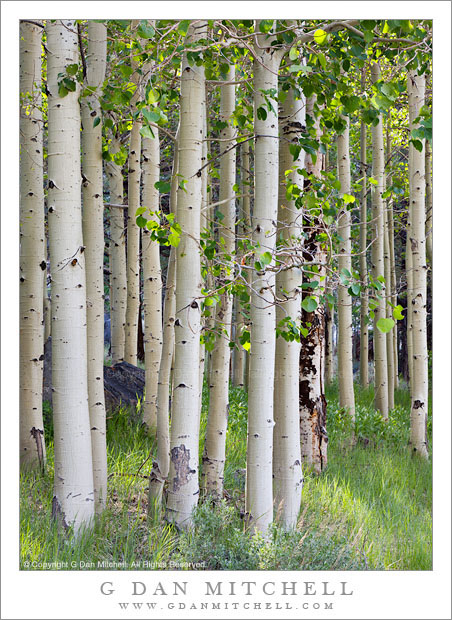
Morning light filters through an eastern Sierra aspen grove on a spring morning.
I often photograph the eastern Sierra aspens when they change colors in the fall, but these groves are appealing in every season – whether bare branches in snow, with green leaves quaking in the summer breezes, turning gold in fall, or with new leaves emerging in late spring.
I photographed these on one of those late-spring days. I had been up much earlier to photograph another subject elsewhere, and then returned to my camp site a bit later in the morning. This is a camp that I often use when photographing in the area east of Yosemite, so I know its surroundings quite well. The area is full of aspen trees, an there are a few small groves along a nearby section of the road that I often walk to. On this morning I stopped on my way back from that other place, just pulling over to the side of the road to shoot as the morning sun light was just arriving at this grove as the sun rose above the surrounding peaks.
G Dan Mitchell is a California photographer whose subjects include the Pacific coast, redwood forests, central California oak/grasslands, the Sierra Nevada, California deserts, urban landscapes, night photography, and more. Blog | About | Flickr | Twitter | Facebook | Google+ | 500px.com | LinkedIn | Email
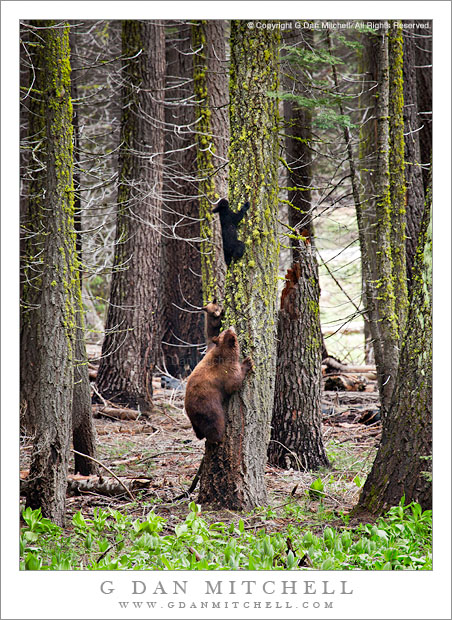
Two black bear cubs and their mother climb trees in Yosemite National Park, California.
I was very fortunate to be able to watch this bear family a couple of years ago – and to have a long enough lens to do so without intruding on them. The mother bear seemed to be alternately letting the “kids” play around and do whatever they felt like, and then offering them “climbing lessons” on some of the trees. The cub with black fur seemed the most comfortable at this, quickly scrambling straight up the trunks to surprising heights, moving with agility that reminded me of monkeys. The brown-fur sibling seemed a bit more cautious and “mama” seemed to have to offer a bit of encouragement and support, much as a human parent might do. Her actions at this point reminded me of my own experience with my kids the first time they climbed something (that seemed to them to be) dangerous – I followed close behind with my “front paws” around them, ready to catch if necessary.
While the brown cub initially hesitated quite a bit, before long it also took off and quickly ascended way up in the tree, and before long the whole family was 20 or more feet off the ground.
G Dan Mitchell is a California photographer whose subjects include the Pacific coast, redwood forests, central California oak/grasslands, the Sierra Nevada, California deserts, urban landscapes, night photography, and more. Blog | About | Flickr | Twitter | Facebook | Google+ | 500px.com | LinkedIn | Email