
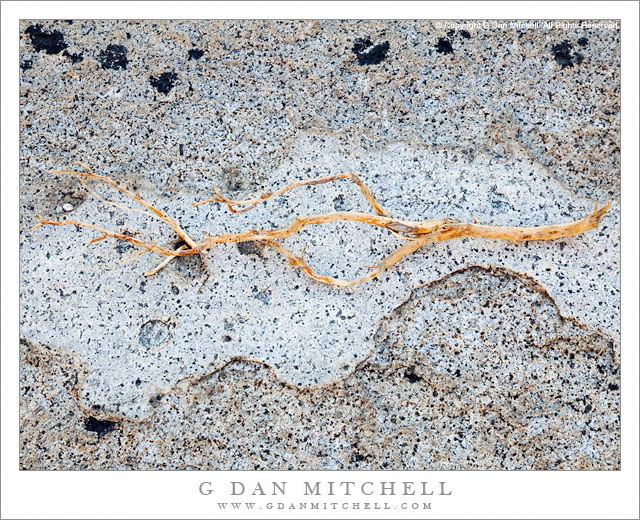
Dead Branch, Glaciated Granite

Dead Branch, Glaciated Granite

Dead Branch, Glaciated Granite. Yosemite National Park, California. June 28, 2010. © Copyright G Dan Mitchell – all rights reserved.

A dead branch lies on glacially-polished granite in the Yosemite National Park back-country.

I made a promise to someone to not say where this photograph was made – I’ll just say it is in Yosemite National Park. But the exact location really doesn’t matter too much, as these large expanses of glaciated granite slab are a common feature throughout the park, and you could find similarly interesting geology in thousands of locations.

I was a little surprised to find this weathered branch in this location, since it was a good distance from any trees and also not near any flowing water. Besides its location, a few other things about it caught my attention. First, its curving shapes lined up in a way tht seems to tie in with the bit of glacially-polished granite that lies beneath it. (And, yes, this is exactly where the branch was when I found it.) In a way, the larger shape of the lighter area of granite winding across the photograph from side to side almost seems like a much thicker echo of the curving shape of the branch. In addition, the warm brown tones of the branch seem to stand out a bit – though perhaps more in a larger print – against the relatively drab color of the rock.

G Dan Mitchell Photography | Flickr | Twitter | Facebook | Email
Text, photographs, and other media are © Copyright G Dan Mitchell (or others when indicated) and are not in the public domain and may not be used on websites, blogs, or in other media without advance permission from G Dan Mitchell.
Megapixel Mania – An Extended Riff

I read (yet another… ;-) megapixel rant somewhere online yesterday, and it got me thinking again about the fixation on megapixels as a measure of camera “value,” and the odd and sometimes irrational ways that people respond to this issue. It is well known that over the past decade or more, as digital photography technologies have become more and more prevalent (displacing film in many areas), camera technology has continued to advance in many ways. Among these advances is the ability to increase the number of photosites on sensors of a given size – e.g. give us “more megapixels.”

The responses to this tend to fall into three broad categories: Continue reading Megapixel Mania – An Extended Riff

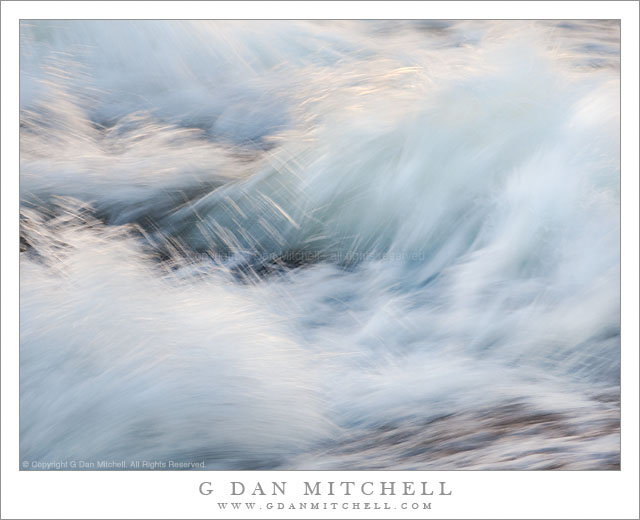
Whitewater, Tenaya Creek

Whitewater, Tenaya Creek

Whitewater, Tenaya Creek. Yosemite National Park, California.June 28, 2010. © Copyright G Dan Mitchell – all rights reserved.

Turbulent whitewater flows through an area of steep granite along Tenaya Creek, Yosemite National Park.

You can, of course, find a place to shoot subjects like this one all over the Sierra and no doubt in many other places as well. This photograph was made during a period of relatively high water early in the season and in a spot where the water flowed over some rocks in shade. Sunlight on the other side of the stream reflected into the water and revealed highlights, especially the flying spray that I allowed to blur with a somewhat slow shutter speed.

The moving water in Sierra streams and rivers seems to be an almost irresistible subject for many photographers, and I confess that I count myself among them. In some ways it is almost too easy to make these photographs, and one basic requirement is a willingness to make quite a few exposures. The instantaneous motion of the water and the reflections of light simply cannot be controlled or predicted, so one almost has to make many, many exposures. Of course, there is a bit more to it than pointing the camera at water and then repeatedly pressing the shutter release. It is important to find some sort of compositional interest first – it could be where water flows around or over a rock, a place where the light catches the water, or possibly just the twisting forms of turbulent water. Light is extra important in these photographs I think – most often the colors come from a combination of the blue-green shades of water full of foam and from reflected light from things that are out of the frame. (In this photograph, the light mostly comes from sunlight reflected off of granite on the far side of the stream.) Shutter speed is an important consideration, as a short exposure will stop or nearly stop the water and freeze the motion, a somewhat longer exposure can hold some detail but still allow blur along the direction of the flow, and very long exposures can create a misty and diffuse effect.

G Dan Mitchell Photography | Flickr | Twitter | Facebook | Email
Text, photographs, and other media are © Copyright G Dan Mitchell (or others when indicated) and are not in the public domain and may not be used on websites, blogs, or in other media without advance permission from G Dan Mitchell.

‘From Film Holder to Memory Card’ at TOP

The Online Photographer (a.k.a. “TOP”) is one of the blogs I follow regularly – lots of great thought-provoking posts show up there on a regular basis, frequently written by folks who know what they are talking about. Take a look if you don’t already follow TOP.

I enjoyed a recent article (“From Film Holder to Memory Card”) by photographer Charles Cramer in which he describes his transition from large format film gear to using medium format digital systems. My favorite example of Charlie’s ironic humor in the post is his “apology” to those who haven’t made the switch: “Note to my large format friends: O.K., I sold out—but I get to use zoom lenses!!!”

In any case, this post is another data point to consider if you happen to be one of those folks who is certain that great photography must be created using traditional film gear and processes. While there is absolutely no question that great work can still be done that way, it is equally possible to do wonderful photography with newer technologies… and, as Charlie illustrates, there are some things that can simply be done more effectively, less expensively, and with better results.

G Dan Mitchell Photography | Flickr | Twitter | Facebook | Email
Text, photographs, and other media are © Copyright G Dan Mitchell (or others when indicated) and are not in the public domain and may not be used on websites, blogs, or in other media without advance permission from G Dan Mitchell.