
Category Archives: Photographs: Death Valley

Hills And Alluvial Fan

Hills And Alluvial Fan
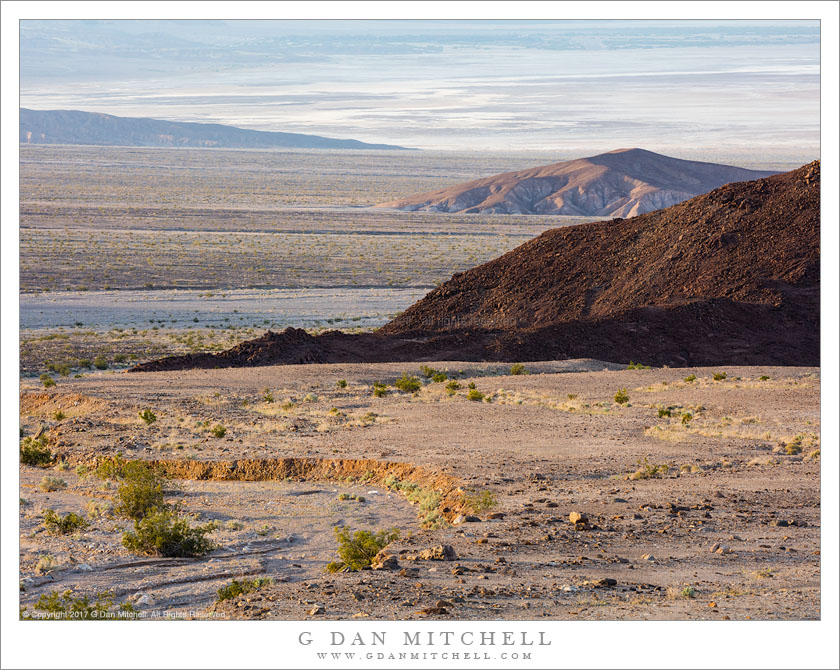
Morning light on desert hills and a gigantic alluvial fan above the salt flats of Death Valley

Hills And Alluvial Fan. Death Valley National Park, California. april 6, 2017. © Copyright 2017 G Dan Mitchell – all rights reserved.

Morning light on desert hills and a gigantic alluvial fan above the salt flats of Death Valley

There are a number of things that characterize Death Valley for me — the arid climate, of course, but also the exposed geology, the texture and sound of gravel underfoot, the widely scattered plant life, the quality of atmosphere and light. But most of all I think it is the immense scale of the place that impresses me. It is easy to overlook the fact that the small hill or those dunes or that peak that seem so close may be far enough away that you could not walk there in a day, or that it might take a few hours of driving.

That scale is visible in this photograph, though it may not be immediately apparent. While the foreground was, with its low walls illuminated by early morning light, is very close, and getting to the first dark hill might take no more than 15 minutes, the further hill down on the lower portion of the alluvial fan might require a morning’s walk. It would likely take all day to get to the closest portion of the distant salt flats, and the furthest areas at the upper part of the frame would require a few days of walking. I arrived at this place — but not by walking! — before the sun rose, when it was cloudy and seemed like it might not be a good day for light. But there were a few breaks in the clouds, and across the valley to the right of the scene some sun was striking a mountain ridge. Before long, as the sun came up and rose higher in the sky, that light began to move closer until it finally washed across the landscape in front of me.


G Dan Mitchell is a California photographer and visual opportunist. His book, “California’s Fall Color: A Photographer’s Guide to Autumn in the Sierra” is available from Heyday Books and Amazon.
Blog | About | Flickr | Twitter | FacebookGoogle+ | LinkedIn | Email


All media © Copyright G Dan Mitchell and others as indicated. Any use requires advance permission from G Dan Mitchell.
Abandoned Stamp Mill

Abandoned Stamp Mill
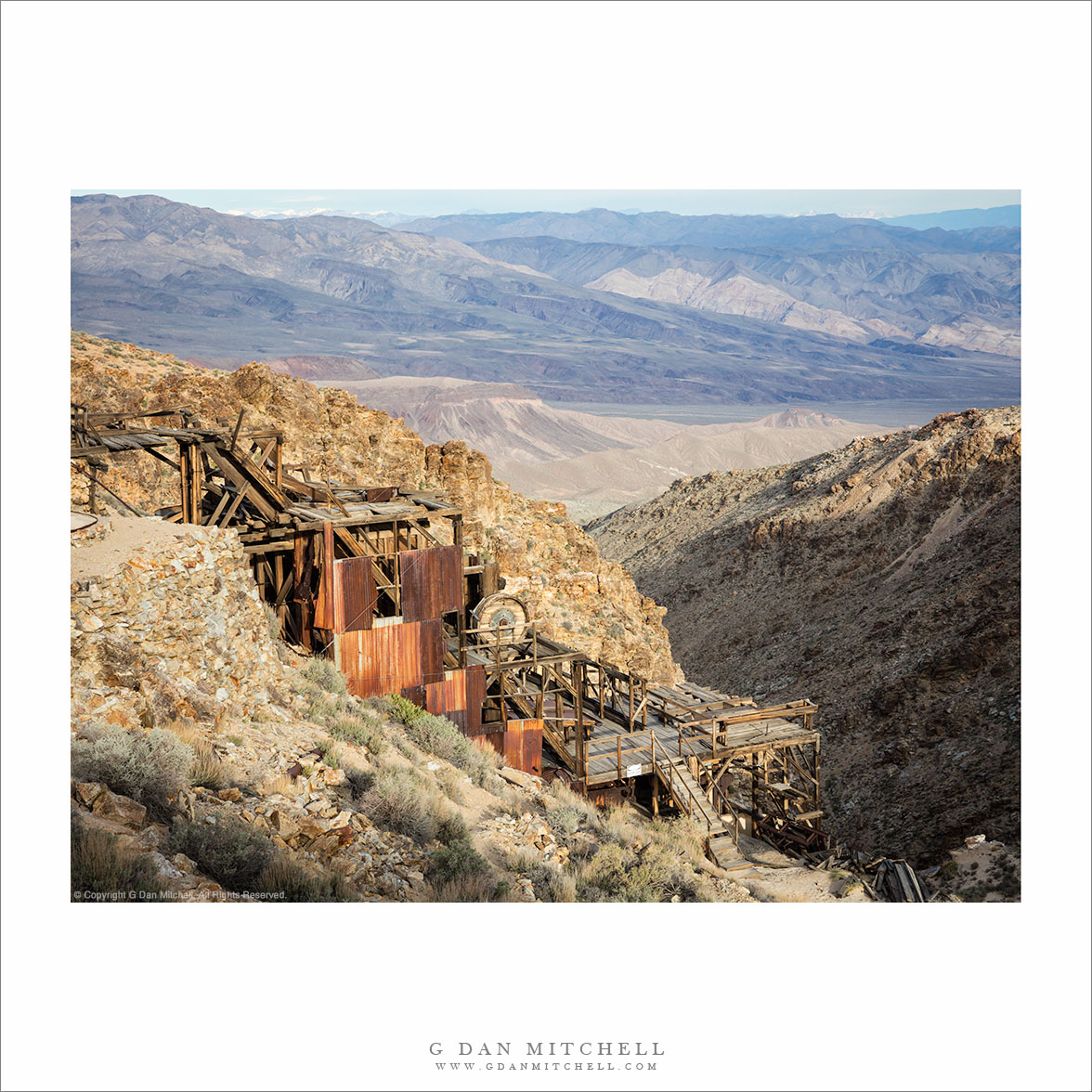
“Abandoned Stamp Mill” — An abandoned water-powered stamp mill high in the Panamint Range, Death Valley National Park

It seems that every national park or monument has both a natural and a human hisstory, or perhaps a story about the relationship between the two. While the power of natural forces (heat, water, geology, and more) is abundantly obvious in the huge, austere landscape of Death Valley National Park, the human history of the place is rarely far from view. It begins with the evidence of people who lived here long before European-origin settlers came, evidence that can be seen in rock art scattered throughout the park, in the recognition that many settlements (current and now-abandoned) have a very much longer history than we may think, and in the native people who still occupy and identify with this landscape.

Perhaps more obvious is the more recent history of those who came to look for mining success. (There are places in the park where extraction still takes place.) Some examples are obvious to the casual visitor, but the more time you spend in the back-country of the park the more you understand that this particular history is everywhere — though not usually as obvious as this example. This stamp mill, built to crush gold ore, is amazing in multiple ways. Perched at the end of high ridge in very remote location, it was powered in the most unlikely manner… by water piped in from a spring over twenty miles away. The location is stupendous, and it is easy to think that practical issues may not have been the only considerations in choosing the site. From here one can look down thousands of feet to broad alluvial slopes leading towards Death Valley, but one can also look further into the distance and see the snow-covered peaks of the Sierra Nevada.


Leave a comment or question using the form. (Click the title to see the full article and to comment if you are viewing it on the home page.)

G Dan Mitchell is a California photographer and visual opportunist. His book, “California’s Fall Color: A Photographer’s Guide to Autumn in the Sierra” (Heyday Books) is available directly from him. Blog | Bluesky | Mastodon | Substack Notes | Flickr | Email

All media © Copyright G Dan Mitchell and others.

Desert Hills, Morning

Desert Hills, Morning
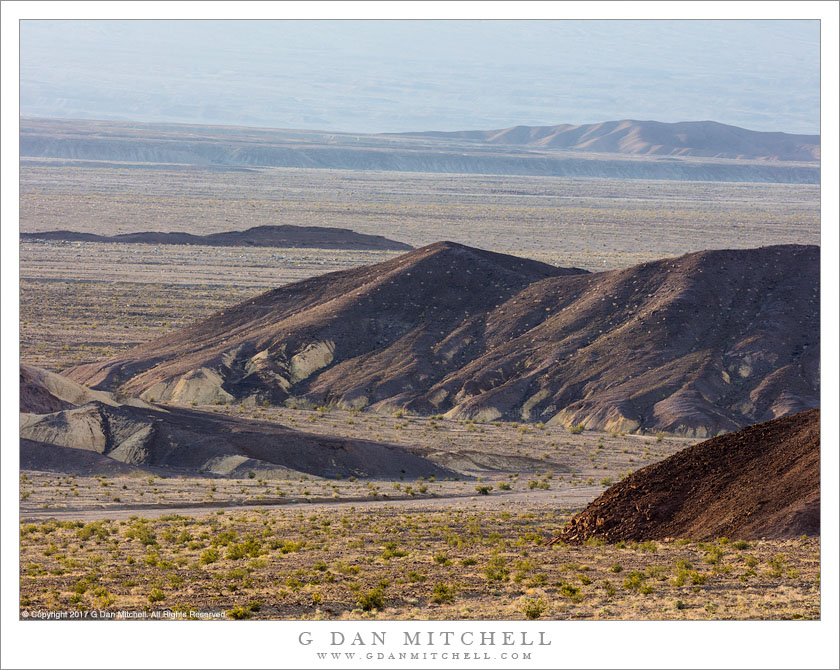
Morning light slants across desert hills, Death Valley National Park

Desert Hills, Morning. Death Valley National Park, California. April 6, 2017. © Copyright 2017 G Dan Mitchell – all rights reserved.

Morning light slants across desert hills, Death Valley National Park

If you know Death Valley well, you already know this — but to many of you it may come as a surprise to realize just how much of Death Valley’s character is the result of the actions of water. The main valley itself was once the floor of a huge lake, and quite a few formations were formed beneath its surface. Once you realize this you begin to see the evidence everywhere. And in the time since the lake’s waters receded, the effects of water have continued in other ways. Evidence of flowing water is everywhere, from the gullies inscribed into the hillsides, to the washes that are found almost everywhere, and including the gigantic alluvial fans forms as floods carried eroded material from the high mountains out onto the desert floor. This extraordinarily dry landscape is, oddly enough, one of the easiest places to see the effects of water.

I had originally planned to photograph in a salt flat area where a bit of water flows, but when I arrived and found that my intended distant subject was under dim, cloudy light I decided to go with plan b and move on to higher ground. I had scoped out this location on a previous evening and was intrigued by the overlapping patterns of darker hills rising above the alluvial fan and the way they recede into distant haze. In the morning I could tell from a distance that there was light up here, so I quickly headed this direction, arriving just as the first light touched some clouds overhead. As I continued to photograph the clouds moved, bringing alternating periods of hazy gloom and then beautiful light.


G Dan Mitchell is a California photographer and visual opportunist. His book, “California’s Fall Color: A Photographer’s Guide to Autumn in the Sierra” is available from Heyday Books and Amazon.
Blog | About | Flickr | Twitter | FacebookGoogle+ | LinkedIn | Email


All media © Copyright G Dan Mitchell and others as indicated. Any use requires advance permission from G Dan Mitchell.
Desert Spring

Desert Spring
Pools of desert water reflect sunrise light on distant mountains, Death Valley National Park

Desert Spring. Death Valley National Park, California. March 31, 2015. © Copyright 2015 G Dan Mitchell – all rights reserved.

Pools of desert water reflect sunrise light on distant mountains, Death Valley National Park

Although it is dawn in this photograph, I had already been up and photographing for some time before I took a break to walk along an observation area and next to the highway at this popular location. The pools of water have their source underground at the base of the tall mountains standing behind my camera position.

Beyond the water are salt flats, some in the “classic” flat white style, and others in the inhospitable and rugged “Devil’s Golf Course” style. The foreground water reflects the morning blue sky, and further out it reflects the ridge of the Panamint Mountains on the far side of the Valley.


G Dan Mitchell is a California photographer and visual opportunist. His book, “California’s Fall Color: A Photographer’s Guide to Autumn in the Sierra” is available from Heyday Books and Amazon.
Blog | About | Flickr | Twitter | FacebookGoogle+ | LinkedIn | Email


All media © Copyright G Dan Mitchell and others as indicated. Any use requires advance permission from G Dan Mitchell.