
Category Archives: Photographs: Desert

At the Edge of the Salt Flats

At the Edge of the Salt Flats, Death Valley National Park.
“At the Edge of the Salt Flats” — Panamint mountains tower above as a small wash runs to the edge of the salt flats, Death Valley.

During my late-February visit to Death Valley National Park I spent two early mornings photographing this location. It is generally most interesting at dawn, when the morning light shines on the distant Panamint Mountains, so I was there well before sunrise. In order to find ideal locations here you really have to scout ahead of time. On the first of the two visits I slightly missed my target location in the darkness. I still got photographs, but before my return on the last morning of my trip, I checked it one more time and determined that following this runoff gully would get me where I needed to be.

There was another benefit from following the little gully. The soil on the higher ground to either side is quite soft and walking on it leaves obvious footprints. In many places the bottom of the gully is covered with small rocks, and it is easier (on me and the landscape1) to walk on this harder surface. Distances here are deceiving. If you started at sunrise (and could find a route) it would take you an entire, long day just to get the base of those mountains.


G Dan Mitchell is a California photographer and visual opportunist. His book, “California’s Fall Color: A Photographer’s Guide to Autumn in the Sierra” (Heyday Books) is available directly from him.

G Dan Mitchell: Blog | Bluesky | Mastodon | Substack Notes | Flickr | Email


All media © Copyright G Dan Mitchell and others as indicated. Any use requires advance permission from G Dan Mitchell.
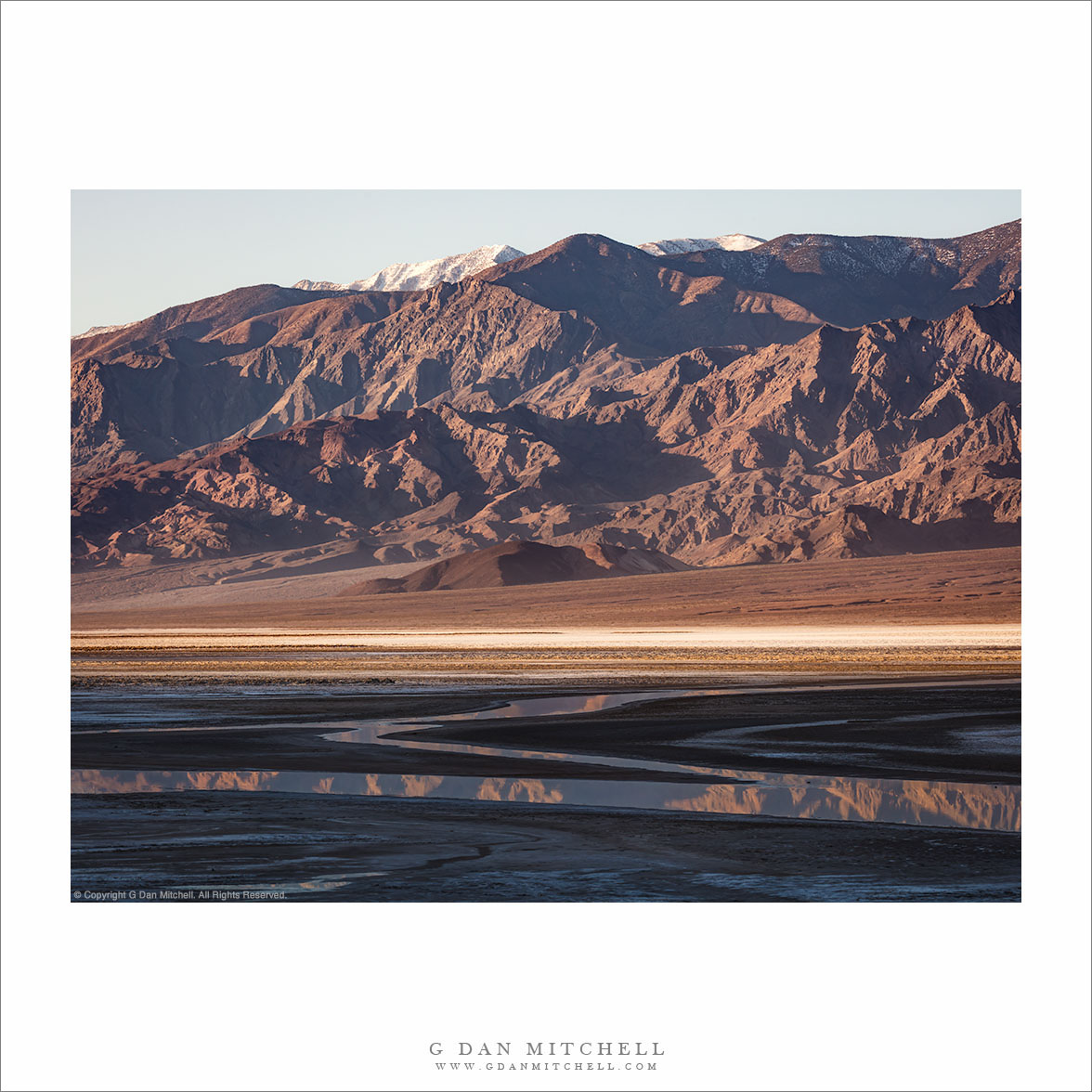
Salt Flats to Mountain Peaks

Salt Flats to Mountain Peaks, Death Valley
“Salt Flats to Mountain Peaks” — Snow-covered Telescope and Rogers Peaks and the Panamint Mountains tower above Death Valley salt flats in morning shadows

It still seems odd to find water flowing here, but out on the salt flats of Death Valley it does flow at all times of the year. It is extremely shallow and it moves very slowly — but the amount of moisture out there is still impressive. Hint: don’t walk on these flats — you aren’t going to enjoy the thick mud on your shoes, the sensation of sinking into it, or the tracks you leave behind.

These mountains face the rising sun, so I was out there before sunrise, getting set up and framing some compositions so that I could work rapidly as the sun arrived. It comes quickly, and it is only minutes from the first light on the high, snow-covered peaks until the line of light starts to creep across the flats. This isn’t the lowest spot in the valley, though it is below sea level. The highest of those distant peaks is over 11,000 feet tall.


G Dan Mitchell is a California photographer and visual opportunist. His book, “California’s Fall Color: A Photographer’s Guide to Autumn in the Sierra” (Heyday Books) is available directly from him.

G Dan Mitchell: Blog | Bluesky | Mastodon | Substack Notes | Flickr | Email


All media © Copyright G Dan Mitchell and others as indicated. Any use requires advance permission from G Dan Mitchell.
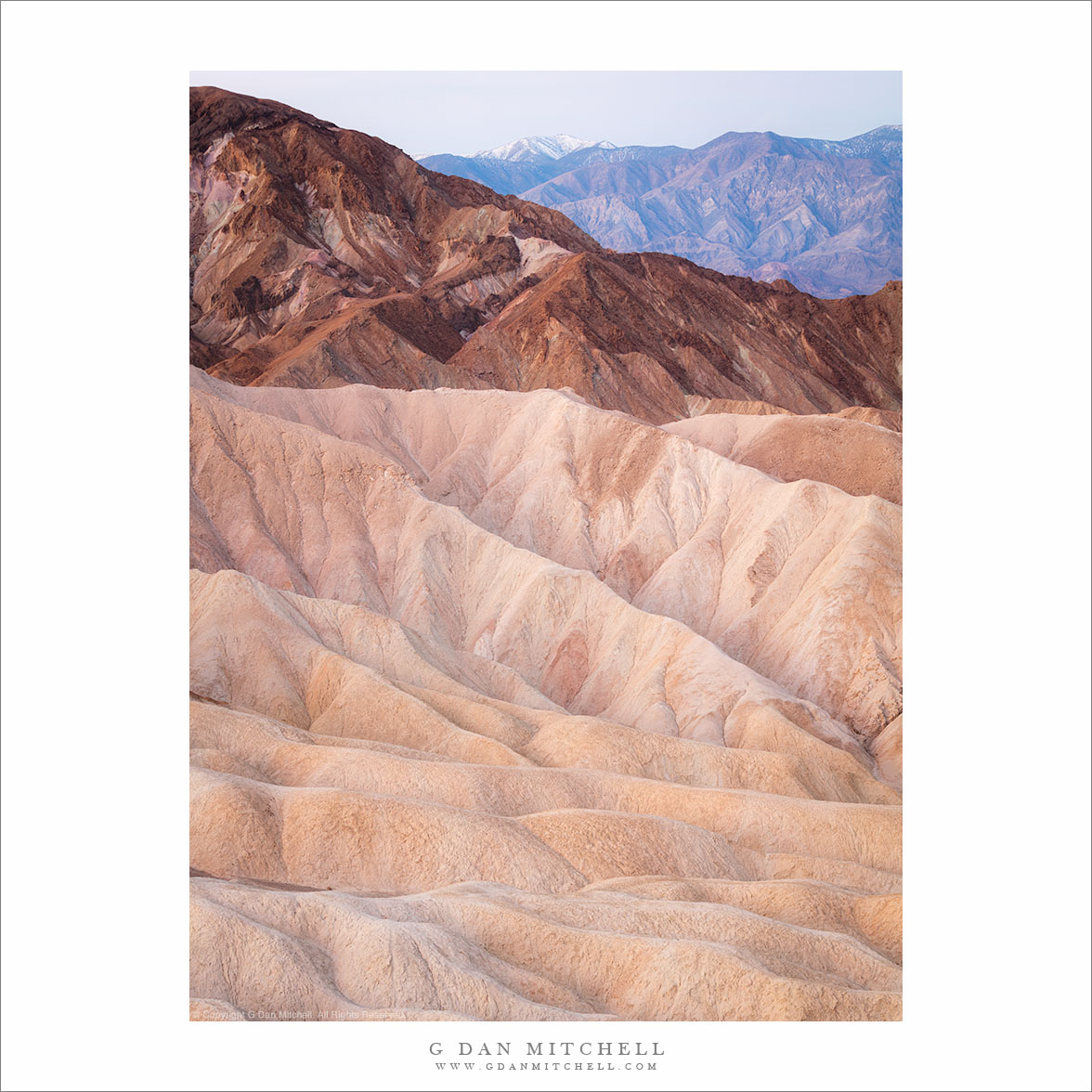
Zabriskie Before Sunrise

Zabriskie Before Sunrise,Death Valley
“Zabriskie Before Sunrise” — Badlands terrain, distant Panamint Mountains, and Rogers Peak.

I made this photograph right around sunrise. A half hour earlier I had abruptly aborted my drive to a different locationi when I thought I saw some promising clouds in the pre-dawn dusk. I thought that they might produce something exceptional at sunrise. My hunch was wrong — it was a lovely morning at Zabriskie, but nothing particularly out of the ordinary. But since I was there I went ahead and photographed, including this image that includes the short and long views.

As I was standing there waiting for the right light, some women asked about that snow-covered peak. I said it was Telescope Peak, then realized my error — Telescope is hidden behind the dark foreground ridge, and the high point visible here is actually Rogers Peak, a lower summit near Telescope. One of the remarkable things about Death Valley National Park is the range of climates it encompasses. We can stand in an arid desert location like this one and look up to snow-covered alpine peaks.


G Dan Mitchell is a California photographer and visual opportunist. His book, “California’s Fall Color: A Photographer’s Guide to Autumn in the Sierra” (Heyday Books) is available directly from him.

G Dan Mitchell: Blog | Bluesky | Mastodon | Substack Notes | Flickr | Email


All media © Copyright G Dan Mitchell and others as indicated. Any use requires advance permission from G Dan Mitchell.
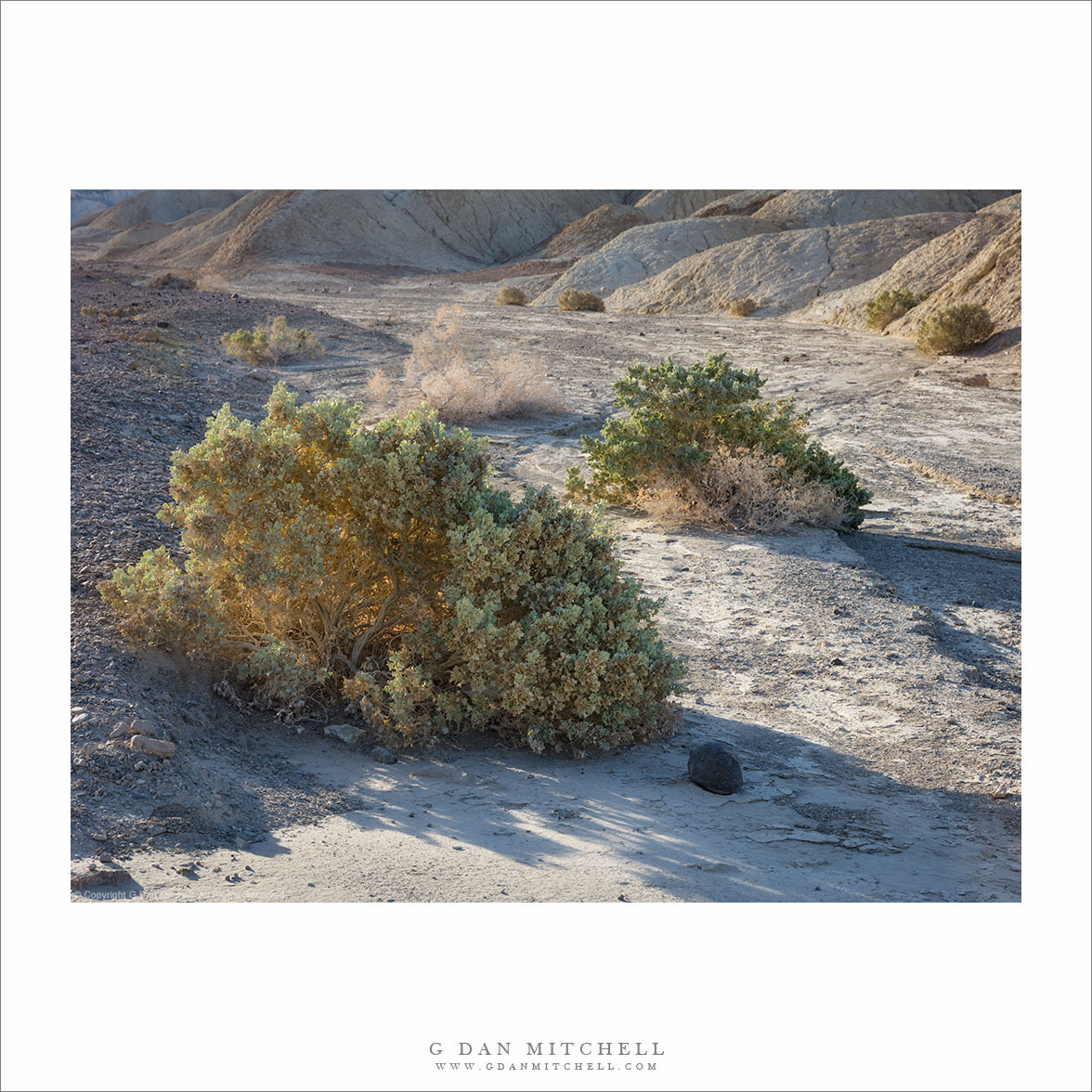
Desert Holly Plant, Dry Wash

Desert Holly Plant, Dry Wash, Death Valley
“Desert Holly Plant, Dry Wash” — A dormant desert holly plant in a desert wash, Death Valley.

This photograph comes from one of the more arid, inhospitable-looking locations in Death Valley National Park. The soil here is not conducive to much plant life, and few plants manage to eke out an existence. One that does is the desert holly. When it gets enough water it sports lovely gray-green foliage, but when the heat and aridity become too much the plant goes dormant and turns brown/tan.

These plants are growing along the edges of a desert wash, which makes sense given that any sufficient runoff will move down this stream bed and leave behind a bit more moisture for the plants growing there. Washes like this, though often with a more gravelly surface, are everywhere this park, and they frequently provide passage into mountains.


G Dan Mitchell is a California photographer and visual opportunist. His book, “California’s Fall Color: A Photographer’s Guide to Autumn in the Sierra” (Heyday Books) is available directly from him.

G Dan Mitchell: Blog | Bluesky | Mastodon | Substack Notes | Flickr | Email


All media © Copyright G Dan Mitchell and others as indicated. Any use requires advance permission from G Dan Mitchell.