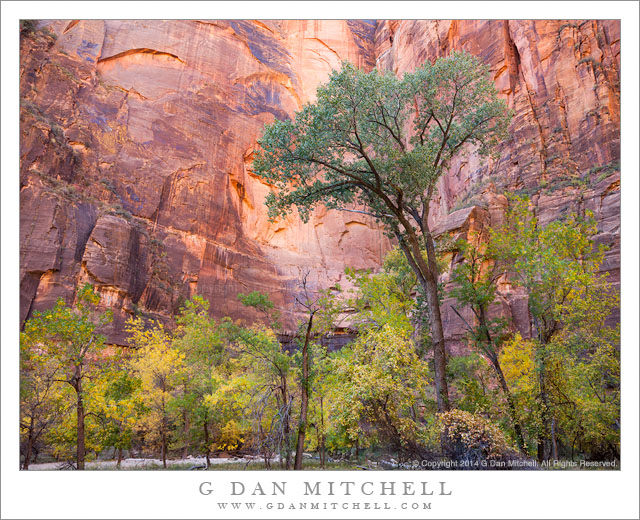
An old cottonwood tree towers about streamside trees at the bottom of gigantic sandstone cliffs.
This is a well-known and heavily traveled location in Zion Canyon along the Virgin River in Zion National Park — yet a place that I’m unable to resist visiting when I’m in Zion NP. It probably isn’t necessary for me to name the spot, since most anyone who has been there likely recognizes it.
Here there is a bend in the path of the Virgin River, which flows along the base of a very tall section of the canyon, tight against the outside of the bend where the river continues to work on carving the sandstone deeper. Trees grow along the creek at the base of the red rock wall, and the curve of the canyon creates a feeling that might be described as being almost cathedral-like. The light is often subdued, at least during the seasons when I have visited, since the canyon walls are so high that the sun only rises above them for a short time each day. In the particular spot where I made the photograph, one massive old cottonwood tree towers above the rest.
G Dan Mitchell is a California photographer and visual opportunist whose subjects include the Pacific coast, redwood forests, central California oak/grasslands, the Sierra Nevada, California deserts, urban landscapes, night photography, and more. Blog | About | Flickr | Twitter | Facebook | Google+ | 500px.com | LinkedIn | Email
This is another multi-photograph post — in this one I share four photographs from the Grand Staircase-Escalante National Monument that feature trees in various back-country landscapes ranging from the canyons and rock formations to one otherwise perhaps un-notable stop near a campsite where I stayed.
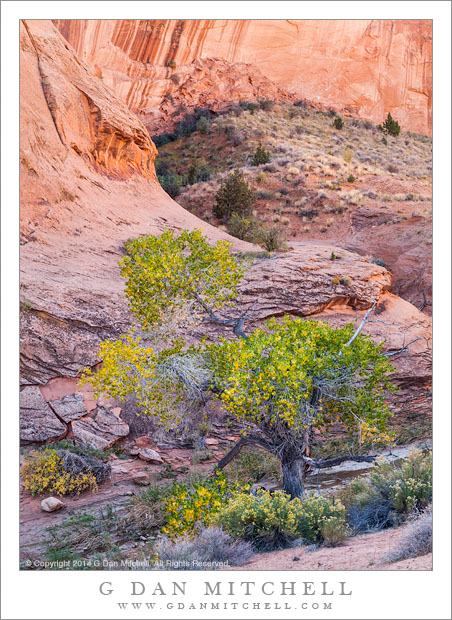
Colorful autumn foliage on a cottonwood tree next to a creek at the bottom of a deep sandstone canyon
This stout cottonwood tree grows in the wash at the bottom of this deep canyon, at the base of huge sandstone walls that tower above and wrap around curves in the canyon’s path. I had stopped here to photograph a different tree — it is among those shared in this group — and after finishing with that tree I looked over here to see this one standing against the worn and curving rock shapes at the base of the canyon walls.
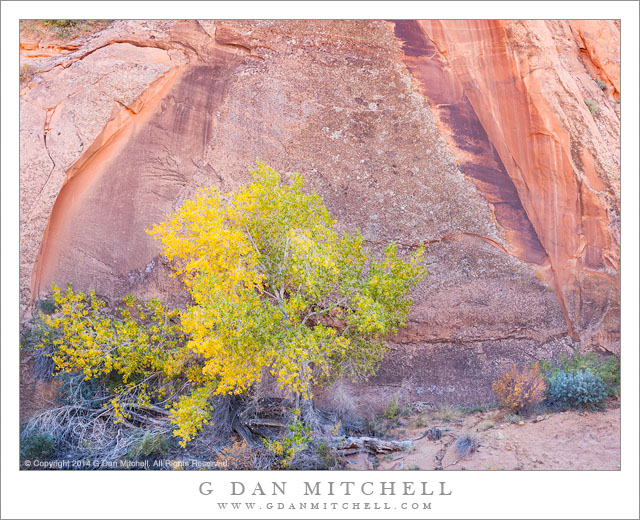
Fractured and sandstone canyon walls arch above a cottonwood tree with fall foliage
This is one of two photographs of this tree that I like. (The other is a in portrait orientation, and may give a better sense of the trees size and the relative scale of the huge sandstone canyon wall.) The tree grows in the bottom of the wash and right up against the canyon walls, with several arch shapes in the sandstone creating a sort of frame for it.
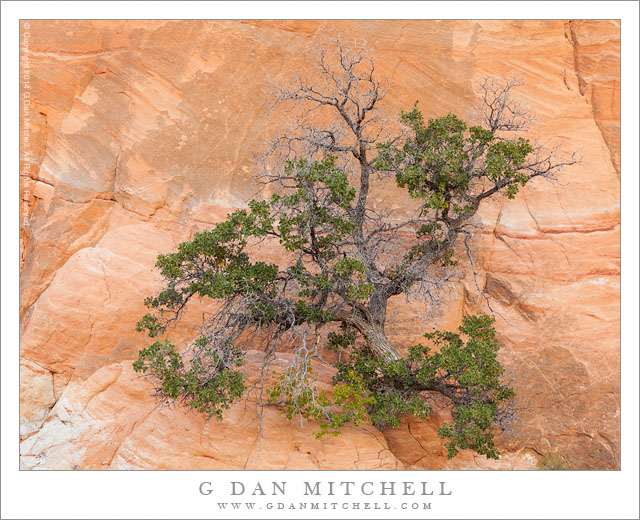
A solitary oak tree grows from a crack in Utah sandstone
This photograph comes with a bit of a personal story. In the morning we (a group of six photographers) had departed our camp on foot to hike down a nearby wash and drop into a deeper canyon. Although the morning began well, with a pleasant walk down the wash, followed by some exploration as we tried to find a good way to drop into the deeper canyon, I suddenly developed a knee problem — I decided to remain behind as the group went on. I walked back to camp, making photographs along the way, and then drove to some other places along our gravel road looking for other subjects. In the late afternoon I returned to camp, though no one else had yet returned. So I decided to do a bit of exploring near camp, and I ended up at the base of a sandstone face as the sun dipped behind mountains to the west — and I photographed this tree in the low light before heading back to camp.
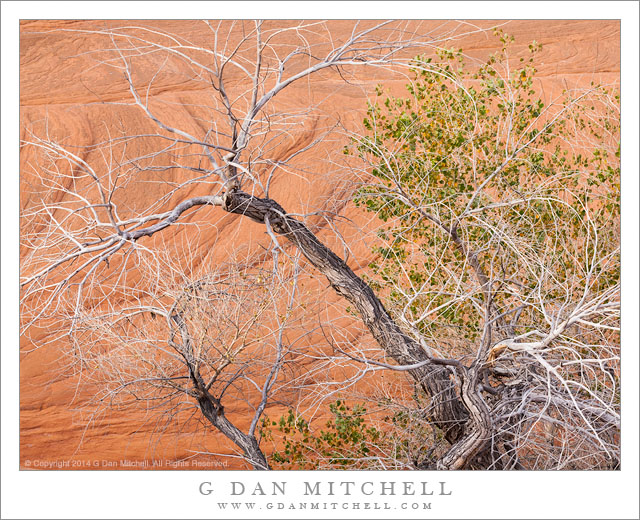
On our first night together as a group in a back-country area of Utah we set up camp and then headed out to photograph something as the evening approached. We drove, ending up at a spot where large sandstone formations are backed by an even larger area of smooth sandstone surfaces, interrupted by potholes and other features. At one point we were in one of those locations where the number of obvious photographic subjects was limited — basically, there was a beautiful pothole with a true and there was this old snag. With six photographers, interesting questions arise. Do we all shoot the same subject? If one person shoots it first, is it OK for the next to photograph from the same angle? How could we each take this common subject and do something different with it? I initially resolved to not shoot this snag, but a bit later I came back and gave in to temptation! ;-)
G Dan Mitchell is a California photographer and visual opportunist whose subjects include the Pacific coast, redwood forests, central California oak/grasslands, the Sierra Nevada, California deserts, urban landscapes, night photography, and more. Blog | About | Flickr | Twitter | Facebook | Google+ | 500px.com | LinkedIn | Email
Continuing with this week’s experiment in releasing multiple photographs in a single post, this set includes four photographs from Utah’s Capitol Reef National Park.
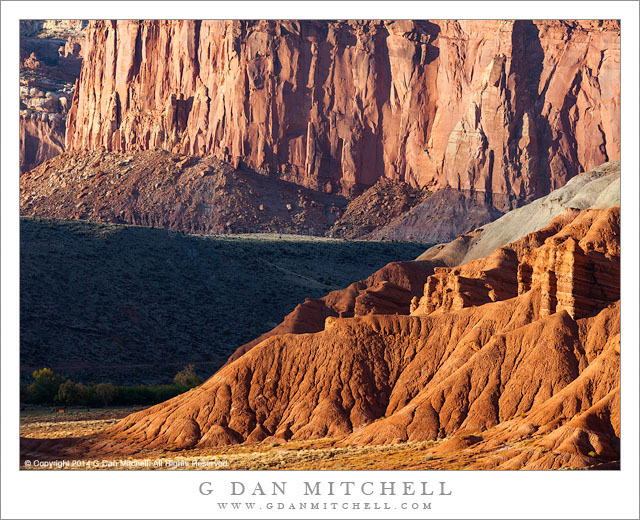
Hills and sandstone cliffs above the Fruita District in evening light, Capitol Reef National Park
On our first evening in Capitol Reef, where we stated at the campground at Fruita, we had this beautiful though momentary spectacular light late in the day, as the lowering sun managed to shine through openings in clouds to the west.
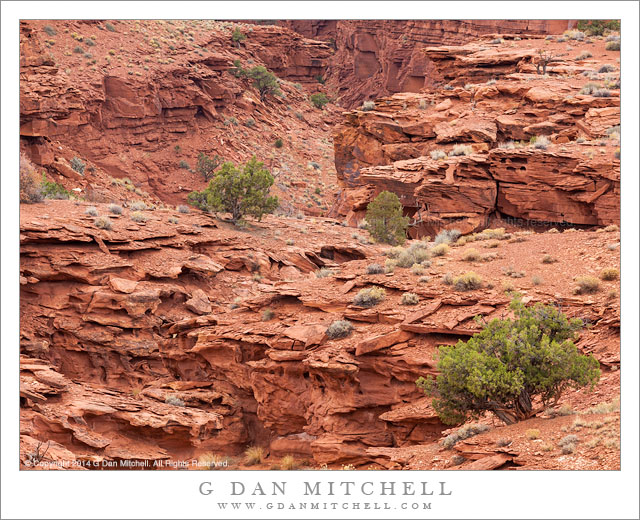
A gully begins to cut into the red rock surface of desert terrain
This was a tricky morning for photography. At dawn there was some beautiful light making its way through breaks in a developing cloud cover. However, shortly after dawn those clouds increased and began to turn the morning gray. Shooting can be a challenge in such light, though it works better for some subjects than others — it can help when the soft, filtered light fills in the shadows, and sometimes the subdued light can enhance the saturation of some colors. This small canyon is west of the main areas of Capitol Reef, where it cuts deeply into the tilting plateau areas.
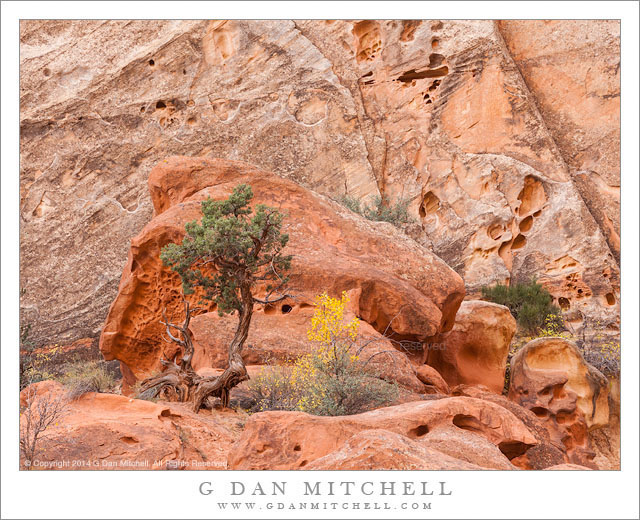
We spent an evening exploring some of the washes and canyons along the west side of Capitol Reef National Park, and by the time we got deep into this canyon the light was coming from low in the sky, creating conditions of very soft light in the bottom of the canyon. Here a small tree stands in front of rocks with interesting shapes and hollows.
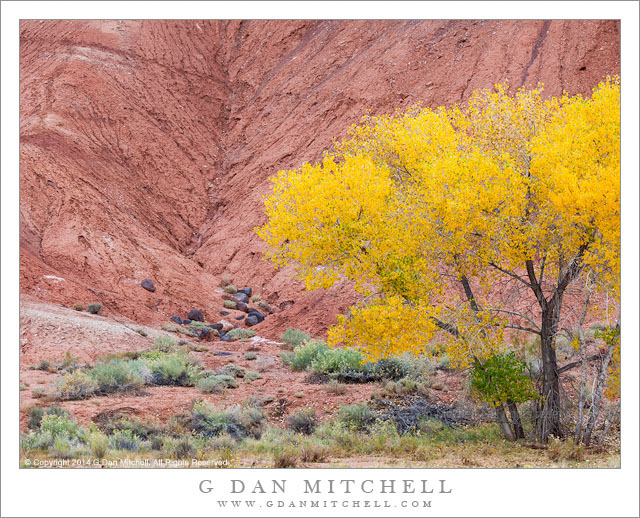
Brilliant yellow autumn cottonwood tree foliage against a red earth hill and gully
This photograph was also made on the cloudy morning mentioned above. When we first realized that we had lost the sun, we started out by heading straight to a nearby grove of cottonwood trees, whose colors can stand out nicely in such light. (In some ways, the colors can look better in this light, as the still glow but they don’t pick up the white highlights of direct sun.) The color palette here is quite varied, though not unexpected for this area — with the dark shape of the tree trunks, the bright yellow leaves, a few green leaves at the bottom of the trees, the dusty greens of the smaller plants, and the red/pink coloration of the gully.
G Dan Mitchell is a California photographer and visual opportunist whose subjects include the Pacific coast, redwood forests, central California oak/grasslands, the Sierra Nevada, California deserts, urban landscapes, night photography, and more. Blog | About | Flickr | Twitter | Facebook | Google+ | 500px.com | LinkedIn | Email
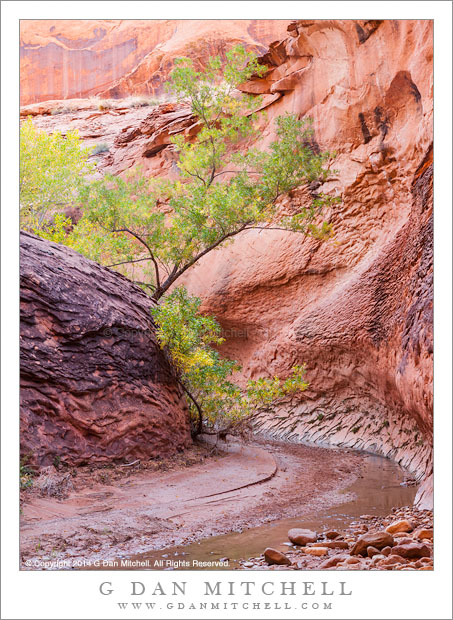
A box elder with autumn foliage grows along the stream at the bend in a red rock canyon
There are many patterns familiar to those who enter these canyons. In many cases, the creeks and rivers meander back and forth, and over time they may have cut paths deep into the sandstone layers that also meander in the same way. Walking along such a small creek, looking up, and realizing that a winding canyon hundreds of feet deep was cut but the little creek gives you a sense of deep time… and also a clear indication that such creeks are not always so gentle. The winding patterns also lead you on as you descend the creeks. Each time you round a bend like this one you get a view further along in the canyon… to the next bend, where the creek turns out of sight again. And you say/think to yourself, “just one more bend and then I’ll turn around.” So you keep going and round that next bend, where you can see a bit further into the canyon… to the next bend. And you say/think to yourself, “just one more bend and then I’ll turn around…”
This creek doesn’t follow the perfect pattern of consecutive meanders that are found in some canyons, but it did in this section where I found a single box elder tree growing at the edge of a rock that butted up against the wetter, sandy section of the water course. And far above, the gigantic walls of this canyon mirrored, as expected, the curves of the bottom of the canyon, and warm light bouncing among the canyon walls filtered down here to gently illuminate the depths of this red canyon.
G Dan Mitchell is a California photographer and visual opportunist whose subjects include the Pacific coast, redwood forests, central California oak/grasslands, the Sierra Nevada, California deserts, urban landscapes, night photography, and more. Blog | About | Flickr | Twitter | Facebook | Google+ | 500px.com | LinkedIn | Email
Photographer and visual opportunist. Daily photos since 2005, plus articles, reviews, news, and ideas.
Manage Consent
To provide the best experiences, we use technologies like cookies to store and/or access device information. Consenting to these technologies will allow us to process data such as browsing behavior or unique IDs on this site. Not consenting or withdrawing consent, may adversely affect certain features and functions.
Functional
Always active
The technical storage or access is strictly necessary for the legitimate purpose of enabling the use of a specific service explicitly requested by the subscriber or user, or for the sole purpose of carrying out the transmission of a communication over an electronic communications network.
Preferences
The technical storage or access is necessary for the legitimate purpose of storing preferences that are not requested by the subscriber or user.
Statistics
The technical storage or access that is used exclusively for statistical purposes.The technical storage or access that is used exclusively for anonymous statistical purposes. Without a subpoena, voluntary compliance on the part of your Internet Service Provider, or additional records from a third party, information stored or retrieved for this purpose alone cannot usually be used to identify you.
Marketing
The technical storage or access is required to create user profiles to send advertising, or to track the user on a website or across several websites for similar marketing purposes.

 G Dan Mitchell is a California photographer and visual opportunist whose subjects include the Pacific coast, redwood forests, central California oak/grasslands, the Sierra Nevada, California deserts, urban landscapes, night photography, and more.