Category Archives: Photographs: Wildlife

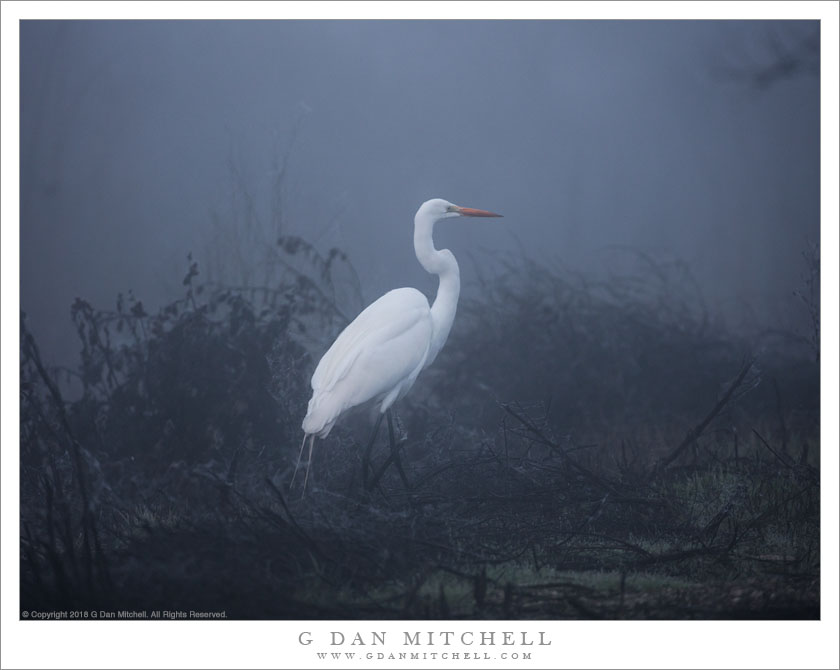
Egret, Blue Hour Fog

Egret, Blue Hour Fog
An egret hunting in blue hour fog

Egret, Blue Hour Fog. © Copyright 2018 G Dan Mitchell – all rights reserved.

An egret hunting in blue hour fog

For those who don’t know the term, “blue hour” is that twilight period when the light tends to become soft and blue, most likely because the primary illumination is from the blue sky itself, with no assistance from direct sunlight. You might not notice the depth of the blue color of the light if you don’t think about it carefully or look at a photograph. Our eyes adjust to the color and see things as being “normal,” but the camera records (more or less) “what is.” Most often when people refer to blue hour they are referencing that period of early twilight — just after the red sunset tones have faded, but before it becomes extremely dark. Of course, there are two “blue hours” every day – one before sunrise and one after sunset.

I usually start my bird photography before it becomes light, and I frequently have to wait a bit before starting to photograph. On this morning it was exceptionally murky — not only was it still dark, but the tule fog was very thick. Eventually I looked for subjects that I could photograph in this challenging light. You are never far away from an egret in places like this, and it wasn’t long before I came upon one that was hunting in the nearby vegetation. In many cases I might try to compensate for the blue tones and the darkness, but here I instead decided to “go with the blue” and produce a photograph that feels more like such mornings actually feel.


G Dan Mitchell is a California photographer and visual opportunist. His book, “California’s Fall Color: A Photographer’s Guide to Autumn in the Sierra” is available from Heyday Books and Amazon.
Blog | About | Flickr | Twitter | FacebookGoogle+ | LinkedIn | Email


All media © Copyright G Dan Mitchell and others as indicated. Any use requires advance permission from G Dan Mitchell.
The Cranes Return

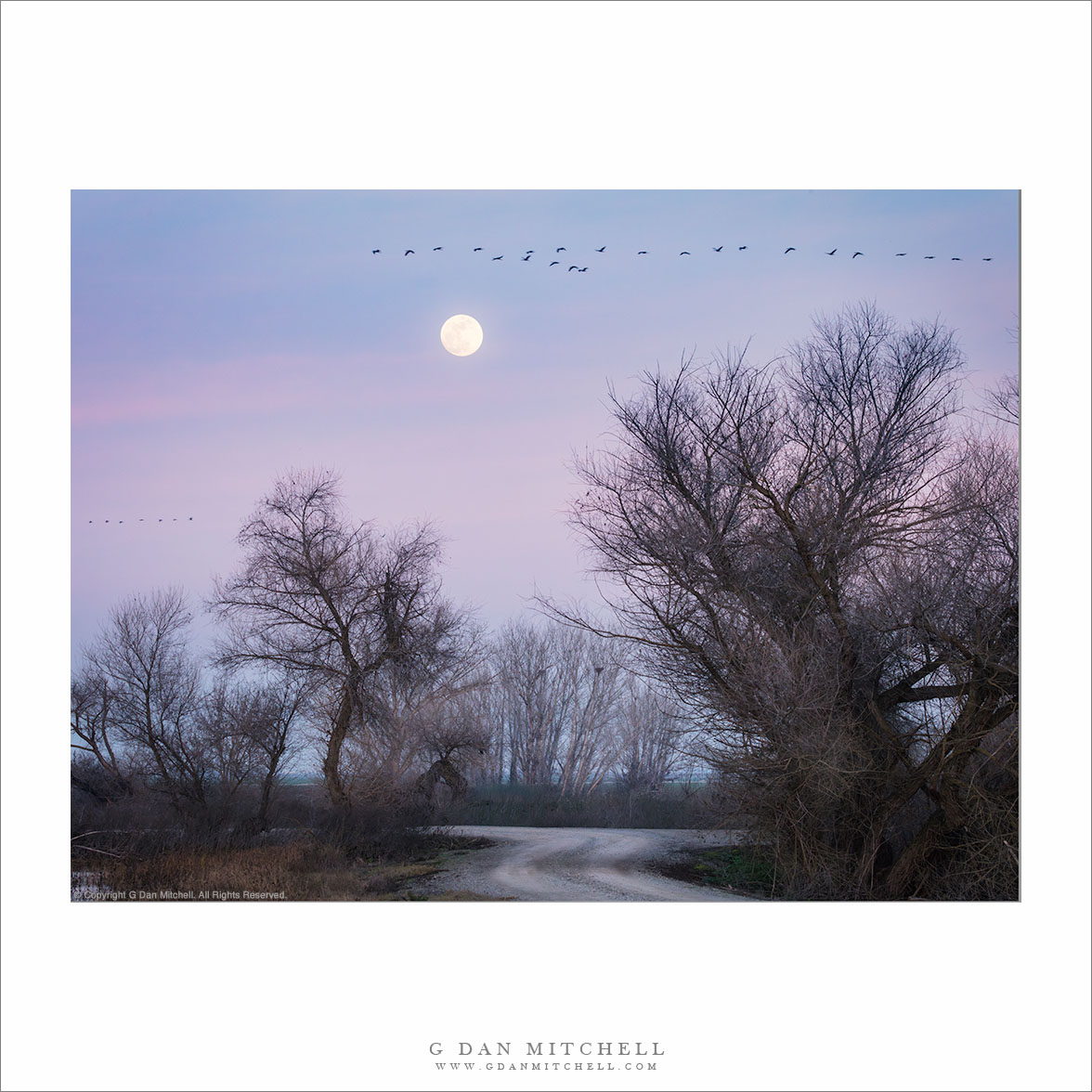
The Cranes Return
“The Cranes Return” — Sandhill cranes fly over full moon in twilight and return San Joaquin Valley wetlands

I understand that the “Super Blue Blood Moon” or something similar occurred early this morning. I missed it. (Well, not quite. I did look out my window before sunrise, and I saw a bit of the eclipse over my neighbor’s house.) However, almost exactly 12 hours earlier I was in a position to look at and photograph that very same moon as it rose over the Sierra Nevada and climbed into the sky above California. It was a beautiful, quiet, peaceful moment at the end of a long day photographing birds.

I chose this particular day to visit the wetlands for a couple of reasons. First, I knew there would be ground fog in the morning and that fog often leaves behind a soft and hazy atmosphere. Second, I knew that the moon would rise from behind the Sierra about a half hour before actual sunset, putting it at an interesting elevation above the horizon at sunset and during the blue hour, that period when the moon seems bright but the ambient light is still sufficient to illuminate the landscape. I began watching for the rising moon at the appointed time, but it did not immediately appear, because it still had to clear the Sierra and because the atmosphere above the valley was so thick with haze. Perhaps twenty minutes later it began to emerge from the haze, and I quickly moved to a spot I had previously considered, where some trees break up the otherwise flat landscape here where a gravel road winds among them. I hoped that the cranes might appear — they often do during the moments shortly after sunset — and hoped even more that they might pass through the scene. Sometimes one does get lucky, and a long string of the birds flew just above the moon as the sky turned pink and deeper blue.


Leave a comment or question using the form. (Click the title to see the full article and to comment if you are viewing it on the home page.)

G Dan Mitchell is a California photographer and visual opportunist. His book, “California’s Fall Color: A Photographer’s Guide to Autumn in the Sierra” (Heyday Books) is available directly from him. Blog | Bluesky | Mastodon | Substack Notes | Flickr | Email


All media © Copyright G Dan Mitchell and others.

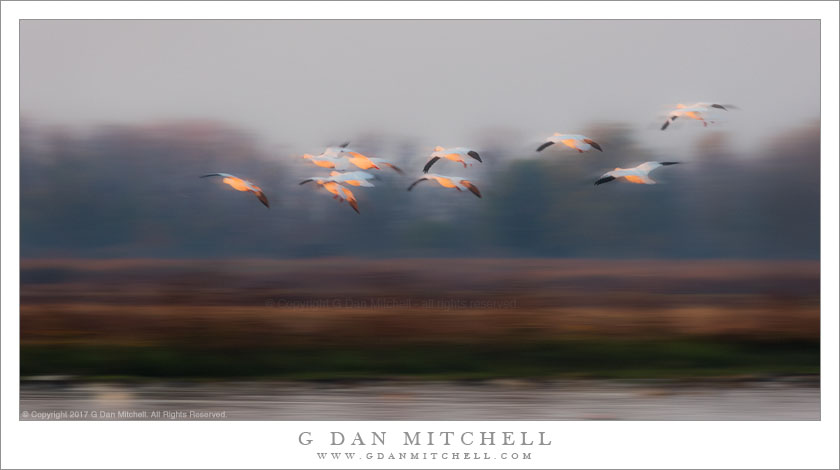
Into Evening Light

Into Evening Light
A small group of geese takes flight in evening light

Into Evening Light. © Copyright 2017 G Dan Mitchell – all rights reserved.

A small group of geese takes flight in evening light

There are many ways to photograph birds: sharp images of birds filling the frame that reveal the details of color and shape and feathers, landscape photographs that show them in the worlds they inhabit, shots that capture them social groups ranging form groups of a few individuals up to flocks of many thousands, captures of them engaging in particular behaviors, and much more. (I’m occasionally amused by discussions of “the way” to photograph birds of or “the right” equipment to do this.)

This flock of geese suddenly took to the air as the very last golden hour light shone across this hazy landscape, and the birds were partially illuminated by the colors of the warm sunset light, but against the less vibrant colors of the local surroundings. A sharp-edged photograph was a possibility, but here I think the abstracting blur of camera motion and fast-flying birds may better suggest the feeling of the scene.


G Dan Mitchell is a California photographer and visual opportunist. His book, “California’s Fall Color: A Photographer’s Guide to Autumn in the Sierra” is available from Heyday Books and Amazon.
Blog | About | Flickr | Twitter | FacebookGoogle+ | LinkedIn | Email


All media © Copyright G Dan Mitchell and others as indicated. Any use requires advance permission from G Dan Mitchell.
One Goose From The Flock

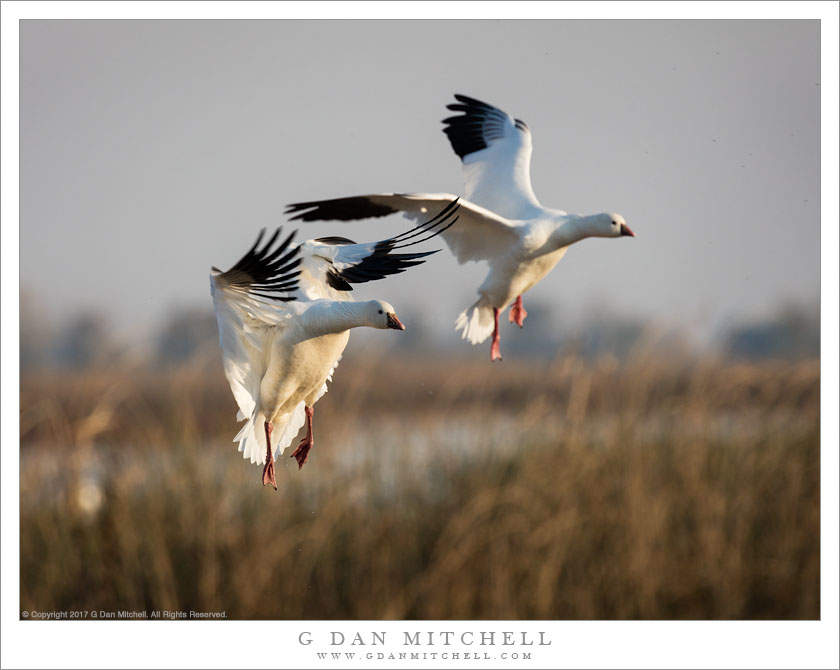
One Goose From The Flock
A goose takes flight along with the rest of the flock

One Goose From The Flock. San © Copyright 2018 G Dan Mitchell – all rights reserved.

A goose takes flight along with the rest of the flock

Some birds are most often photographed as individuals, usually because that is how they live. Examples include egrets, eagles, hawks, and many other hunting birds. To simplify a bit, a major challenge is to get close enough (physically and/or with a big lens) so that an individual is large enough in the frame to produce a photograph and so that distinguishing characteristics of the bird (along with some aspect of its environment) are visible. I rarely do that with geese snow geese, Ross’s geese, and other wild geese. These are, by their nature, birds that live in communities. I most often see and photograph them in groups which may range in size from a few individuals up to many thousands.

Some of the other members of the flock are partially visible in this photograph, so the image isn’t entirely of a lone bird. However, because the others are shown only in part and out of focus, my attention here is drawn to the largest, central bird with wings outstretched as it ascends. I made the photograph on a day when I found myself unusually close to a large flock for a good amount of time — they were spread across a dirt access road I was using. Eventually, as always happens with geese, some of the birds began to get ideas about going elsewhere, and this time I was very close to their lift-off.


G Dan Mitchell is a California photographer and visual opportunist. His book, “California’s Fall Color: A Photographer’s Guide to Autumn in the Sierra” is available from Heyday Books and Amazon.
Blog | About | Flickr | Twitter | FacebookGoogle+ | LinkedIn | Email


All media © Copyright G Dan Mitchell and others as indicated. Any use requires advance permission from G Dan Mitchell.