
Category Archives: Photographs: Yosemite

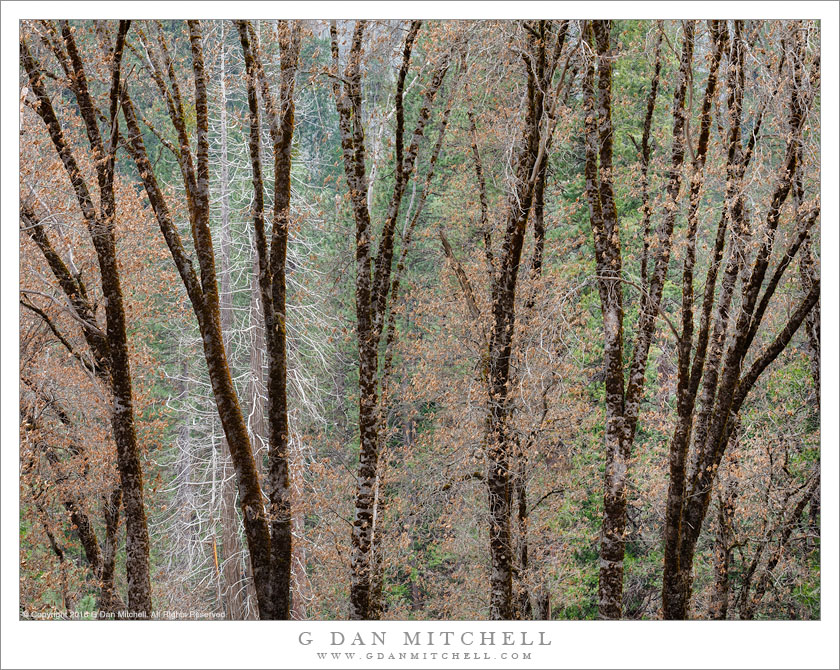
Looking West

Looking West
Looking across Sierra Nevada foothills toward California’s Central Valley at dusk

Looking West. © Copyright 2018 G Dan Mitchell – all rights reserved.

Looking across Sierra Nevada foothills toward California’s Central Valley at dusk

I didn’t intend the photograph to be such, but it could be at least a bit metaphorical. I made in near the end of my period as a Yosemite Renaissance artist-in-residence, at opportunity that provided me with a total of about two weeks to photograph in the park, mostly in the Valley. (More of the photography from this work will be seen in an exhibit opening at Gallery 5 in Oakhurst in June — stay tuned for the details!) Hence the metaphorical “sunset” on the photography for this project (unless I manage to squeeze in one more quick visit next week!) and “looking west” toward my home in the San Francisco Bay Area, from which I post this image.

I suppose this photograph is also a bit more evidence — as if it were needed! — that Yosemite is far more than just the Valley, as incomparable as that area of the park is. I made the photograph on my evening “commute” between the Valley and my lodging elsewhere in the park, and by this evening I had already selected the location as a likely prospect. Often when I’m in the park my orientation is to the highest peaks lying on its eastern boundary along the Sierra crest. But on this evening I was looking the other way, towards layers of foothills descending toward California’s Great Central Valley to the west.


G Dan Mitchell is a California photographer and visual opportunist. His book, “California’s Fall Color: A Photographer’s Guide to Autumn in the Sierra” is available from Heyday Books and Amazon.
Blog | About | Flickr | Twitter | FacebookGoogle+ | LinkedIn | Email


All media © Copyright G Dan Mitchell and others as indicated. Any use requires advance permission from G Dan Mitchell.
Detail, Granite Face

Detail, Granite Face
Detail view of a section of a Yosemite Valley granite cliff face

Detail, Granite Face. © Copyright 2018 G Dan Mitchell – all rights reserved.

Detail view of a section of a Yosemite Valley granite cliff face

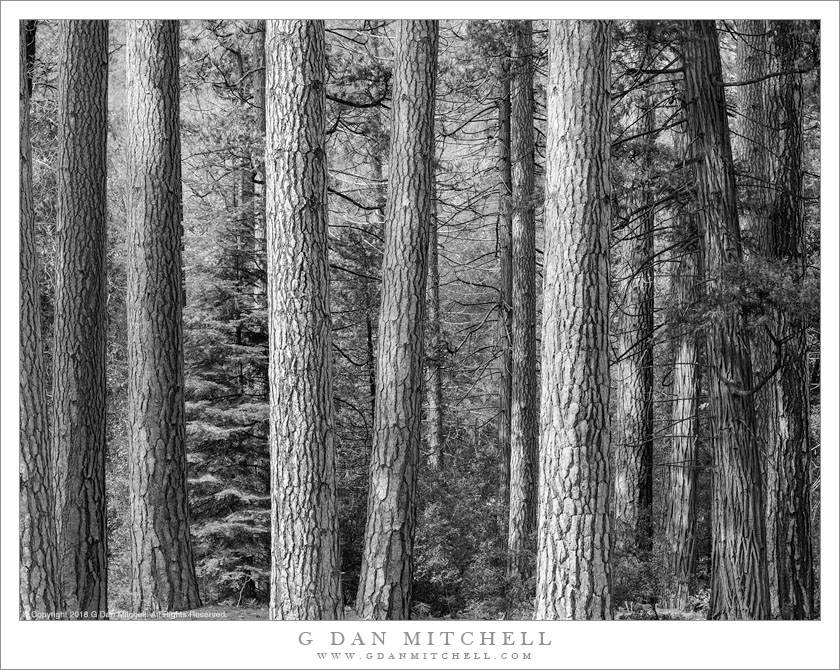
Yosemite, and especially Yosemite Valley, is famous for its “granite” (quotation marks for any geologists reading this post…) cliffs, towers, domes, slabs, and other formations. While we tend to think of this rock as being “gray,” the coloration varies quite a bit depending on the nature of the rock itself, the presence of lichens or plants, and on the light. Almost everywhere the expanses of granite are cut through by intrusions of different colored rocks. I don’t usually think of this particular face as being all that colorful, but on this morning the light somehow brought out the rust-colored tones on many sections of the rock.

I did just enough rock climbing many years ago to have developed memories of the sensations of such rock, from the cold and smooth slabs, to sharp edges of cracks, and rough surfaces (you hope!) on some friction routes. A close look at this section of cliff reveals an amazing variety of surfaces and irregularities. Perhaps most obvious is the large, curving vertical crack towards the left. The dark water stains are also striking, as is that rust colored rock. A closer look reveals other patterns, including a diagonal rising from left to right.


G Dan Mitchell is a California photographer and visual opportunist. His book, “California’s Fall Color: A Photographer’s Guide to Autumn in the Sierra” is available from Heyday Books and Amazon.
Blog | About | Flickr | Twitter | FacebookGoogle+ | LinkedIn | Email


All media © Copyright G Dan Mitchell and others as indicated. Any use requires advance permission from G Dan Mitchell.
Black Oaks, Spring Snow

Black Oaks, Spring Snow
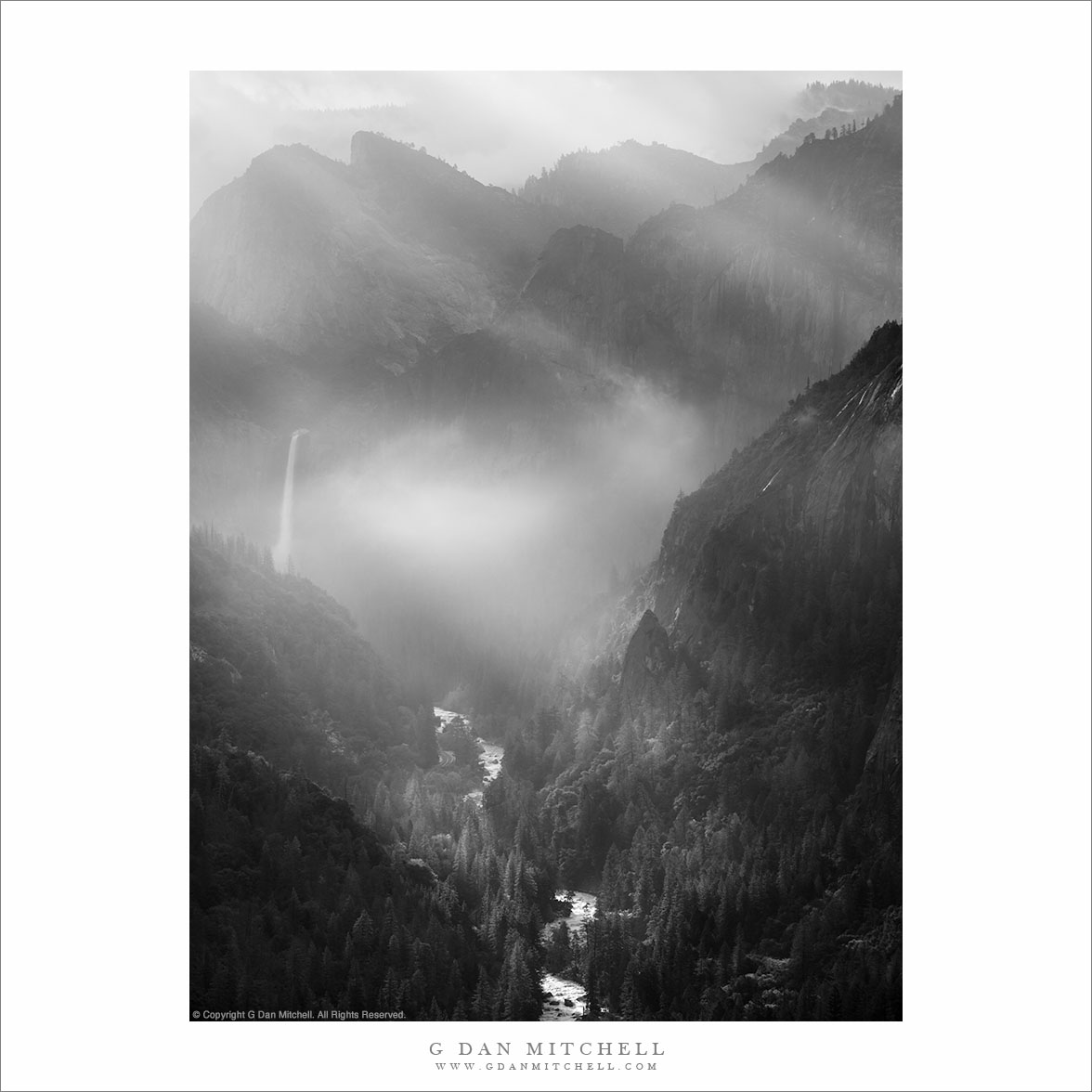
Spring snow falls on a black oak grove, Yosemite Valley

Black Oaks, Spring Snow. © Copyright 2018 G Dan Mitchell – all rights reserved.

Spring snow falls on a black oak grove, Yosemite Valley

It is hard to pick a favorite season in Yosemite Valley. Fall brings much cooler temperatures, diminishing crowds, and autumn colors. Winter brings snow and clouds drifting among peaks and across meadows. In spring the waterfalls flow strongly again as rivers rise, and the Valley’s vegetation comes back to life. Perhaps the ideal time is the transition between winter and spring, when on the ideal day you can experience a bit of both seasons. (Identifying the least favorite is easy. That would be summer, on account of the sometimes extreme heat and the frequent crowds of tourists. I generally stay away between June and mid-September.)

This was one of those spring days that briefly felt more like winter. A quick snow storm came through, dropping temperatures and leaving a few inches of snow on trees and on the ground. (It was almost all gone before noon the next day, when spring returned.) These black oak trees, with their graceful trunks and branches, are always lovely, but when snow falls they are special. There was just enough snow to coat the upper branches of these trees, and snow and mist swirled beyond among the cliffs surrounding the Valley.


G Dan Mitchell is a California photographer and visual opportunist. His book, “California’s Fall Color: A Photographer’s Guide to Autumn in the Sierra” is available from Heyday Books and Amazon.
Blog | About | Flickr | Twitter | FacebookGoogle+ | LinkedIn | Email


All media © Copyright G Dan Mitchell and others as indicated. Any use requires advance permission from G Dan Mitchell.
Dead Trees, Snow

Dead Trees, Snow
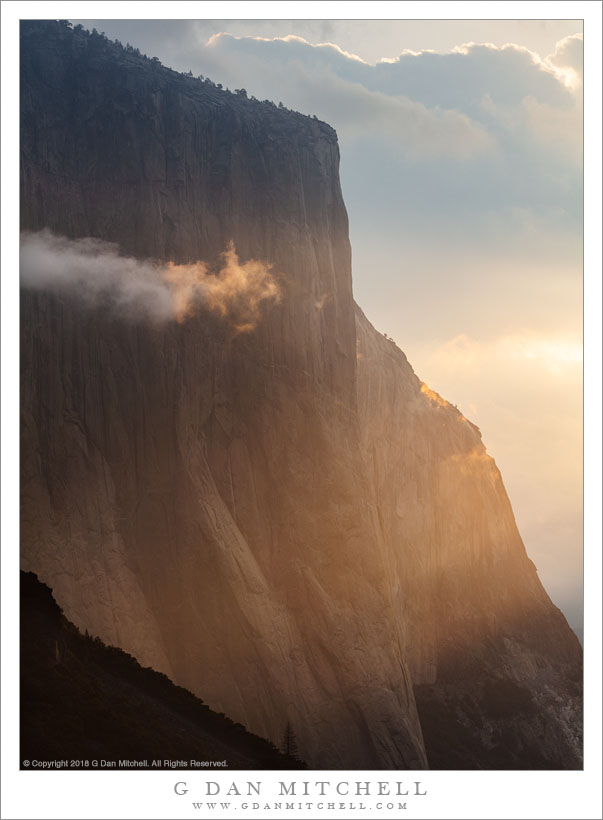
Burned forest trees silhouetted against snow storm clouds swirling around a granite face

Dead Trees, Snow. © Copyright 2018 G Dan Mitchell – all rights reserved.

Dead forest trees silhouetted against snow storm clouds swirling around a granite face

I have written before about my long-term process of trying to find ways to photograph the beauty of dead or burned forests, a subject that I was brought up to regard as a tragedy. For decades, Smokey the Bear told me that forest fires were a wholly bad thing, to be avoided at all costs. Eventually we came to understand and (mostly) accept that fire is a normal and even necessary part of the life-cycle of healthy forests, and in places like Yosemite fires are often “managed” rather than suppressed. Currently in the Sierra Nevada the issue is compounded by the sight of millions of trees that fell victim to bark beetles during the recent drought, and whole forests have died in some places. A few dead trees are a normal part of the landscape, but this is unprecedented in the lives of any of us.

This photograph was made on a snowy day in Yosemite Valley, probably the last such day of the current season as winter turns to spring. Beyond the stark trees, a combination of clouds and blowing snow mostly obscured the Valley’s cliff faces. This photograph illustrates something else I figured out about photographing tall trees some years ago. I used to feel that the way to show the vertical scale of tall trees was to move back and show the whole tree, usually in a vertically framed image. I specifically recall the day when I figured out that there is another way. I was photographing in the coast redwood forest north of San Francisco, where I was unable to move back to get the tree-encompassing distance. I realized that I could do the exact opposite of what I had been doing — use a panoramic framing that does not show the whole tree, but instead implies by absence that subject is too tall to fit in the camera’s frame.


G Dan Mitchell is a California photographer and visual opportunist. His book, “California’s Fall Color: A Photographer’s Guide to Autumn in the Sierra” is available from Heyday Books and Amazon.
Blog | About | Flickr | Twitter | FacebookGoogle+ | LinkedIn | Email


All media © Copyright G Dan Mitchell and others as indicated. Any use requires advance permission from G Dan Mitchell.