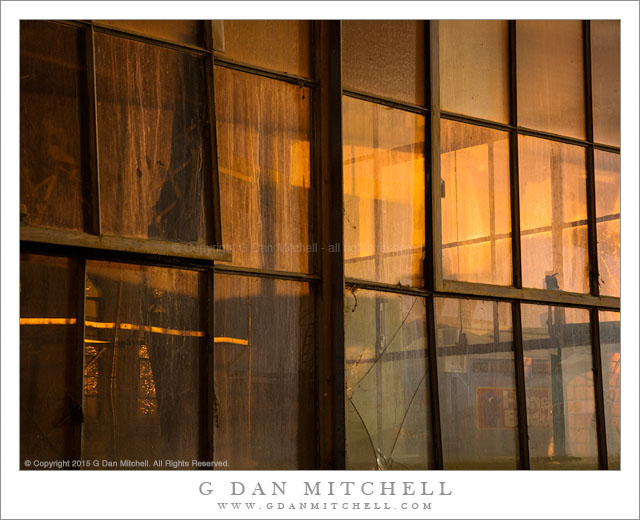
Layers of windows and reflections at night, illuminated by ship yard security lights
This is a prosaic subject that, to me at least, becomes more mysterious the more I look at it. As I walked down a very familiar alley way — perhaps the most familiar one to typical Mare Island night photographers, and a place I have been in many, many times — I looked at parts of it differently. Perhaps this was because the alley was closed off this time or maybe because one of the huge overhead structures that looms able this area was covered with immense scaffolding. Possibly it was the fact that interior lights in a neighboring building were, for the first time I can remember, still on and shedding light on the alley.
In any case, I went straight to this corner window that I had not really even noticed in the past. I was attracted by they interesting reflected light and the converging lines of the window frame, and then I began to notice the many layers of light and shape in the subject — especially the light coming thought another set of windows around the far corner of the building.
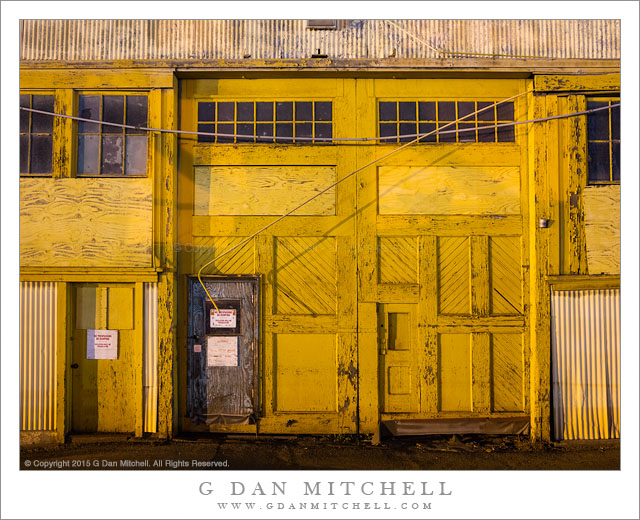
Night photograph of yellow building wall, doorway, windows, and warning signs, Mare Island Naval Ship Yard
This will be the first of a series of night photographs, made on a recent visit to the Mare Island Naval Ship Yard in Vallejo, California. I have been photographing at night here for more than a decade now. As I return I continue to find new things to photograph as the lighting is always different and the buildings themselves change. For example, on this visit I found that a dry dock area that has recently been used to dismantle old ships is lit in such a way as to light familiar buildings in new ways, and that some ship yard equipment that used to be behind security fences was now more accessible.
The architecture of this old building is found all over Mare Island and in other military and similar locations all over the country. (At a recent exhibit in San Francisco many viewers of one of my Mare Island photographs were almost certain that the photograph was from Hunters Point — and I can see why, as the same sort of architecture is found there.) Many buildings near this one appear to have been damaged in a north bay earthquake that happened not too long ago — a chunk of the building’s roof is damaged, some of the hanging conduit may have come down in the quake, and a corner of the next door brick building is gone.
A Fujifilm “Instant Savings” promotion just started today (November 15, 2015), and it brings some excellent price reductions on all of the current X-Series cameras and a whole bunch of lenses. This is a great opportunity to acquire or upgrade a Fujifilm system!
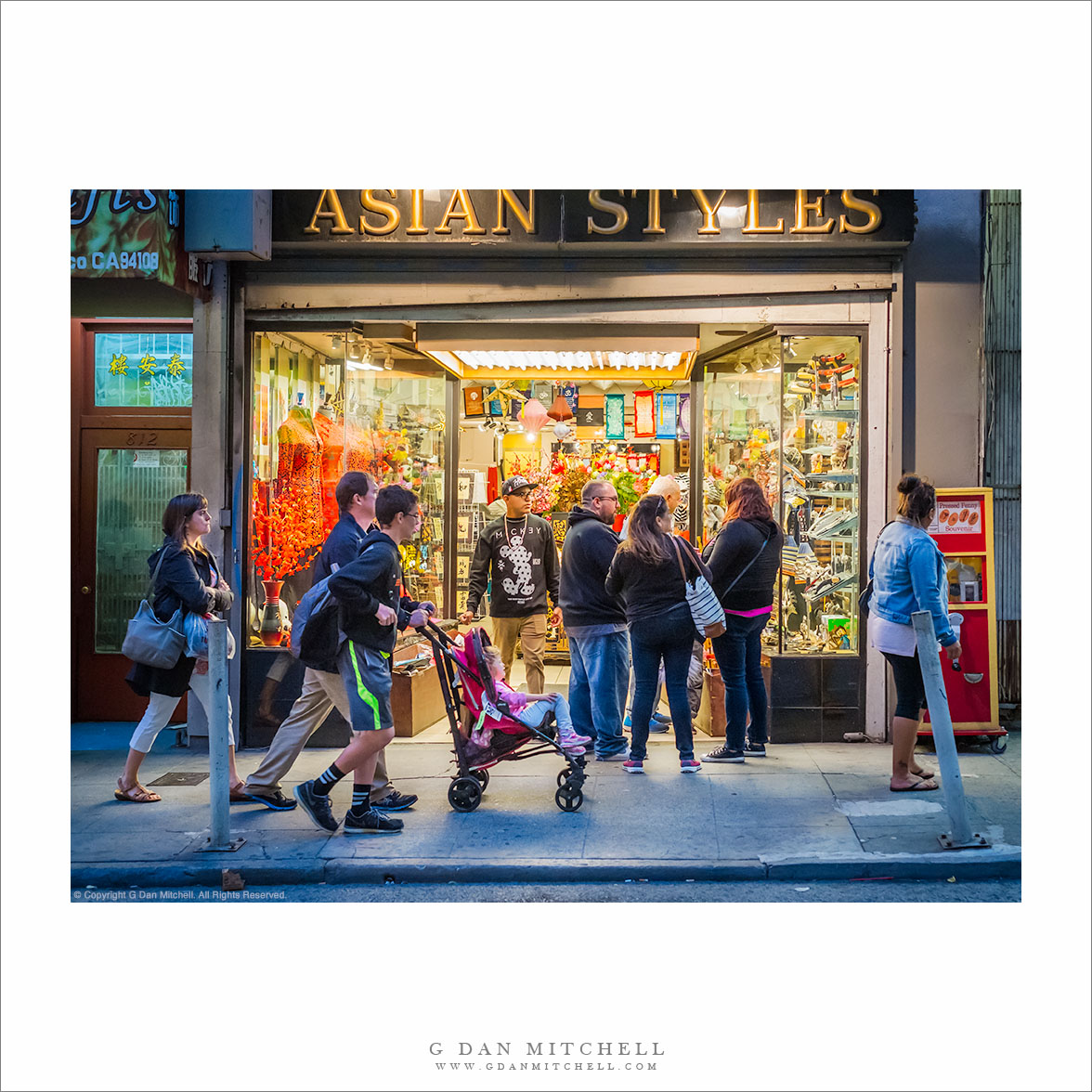
“Asian Styles” — People in front of a San Francisco storefront at night
If you follow this website and my photography, you may already know that I’m a big fan of the Fujifilm X-Series cameras and lenses. I rely on the little X-E1 plus a small set of the excellent Fujifilm lenses for my street and travel photography. This 1.5x cropped sensor camera system performs beautifully.
The list of cameras and lenses is too long for me to describe each piece of equipment. I’ll mention a few, but feel free to leave a comment if you have questions about anything on the list.
Fujifilm X Series Cameras
Summary: The X-Pro1 feels like an old-school interchangeable lens rangefinder camera. The X-Pro1 is the current high-end in this series — and probably the body I would get for my own use if I were buying right now. The X100T is a rangefinder body with a fixed 35mm-equivalent lens. The XT-10 shares many features with the X-T1, including its sensor, but at a lower price. The X-E2 is a very compact rangefinder-style interchangeable lens body with an electronic viewfinder. (It is the updated version of my X-E1.) The X-30 is a very small camera with an integrated zoom lens and a smaller sensor. With the exception of the X-30, all of these cameras use the excellent 16MP, 1.5x cropped sensor Fujifilm x-trans sensor.
X-Pro1: Fujifilm’s innovative interchangeable lens camera combining an optical rangefinder design with an electronic viewfinder.
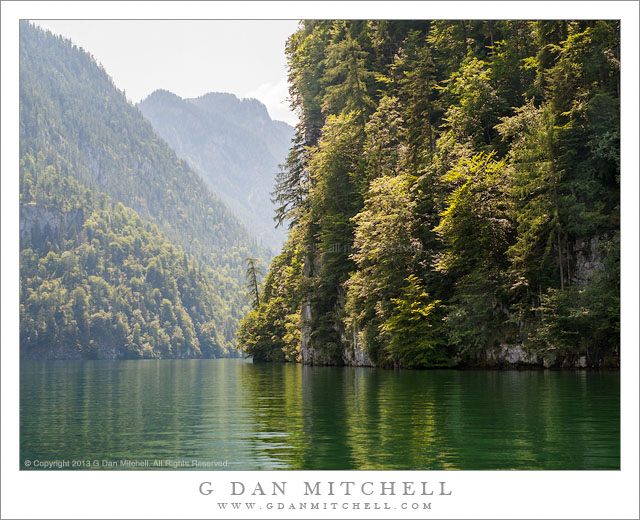
Steep, tree-covered cliffs along the shore of the Konigsee, Berchtesgaden National Park, Germany
Fujifilm lenses for X Series interchangeable lens cameras
Summary: Based on my own experience with a number of the lenses and confirmed by many other reports, the Fujifilm lenses provide first-rate optical performance. The range from very small prime lenses up to large aperture zooms that are competitive with the best from the DSLR manufacturers. I have marked lenses that I own and use with asterisks — *.
Links go to site-affiliate B&H Photo, and purchases through these links return a small percentage of the sale price to support this website. Your price will be the same as if you clicked directly on the vendors own links. Thanks for your support!
Leave a comment or question using the form. (If you are reading this on the home page, click the article title to see the full article and the comment form.
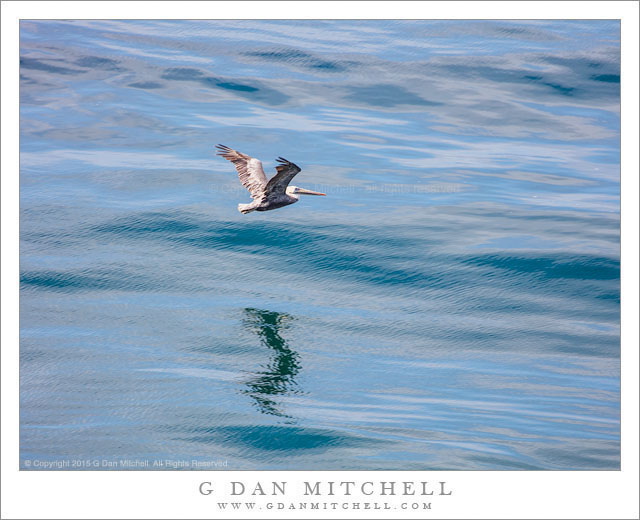
A pelican skims above the ocean along California’s Central Coast
The brown pelicans are almost certainly my favorite California shore birds, and I photograph them often enough that I think I understand some of their habits and know when and where I’m likely to find them. (On the other hand, I have to admit to being completely unaware that we also have white pelicans until just a few years ago!) When I photograph them I often look for several specific kinds of opportunities — their incredibly low flight as they skim in groups right above the way, close passes in front of me as they ride thermals along the top edges of coastal bluffs, and their approach as they pass over peninsulas extending from the shoreline.
Seeing pelicans on this morning was a little bit of a surprise since I had not seen or photographed them much recently. I went to Point Lobos after hearing that humpback whales had been spotted close to shore, so I went right to the top of a high bluff where I could survey a big area of coastal waters. (My “whale hunt” was more than amply rewarded when groups of the whales appeared very close to the shore and engaged in bubble feeding behavior.) I wasn’t looking for pelicans, but when a few passed down below along the water’s surface I tracked them. This one flew over a small area of relatively smooth water, the surface of which reflected the mixed fog and blue sky along with the distorted shape of the bird’s shadow.

 G Dan Mitchell is a California photographer and visual opportunist. His book, “California’s Fall Color: A Photographer’s Guide to Autumn in the Sierra” is available from Heyday Books and Amazon.