
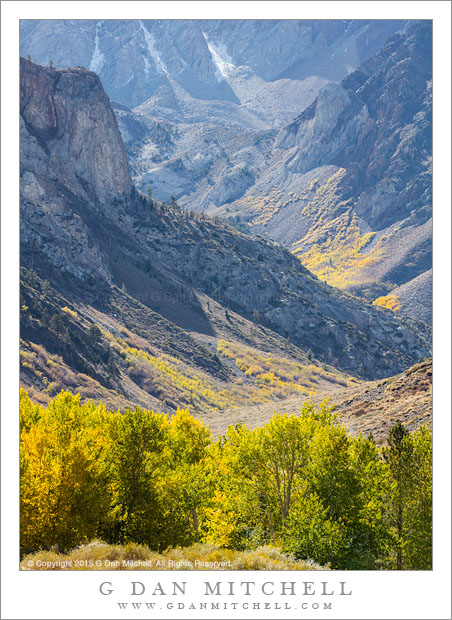
Fall Foliage in Transition, Eastern Sierra

Fall Foliage in Transition, Eastern Sierra
Fall color comes to cottonwood and aspen trees in McGee Canyon, Eastern Sierra Nevada

Fall Foliage in Transition, Eastern Sierra. Sierra Nevada, California. October 9, 2015. © Copyright 2015 G Dan Mitchell – all rights reserved.

Fall color comes to cottonwood and aspen trees in McGee Canyon, Eastern Sierra Nevada

This is a favorite east side Sierra Nevada canyon. Like so many of these canyons, it spills out into the Valley east of the sharp eastern front of the range, with evidence of ancient glaciation in the form of lateral moraines. It quickly twists and turns and rises toward the monumental peaks of the Sierra crest, quickly transitioning from essentially desert country to alpine terrain in a matter of a relatively few miles. This particular canyon doesn’t necessarily look like much from the valley, as its lower reaches are obscured by the moraine ridges near its base. But as soon as you cross those low hills and enter the main canyon, its steep walls and stupendous scale become obvious.

In the fall the lower canyon is full of cottonwood trees turning golden, while higher up the canyon aspens change color a bit earlier. Several years ago I backpacked into this canyon in September, the only time I’ve done so, and I passed through some of the earliest color I’ve seen in the Eastern Sierra. This was another early color year, largely as a result of California’s four-year drought. On this visit there was a bit of relief from the incessant heat and dryness as weather fronts passed through, and a bit of snow is visible along the higher faces.


G Dan Mitchell is a California photographer and visual opportunist. His book, “California’s Fall Color: A Photographer’s Guide to Autumn in the Sierra” is available from Heyday Books and Amazon.
Blog | About | Flickr | Twitter | FacebookGoogle+ | 500px.com | LinkedIn | Email


All media © Copyright G Dan Mitchell and others as indicated. Any use requires advance permission from G Dan Mitchell.
Morning Musings: Canon and Mirrorless Cameras

(It has been a while since I’ve written a “morning musings” post, but since I’ve been “musing” about Canon and mirrorless cameras over the past few days and learning a few things about the subject, it seems like time for another such post.)

Unless you’ve been under a rock for the past few years you are aware of the introduction of so-called mirrorless cameras by several manufacturers and of the increasing sophistication of these cameras. Their features typically include:

  • smaller and lighter bodies that may be reminiscent of older rangefinder film cameras.
  • the ability to allow use of smaller lens designs, due to the shorter distance between the lens mount and the sensor.
  • electronic viewfinders (EVFs) that can incorporate additional useful tools and information into the viewfinder display and which have advantages in low light.
  • designs and features that increasingly appeal to serious photographers.

There are still issues with these cameras, and while much progress has been made and will continue, they still lag behind DSLRs is some areas:

  • battery consumption rates tend to be quite high by comparison to DSLRs.
  • AF performance is uneven and in some cases quite slow.
  • EVFs have latency issues.
  • Not everyone is fond of looking at an EVF monitor instead of the “real” image on focusing screen.
  • With some systems (notably Sony) using a wide range of lenses will likely require the use of third-party adapters.

I’ve been using a Fujifilm X-trans mirrorless system for my travel and street photography for nearly three years. (Mine is a discontinued model, but if I were buying today I would get the Fujifilm XT1 or perhaps the Fujifilm XT10.) Virtually all of my street/travel photographs of the past two years were made with my Fujifilm camera and lenses.  For this photography, the small size and excellent quality of the system compensates for the slower AF speeds and the battery consumption issues.

More recently the Sony A7r and A7rII cameras have gotten a lot of attention. When first introduced, the A7r came with the highest MP full frame sensor then available. The cameras can use (with varying degrees of compatibility and functionality) a wide range of non-Sony lenses, and they have a number of the other pluses associated with mirrorless designs. Several landscape photographer friends use the A7r and A7rII bodies for their tripod-based, manual focus photography, and I know several street/travel photographers who like the system a lot.

Sony and Fujifilm are not the only companies moving in this direction. For example, Olympus and others produce some very fine small mirrorless cameras.

All of which leads to the question: “Where is Canon’s mirrorless offering?” (Or, “Is the EOS-M the best Canon can do?”) Continue reading Morning Musings: Canon and Mirrorless Cameras

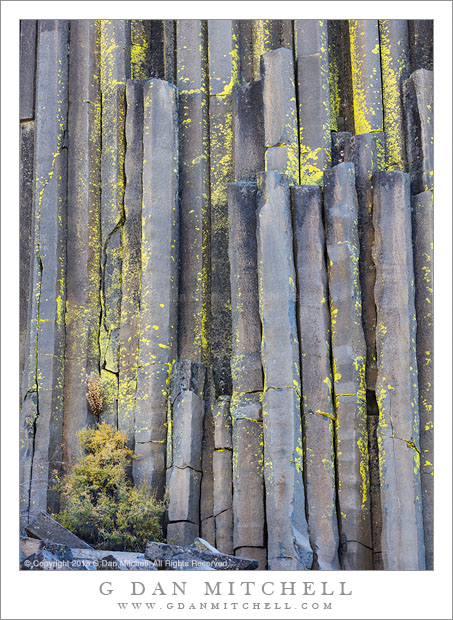
Columns and Lichen

Columns and Lichen
Basalt columns and bright yellow lichen, Devils Postpile National Monument

Columns and Lichen. Devils Postpile National Monument, California. October 9, 2015. © Copyright 2015 G Dan Mitchell – all rights reserved.

Basalt columns and bright yellow lichen, Devils Postpile National Monument

This photograph is probably the result of at least one accident. We had gone to the Eastern Sierra for a few days to photograph fall color, arriving late in the evening, tired and ready to sleep. We discussed how early we would get up the next morning, but I managed to remain vague about my plans, secretly hoping that I might not wake up on “photographer time,” but perhaps actually sleep in a bit! In fact, that is what happened — and it was probably a good thing since I was tired after three busy weeks including several previous trips over the crest to photograph on the east side of the range.

Of course, once we got up late we still had to figure out what we would photograph. Obviously dawn light was out of the question, and it seemed like we might not get out until the best early and soft light for aspen color had passed. We hatched a very general plan to head over to Devils Postpile National Monument, though I didn’t have real high hopes for it. However, once we arrived we realized that we had actually come at just the right time. This feature, at this time of year, doesn’t get sunlight very early. When we arrived the face was still in beautiful, soft, shaded light but the surroundings were reflecting some light onto the columns. That’s what I call a “happy accident!”


G Dan Mitchell is a California photographer and visual opportunist. His book, “California’s Fall Color: A Photographer’s Guide to Autumn in the Sierra” is available from Heyday Books and Amazon.
Blog | About | Flickr | Twitter | FacebookGoogle+ | 500px.com | LinkedIn | Email


All media © Copyright G Dan Mitchell and others as indicated. Any use requires advance permission from G Dan Mitchell.
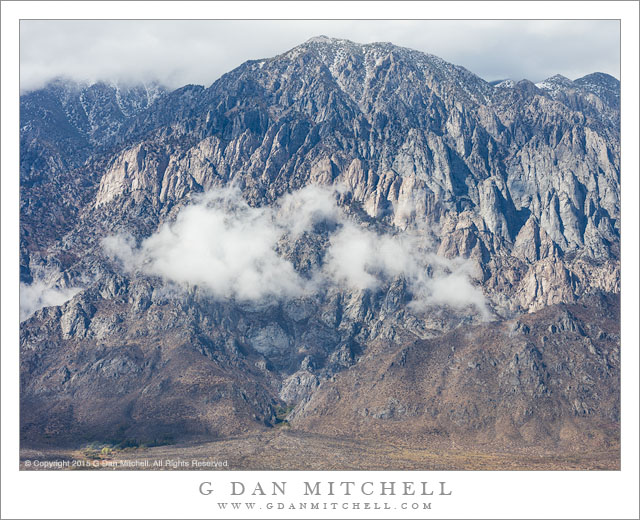
Eastern Escarpment, Clearing Autumn Storm

Eastern Escarpment, Clearing Autumn Storm
An early season autumn leaves a dusting of snow atop Wheeler Ridge, Eastern Sierra Nevada

Eastern Escarpment, Clearing Autumn Storm. Eastern Sierra Nevada, California. October 4, 2015. © Copyright 2015 G Dan Mitchell – all rights reserved.

An early season autumn leaves a dusting of snow atop Wheeler Ridge, Eastern Sierra Nevada

This long ridge in the Eastern Sierra just north of the town of Bishop has long fascinated me, though for the most part I’ve only looked at it from a distance. (Or from the other side, as there is access via along valley to the west, but that’s a story for another post.) At first I was mostly aware of this steep section of the eastern escarpment of the range when it served as a spectacular backdrop for views of the pastureland and cottonwood trees of Round Valley. But with increased familiarity with the area and opportunities to view if from many directions and distances, I began to note what a tremendously rugged and daunting bit of terrain it is. In many ways, if you ignore the scant vegetation on its slopes, it looks more like the mountains of the desert, even reminding me a bit of places in Death Valley, though with more granite-like rock. Unlike many other Eastern Sierra locations, there is little (no?) evidence of glaciation, but plentiful evidence of erosion from water, including the classic alluvial fan spreading from the steep valley between the low hills in the foreground.

Despite the lack of glacial evidence, the scene presents many other classic components of the eastern face of the range in Autumn. Although it is small against the tremendous landscape, there is an aspen grove and a bit of summer-brown grass near the lower left. The main rocks seem to be the granite that we expect to see in the Sierra. The rocks are lit by filtered sunlight from the southeast. And the cloud drifting in front of the rugged face is the remnant of a passing storm that has dusted the highest peaks with a bit of early season snow, promising that winter cannot be far off.


G Dan Mitchell is a California photographer and visual opportunist. His book, “California’s Fall Color: A Photographer’s Guide to Autumn in the Sierra” is available from Heyday Books and Amazon.
Blog | About | Flickr | Twitter | FacebookGoogle+ | 500px.com | LinkedIn | Email


All media © Copyright G Dan Mitchell and others as indicated. Any use requires advance permission from G Dan Mitchell.

Photographer and visual opportunist. Daily photos since 2005, plus articles, reviews, news, and ideas.