(“A Photograph Exposed” is a series exploring some of my photographs in greater detail.)
“Island and Trees, Tuolumne River” — Trees grow on a small ,rocky island in the Tuolumne River, Yosemite National Park
If you follow this website you may have seen this photograph before — it is one of two that were the subjects of an earlier article (“A Photograph Exposed: One Subject, Two Compositions“) focusing on compositional decisions I made when I photographed this Sierra Nevada subject. In this companion article I want to look at the next step — going from that original exposure to the final (at least for now!) interpretation of the subject that you see above, and the how and why of post-processing the image.
For me, post-processing is as much a part of the creative process of photography as is composing and making the exposure. In fact, many of the decisions that I make at the time of exposure anticipate what I may do during the post-processing stage. These decisions recognize that the camera does not “see” the same way that we do, and that simply trying to produce an exposure that looks the exactly like the actual scene is often both hopeless and counterproductive.
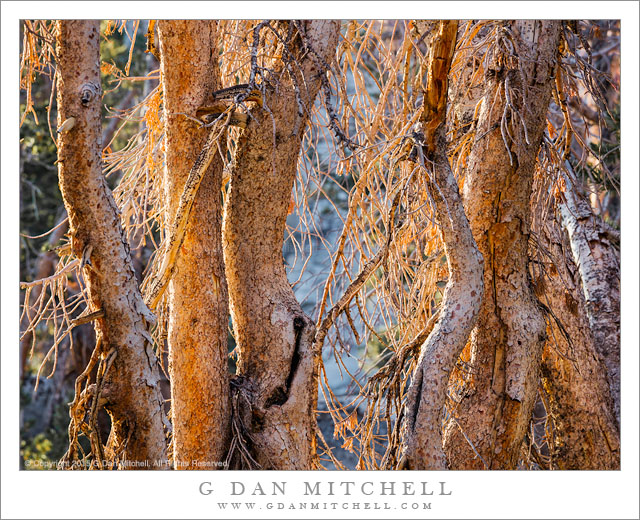
A small grove of high elevation pine trees in morning Sierra Nevada light
Although I visit the Sierra frequently, it has been some time since my last real backpacking trip and even longer since I last me up with my “Talusdancers” friends. The Talusdancers go way back — to a time about two decades ago when a loosely organized group of us began joining regularly for Sierra backcountry trips that ranged from a few days to longer than a week. In early August I had the opportunity to get these things back on track, with a three-day backpack trip in the eastern Sierra with three of the old gang. I arrived before the others, was on the trail by mid-afternoon, and had set up camp and was fixing dinner before the sun set. My friends apparently got to the trailhead much later and didn’t start hiking until about 6:00 PM. As the sun was setting I heard the “holler” of my friend Owen coming from across the valley, and I yelled back to let him know I as there. They soon arrived, and I can report that there are few things more wonderful that meeting up in the backcountry with good friends you have not seen for some time!
Our camp was on a rise above the shore of a sub-alpine lake, a very familiar Sierra Nevada setting. Beyond the lake to the west the terrain rises, past more lakes and thinning trees, into the alpine zone, and eventually to Sierra crest peaks and ridge lines. To the east there was a long valley with several more lakes, ending at a drop off between the descending canyon walls, and in the far distance we could see the high desert of Owens Valley and even further off the line of the White Mountains. We camped in the midst of an open grove of small, high-elevation lodgepole pines, common Sierra trees, but always beautiful in the early morning light.
Motion blurred photograph of a Chinatown store window display
Part of what I enjoy about night photography is the way that the environment is transformed and how I often have to resort to “seeing as the camera sees” more than seeing as I see in the dim light. The camera sees better in low light, it can pick up colors that fade almost to monochrome in nighttime human vision, and it can “see” things like blur motion with longer exposures.
For a few minutes on this evening I decided to play around with long exposure blur. Instead of keeping the ISO high so that I could use short shutter speeds in the low light and stop motion, I lowered the ISO and intentionally selected smaller apertures and very long shutter speeds. Then I used the combination of subject motion and intentionally moving the camera myself to create abstractions. It may hardly matter, but the subject here was a store window full of colorful lanterns.
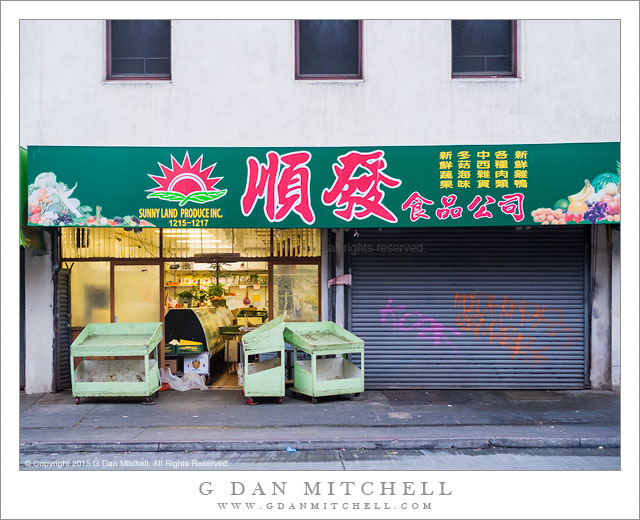
Closing time at shops in San Francisco’s Chinatown district.
In late July I met up with a group of fellow night/street photographers in San Francisco. The group’s explorations ranged between the commercial hub of Union Square and the old neighborhood of North Beach. (The rest of the group got there before I did and they began with dinner in the latter district.) I finally connected with the group along Stockton Street, the less touristy portion of Chinatown.
I frequently walk though here but often don’t make too many photographs. I love the Stockton Street area, with its vibrant shops and busy morning crowds, but sometimes I feel a bit too intrusive making photographers there and then. But on this evening things were quieting down, shops were closing, and there were fewer people.