
Lenses for Landscape Photography (Morning Musings 1/12/15)

This isn’t exactly a regular “morning musings” post, but I wanted to share this stuff and it seemed like a good pretext! This post concerns two related articles at the website:

From time to time I share new posts in my “Photographic Myths and Platitudes” series. These articles deal with common ideas about photography that range from “open to question” to quite wrong. I try to look at these issues from a perspective that is both objective and based on actual photographic practice.

I wrote the first of these two articles about lenses for DSLR landscape photography back in 2010 after reading one too many claims that wide-angle lenses are landscape lenses and that longer focal lengths are not good ‘landscape lenses.’  It shouldn’t be a surprise that I disagree. The first article goes over reasons to consider a wide range of focal lengths for photographing landscape.

When I wrote that first article I realized that there was another notion about landscape photography that needed a closer look, a belief that prime lenses are better than zoom lenses for landscape photography. This long-cherished idea probably has its roots back in an earlier period of photography when all photography (not to mention all landscape photography) was done with prime lenses, and in a somewhat later period when early zoom lenses had some serious shortcomings. But things are a lot different today, and most of the excellent contemporary DSLR (and a great deal of medium format) landscape photography that you see and enjoy today was done with zoom lenses.

Knowing what a sensitive issue this is for some photographers, I delayed writing part II for over four years! I’ll acknowledge in advance that there are some reasons to shoot landscape subjects with non-zoom lenses, and that my perspective is not The Truth about landscape photography lenses. However, I’m certain that the majority of landscape photographers will be best served by today’s excellent zoom lenses.

In any case, part II deals with this issue, and it is available now. I hope you’ll enjoy it and perhaps learn something new.

Morning Musings are somewhat irregular posts in which I write about whatever is on my mind at the moment. Connections to photography may be tenuous at times!


G Dan Mitchell is a California photographer and visual opportunist whose subjects include the Pacific coast, redwood forests, central California oak/grasslands, the Sierra Nevada, California deserts, urban landscapes, night photography, and more.
Blog | About | Flickr | Twitter | FacebookGoogle+ | 500px.com | LinkedIn | Email

Text, photographs, and other media are © Copyright G Dan Mitchell (or others when indicated) and are not in the public domain and may not be used on websites, blogs, or in other media without advance permission from G Dan Mitchell.
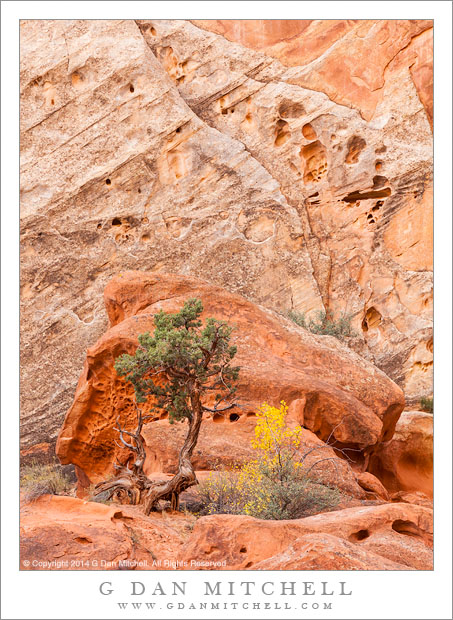
Juniper, Boulder, Cliff

Juniper, Boulder, Cliff

Juniper, Boulder, Cliff. Capitol Reef National Park. October 21, 2014. © Copyright 2014 G Dan Mitchell – all rights reserved.

A small juniper tree grows next to a sandstone boulder at the bottom of a cliff, Capitol Reef National Park

I’m digging back into the October Utah photographs yet again for this one. It comes from Capitol Reef National Park, where I spent about three days out of a longer visit to Utah. I started in far southwest Utah, wandered a bit in the Vermillion Cliffs area, followed a back road north to highway 12, then headed over Boulder Mountain to the Park, where I met a friend and got a campsite for a few days.

I’m gradually pushing out the boundaries of my knowledge of this park, and part of that growth on this trip involved shooting in some tricky light. On this late afternoon, between some other subjects, we ended up in a well-traveled canyon as the tall canyon walls and some cloudiness softened the light. After reaching our furthest point in the canyon we turned around and started back, and as we passed back through one twisting section we saw several interesting photographic possibilities, stopped, and spent a bit of time looking and photographing. This small juniper tree stood in front of an old red rock boulder, and the green of the tree and red of the rock complemented one another. I was also fascinated by the complex, angled, and sometimes-curving patterns on the vertical cliff wall in the background.


G Dan Mitchell is a California photographer and visual opportunist whose subjects include the Pacific coast, redwood forests, central California oak/grasslands, the Sierra Nevada, California deserts, urban landscapes, night photography, and more.
Blog | About | Flickr | Twitter | FacebookGoogle+ | 500px.com | LinkedIn | Email

Text, photographs, and other media are © Copyright G Dan Mitchell (or others when indicated) and are not in the public domain and may not be used on websites, blogs, or in other media without advance permission from G Dan Mitchell.
Digital Exposure: Some Basic Rules (Morning Musings 1/10/15)

Earlier this week I read Alan Ross’s fine article about the zone system and the possibility of adapting it for use with digital photography. (“Can the Zone System Go Digital“) It is a fine summary of some very important principles of exposure, and it is one of the most straightforward and readable explanations of the basics concepts of zone system exposure I’ve seen. It also offers a useful way to apply zone system principles to shooting with digital cameras.

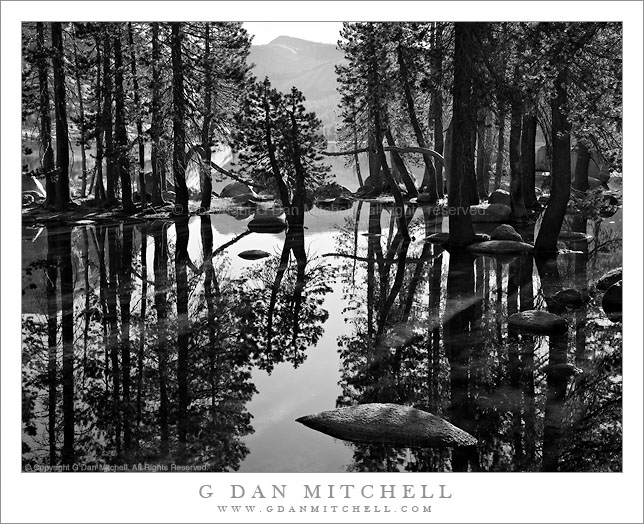
Shoreline Reflections, Tenaya Lake

I don’t use the zone system, but I do expose in ways that often have the same goals, especially when faced with subjects that have a very wide dynamic range (risking a loss of shadow and/or highlight detail) or, oddly, a very narrow dynamic range (where metering systems can try to turn everything neutral gray.) As I read his article I thought it might be fun to try to distill some of my basic principles for exposure down to a very short list. Here it is:

  • Protect the highlights! — Overexposed highlights and bright areas can completely lose detail if they are overexposed with digital photography, and these details may not be recoverable in post.
  • Watch out for dark tones that are too dark — If dark tones go too dark, they may need to be pulled back up in post, and noise, banding, and other artifacts can be the result of radical lightening of dark areas.
  • Consider the most important values in the scene, and adjust exposure to favor them — You may want to compensate for the camera’s tendency to want to make black and white tones end up gray in narrow dynamic range photographs
  • If important, subtle tonal variations are found in the shadows or in the highlights, consider offsetting exposure to protect them — You may want to underexpose just a bit to retain differences among tones in the bright areas. If there are a lot of important details in very dark shadows, you may wish to overexpose a bit.
  • Use the danged histogram — The RGB histogram display quickly tells you a lot of important things about your exposure.
  • Use the camera as the meter — Go ahead and make an exposure to test your settings. While there is a certain historical macho that says you should get it right in a single exposure, or that you should use a handheld meter, modern digital cameras can provide just as much information as external meters.
  • Don’t be afraid to bracket — Sometimes it is simply faster to make several bracketed exposures rather than to figure out one “perfect” one. That may sound like a photographic blasphemy to some… but it works!

Do you have other basic exposure rules that can be applied in a general way?


G Dan Mitchell is a California photographer and visual opportunist whose subjects include the Pacific coast, redwood forests, central California oak/grasslands, the Sierra Nevada, California deserts, urban landscapes, night photography, and more.
Blog | About | Flickr | Twitter | FacebookGoogle+ | 500px.com | LinkedIn | Email

Text, photographs, and other media are © Copyright G Dan Mitchell (or others when indicated) and are not in the public domain and may not be used on websites, blogs, or in other media without advance permission from G Dan Mitchell.

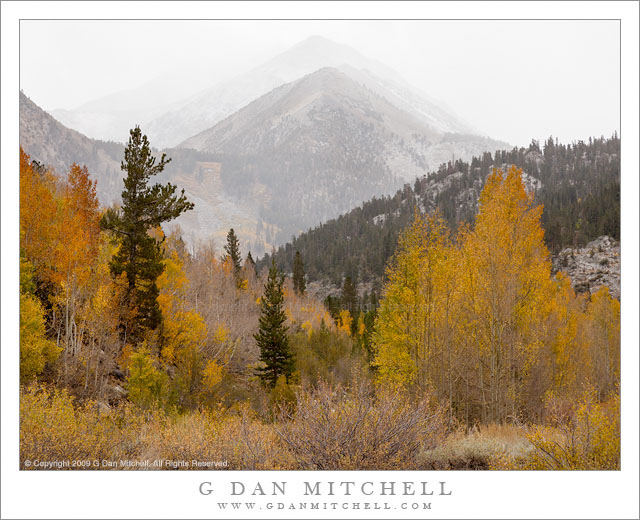
Snow Flurries, Bishop Creek

Snow Flurries, Bishop Creek

Snow Flurries, Bishop Creek. Sierra Nevada, California. October 4, 2009. © Copyright 2009 G Dan Mitchell – all rights reserved.

Light autumn snow falls on peaks above aspen groves along the South Fork of Bishop Creek

This is a photograph from a wonderful, short trip into the eastern Sierra about five years ago. I believe that I made two trips to the “east side” that fall to photograph aspens, and on this one (the first of the two) I had a couple of days of winter-like weather with clouds and snow. This could put a damper on photography… unless you share my fascination with “interesting” weather, in which case it seems like that best thing that could happen.

I came back from this trip with some very special photographs, mostly because I ran into conditions that were not quite so typical for Sierra autumn. The most typical Sierra day at this time of year starts cold but then becomes warm and sunny with the beautiful autumn light. I love those days, but I’ve seen enough of them to like some variety, too. And that’s what I got on this trip. On one morning it was so cloudy up high that I decided to drive down out of the range and shoot back up towards in the broken light of a stormy dawn. On this day I headed back up toward the high country and photographed aspen color against a backdrop of mountain peaks disappearing into snow showers.


G Dan Mitchell is a California photographer and visual opportunist whose subjects include the Pacific coast, redwood forests, central California oak/grasslands, the Sierra Nevada, California deserts, urban landscapes, night photography, and more.
Blog | About | Flickr | Twitter | FacebookGoogle+ | 500px.com | LinkedIn | Email

Text, photographs, and other media are © Copyright G Dan Mitchell (or others when indicated) and are not in the public domain and may not be used on websites, blogs, or in other media without advance permission from G Dan Mitchell.

Photographer and visual opportunist. Daily photos since 2005, plus articles, reviews, news, and ideas.