
Photographing Icons — Pluses and Minuses (Morning Musings 8/29/14)

Autumn Leaves, Reflection of a Monolith

When it comes to photographing “icons” (the famous things that everyone photographs when they visit certain locations) the disagreements can become impassioned and the points of view range from “Don’t do it!” to “That’s why I go!” After replying to a question about photographing a particular icon (Zabriskie Point in Death Valley) recently I thought a bit about how the answer to the “should I photograph them?” question is a bit trickier than either “yes” or “no.” So, here’s an off-the-cuff listing of some things to consider.

Pluses – Reasons to go ahead and photograph them:

  • If you are new to a location, you have to start somewhere. Even if your goal is to eventually develop a deeper and more thorough understanding of a place you will likely need to discover even the most obvious things about the location first, and your knowledge should include these elements as well.
  • There is usually a good reason that an icon has achieved iconic status. If you haven’t seen them before, they are not the “same old same old” to you, so go ahead and enjoy their newness. (I was reminded of this a few years back when I visited Arches National Park for the first time. I had not studied the place at all before going, and my response to the place was a very strong one — even though I didn’t know that I was, at least in some cases, responding to elements that are well-known.)
  • While you are very unlikely to create a wholly new and original photograph of a subject that has been photographed perhaps millions for times (Tunnel View at Yosemite, anyone?), at a certain point in your photographic development there is something to be said for trying to understand the ways in which others have photographed icons and the means (technical and aesthetic) by which they created their images. Consider it a form of distant apprenticeship.
  • Sometimes it is possible to photograph an icon in ways that are new and fresh. This often depends on being able to see past the obvious and on being sensitive to the times when something really special happens with them. It is extremely challenging to create a new way of seeing very familiar things, but it is sometimes possible.
  • If you are very serious about this photography thing, it isn’t a bad idea at all to have  some images of iconic subjects in your catalog for practical reasons.
  • In the right situation, in the right place, at the right icon, on the right day, there can be social value in being in such places. I once photographed Horsetail Fall on a beautiful winter evening in Yosemite Valley, and soon realized that the outcome wasn’t so much going to be photographic as it was realizing the miracle of joining hundreds of people from around the globe who gathered in mid-winter in snowy meadows to gaze upwards toward a high rock face in the hope of glimpsing a transitory and rare effect of water and light and rock.

Minuses – Reasons to be cautious about “icon fever,” and a few thoughts about alternatives

  • It is extremely unlikely that you are going to produce a photograph that is new or special beyond its potential to recall your personal experience of being there. The best photographs of such subjects are rarely made in typical conditions, but instead in truly exceptional light and atmosphere at just the right moment on just the right day in just the right season.
  • There is a risk of falling into the trap of “capturing” trophies — traveling from place to place with the goal being primarily or exclusively to bag shots of those icons. I would argue that this, in and of itself, ultimately is not going to be very rewarding.
  • Too much focus on icons that distract you from other wonderful and beautiful things in the vicinity of the icons.
  • I’ve seen people disappointed that the prospective iconic shot did not work in the light and other conditions that they had to work with — while that very light and those conditions were making other nearby subjects beautifully photographable.
  • Focusing too much on the goal of reproducing the view you already know from other photographs can blind you to other ways of seeing that very thing. What else is in the scene? What smaller element of the scene might make a photograph?
  • By focusing on the things that are iconic, it is possible to miss the fact that great photographs are often less about the objective existence and form of those things, and more about how we see.

Photographing icons has its place. Almost all of us have done it and almost all of us will continue to do so. But if you are at a point where that is your primary goal, I urge you to grow your photography by thinking outside of that box.

Your thoughts? Leave a comment below.

G Dan Mitchell is a California photographer and visual opportunist whose subjects include the Pacific coast, redwood forests, central California oak/grasslands, the Sierra Nevada, California deserts, urban landscapes, night photography, and more.
Blog | About | Flickr | Twitter | FacebookGoogle+ | 500px.com | LinkedIn | Email

Text, photographs, and other media are © Copyright G Dan Mitchell (or others when indicated) and are not in the public domain and may not be used on websites, blogs, or in other media without advance permission from G Dan Mitchell.
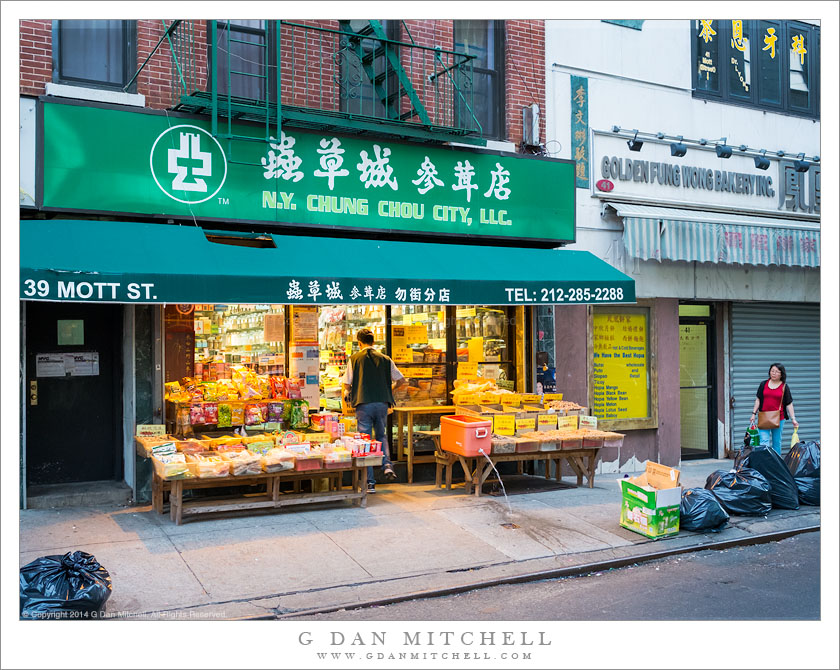
N.Y. Chung Chou City, LLC

N.Y. Chung Chou City, LLC
Bright lights of a Manhattan Chinatown shop on a summer evening

N.Y. Chung Chou City, LLC. New York City. August 10, 2014. © Copyright 2014 G Dan Mitchell – all rights reserved.

Bright lights of a Manhattan Chinatown shop on a summer evening

After dinner in New York’s Chinatown district, we went out to walk a very roundabout route to the subway. This was approaching my new favorite time for doing street photography — at night! With the newest cameras (I’m using a Fujifilm X-trans mirrorless for city shooting) the high ISO performance is good enough that I can crank it up, put on a f/1.4 lens, and shoot handheld in the urban night, working with only the ambient lighting. It wasn’t quite that dark here, but you can see that it was dark enough that the lighted interior of the shop was brighter than outside.

These scenes seem, to this west coaster, part of the culture and aura of New York City. There is a lot more going on here than might meet the eye, and I won’t even try to explain all of it. The ubiquitous plastic trash bags are an obvious feature. In my native part of the world, most neighborhoods appear to be places where trash doesn’t exist, but in New York everyone seems to just accept it as a part of the urban world. There is the odd matter of the cooler in front of the store entrance, which rests of a shelf and spews a stream of water onto the sidewalk. Between the light and the green awnings, the colors are fairly bright. And, at this early hour of the evening, a pool of light from the shop spills out onto the sidewalk.

G Dan Mitchell is a California photographer and visual opportunist whose subjects include the Pacific coast, redwood forests, central California oak/grasslands, the Sierra Nevada, California deserts, urban landscapes, night photography, and more.
Blog | About | Flickr | Twitter | FacebookGoogle+ | 500px.com | LinkedIn | Email

Text, photographs, and other media are © Copyright G Dan Mitchell (or others when indicated) and are not in the public domain and may not be used on websites, blogs, or in other media without advance permission from G Dan Mitchell.
Calero Oaks and Summer Grass

Calero Oaks and Summer Grass

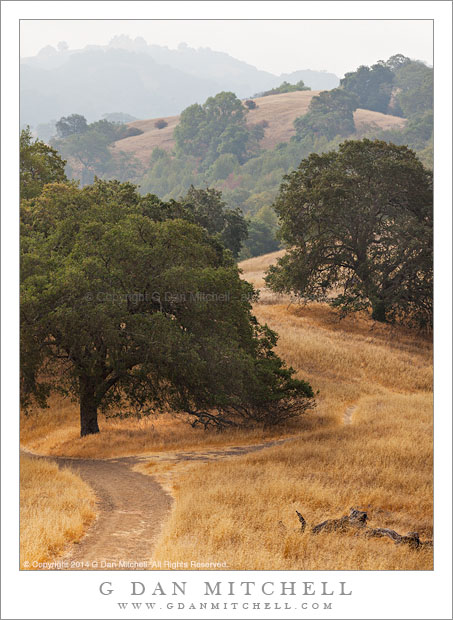
Calero Oaks and Summer Grass. Santa Clara County, California. August 17, 2014. © Copyright 2014 G Dan Mitchell – all rights reserved.

Oak and grass-covered summer hills extending into late summer morning haze

This is a portrait orientation version of more of less the same scene I shared in an earlier photograph from the same mid-August morning hike through a familiar, long time favorite local hiking and photography location. It is an area full of grasslands and oak-covered hills, lush and green for a few months each winter and spring, and then California gold/brown for much of the rest of the year. I have hiked these hills and this specific trail for many years, though it had been several months since my last prior visit — it was good to be “home” again!

This morning was special for a few reasons. There was a wonderful feeling of returning to “my world” following a few months away from this place and my return, only days earlier, from a lengthy trip to the east coast that included more than a week in the very urban environment of New York City. It also turned out, a bit to my surprise, that this hike would bring my annual “autumn is just around the corner” experience — that day each year when something tells me clearly that summer is beginning to wind down and that the beauties of autumn are not far away.

G Dan Mitchell is a California photographer and visual opportunist whose subjects include the Pacific coast, redwood forests, central California oak/grasslands, the Sierra Nevada, California deserts, urban landscapes, night photography, and more.
Blog | About | Flickr | Twitter | FacebookGoogle+ | 500px.com | LinkedIn | Email

Text, photographs, and other media are © Copyright G Dan Mitchell (or others when indicated) and are not in the public domain and may not be used on websites, blogs, or in other media without advance permission from G Dan Mitchell.

Foregoing Seeing in Order to Capture (Morning Musing 8/27/2014)

Photographing Van Gogh
Capturing Van Gogh

This “morning musing” may sound just a little grumpy, but there you go.

On a recent trip through Chicago and New York City I had lots opportunities for people watching, an endlessly fascinating activity in big cities. Since many folks we say, especially in the most popular areas, were tourists (like us!) there were many people making photographs of their experience. That is a Good Thing — like most everyone, I treasure old photographs of such family activities, and I try to remember to make a few of them myself.

However, I also saw a frequent occurrence that makes me a bit sad for some of these travelers. Confronted with the opportunity for an experience, a surprising number pass up on that opportunity and instead settle for a record proving that — what? — they saw the thing or that they stood near it.

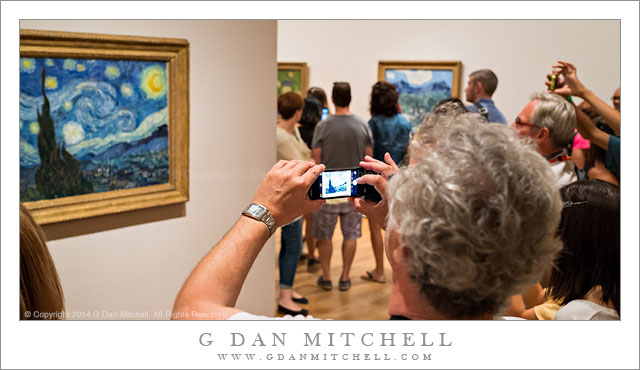
The gallery holding Van Gogh’s “Starry Night” painting, one of the most famous and familiar paintings today. (The gallery also contains a lot of other very wonderful work of the same calibre, for sure.) Before spending some time looking at the painting and trying to understand it, feel it, and fix in my mind many of its details, I spent some time watching the other people who were also there to view it. There were, not surprisingly, all sorts of responses — ranging from apparent boredom to rapt engagement with this work.

Among people with cameras of some sort, two ways of responding to the painting puzzled and continue to puzzle me.

The first is the apparent compulsion to make a smartphone image of the thing and then quickly move on. Actually, this goes a bit beyond puzzling me and almost leaves me stunned. On the practical level, if one really wants a photograph of the painting to review later it is trivially easy to find a really good one on the web or in a book, an image that will be far better than a handheld smartphone snap. On the affective level, it seems almost sad to see people with the opportunity to stand within feet of one of the world’s great works of visual art choose to raise a smartphone and press a virtual button rather than experiencing the actual thing.

The second is just plain bizarre. In these cases, less frequent than the first but still not uncommon, someone (mom or dad in many cases) sends other family members up next to the painting and has them pose, smiling awkwardly as the rest of us look away from the painting to watch them, for a snapshot that shows that they did, indeed, stand in the vicinity of a great painting and photograph themselves before moving on…

(To answer the inevitable and entirely appropriate question, Did I photograph the painting? — No.)

G Dan Mitchell is a California photographer and visual opportunist whose subjects include the Pacific coast, redwood forests, central California oak/grasslands, the Sierra Nevada, California deserts, urban landscapes, night photography, and more.
Blog | About | Flickr | Twitter | FacebookGoogle+ | 500px.com | LinkedIn | Email

Text, photographs, and other media are © Copyright G Dan Mitchell (or others when indicated) and are not in the public domain and may not be used on websites, blogs, or in other media without advance permission from G Dan Mitchell.

Photographer and visual opportunist. Daily photos since 2005, plus articles, reviews, news, and ideas.