
Crossing The Stream

Crossing The Stream
Two backpackers (and their dog) negotiate a stream crossing in the John Muir Wilderness.

Crossing The Stream. John Muir Wilderness, California. August 31, 2017. © Copyright 2017 G Dan Mitchell – all rights reserved.

Two backpackers (and their dog) negotiate a stream crossing in the John Muir Wilderness.

I was out photographing around the lower end of the lake above this stream when two backpackers passed by. I was fascinated by watching them as they came through here, and their progression to and across the stream reminded me of some aspects of backcountry travel that are important and quite different from how we live our typical day-to-say city lives. They were moving efficiently as they approached the obstacle of this stream at the trail crossing. At first glance the crossing seemed obvious, with the trail clearly arriving and departing from opposite sides of this wide spot in its course. But, as is frequently the case, the crossing wasn’t as simple as it first looked — the water was unusually high for this time of year – and no ideal crossing was apparent. They stopped, looked around, tried a few options, finally settled on stepping across on slightly submerged rocks, and they crossed. The first hiker got across fine, and the dog followed, but the second hiker slipped into the water just a bit and then apparently lost a set of glasses. They pondered a bit, realized that they couldn’t get them back, and then set off, once again moving with a purpose across the meadow and on toward a higher lake.

I now think of something else when I see such backpackers, younger (to me, anyway!) backcountry visitors who seem in many ways like me a few decades ago. I envy their ability to carry large loads and to move quickly. I can still carry what I need to, but it is harder and slower than it once was! I also think about how much they cannot yet know about their potential future in these places, including the prospect that their appreciation and connection to the wilderness will grow and mature in ways that they cannot yet foresee. Sometimes I want to stop and tell them… but I never do.


G Dan Mitchell is a California photographer and visual opportunist. His book, “California’s Fall Color: A Photographer’s Guide to Autumn in the Sierra” is available from Heyday Books and Amazon.
Blog | About | Flickr | Twitter | FacebookGoogle+ | LinkedIn | Email


All media © Copyright G Dan Mitchell and others as indicated. Any use requires advance permission from G Dan Mitchell.
Mini Medium Format… or Not?

A photographer and friend asked me for my thoughts on mini medium format, or “miniMF,” camera systems. I told her the answer was complex and that I’d write it up at the blog. Here it is!

I have attempted to include several things in the article: a bit of background regarding formats, some objective facts (“the numbers”) about them and their relationships, pluses and minuses of various options, my own current subjective thoughts on what this means to me, and a few alternative perspectives.


The evolution of digital medium format cameras has been among the most interesting photographic developments over the past few years. High MP backs from companies like Phase One and Leaf became the high-end standard for digital image making, and other companies have recently entered the market. The larger sensors may provide improved image quality in several ways: greater system resolution, greater pixel resolution, improved dynamic range, less noise, and more.

It wasn’t that long ago that digital formats larger than full frame were out of reach for nearly all photographers, with costs that were frequently many tens of thousands of dollars, often for only the digital back, which had to be attached to a medium format body.

However, in the last few years several manufacturers have driven down the cost of camera systems using larger-than-full-frame sensors, and now digital “medium format” (more on that term in a moment) bodies are available for less than $7000. A range of manufacturers are now in this market, including Fujifilm, Pentax, and Hasselblad.

When the costs of larger sensor bodies were in the mid-$20k and up (sometimes very up) range, few photographers using full frame DSLR or mirrorless cameras could realistically consider them as options. But the current $6500-$9000 price isn’t that much higher than the most expensive full frame bodies. At these prices the potential improvements in image quality are enough to make folks take a closer look, especially if they are photographers who produce large and high quality prints on a regular basis.

I began to pay attention when the miniMF Pentax 645d came out some years ago (though I was a bit disappointed to find out that the sensor wasn’t really “645” size), and my interest only increased as Pentax updated to the 645z and then as Fujifilm and Hasselblad brought out competing products. I thought a lot about the possible value of such systems for my photography, and I considered getting one. I haven’t done ao — though I won’t rule it out in the future — but I would like to share some of my musings about the choices. Continue reading Mini Medium Format… or Not?

Reflections, Early Morning

Reflections, Early Morning
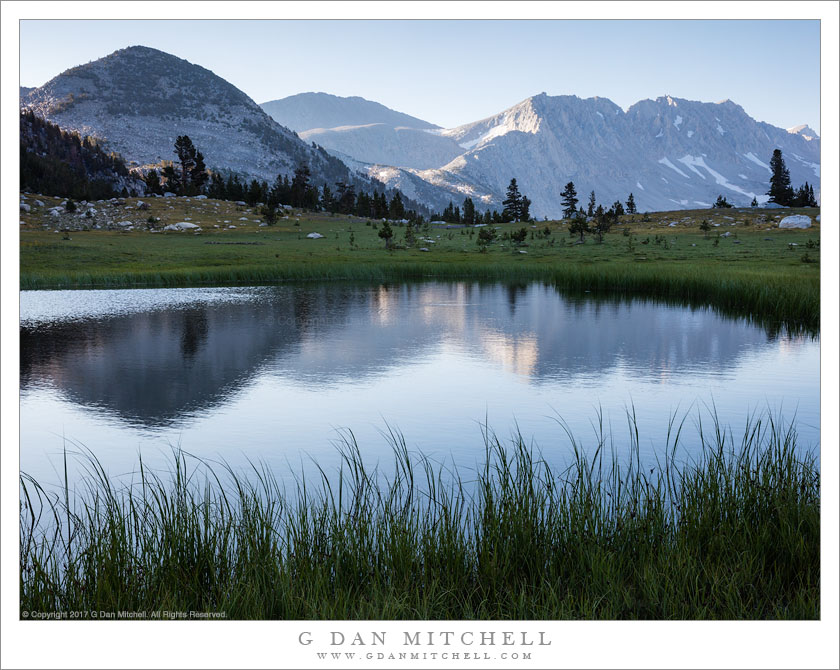
A distant ridge in very early morning light is reflected on the surface of an alpine tarn

Reflections, Early Morning. John Muir Wilderness, California. September 1, 2017. © Copyright 2017 G Dan Mitchell – all rights reserved.

A distant ridge in very early morning light is reflected on the surface of an alpine tarn

A photograph is a curious thing. It can “tell” you things about a subject — and about the person who made the photograph — that might not be easily communicated in other ways. On the other hand, a photograph usually leaves it to the viewer to guess at many aspects of the image’s context — and the viewer either brings her/his own context or may simply be unaware. For example, I probably see this scene very differently from others who view the photograph, even those who were there or who know the place. Let me explain.

What is not “visible” in this photograph? It was made near the end of a long stay in this area, where we were camped in forest a few hundred feet lower near a lake. So by this time I knew the spot quite well, and rather than “discovering” it I was essentially revisiting and looking more closely at things I already had seen. I had crawled out of my tent before sunrise, resisting the temptation to stay in the warm sleeping bag “for just a few more minutes,” and instead unzipping the bag, pulling on a down jacket and boots, heading outside and shouldering my gear. It was still not light when I arrived here, and a made a few “warm up” photographs as I wandered around this pond in the damp meadow. To make the photograph I was standing almost as much in the lake as I was next to it. At the time of this photograph the first, warm dawn light had come and gone, though the alignment of the peaks meant that not much direct light fell on the scene. Having visiting this spot for a week now, I was also noticing that the grass on the rise across the small pond was now visibly transitioning from summer green to autumn brown. As I worked a breeze came up, ruffling the surface of the water — and this photograph was made during a brief interval when it quieted enough to reflect the distant peaks. And speaking of those peaks, as I stood here and looked at them I was also aware that in about 48 hours I would be leaving, crossing a 12,000′ pass that is visible at the low point on that ridge. The trip was coming to an end.


G Dan Mitchell is a California photographer and visual opportunist. His book, “California’s Fall Color: A Photographer’s Guide to Autumn in the Sierra” is available from Heyday Books and Amazon.
Blog | About | Flickr | Twitter | FacebookGoogle+ | LinkedIn | Email


All media © Copyright G Dan Mitchell and others as indicated. Any use requires advance permission from G Dan Mitchell.
Afternoon Clouds, Reflections

Afternoon Clouds, Reflections
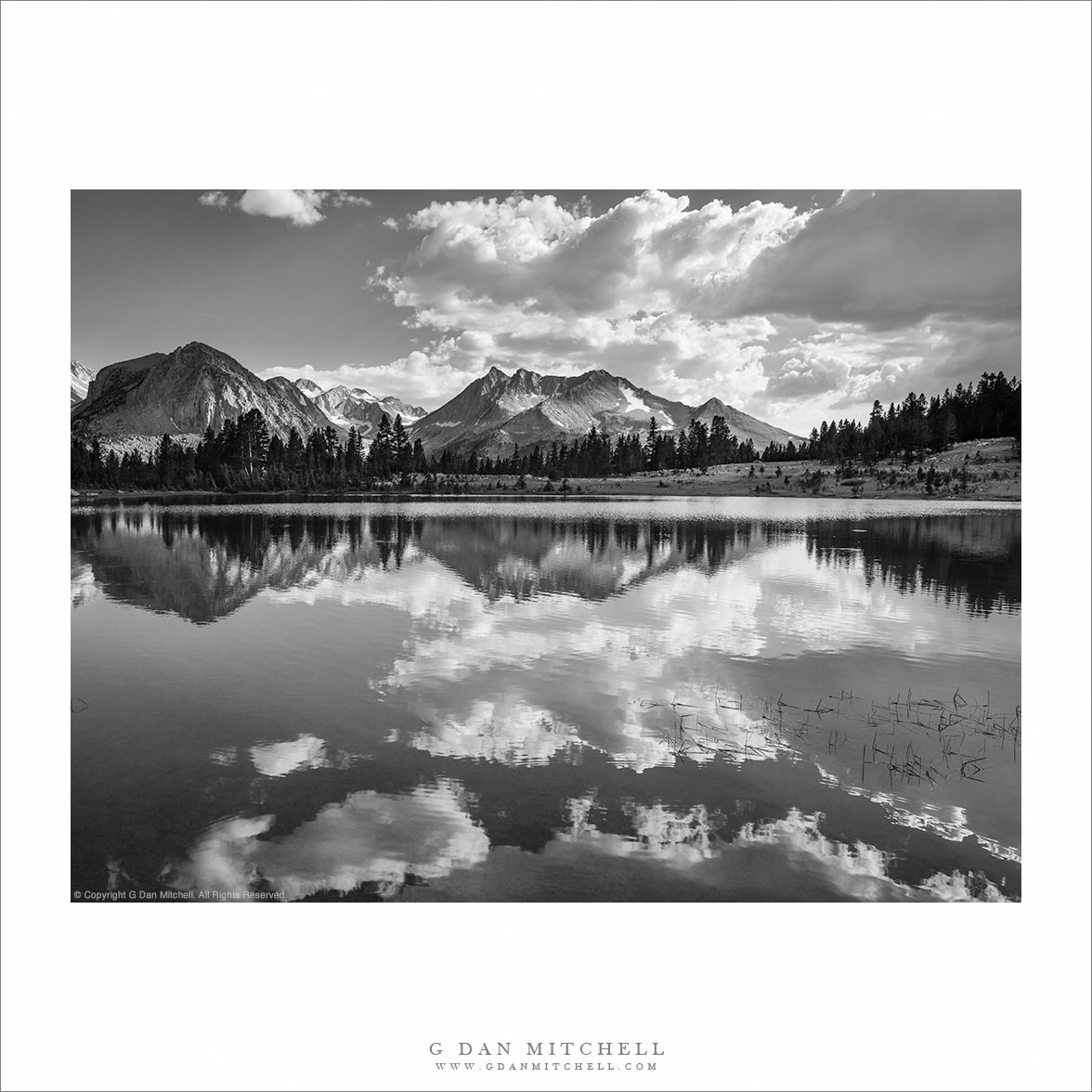
“Afternoon Clouds, Reflections” — Afternoon clouds reflect on the waters of a subalpine Sierra Nevada lake

With all of the other spectacular nearly subjects to photograph, I actually didn’t pay a whole lot of attention to the lake where we were camped until near the end of our nine-day backcountry visit in late August and early September. I did walk past it regularly, sometimes with a camera and other times with a large water bucket to take back to camp. I photographed some of the nearby flowers. But mostly I departed from this area to head of to more distant locations, especially those further up the basin.

As the end of the trip approached I began to feel like I had neglected the lake, so I made time to explore it a bit more. At the upper end there was — as is typical — an extensive meadow with several meandering streams, and the meadow gradually became more marshy at the shoreline. On the far side a thin band of meadow ran between the lake the surrounding forest. The first time I went there I was too late, and light had already gone, shaded by nearby ridges. So this time I went a bit earlier in the late afternoon and arrived at the shoreline while there still was light on the trees and meadow. Even better, the air was crystal clear, impressive clouds had formed over large peaks to our south, and the wind had diminished to the point that the water’s surface was almost mirror smooth.


COMMENT OR QUESTION? Scroll down to the comment form.

G Dan Mitchell is a California photographer and visual opportunist. His book, “California’s Fall Color: A Photographer’s Guide to Autumn in the Sierra” (Heyday Books) is available directly from him. Blog | Bluesky | Mastodon | Substack Notes | Flickr | Email

All media © Copyright G Dan Mitchell and others.

Photographer and visual opportunist. Daily photos since 2005, plus articles, reviews, news, and ideas.