I recently was asked a few questions about backpacking photography, mostly related to equipment, so I thought I’d post something to augment an existing article on this website: My Backpacking Photography Equipment. (You’ll probably want to take a look at that one, too!)
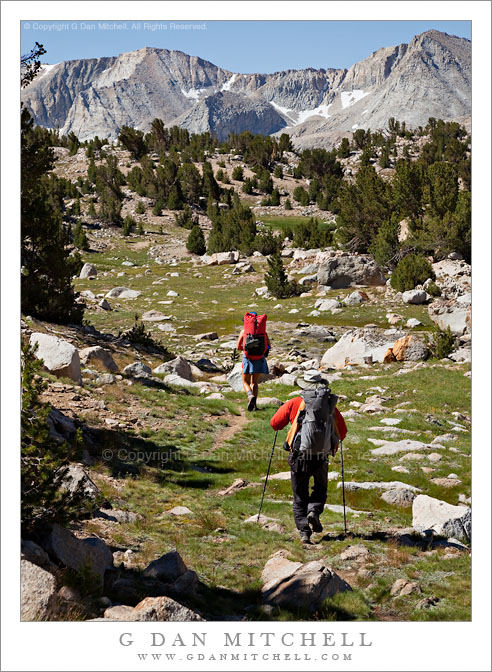
Backpackers, Near MIlestone Basin
Scott emailed recently to ask several questions, and I’ll consider some of them here. His first question has to do with gear, as in “how much” to take. He suggests that it is hard to find a balance between high enough quality imagining, sufficient equipment to cover possibly opportunities, and carrying the stuff! Once you start carrying the stuff on your back, fundamental compromises among conflicting demands are necessary.
A sunset view down toward the edge of the Temblor Hills toward Carrizo Plain, lakes, and distant mountains
This has been — and likely will continue to be — and exceptional spring for California wildflower color. After an extended and historic drought that lasted roughly five years, the rainy season now coming to an end has been record-setting in the opposite direction. We’ve had floods, washing out highways, remarkable snowfall, and as of this week the state produced an all-time record for seasonal precipitation in portions of the norther Sierra Nevada. The natural world seems to have come back to life again, and in places that have been arid for the past few years we are now seeing lush green spring growth and lots of wildflowers.
Many of us decided to visit some of the interior locations where the seasonal grasslands can produce impressive wildflower blooms. On my way to Death Valley during the first week of April I detoured to join friends who were already in the Carrizo Plains region, and I managed to do one evening and one morning of photography there. On the first evening we found a somewhat remote area in the hills alongside the plain where we could see some large fields of flowers above, and we headed up into the hills to photograph them. From this elevation the views of the Plain opened up, and I made this photograph during the final minutes before sunset.
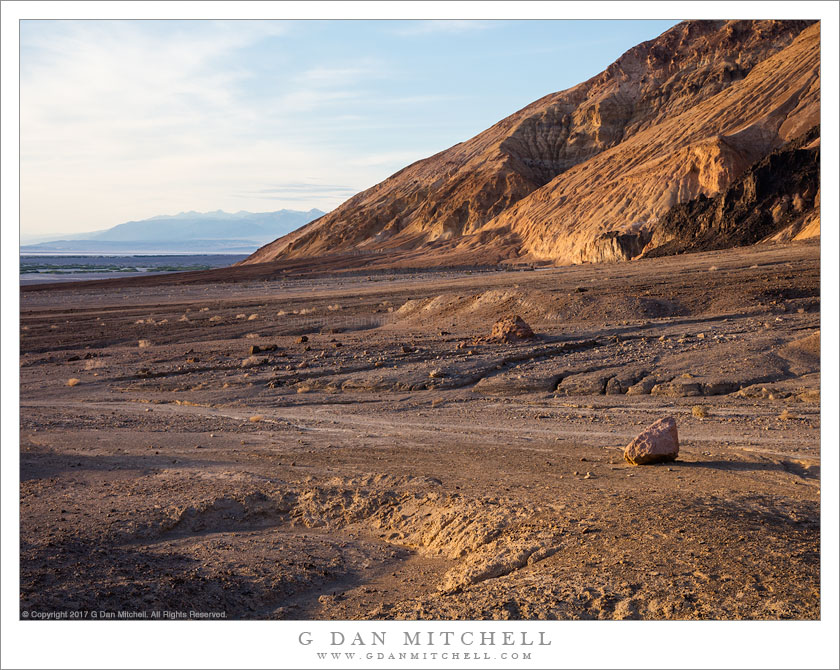
Evening light on golden hills and a wash at the base of the Black Mountains
I often use a sort of scheduling strategy when photographing in Death Valley. I get up before dawn and start with some subject that works will in the first light, and then I work a second subject that is promising in somewhat later light. Following a midday break (spent in camp or perhaps traveling to a more distant location) I reverse course later in the day, starting with a subject that works in non-golden hour light and then moving to one that works well around sunset and beyond. If conditions are right, I may even add a night subject! The second morning subject and the first afternoon subject are often canyons of one sort or another, where the edge-of-the-day light can be too dim, but where later light from a higher sun can be wonderful.
I had begun this afternoon’s photography with such a subject, one of the canyons along the eastern side of the valley. In the 90 degree plus afternoon heat I loaded up my pack with camera gear and water and slowly wandered into a narrow canyon where there was beautiful shade and somewhat moderated temperatures. Eventually it was time to return from the canyon and I reversed course and emerged from the mouth of the canyon during golden hour. This time I didn’t even have to travel to the final location since I was already there! At the time I made this photograph the long shadow of the Panamint range had stretched almost all the way across the valley and would soon steal the light from these hills, but for a few moments the golden light produced lengthy shadows and a colorful glow on the hills and along the wash emerging from the canyon.
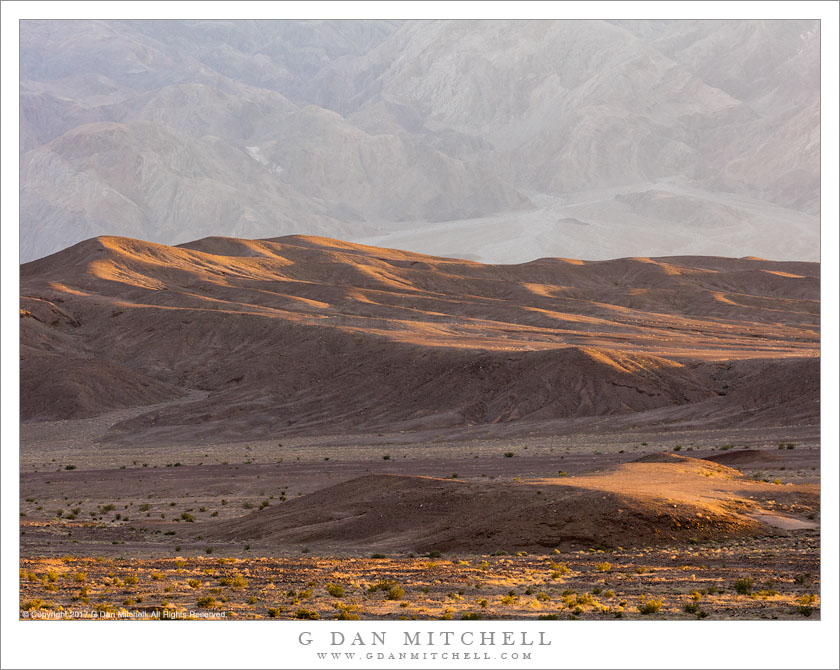
Evening light on desert hills, Death Valley National Park
I have had my eye on this general area of Death Valley for some time, revisiting regularly to try to get a better feel for its character and photographic possibilities. It lies along a route between other more iconic subjects, but because I identify so strongly with the sense of immense space, the atmospheric haze, and the quiet of “empty” spaces in this landscape, the non-iconic nature actually appeals to me. A few years ago when I started to look more carefully at this area I was attracted to its upper portion, where it comes up against some rugged mountains. But as I traveled there I kept looking at this landscape of lower and initially less impressive hills, thinking about how their forms might be photographed.
On my most recent Death Valley trip I decided to get serious about “working” this landscape, and I visited and revisited this general area three times, at different times of the day and in different conditions. (Not once did I see another photographer here, despite the easy accessibility and the interesting visual potential!) This visit was in the evening when, following my usual afternoon down time, I headed out for late afternoon and golden hour photography. I went straight to the top of a small hill I had located on earlier visits, set up to photograph, and simply watched quietly as the light evolved. The beautiful light on this hill, which is not a very striking feature in more typical light, immediately caught my attention, especially with the muted features of the more distant mountains visible beyond. This light didn’t last long, but it produced one of the quiet and subtle beauties of the desert landscape that I treasure.