
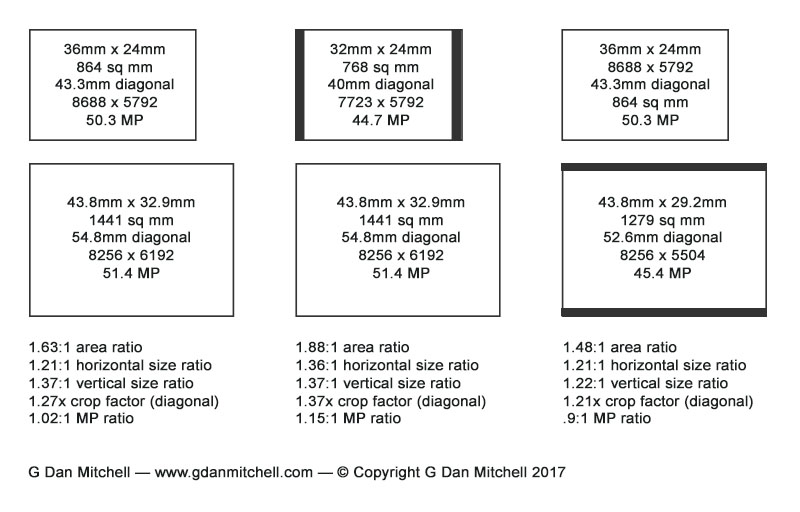
Comparing 33 x 44mm “miniMF” and 24 x 36mm Full Frame Sensors

Comparing Full Frame and miniMF Sensors
Comparing full frame 24mm x 36mm and Fujifilm mini-MF 33.8mm x 43.8mm sensors

Starting a few years ago with cameras like the Pentax 645d and then 645z and continuing with new cameras from Hasselblad and Fujifilm, systems using  the “miniMF” 33mm x 44mm sensors have become more readily available and less expensive.

In preparation for writing something about the merits of the two types of systems I created this image that holds quite a bit of technical comparison data based on pixel counts (e.g. — “megapixels”), sensor size, and ways of comparing them.

For now I won’t try to analyze this too much, except to say that comparisons between the two formats are more complicated than you might think and they are somewhat subjective — it matters how you plan to use them. For example, do you prefer to use the 3:2 aspect ratio of full frame,  or the 4:3 ratio of miniMF, or will you adapt to whichever you are using? This chart shows you how that affects your comparisons.

NOTE: The graphic is a first attempt at including a lot of information in a single chart. It has some problems, especially with the numbers representing crop factor. I’ll update the image to correct the errors before long, and at that point I’ll use it in a more substantive post about comparing the formats.

© Copyright 2016 G Dan Mitchell – all rights reserved.


G Dan Mitchell is a California photographer and visual opportunist. His book, “California’s Fall Color: A Photographer’s Guide to Autumn in the Sierra” is available from Heyday Books and Amazon.
Blog | About | Flickr | Twitter | FacebookGoogle+ | LinkedIn | Email


All media © Copyright G Dan Mitchell and others as indicated. Any use requires advance permission from G Dan Mitchell.
Door, Steps, and Window

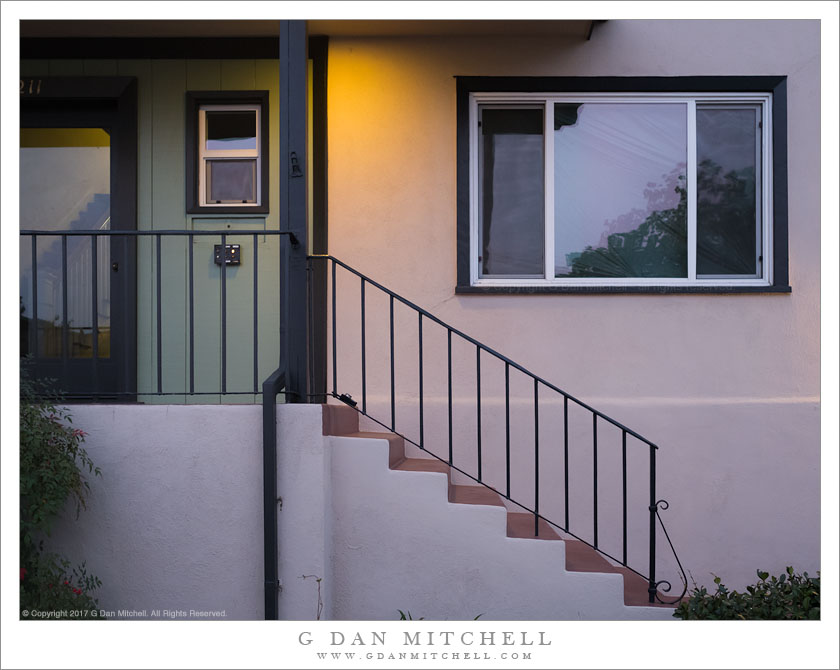
Door, Steps, and Window
The front of an urban Pasadena building at twilight

Door, Steps, and Window. Pasadena, California. January 6, 2017. © Copyright 2017 G Dan Mitchell – all rights reserved.

The front of an urban Pasadena building at twilight

Here I’ll interject an “urban landscape” into the stream of mostly natural landscape photographs that I’ve recently posted. This photograph comes from a visit to Southern California, mostly in the Pasadena area, just after the New Year’s Day Holiday. We were there for a family event, but there were plenty of opportunities to do street and similar kinds of photography in the characteristic Southern California environment.

We had been out walking in the afternoon, and as evening came on it was that time that is so magical for handheld street photography, the time just after sunset when there is still ambient light as artificial lights start to come on and take over the landscape. We continued to wander, taking a big look back into central Pasadena and past some residential areas where I found this little vignette.


G Dan Mitchell is a California photographer and visual opportunist. His book, “California’s Fall Color: A Photographer’s Guide to Autumn in the Sierra” is available from Heyday Books and Amazon.
Blog | About | Flickr | Twitter | FacebookGoogle+ | LinkedIn | Email


All media © Copyright G Dan Mitchell and others as indicated. Any use requires advance permission from G Dan Mitchell.

Juniper, Sage, and Red Rock

Juniper, Sage, and Red Rock
A juniper tree stands amidst broken red rock terrain in light reflected from nearby sandstone cliffs

Juniper, Sage, and Red Rock. Capitol Reef National Park, Utah. © Copyright 2012 G Dan Mitchell – all rights reserved.

A juniper tree stands amidst broken red rock terrain in light reflected from nearby sandstone cliffs

This photograph includes a number of the characteristic features of this southern Utah Landscape: a solitary juniper tree growing from rocky terrain, sage brush and other brushy plants, the textured red rock, and the intensified color from light bouncing from other red rock cliffs nearby. Here, too, is a bit of rock left from a layer of lighter rock — in this area of Capitol Reef National Park steeply tilted strata place such diverse rocks together in surprising places.

This spot is high on a ridge in a less accessible part of Capitol Reef National Park. This park seems like a bit of an oddity in some ways. If you drive through it probably seems tiny, since the road cuts across it narrow east-west dimension, but the park stretches a good distance north and south. The accessible attractions are very appealing, but most of them lie a short distance from the highway, and to get to the more remote areas of the park you are likely going to have to drive a good distance on some less “civilized” roads and then get out and walk. The area where I made the photograph is such a place. While getting their doesn’t require a major expedition, it is far enough away from the main road that the number of visitors is small and silence and solitude are plentiful.


G Dan Mitchell is a California photographer and visual opportunist. His book, “California’s Fall Color: A Photographer’s Guide to Autumn in the Sierra” is available from Heyday Books and Amazon.
Blog | About | Flickr | Twitter | FacebookGoogle+ | LinkedIn | Email


All media © Copyright G Dan Mitchell and others as indicated. Any use requires advance permission from G Dan Mitchell.
Juniper and Red Rock Cliff

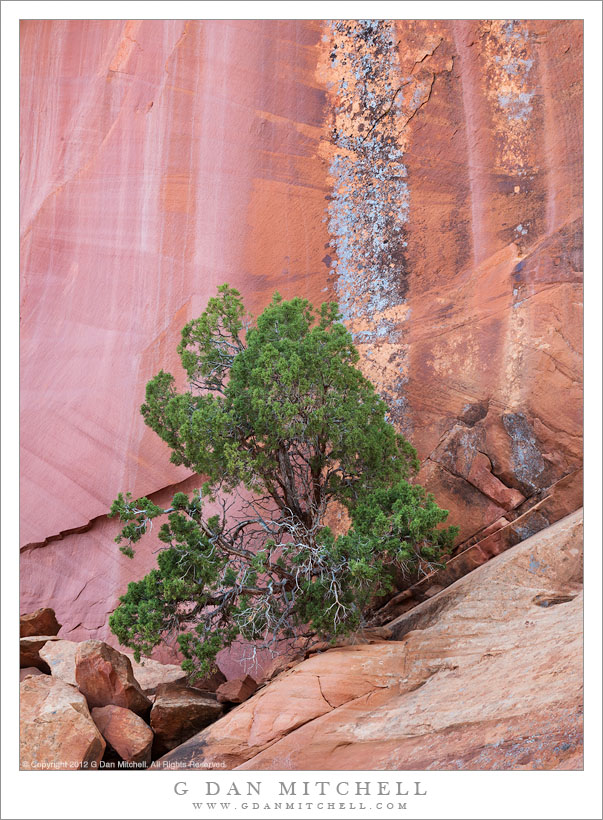
Juniper and Red Rock Cliff
A solitary juniper tree grows at the base of a Utah red rock cliff

Juniper and Red Rock Cliff. Capitol Reef National Park. October 27, 2012. © Copyright 2012 G Dan Mitchell – all rights reserved.

A solitary juniper tree grows at the base of a Utah red rock cliff

This being Utah, it represents a place that will likely be in need to attention and support from all of us who love our shared national lands, in opposition to those who would privatize them for purposes of extractive industry, damn the consequences. The photograph comes from an autumn visit to Southern Utah nearly five years ago, when I joined a group of fellow photographers to explore areas from Capitol Reef to Zion and points in between. This is, as many of you know, stunningly beautiful country, particularly if you get off the main roads a bit and poke around in odd washes and canyons and remote routes.

This lovely juniper tree grows at the base of a sculpted sand stone face that is marked by all sort of veins, weathering, and water stains. The tree grows from what appears to be nearly solid rock, likely finding sustenance on whatever debris has filled a crack at the base of the cliff over the years. The colors of this part of the world area simply extraordinary, with the base being the infinite shades of sandstone color, bathed in everything from direct sun to light that has become saturated by bouncing its way among the colorful walls until it reaches the depths of narrow canyons.


G Dan Mitchell is a California photographer and visual opportunist. His book, “California’s Fall Color: A Photographer’s Guide to Autumn in the Sierra” is available from Heyday Books and Amazon.
Blog | About | Flickr | Twitter | FacebookGoogle+ | LinkedIn | Email


All media © Copyright G Dan Mitchell and others as indicated. Any use requires advance permission from G Dan Mitchell.

Photographer and visual opportunist. Daily photos since 2005, plus articles, reviews, news, and ideas.