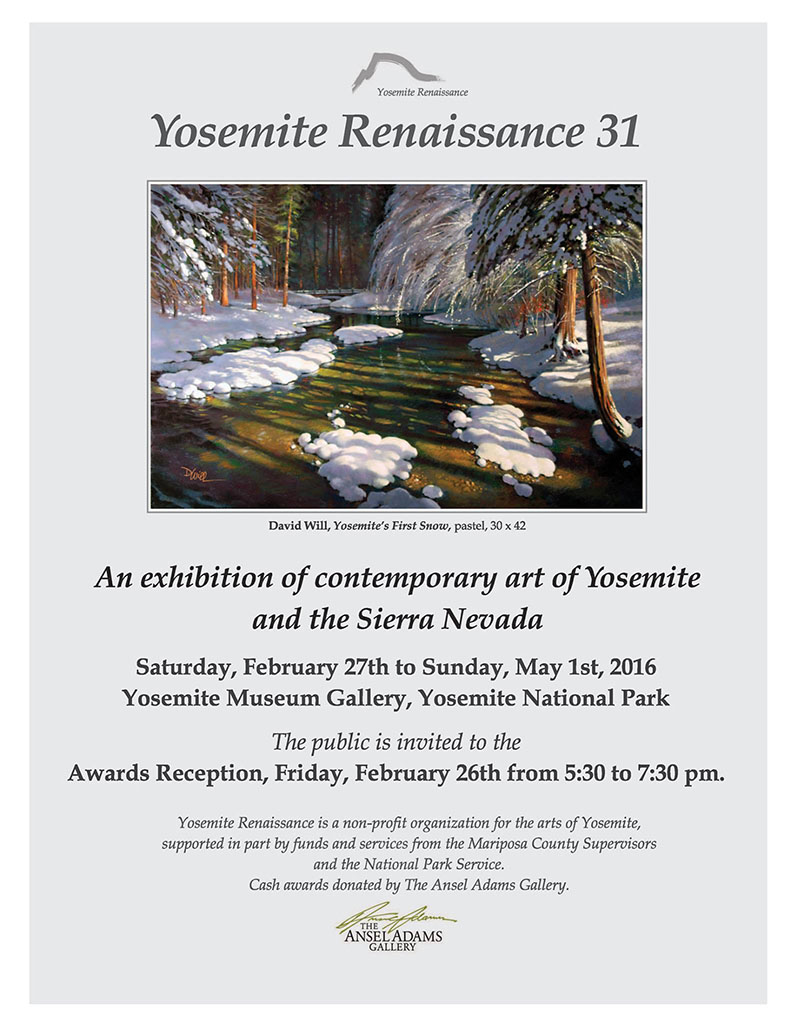
The 31st annual Yosemite Renaissance Exhibit opens this weekend in Yosemite Valley. Come on by if you are in the park! The free opening Artists Reception is on Friday, February 26 at 5:30-7:30pm in the Visitor Center Gallery. The show then runs from Saturday, February 27 though May 1.
Yosemite Renaissance features artists who work in and around Yosemite and the Sierra. It includes a range of media — photographs, painting, ceramics, sculpture, and more.
I’m honored that one of my photographs was again included in the exhibit — for the fourth year in a row. This time it is a photograph I made at Devil’s Postpile National Monument last year: “Basalt Columns, Lichen, Autumn Plants”
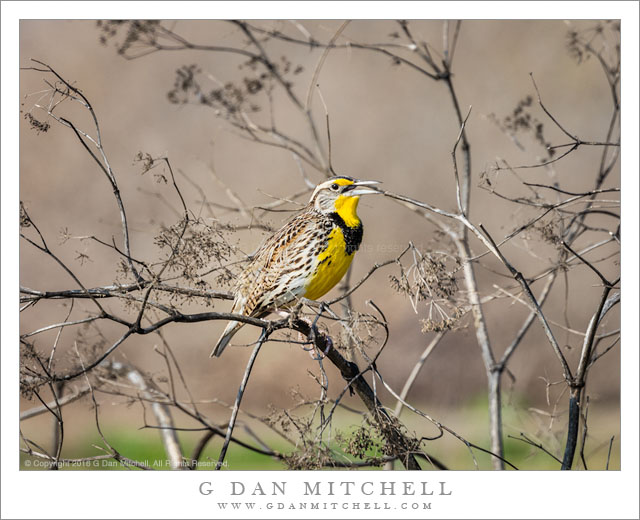
Western Meadowlark perched in San Joaquin Valley branches
I’m going to indulge my bird photograph collection interest and share what is really just a photograph of another little bird! This beautiful little bird was a side attraction I found during a recent visit to the California Central Valley to mainly photograph geese and cranes, plus the odd heron and egret.
Photographing the larger birds is an experience that often vacillates between moments of wildly photographing as birds fly above, or as huge flocks take to the sky, and then long periods of not doing much at all — waiting for birds, trying to figure out where the birds are, moving to another location to find birds, and so forth. But I’ve found that when I keep my eyes open I find interesting things that aren’t what I was initially looking for. That was the case with this yellow western meadowlark, which was standing in some brush alongside a perimeter road at a wildlife refuge and which I just happened to spot while passing by.
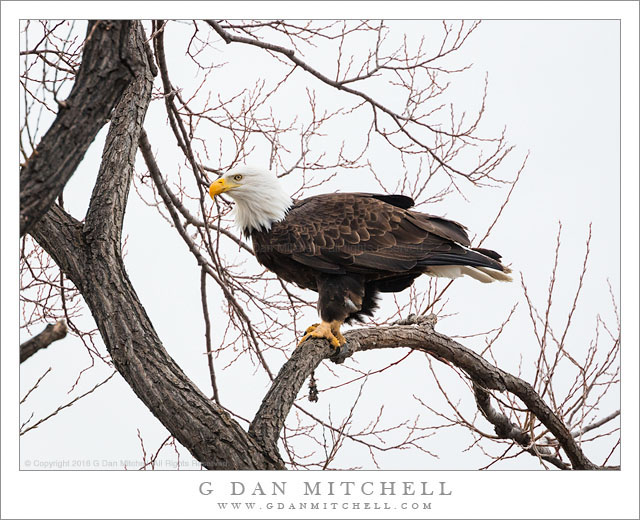
I rarely see bald eagles in my home territory in the San Francisco Bay Area, so seeing them when I travel is a special treat. This area of the Klamath Basin that I visited in mid-February is known for them — in fact there is one refuge in the area that is off-limits to humans, specifically so that these magnificent birds can flourish without being disturbed. As I was out in a refuge on afternoon and driving along a levee I spotted a group of people stopped ahead. I slowed down and approached slowly, not wanting to disturb whatever they say, and I soon saw the very big eagles nest up in one of the trees. Soon I saw that there were two eagles in the tree, and I made some initial photographs.
I returned to the area again the next evening, this time with a better organized plan. Sure enough, both eagles were again out and about in the are of their nest, alternating between perching in the nest and heading out to hunt. At one point this eagle returned from a hunt, but instead of going to the nest and sharing its prize, the bird perched on a branch a few hundred feet from where its partner was in the next and it proceeded to feast on something it had caught. This provided an excellent opportunity to get a relatively close (with a long telephoto) and unobstructed view of the bird. After eating, the eagle tore some trigs and small branches from the tree and flew off to carry them back to the nest — as if to say, “Sorry, no food. But I did bring something nice for the house.”
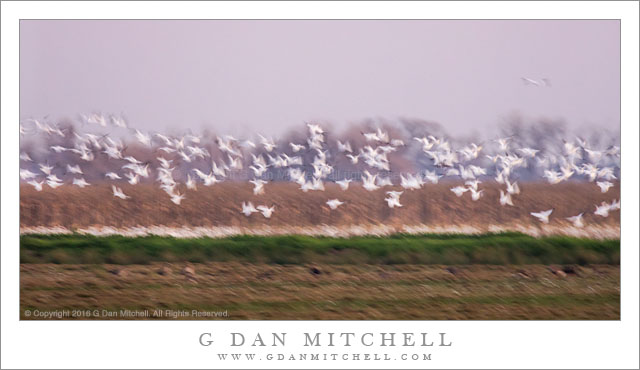
The edges of the day are the most magical times in these Central Valley wetlands — from the thick morning tule fog that hides everything from sight and mutes sound, to the hazy evening twilight as the light decreases and takes on the dusk colors. A huge flock of geese was mostly settled in on this newly mown corn field, but every so often they would suddenly take flight and pass back and forth above the fields before settling down once again.
By the time this group flew past the light was failing quickly. I had a long lens on my camera, hardly the right thing for sharp photographs in deep twilight, and even pushing my ISO left me with very low shutter speeds. At this point, rather than fight, I go with the long shutter speeds and have a few final minutes working with the long exposure blur, tracking the flock but letting their motion and the background blur into abstract forms.