
Tag Archives: bend

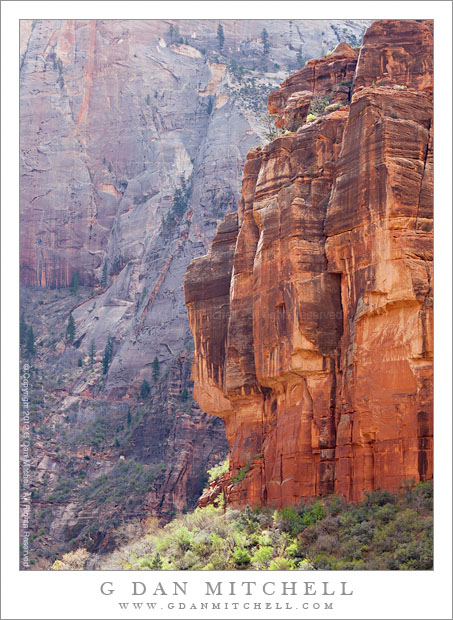
Sandstone Tower and Cliff, Morning

Sandstone Tower and Cliff, Morning - A nearby sandstone tower backed by a more distant cliff face in morning light, Zion National Park.
A nearby sandstone tower backed by a more distant cliff face in morning light, Zion National Park.

Sandstone Tower and Cliff, Morning. Zion National Park, Utah. April 4, 2012. © Copyright 2012 G Dan Mitchell – all rights reserved.

A nearby sandstone tower backed by a more distant cliff face in morning light, Zion National Park.

If you look at the photograph that I posted yesterday, you can probably locate almost the entire composition of this photograph contained within the earlier one. This perhaps illustrates one or more things about how I sometimes think when making photographs. One approach that I think I use quite a bit is to try to isolate small sections within much larger landscapes. If you look at yesterday’s image, you’ll see that it uses a fairly familiar sort of approach, namely to include a fairly large swath of “stuff” from close to far away within the frame. Today’s image, though, eliminates out all of that other stuff that might provide a wider context and instead just “shows” one small, interesting bit of the larger scene. And, obviously, I used a longer lens – something else that I often do when shooting landscape. I’m most certainly not one of those photographers who buys into the notion that “landscape photography is done with wide-angle lenses!” I also like juxtapositions. In this scene there are perhaps quite a few – and you might even see some that I’m unaware of. There are color juxtapositions the bright green at the bottom against the very different tones of the rocks; the brighter reddish rocks in the foreground against the darker and more blue or even purple tones of the more distant rocks; the clarity of the close and sunlit red rocks against the lower contrast and somewhat haze-obstructed character of the distant cliff.

The location is in the Virgin River drainage of Zion Canyon. One person described it as “Yosemite in red,” and now that I have been there I can certainly see why! While the overall scale of this valley is smaller than that of Yosemite, the verticality of the place is just as stunning. In fact, in some ways, because the walls are closer and because of the wild colors, it may be more stunning. (Of course, Yosemite does have those waterfalls… and some crazy dome formations… and the massive scale of features like El Capitan. I digress… ;-) The smaller scale makes some kinds of photography perhaps a bit easier. For example, those “juxtapositions” I mentioned above can be fine tune a bit more readily by moving the camera position a few feet. (I did that here as I moved the camera a bit to get three trees way up on the far cliff to line up to the left of the upper section of the closer formation on the right side of the frame. Ironically, you probably didn’t even see them until I mentioned that… ;-)

G Dan Mitchell is a California photographer whose subjects include the Pacific coast, redwood forests, central California oak/grasslands, the Sierra Nevada, California deserts, urban landscapes, night photography, and more.
Blog | About | Flickr | Twitter | FacebookGoogle+ | 500px.com | LinkedIn | Email

Text, photographs, and other media are © Copyright G Dan Mitchell (or others when indicated) and are not in the public domain and may not be used on websites, blogs, or in other media without advance permission from G Dan Mitchell.
Zion Canyon, Virgin River, Spring

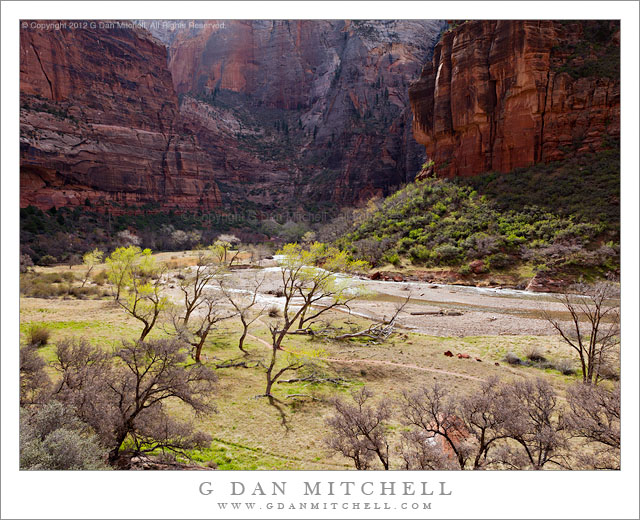
Zion Canyon, Virgin River, Spring - The Virgin River flows through Zion Canyon near Weeping Rock, Zion Canyon National Park, Utah.
The Virgin River flows through Zion Canyon near Weeping Rock, Zion Canyon National Park, Utah.

Zion Canyon, Virgin River, Spring. Zion National Park, Utah. April 4, 2012. © Copyright 2012 G Dan Mitchell – all rights reserved.

The Virgin River flows through Zion Canyon near Weeping Rock, Zion Canyon National Park, Utah.

On this morning we were back in Zion Canyon, following the Virgin River up the Valley to various locations. While it was still quite early we had walked up to the base of Weeping Rock, deep in the shaded area in the center of this photograph, and photographed there in the quiet shade. Then we moved a short distance up this part of the canyon where it makes a rather sharp series of turns and stopped an a place where there were visits up, down, and across the Virgin River and along the huge sandstone cliffs in all directions.

Looking around, I saw that there were some scattered clouds that were moving across the sky and alternative shading and lighting various portions of the landscape, and creating some dramatic effects, especially when the light came from behind the group of cottonwood trees along the banks of the river below me. The skeletal forms of the trees’ trunks were still clearly visible and, when the light was bright enough, they cast mirror-image shadows on the new grass below. The tops of the trees were fringed by new leaves, and these glowed brightly in the backlight coming from above the far cliffs above Weeping Rock. There was just enough haze in the air, amplified a bit by backlighting, to suggest the distance and massive size of the dark cliffs.

G Dan Mitchell is a California photographer whose subjects include the Pacific coast, redwood forests, central California oak/grasslands, the Sierra Nevada, California deserts, urban landscapes, night photography, and more.
Blog | About | Flickr | Twitter | FacebookGoogle+ | 500px.com | LinkedIn | Email

Text, photographs, and other media are © Copyright G Dan Mitchell (or others when indicated) and are not in the public domain and may not be used on websites, blogs, or in other media without advance permission from G Dan Mitchell.
Meadow Plants, Early Snow

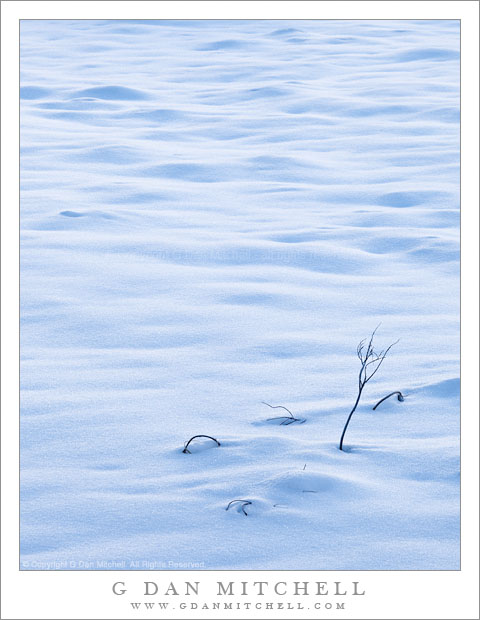
Meadow Plants, Early Snow - Meadow plants bend beneath the weight of an early October snowfall, eastern Sierra Nevada, California.

Meadow Plants, Early Snow. North Lake, Eastern Sierra Nevada, California. October 8, 2011. © Copyright 2011 G Dan Mitchell – all rights reserved.

Meadow plants bend beneath the weight of an early October snowfall, eastern Sierra Nevada, California.

I made this photograph on a very cold early October morning high in the eastern Sierra after a series of early season snow storms had passed over the Sierra. The gravel road to North Lake had apparently just opened again on the morning I arrived, and few other people were there. I was there to photograph autumn aspen color, but the opportunity to photograph snow scenes so early in the season distracted me.

As I walked the road skirting the edge of North Lake, I passed by meadows that were completely covered by new, untouched snow. Here and there a few small plants managed to poke up from beneath the white blanket.

Merry Christmas and Happy New Year!

G Dan Mitchell is a California photographer whose subjects include the Pacific coast, redwood forests, central California oak/grasslands, the Sierra Nevada, California deserts, urban landscapes, night photography, and more.
Blog | About | Flickr | Twitter | FacebookGoogle+ | 500px.com | LinkedIn | Email

Text, photographs, and other media are © Copyright G Dan Mitchell (or others when indicated) and are not in the public domain and may not be used on websites, blogs, or in other media without advance permission from G Dan Mitchell.

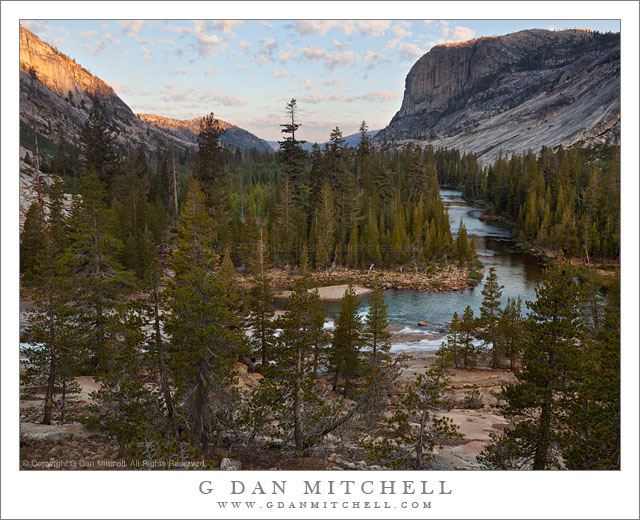
Tuolumne River Below Glen Aulin, Morning

Tuolumne River Below Glen Aulin, Morning

Tuolumne River Below Glen Aulin, Morning. Yosemite National Park, California. September 16,2011. © Copyright 2011 G Dan Mitchell – all rights reserved.

Early light on morning clouds above the Tuolumne River Canyon below Glen Aulin, Yosemite National Park.

This is the same bend in the Tuolumne River, located below Glen Aulin and before the river descends toward Waterwheel Falls and eventually the abomination of Hetch Hetchy Reservoir, that was shown in a photograph of late afternoon light that I posted here a few days ago. This time it was early morning. We had been up well before sunrise and had wandered off in various directions to find early morning photographic subjects. My main goals were the cascading water along the edge of this section of the river (a bit of which is visible in the lower portion of the frame) and a granite bowl to the right of this view. As I came over the rise above this area before descending I saw the beautiful sparse clods to the west, probably extending to the edge of the Sierra and still with pastel colors from dawn light.

A technical observation about this photograph. This scene presented a technical challenge in the form of an extremely wide dynamic range between the bright and red-saturated first direct sunlight on the ridge at upper left and the much darker areas of forest in shade along the river and in the foreground. With a digital exposure, in a scene like this one, the primary rule for me is “don’t blow out the highlights.” If I had overexposed the sky the clouds would have turned into pure white, texture-free blotches and that bit of early sun on the rocks would have lost detail and taken on a very strange coloration. However, an exposure that protects the highlights in a scene like this one can leave the shadows nearly black. While it is possible to “fix” that a bit in post, the result is not necessarily very good when the dynamic range is very large. One “traditional” solution would have been to use a graduated neutral density filter (or “GND”) that blocked some of the brightest areas at the top of the frame while not affecting the lower 2/3 or so. But I don’t use them, and in this case the result would not have been totally wonderful since the same filtering that would reduce sky brightness would also make the large granite dome at the right end up nearly black at the top.

So instead of filtering at the time of exposure, I decided that I would use the roughly comparable, but more flexible, “exposure blending” techniques in post. With that in mind I made several photographs at different exposures – some at shorter shutter speeds to avoid the blown out highlights and others at increasingly slower shutter speeds to reveal the shadow detail that my eyes could see but which the camera otherwise could not. During the post-production phase, I selected two of the exposures, one that was as bright as possible but without blowing out the sky and sunlight, and the other two stops lighter to reveal that shadow detail in a way that seemed consistent with what I recall the scene actually looked like. The two source images were carefully adjusted during raw conversion and their two layers carefully aligned. With the darker image (the one with the “good” sky) on the top, I began to “paint” out the mask to reveal the details of the foreground forest, river, and rocks. (In answer to the expected question, this is not the same as HDR. That is a more or less automated process that works in a different way. Exposure blending is typically a manual process that relies a great deal on the photographers judgment and recall of the actual scene.)

G Dan Mitchell is a California photographer whose subjects include the Pacific coast, redwood forests, central California oak/grasslands, the Sierra Nevada, California deserts, urban landscapes, night photography, and more.
Blog | About | Flickr | Twitter | FacebookGoogle+ | 500px.com | LinkedIn | Email

Text, photographs, and other media are © Copyright G Dan Mitchell (or others when indicated) and are not in the public domain and may not be used on websites, blogs, or in other media without advance permission from G Dan Mitchell.