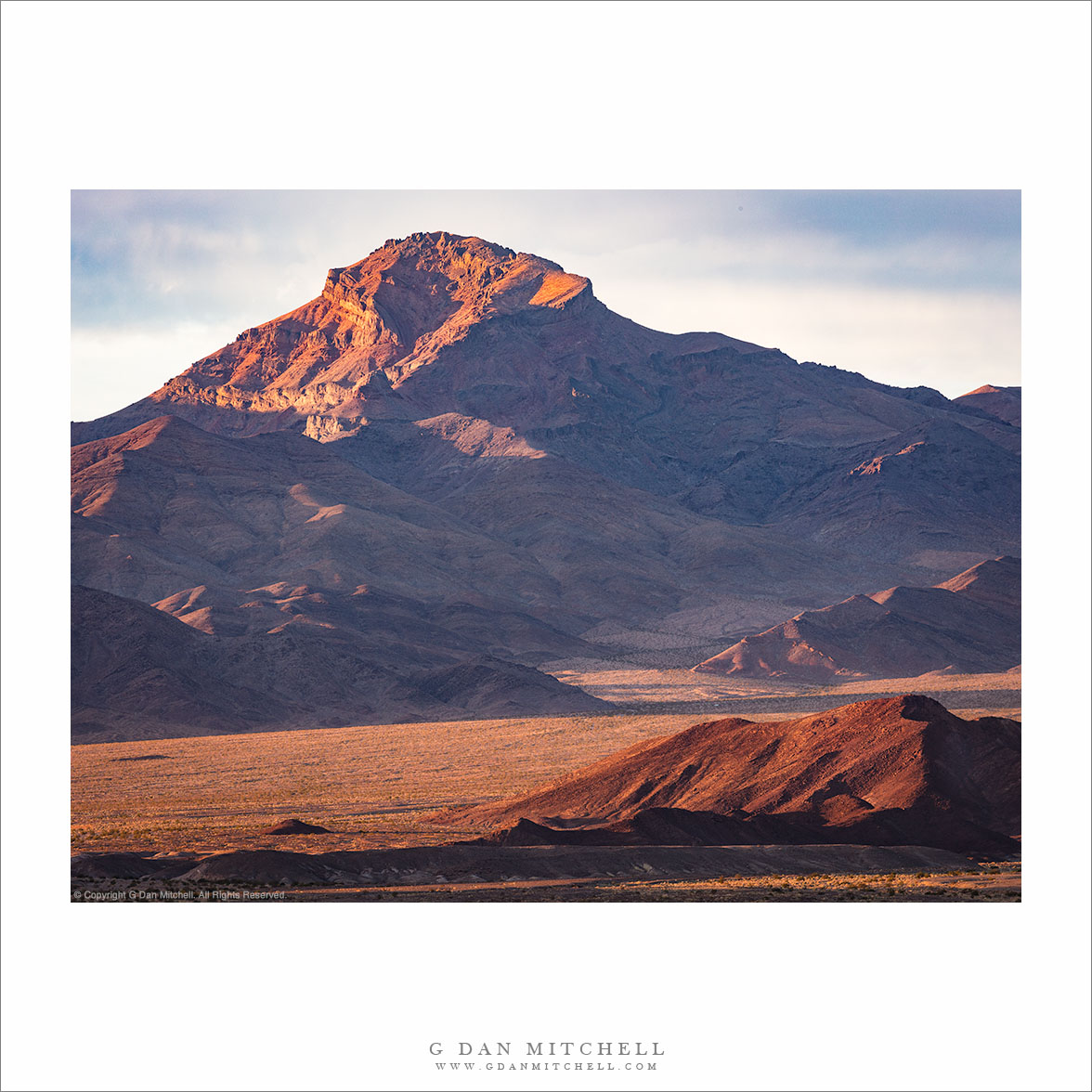
“Corkscrew Peak, Evening” — Evening light on the giant alluvial plain leading up towards Corkscrew Peak.
This peak has long intrigued me — along with the entire ridge that it lies on. Perhaps the name first caught my attention when I was trying to identify landmarks in photographs I took from out in the Valley. Hint: it does not really look much like a corkscrew, though I can see how the tilted rock layers that seem to run around it inspired the name.
I photographed this on my first evening in Death Valley back in February. After a very long drive from the Bay Area I set up camp, rested a bit, and then it was time to go find something to photograph. Since it was late in the day I wanted to keep it somewhat simple, so I headed to this spot along a road leading out of the Valley, arriving just in time to photograph the day’s last light.
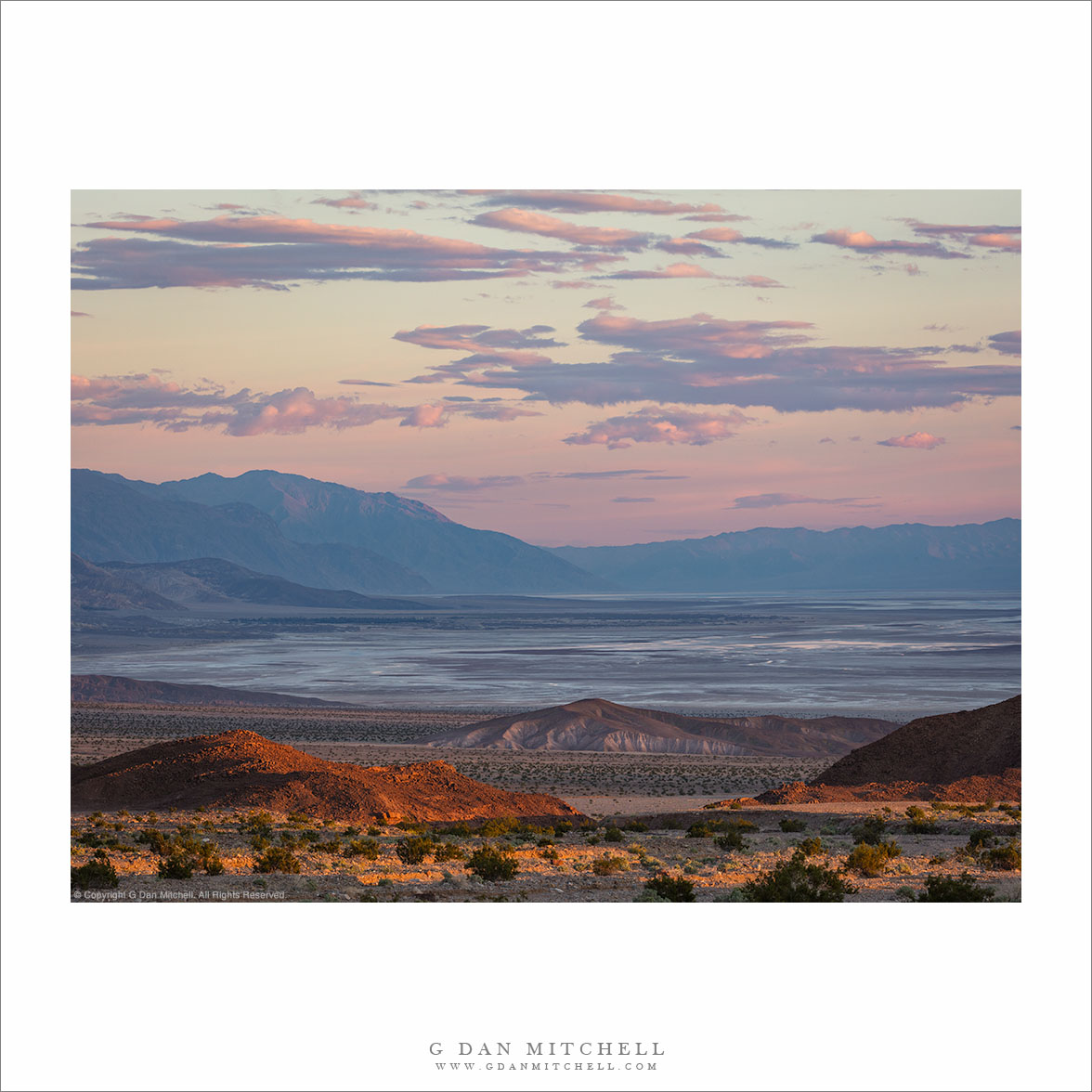
“Evening Sky and Haze, Death Valley” — Sunset sky, distant mountains, clouds and haze — Death Valley.
Death Valley National Park is a huge place — not just as measured by its total area but also by the immense spaces we view there. In many places we look across dozens of miles toward objects so far away that they are obscured by the atmosphere even on clear days. We might look at a “nearby” destination and think, “I’ll walk there.” If we try, hours later our intended destination will still be in the distance.
This photograph, made at sunset in the central part of the great valley, is an example. If I had gotten in my car and started driving, it would have taken me an hour and a half or longer to reach the base of those mountains in the distance. In this scene the valley has already fallen into the shadows of the Panamint range and a final bit of soft side-light glances across the large wash in the foreground.
G Dan Mitchell is a California photographer and visual opportunist. His book, “California’s Fall Color: A Photographer’s Guide to Autumn in the Sierra” is available from Heyday Books, Amazon, and directly from G Dan Mitchell.
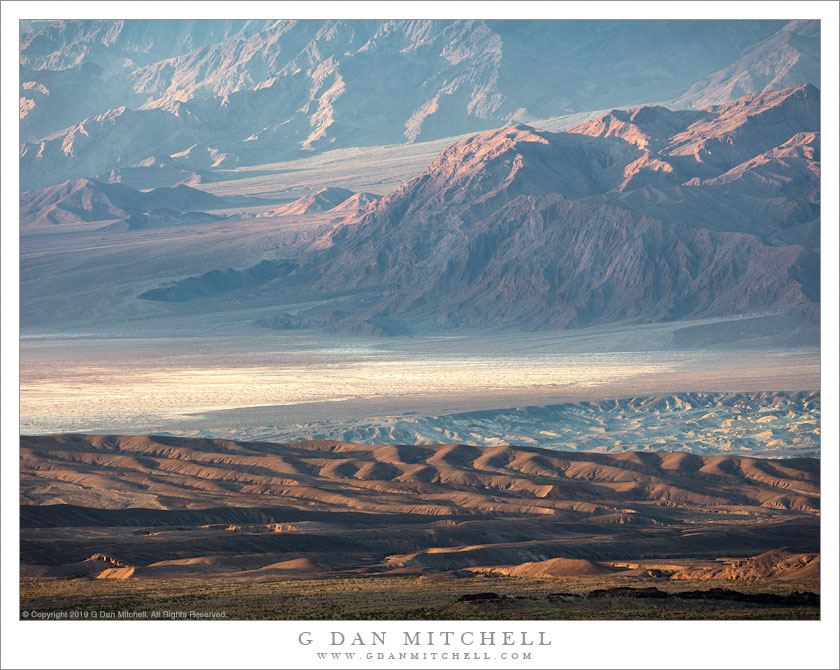
Morning sunlight on Death Valley hills and the foothills of the Panamint Mountains.
One’s orientation to “landscape” may manifest in many ways — a focus on the large or the small, an approach that implies objective realism or one that embraces subjectivity, the discovery of new landscapes or the deeper exploration of those already known, an interest in ostensibly “untouched” subjects or attention to those affected by the human presence, and more. Death Valley is diverse enough for any of these, but I often find myself focusing on the largest scale subjects. The place is huge, and at the right hours, in the right seasons, and in the right places the park is a place of deep silence and immense stillness.
This was the last morning of my most recent visit, and I went out alone very early, heading to a place that afforded a somewhat elevated perspective. As I traveled there I was not optimistic about the prospects for the morning — the sky was mostly overcast, there was a bluish haze in the air, and even the earliest light was blocked by clouds to the east. But one thing I relearn nearly every time I go out is that if you go out enough and are persistent enough, things happen, and sometimes they happen at the least likely times. As this morning wore on, some time after the first light that could have been colorful, the sun began to break through the clouds, and areas of light and shadow moved across this immense landscape. As I made this photograph the light was shining on the foothills of the Panamint Range, many miles away and on the far side of Death Valley.
G Dan Mitchell is a California photographer and visual opportunist. His book, “California’s Fall Color: A Photographer’s Guide to Autumn in the Sierra” is available from Heyday Books and Amazon.
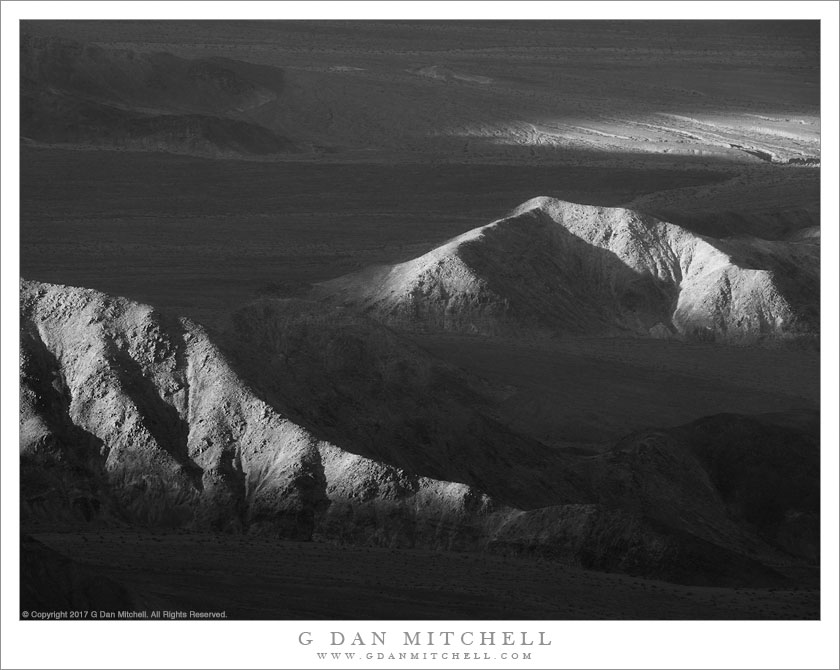
Evening light into Blackwater Wash illuminates buttes above Death Valley
These buttes or hills have fascinated me for a long time. They project out of the gigantic gravel fields of the alluvial fan at the base of the Panamint Mountains known as Blackwater Wash. They are visible from the floor of Death Valley, across its wide expanse to the west, often partially obscured by haze late in the day. From a few high points in the Panamint range they are also visible from above, often poking up above ridges or framed by v-shaped canyons.
I made this photograph from one of those higher positions, a location along the summit ridge of the Panamint Mountains that provides views in all directions, including down into Death Valley itself. This time I was there near the end of the day, as haze filled the valley and the last sunlight of the day came over the summit of the mountain range, casting beams of light down into the canyon and lighting these hills.
Photographer and visual opportunist. Daily photos since 2005, plus articles, reviews, news, and ideas.
Manage Consent
To provide the best experiences, we use technologies like cookies to store and/or access device information. Consenting to these technologies will allow us to process data such as browsing behavior or unique IDs on this site. Not consenting or withdrawing consent, may adversely affect certain features and functions.
Functional
Always active
The technical storage or access is strictly necessary for the legitimate purpose of enabling the use of a specific service explicitly requested by the subscriber or user, or for the sole purpose of carrying out the transmission of a communication over an electronic communications network.
Preferences
The technical storage or access is necessary for the legitimate purpose of storing preferences that are not requested by the subscriber or user.
Statistics
The technical storage or access that is used exclusively for statistical purposes.The technical storage or access that is used exclusively for anonymous statistical purposes. Without a subpoena, voluntary compliance on the part of your Internet Service Provider, or additional records from a third party, information stored or retrieved for this purpose alone cannot usually be used to identify you.
Marketing
The technical storage or access is required to create user profiles to send advertising, or to track the user on a website or across several websites for similar marketing purposes.


Join the discussion — you are welcome to leave a comment or question. (Comments are moderated and may not appear immediately.)