
Tag Archives: canyon

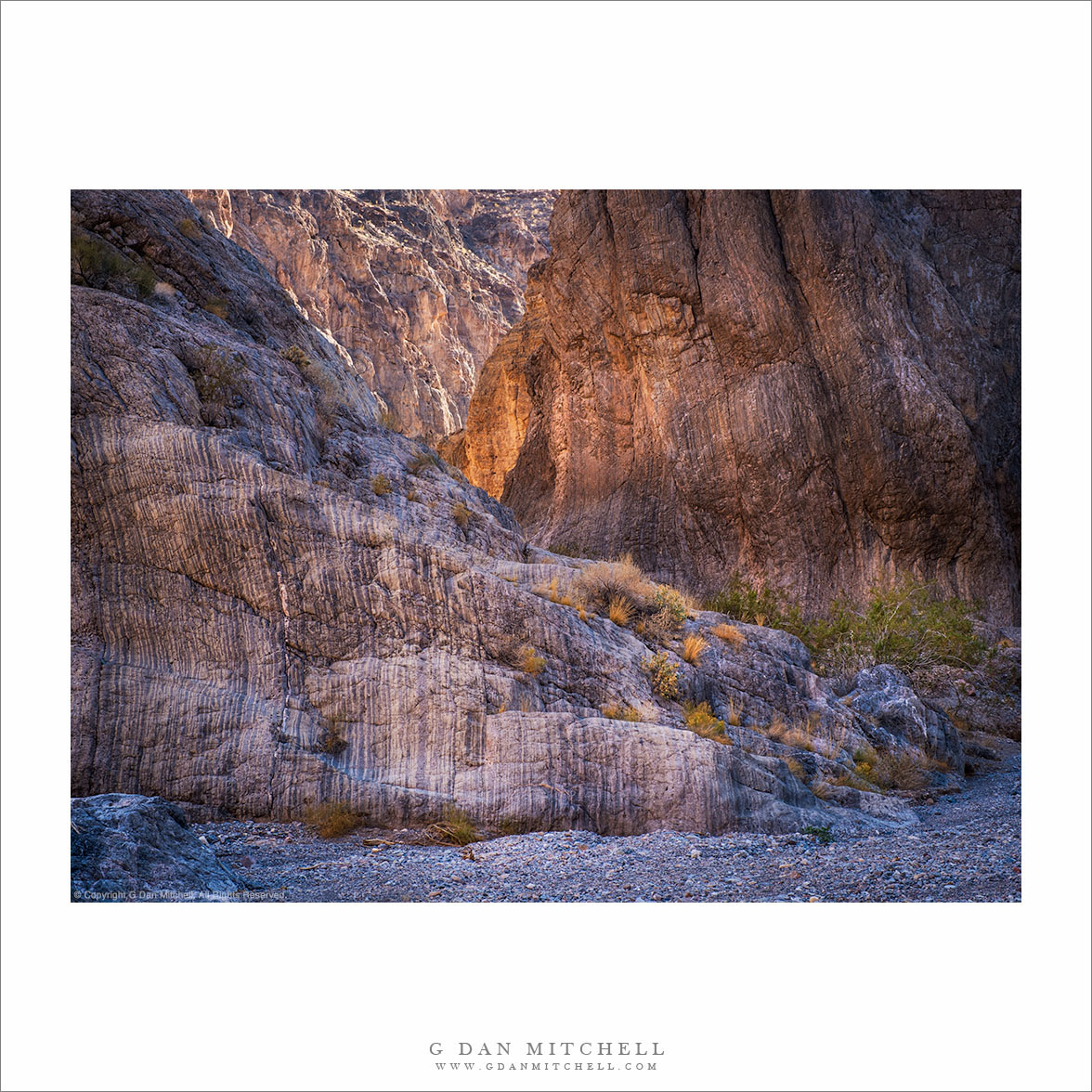
Canyon Light

Canyon Light, Death Valley National Park
“Canyon Light” — Direct light, reflected light, and deep shadows as a canyon winds through desert mountains, Death Valley.

We love fantastically narrow and twisty slot canyons, but those are more of the exception to the rule. You can find those in Death Valley, but more likely you’ll find a scene like this one, at least in canyons that run through steep, rocky mountain ranges, like this one on the east side of the valley. Through much of its length it is more than wide enough that a vehicle could pass, if they were allowed here. Note also the very rugged and broken rock formations — this is not your smooth-walled Utah red rock canyon!

At this spot the canyon takes a couple of very sharp bends around the tall face to the right. When the trend of the canyon lines up the right way, very little direct sunlight penetrates all the way down. Instead the canyon bottom is often in shade, but that shade is filled with soft, reflected light that has bounced between the canyon walls. When I hike these canyons I always look forward to passing through these spots.

G Dan Mitchell is a California photographer and visual opportunist. His book, “California’s Fall Color: A Photographer’s Guide to Autumn in the Sierra” (Heyday Books) is available directly from him. Blog | Bluesky | Mastodon | Substack Notes | Flickr | Email

4 responses to “Canyon Light”

  1. Charlie Colladay Avatar
    Charlie Colladay

    Love this shot! The longer I look at it the more I like it. Forgive me for being such a pendant, but I am so moved by the intricacies of the light in this photo.

    Nice, tight composition of three separate layers: the far layer in direct sunlight; the middle, golden layer and the “giant’s foot” in the foreground. At first glance my eye was drawn to the well defined textural striations of the foreground in a seemingly softer, bluer, open shade type light. But no! It’s actually strongly directional (from the left, reflected by ?) which makes the vertical striations really pop. The far layer is being illuminated by the sun’s direct rays coming from the right, which is how we know the foreground light from the left is reflected (assuming no auxiliary lighting). The middle golden layer is the real mystery. The bright gold color and intensity of the light is greater at the left edge and gradually falls off into open shade light at the far right. The reflected light source must be something close by and behind the “giant’s foot” that is strongly reflecting the sun’s rays. It’s almost like the photographer laid out a large gold colored tarp to act as a reflector. But I doubt that. More likely it’s a warm colored rock formation that is serving as the reflector. Beautiful.

    Whatever the case…this is an amazing photo! I love it when a photo strikes you at first and then even more so as your eye roams around and you try to figure out why you like it so much. In the final analysis, it’s no surprise how often it comes down to the “Light” and we are then reminded that the Greek root of “photography” is “light drawing”.

    Nice work Dan!

    Charlie Colladay

    1. G Dan Mitchell Avatar
      G Dan Mitchell

      Thanks Charlie,

      YOu certainly have an eye for light!

      The combination of layers and light is pretty much what this photograph is “about.” As you surmised, there are three kinds of ight (at least) at work in the photograph. OK, maybe four.

      There is the direct sunlight on the far canyon wall. Then there is the light reflected from a(n out of sight) reddish section of cliff that illuminates the middle face. The foreground light is coming from behind and above my camera position — a combination of more reflected light and light from the open sky. The forth kind of light? The deeper shadows with the more blue tones.

      One of the things I love about these canyons is precisely that variety of lighting, and especially the way that the light picks up colors from the sky and from whatever surface reflects it.

      Dan

  2. Greg Avatar
    Greg

    Dan:

    It reminds me of Dedeckera Canyon over at the Eureka Dunes.

    1. G Dan Mitchell Avatar
      G Dan Mitchell

      Thanks for sharing that. I’ve been to Eureka several times, but I have never investigated that canyon.

      Dan

Join the discussion —  leave a comment or question. (Comments are moderated and may not appear immediately. Links in comments may be removed.)

This site uses Akismet to reduce spam. Learn how your comment data is processed.

(All media © Copyright G Dan Mitchell and others.)

Curve in the Canyon

Curve in the Canyon
“Curve in the Canyon” — A gravel wash curves through narrows in a Death Valley canyon.

The sensations upon entering one of these canyons after walking in desert heat and sun are striking. It is suddenly much darker and much quieter, and often the air is still. At this bend in the canyon, the walls and edges conspired to create a sort of spiral shape with everything centering on the bigger and warmer-toned section in the upper center of the photograph.

Hiking these canyons they ofcanten start to feel like a steady progression back and forth — a turn to the right is soon followed by one to the left, and so forth. In some canyons this leads to a somewhat humorous “just one more”situation. I might check my watch and note that it is about my turn-around time. I tell myself, “First, just hike to the next curve.” Getting there I tell myself, “You can take a look at what is beyond this section.” So I round the bend and see the canyon continues… and, of course, I just have to continue on to the next bend… and then next… and the one after that.

G Dan Mitchell is a California photographer and visual opportunist. His book, “California’s Fall Color: A Photographer’s Guide to Autumn in the Sierra” (Heyday Books) is available directly from him. Blog | Bluesky | Mastodon | Substack Notes | Flickr | Email

Join the discussion —  leave a comment or question. (Comments are moderated and may not appear immediately. Links in comments may be removed.)

This site uses Akismet to reduce spam. Learn how your comment data is processed.

(All media © Copyright G Dan Mitchell and others.)
Desert Holly Plant, Dry Wash

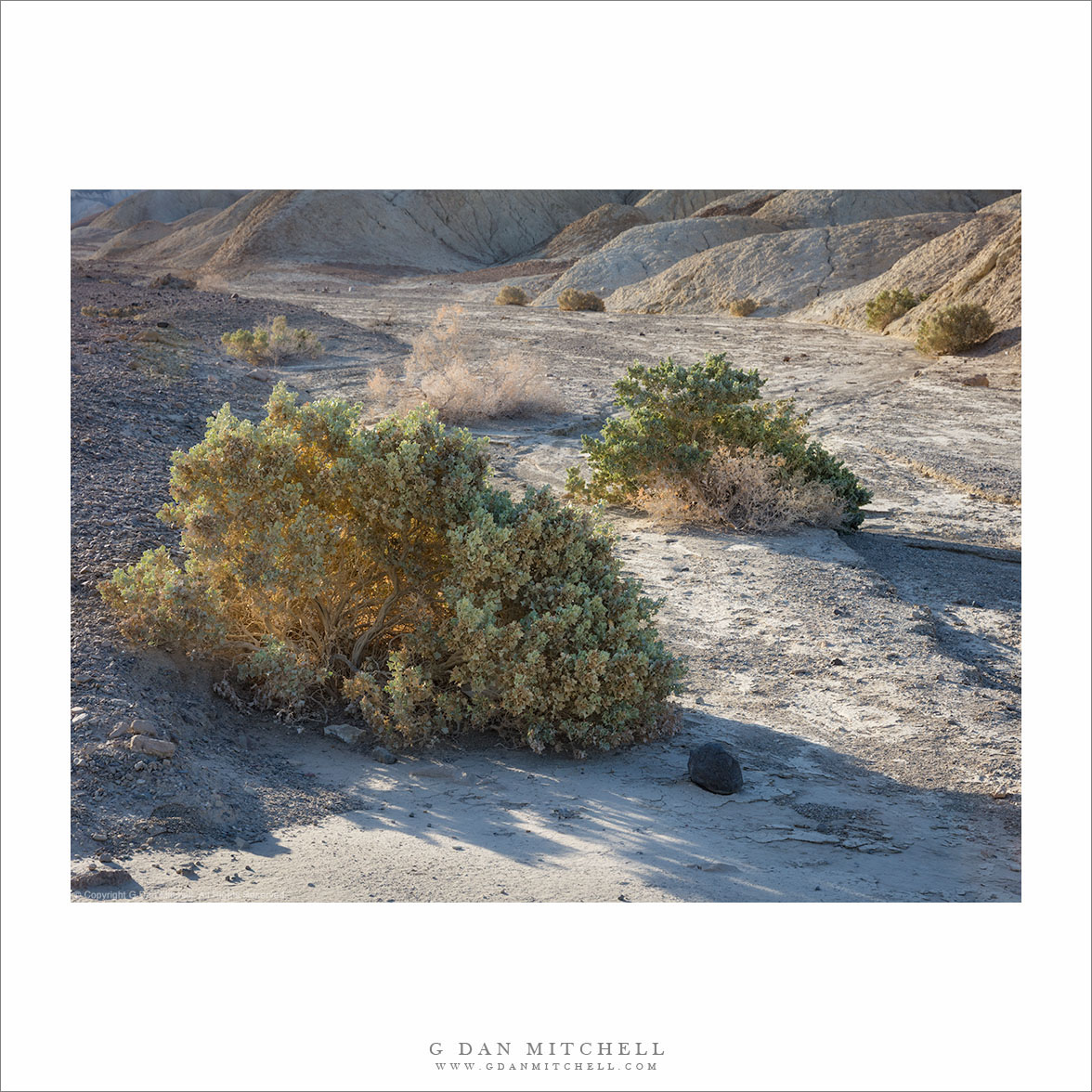
Desert Holly Plant, Dry Wash, Death Valley
“Desert Holly Plant, Dry Wash” — A dormant desert holly plant in a desert wash, Death Valley.

This photograph comes from one of the more arid, inhospitable-looking locations in Death Valley National Park. The soil here is not conducive to much plant life, and few plants manage to eke out an existence. One that does is the desert holly. When it gets enough water it sports lovely gray-green foliage, but when the heat and aridity become too much the plant goes dormant and turns brown/tan.

These plants are growing along the edges of a desert wash, which makes sense given that any sufficient runoff will move down this stream bed and leave behind a bit more moisture for the plants growing there. Washes like this, though often with a more gravelly surface, are everywhere this park, and they frequently provide passage into mountains.


G Dan Mitchell is a California photographer and visual opportunist. His book, “California’s Fall Color: A Photographer’s Guide to Autumn in the Sierra” (Heyday Books) is available directly from him.

G Dan Mitchell: Blog | Bluesky | Mastodon | Substack Notes | Flickr | Email


All media © Copyright G Dan Mitchell and others as indicated. Any use requires advance permission from G Dan Mitchell.

Canyon Narrows Light

Canyon Narrows Light, Death Valley
“Canyon Narrows Light” — Soft, filtered light illuminates the walls of a Death Valley slot canyon.

Desert canyon light is remarkable. A canyon like this one is a huge contrast with the world outside — the intense, harsh desert light gives way to soft, gentle light and shade. The temperature drops. The color of the ight changes, too. Deep in the canyon it often shifts to ward blue, especially when the canyon walls are black or gray. There are also changes and contrasts where different softs of light come together — as in this photograph where the deeply shaded blue tones contrast with the warmer tones of the higher walls.

I walked quickly to get to these narrows, but once I arrived I stopped, took out my tripod, attached my camera, and ambled slowly while searching for photographs. New possibilities appeared at every bend in the canyon, and my progress stalled to a near standstill as I stopped every few feet to look at a new composition.


G Dan Mitchell is a California photographer and visual opportunist. His book, “California’s Fall Color: A Photographer’s Guide to Autumn in the Sierra” (Heyday Books) is available directly from him.

G Dan Mitchell: Blog | Bluesky | Mastodon | Substack Notes | Flickr | Email


All media © Copyright G Dan Mitchell and others as indicated. Any use requires advance permission from G Dan Mitchell.